Wednesday, March 31, 2010

1961 Topps Baseball #5, Johnny Romano

Even in the modern game, a 20-homer catcher with sturdy, 100+ game knees can craft a lengthy career. Back in the 1960s, few guys could pull it off at all, let alone rock the black sleeve-and-cap look John Romano wears on today's #5.

Card front

"Honey" Romano caught at least 100 games six times and made 2 All-Star games, thanks to solid hitting and a decent eye. His 1959 White Sox team won the AL, but lost the Series to L.A.'s newly replanted Dodgers. Romano got but a single at-bat, as veteran Sherm Lollar held state behind the Chicago plate and started all 6 games.

Card back

Following that pennant-winning season, Cleveland extracted both Romano and Norm Cash from Chicago in a 7-player trade. After 5 good years as an Indian, the White Sox brought Romano back in another 7-player deal, this time involving both KC and CLE. (The latter included a young Tommy John and slugger Rocky Colavito.) Johnny eventually closed out his career backing up Tim McCarver in St. Louis.

Value: 1960s Topps "commons" cost 25 cents to $1, depending on condition. This one's miscut top-to-bottom, a frequent enough problem for almost any set printed prior to 1980.

Fake / Reprints: All-Star games aside, I doubt anyone could get rich reprinting Johnny Romanos!

Monday, March 29, 2010

Poll wrap-up: Do you collect big cards?

Thanks to voters in last week's poll! Many folks (OK, most everyone) go for any size, with a few specifying additional types. (Perhaps putting "anything" first would've changed the numbers around. :-)

My collection's largest "card" remains 1969 Topps Team Poster #5, Baltimore Orioles, at 16" x 20". Fortunately, it folds down to 9-card pocket size!

Friday, March 26, 2010

1927 E210 Type 1 Baseball #5, Gabby Hartnett

One of baseball's finest backstops of any era, this Cubs HOFer was also part of some very significant points in its history.
  • Catcher for Babe Ruth's called shot (wonder what pitch he called?)
  • Caught Carl Hubbell's consecutive Ks of Ruth, Gehrig, Foxx, Simmons, and Cronin in 1934 All-Star Game (see 1938 Wheaties #5 for more)
  • "Homer in the Gloamin," a game-winning shot that proved crucial to Chicago's 1938 NL pennant

Cooperstown's Hall of Fame also made Hartnett's catching gear their first acquisition, an honor for any sportsman. Chicago Daily News archives include a 1926 photo of Gabby and his gear.


York Caramel is one of several candy and ice cream companies that sponsored look-a-like baseball sets in the late 1920s (see F50 / W502 #5 for more).


There are 3 distinct E210 printings: Type 1, Type 2, and blank-backed. Orientation of the card backs distinguish Type 1 from Type 2. Put the front photo face-up and turn it over. Type 1 text faces "left" and Type 2 faces "right." There's no other difference that I know of, either in card text or number of cards. (Blank backs obviously distinguish themselves.)

Value: E210 in good shape cost quite a bit. This miscut (but otherwise EX) Hartnett recently fetched $175 on eBay. "Commons" are closer to $50.

Fake / Reprints: While we don't consider look-alike sets from other food companies "reprints," many of their authentic examples look like copies of an E210. In addition, people have tried to fake the most valuable players, making it tough on the typical collector. If you shop for E210s, be very particular who you buy from or get graded versions from a well-known company.

Thursday, March 25, 2010

1977 Kellogg's Baseball #5, John Montefusco

Here's a man with one of baseball's best nicknames: John "The Count" Montefusco. Not many jocks call unapologetically back to classic literature. (The Count of Monte Cristo is also one of the world's best revenge stories--and we all need a good revenge story sometimes.)


Montefusco won NL ROY honors in 1975 and pitched in the 1976 All-Star game. He allowed no runs over 2 innings of a 7-1 NL win and struck out Fred Lynn and Phil Garner.


Not crazy about the back's reused mug shot, as it seems lazy. Couldn't the team (or Kellogg's) get a second photo, especially since John's front pose is nothing to sing about?

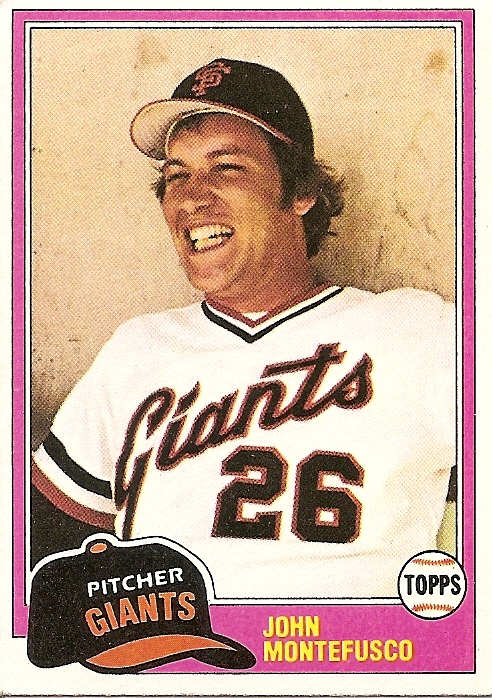
1981 Topps #438, John Montefusco

OK, no further comment! Maybe they should've nicknamed him "Jaws."

Value: Kellogg's are readily available on eBay and Beckett Marketplace and "commons" cost a dollar or two. You can find the entire set for $50 or under, depending on condition.

Fakes / Reprints: It would be a lot of trouble to reprint Kellogg's plastic cards and I've never seen one in the market.

Wednesday, March 24, 2010

1957 Ed-U-Cards Baseball Game #5, Double Play

This awesome action card arrived today, a surprise gift from a trading friend. It's part of a 36-card baseball game from the 1950s, intended for 2 friends playing on a paper diamond. (See several scans and the game board at RubyLane.com.)

Card front

This set's just one of a vast parade of Ed-U-Cards issues covering TV characters, sports, and other subjects. None of the cards feature identifiable teams or players, just drawings of balls, strikes, hits, and outs.

Card back

Much like the Spanish "Cine Manual" set (#5 profile here), this card's tiny pitcher is actually part of a flip movie. Put all 36 cards in numerical order, flip the top edge, and he throws a fastball right at you.

Value: On eBay, complete boxed sets run from $15-20. Single cards should be cheap--if you can find them.

Fakes / Reprints: Never seen a faked Ed-U-Card and they're not probably not valuable enough to try.

Tuesday, March 23, 2010

1971 Topps Baseball Tattoos #5, Al Kaline

Among the world's many schoolyard antics, spit-and-stick tattoos seemed so cool as a youngster. They made you instantly 10 years older, stayed in place for upwards of an hour or so, and used backwards text that reminded me of secret ciphers and decoder rings.

Tattoo strip (blank back)

Kaline's clearly the best player on this collection of floating heads, but let's not sell the other guys short.

  • Lee May hit 20+ homers in 11 consecutive seasons and totaled 354 for his career
  • Billy Grabarkewitz hit for a 134 OPS+ in 1970 and made the All-Star team, playing 156 games at 2B, SS, and 3B for the Dodgers
  • Manny Sanguillen played 12 great years in Pittsburgh, netting 3 All-Star appearances and 2 World Series rings
  • Vada Pinson did everything well and collected over 200 hits 4 times, en route to almost 2800 for his career

The other tattoo panels show team pennants and generic players. I like that they combined "guy signing autographs" with Kaline's autograph. (It's a faithful representation, too--check this "sweet spot" example.)

UPDATE: Tattoos are still with us! A Pack To Be Named Later busted a 2009 Fan Pak and it includes modern versions of the same stick-on stuff. Check it out at APTBNL.

Value: This high-grade strip cost $12 on eBay, about right for a scarce but unpopular Topps test issue.

Fake / Reprints: Another tough issue to fake, since you need perforated pages and ink that transfers when wet. Haven't seen any reprints on the market.

Monday, March 22, 2010

1975 Kellogg's Baseball #5, Greg Gross

Mr. Gross has exactly the kind of name 10 year-olds snicker over. "GREG IS SO GROOOOSSSS!" Sorry, man, the school playground is a kangaroo court of name-calling and hair-pulling.


XOGRAPH's 3D process makes Greg stand out from the card's background and its starry borders shimmer when tilted side-to-side. As mentioned on March 19, Kellogg's used pseudo-3D for every 1970-to-1983 baseball set with one exception, 1973 Kellogg's #5, Don Sutton.


Not many rookies get into 150+ games! Greg rewarded Houston with a .314 average, set a club for hits in a season, and finished 2nd to Bake McBride in ROY voting. The outfield of Gross, Cesar Cendeno, and Bob Watson--all with OPS+ of at least 120--proved the strength of an otherwise mediocre Astro squad.


UPDATE: Found this purported unopened Kellogg's Greg Gross on eBay. You might have to squint to pick out the details, but who'd lie about the contents of something on eBay? :-)

Value: Got Greg from a trading friend. "Common" Kellogg's cards run a dollar or two in good shape.

Fakes / Reprints: Haven't seen a Kellogg's reprint, fortunately! It'd be tough work, given the special plastic and 3D.

Sunday, March 21, 2010

Box Break: 2010 Upper Deck Series 1

Grabbed Target's last 8-pack blaster of 2010 UD Series 1 on Saturday and shot a box break. This video's the edited version, so jumps from pack-to-pack quickly. It's about 6 minutes long and I added some notes along the way.


This blaster produced a few hits and a bunch of base cards. If you're working on the set, post a comment or send an email with your wantlist and I'll try to hit it.

Saturday, March 20, 2010

Poll: Do you collect big cards?

Most of today's cards use the iconic 2.5" x 3.5" size Topps established in 1957, but not everyone does that. Even modern sets sometimes juggle their dimensions and try to catch collectors with something unusual.

1988 Topps Big Baseball, 2.75" x 3.75"

Size and orientation makes a big difference to how a collection looks and displays. Topps from 1955, 1956, and 1960 use horizontals exclusively and they pop up occasionally into the 1970s.

1956 Topps, my favorite set, also 2.75" x 3.75"

A size upgrade means bigger pictures and more visual possibilities. This one shows Ted close-up and in-action, something not easily done on a smaller canvas. Check out how other sizes put their space to use.

1953 Red Man NL, 3.5" square

1967 Topps Posters, 5" x 7"

1969 Topps Posters, 16" x 20" (!)

Card storage is most convenient when everything fits in 9-pocket pages, but collecting isn't all about making it easy on ourselves. See the left sidebar for this week's poll: what sizes do you collect?

Friday, March 19, 2010

1970 Rold Gold Baseball #5, George Sisler

For me, middle school included bizarre amounts of snack food and ice cream. "Home cooking" meant recipes like this tasty dish.
CINNAMON TOAST BITES
4 slices toast
4 Tb butter
1/4 cup sugar
1 Tb cinnamon
1 paper bag
Butter both sides of toast slices and cut each into 3x3 grid. Pour sugar and cinnamon in bag and then add toast pieces. Shake until all pieces coated.

Another extremely common snack? Rold Gold pretzels. My group of friends ate so many, we still appear in sodium impact studies.


The blue border and stadium behind Mr. Sisler look weird because of their simulated 3-D printing process. The XOGRAPH company combined 2 slightly different photos to create the appearance of depth on a flat plastic card, a look Kellogg's (in the 70s) and Sportsflics (in the 80s) both became known for in baseball circles.


Rold Gold used XOGRAPH 3D for their only release, this 15-card set of "All-Time Baseball Greats." Kellogg's republished it through cereal boxes in 1972, using an identical design save for the copyright date (1970 vs. 1972). Topps test-printed 3D cards of their own in 1968, but the set never saw wide release.


Value: XOGRAPH cards don't cost much, so this HOF #5 ran less than $5. (More pricing details at an interest article on completing the whole set.)

Fakes / Reprints: Someone might try to fake one of the extremely rare (and valuable) 1968 Topps 3D cards, but I've never seen a reprinted Kellogg's or Rold Gold card.