Showing posts with label misc. Show all posts

Tuesday, May 5, 2026

Cinco de Mayo team lots giveaway (almost done by June 22)

June 22 update: MLB teams are down to Astros and White Sox, plus several SI for Kids sports.

June 10 update: MLB teams are down to Astros, White Sox, Rockies, and Rangers, plus several of the various SI for Kids sports.

May 12 update: here's what remains for baseball teams, plus SI for Kids sports stacks sneaking in from my younger brother's old collection! Add a comment to this post and email me glidden.matthew at gmail with the team you'd like.

Original post: It's been a while since sending out cards and I'm doing a spring cleaning of all 1980 cards from my collection, reflecting on my ongoing shift to find new homes for that "modern era." They've been grouped by team, with some groups bigger than others, and all available for claiming. The percentage of "junk" (which usually means overprinted 1990s sets) is low overall, if variable. Most of the unusual cards can come from TCMA collectors kits, Conlan cards, 1982-85 Topps/Fleer/Donruss, SI for Kids, and random 2023-25 Topps packs I buy from time to time.


These stacked photos show varied looks at actual team groups.

Add a comment here and email me glidden.matthew at gmail with the team you'd like. 

Thursday, April 10, 2025

April 2025 progress update: #5 type collection now at 90%+

This blog's type collection targets sets with at least one card numbered five from baseball's majors, minors, and foreign issues of the pre-1981 vintage era. Over 600 different sets fall into that camp! While Topps printed more than any other single company, many smaller makers also stand out. Johnston's Cookies printed one of the biggest in my collection, Hank Aaron's 1954 card from the season he wore uniform #5.

UER: 9 HRs & 61 RBIs for Eau Claire in 1952

It proved easiest to track overall type collection progress by decade, which also shows how total sets remained modest though the 1940s and then rose fast after WWII, echoing the growing buying power of children and baseball's own league expansion. Thanks to my 20+ year search, I own 90% of all qualifying vintage #5s.

Decade: # owned of # possible

  • Pre-1920: 19 of 31
  • 1920s: 28 of 39
  • 1930s: 32 of 36
  • 1940s: 28 of 32
  • 1950s: 53 of 59
  • 1960s: 105 of 118
  • 1970s: 198 of 213
  • Minor league: 148 of 152
  • Total: 611 of 680 (90%)

This blog profiled hundreds of different sets so far, as linked from the type wantlist. It goes well over a book in total length and my work since 2019 includes more in-depth research into notable players, card businesses, and other holes in our hobby that I wanted to fill in. Find more of my card stuff on Bluesky @number5typecard and thanks for reading along, however long you've been doing so!

Saturday, August 24, 2024

"It's a Nice Night for an Evening" -- 2024 Oldtime Baseball in Cambridge, MA

My high school friend Max, a youthful Steven Wright of our Seattle classroom, often said things like, "it's a nice night for an evening" and "'Do I want cherry in my Coke?' That's something a jerk would say."

"Thanks, jerk."

Max's evening aphorism came back to me on Thursday during a beautiful night at my neighborhood's annual Oldtime Baseball, which brings dozens of amateurs and former pros to a public ballfield in Cambridge, MA, for a nine-inning combo of game, fundraising, and community. Headliners included Lou Merloni and Jonathan Papelbon, who each dressed in their Red Sox finest, played an inning, and posed for photos.

This event kicked off 30 years ago during a baseball strike, with added inspiration from a large collection of classic uniforms of all leagues, eras, and teams. Their sale table of fitted hats includes a chunk of what fans saw on the field.


I like big hats and I cannot lie -- since anything smaller than 7 5/8 is right out.


You can get as close to game action as you like and we started along the third base line.


This guy in the Seattle Pilots uniform got guff from left field fans every time he took the field and it's for reasons beyond their one year of existence. (I'll explain why soon.)


Pitchers handled about one inning each and managers cycled through lots of players, with pinch-hitter announcements a regular part of the night, most of them sponsored by a local business. (I suspect raising sufficient money for their charity gets you an at-bat.)

Former Red Sox catcher Lou Merloni started the game, squatted for an inning, and gave way to younger knees like Mr. Flexible in this bullpen. We stuck around to see Papelbon, who entered in the eighth. Sure enough, his second batter was pinch-hitter and sportswriter Jared Carrabis, who started this beef about 12 hours before game time.

As predicted, here's Papelbon firing a pitch into Jared's ribs.

Jared tossed his bat, took a couple "angry" steps toward Jonathan, and they put on a brief show of invective. Papelbon's 6" height advantage made their exchange even funnier and we fans laughed it up. One of many highlights that night.

My S.O. Sunny loves to spend money on a good cause, so bid successfully on this signed celebratory 1967 photo of Jim Lonberg. Will see if can add Yaz in the future! (Carl turned 85 the same day of this game. Concidence???)


I snapped this closer photo of our aforementioned Seattle Pilots outfielder. He caught so much crap from fans because you're looking at Jeff Maier, infamous for his catch of Derek Jeter's playoff homer against Baltimore. (Maier himself played ball at Wesleyan and wore this Pilots uniform in honor of ESPN's Jim Caple, who passed away last October and sported it for Oldtime Baseball back in 2006.) He must inspire quite a range of fan reactions.


Already looking forward to our return to Gooch's Corner next year! And always bring your glove to the park!

Tuesday, July 18, 2023

"Baseball in the Berkshires" exhibit in Lee, MA (July to August 2023)

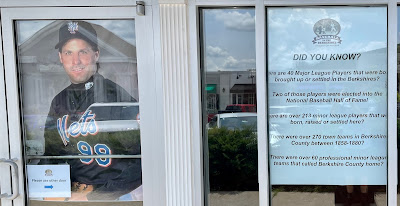
A long chain of events, fortunate and unfortunate, led me to factory outlet shopping in Lee, MA, over the weekend. I parked our car and turned around to see a local success story looking back.

DID YOU KNOW? I'M TURK WENDELL.

Earlier in July, a dedicated group of local historians opened a storefront museum featuring the many MLB, minor league, and amateur baseball teams that played local forms of our pastime since (by their count) at least 1791, with online details at Baseballinberkshires.org.

Jack Chesbro garnered a street-facing banner as half of their Cooperstown inductees.

African-American pioneer Frank Grant is their second HOFer

Local news coverage gave a good sense of the inside, including an on-camera chat with its curator: "Baseball in the Berkshires opens new exhibit in Lee" (July 6, 2023).

I spotted card sorting near the back, where they offered any visiting kids a free variety stack of 1960s to 2000s.

I hope those youngsters appreciate broadcasters well-known, lesser-known, and also Ron Salcedo.

Lots of recognizable names in those stacks, even in the minor league sets. Those exhibit hosts said all their cards came from local collectors and donors.

Their batch of hand-updated cards should be perfect for people playing Immaculate Grid. I've already used Jim Perry multiple times!


If you live anywhere near the Berkshires or take a roadtrip to Cooperstown, I recommend stopping by before the end of August. Tell them you heard about it from that guy holding a Calvin Klein bag!

Wednesday, June 13, 2018

Cards To See Before You Die, a.k.a. #BucketCards

I tweet about baseball as @Number5TypeCard and, every so often, I post photos of my #BucketCards, specific cardboard that's worth an extra look. Here's my latest, a 1930 minor league 8"x10" premium of "Specs" Toporcer.


Most of these "Cards To See Before You Die" show off something interesting, rare, or artistic. They don't need to be impossible or unaffordable. You could find this Joe Adcock on eBay for a few dollars.


Some #BucketCards put you in a baseball context without showing you baseball players.


Others highlight unconventional shots from a century ago.


I post many shots from the 1920s and 1930s, when companies reinvented each year what it meant to be a "baseball card." Art Deco's just one of many styles they tried.


Even if they "can't all be Waners," at least they're all #BucketCards!

Friday, July 31, 2015

National Sports Collectors Show 2015, day two (Thursday) highlights

As time and tide wait for no man, neither do your feet adjust to hours of pounding around the robust concrete floors of Rosemont's convention center. Oy vey. But onto the cards!


I spent two hours sifting through variety boxes at one of my favorite National dealers, Kurt Tourdot. Thanks to John and Len, I also spent awhile thinking about a new haircut. Unitas has a classic gridiron look, but Dawson's closer to what will actually happen on my head.


Speaking of haircuts, here's another guy with a buzz.


Despite finishing my own 1976 SSPC baseball set a few years ago, I'd completely forgotten about its #589 George Brett / Al Cowans Cowens masterpiece of no-budget photography. SSPC showcased several great goofball photos in the "high numbers," but I think this is the best.


It's hard to find subtle, excellent design like the colors and script used for 1962 Post Cereal's CFL set. Would've loved this photo design for Post's baseball sets, which feel cramped in comparison.


Other than last year's Allen & Ginter barbed wire card, Dan Gladden is as close as I'll get to seeing "Glidden" on a trading card.


The barbed wire card, with mention of my great-great-great-uncle Joseph.


I spent an hour-plus sifting through a table of oddball postcards and photos, including this snapshot of Joe DiMaggio looking down at something. He also has a good haircut.


One table featured an 800-count box of autographed 1970s minor league cards. This TCMA manager card from Dubuque's Packers, an Astros farm team, was my favorite for many reasons. They are all cornball and exaggerated reasons.


Nice Yankees patch and perfect companion to this Brooklyn patch from day one.


Longtime blog readers might recall the National Poster Stamp Society's "Eureka Sportstamps" article about their Yankees promotional set. Here's another of their products, a booklet of stick-ons to liven up any kids' binder or desk or what have you.


None of these seals had been sealed to anything, so I suspect it was found in storage rather than purchased for 19c by a sports or seals enthusiast.

At one point, I tried to collect the 1936 S&S Game, one of the hobby's easier 1930s sets to finish. While available primarily as singles into today's vintage market, this was the source for all such cards: a boxed board game called The National Game.


This game came complete with lineups, multiple rule cards, and even a "CASH AWARDS" promo that asked players to write a 100-word essay on why they liked the game itself. That last bit's some cunning work by S&S itself, since customer-written essays would give them a ready supply of marketing research and ideas. In this shape it fetches four figures, well above what I can afford on a collectible.

I found a few more type cards, including these from 1927-29 W560, a multi-sport set with one #5 for each card suit.


In order to better understand the explosion of the 1930s trading card market, I've also picked up more Goudey and National Chicle cards from that era, including some of Goudey's "Indian Chewing Gum," a large set about the American West.


My first two Indian Gum cards ($3 each) feature a settler and a "border patrol leader," spiritual forerunner of today's Texas Rangers law enforcement unit. Clearly a good set for fans of beards.


#49: "[Gen. Ben McCulloch] introduced into the West that death-dealing instrument, the six shooter..."


Speaking of six-shooters and "Indians," here's Sonny Sixkiller, Cherokee and former star QB for the University of Washington, my alma mater. He reprised this role, kind of sort of, as a player in 1974's "The Longest Yard."


Sonny's the true-life QB in this promo photo, instead of leading man Burt Reynolds, who played halfback for FSU. Sonny's career continued briefly as a pro for the 1970s WFL (which itself played but briefly) and he remains in football today as a TV analyst.


In addition to the earlier pair of W560 type cards, I also scored this 1968 Tipps from the Topps #5 panel on turning the double play for $25, starring the Cardinals' Julian Javier. While I'd written about that set based on scans back in 2012 (set profile), it's great to finally own the real deal.

Total #5 type cards owned now stands at 550 for both major and minor leagues! I know that's far more than I thought existed when this project started. Maybe there's another handful to locate before the show's over...? Day three tomorrow!

Tuesday, February 4, 2014

My "history of marketing to children" essay for a job application

I've been unemployed since my MA-based, high-tech employer off-shored their (my) local team last Sept. When I applied for a job today, the on-line application said cover letters were optional. That would normally save me the work of writing one, but I decided instead to add something different: an essay on a topic of personal interest, the evolution of marketing to children. Why do it? Who knows, maybe it'll stand out in the sea of sameness that all piles of resumes become. If not, at least I've outlined ideas worth diving into later.

Dive, Pedro, dive!

Collectors will see how this intertwines with baseball cards, since most of us started plunking down money for packs at a young age. I started at 8, but I've talked to some who were building sets at 5. If you collected cards a century ago, though, you weren't buying the cards, at least not directly. You were buying tobacco. When kids managed to squirrel away savings, they often spent them on life-shortening cigarettes in pursuit of colorful cards. If there's one thing I love about the modern era, it's that we're so far removed from cigarette marketers controlling the hobby.

Rocky and his chaw, friends to the end

So here's what I wrote, interspersed with blog-only card images.

---

Hi [company],

While the application page says a cover letter's optional, one of my favorite interview questions is to ask the candidate to teach me something about a topic they know deeply that others don't. In that spirit, here's a brief history, for good or ill, of how companies began marketing to children.

Back in the late 19th century, few credited children with the "potential" that we do today, often sending them into class-delineated factories or menial trades they could do for less pay than adults. What little money children earned went back to families, as the thinking went, so advertisers didn't consider them potential customers. They aimed at two other groups: professional men (or farmers) and women who made household purchasing decisions.

The dominant luxury industry of that time was tobacco, both in popular use and in advertising. Cigarettes, rolling tobacco, chaw, cigars, snuff, pipes, and so on. We know from legal history how cynically 20th-century tobacco marketers targeted everyone, clandestinely attracting new teen smokers with a purportedly adult product. While early tobacco makers didn't "discover" children as a market intentionally, they set the wheels in motion for advertisers to target what's now a quarter of America's buying power.

In the 1880s, tobacco growers turned two technologies, mechanical packaging and color lithography, into a landmark promotional campaign, the first mass-produced, in-pack trading cards. These cards enthralled both adults and kids, transporting people who rarely left their home town to distant, exciting lands.

Duke's Cigarettes "Rulers, Flags, and Coat of Arms"

Promotional cards covered dozens of subjects and proved massively successful. While aimed at adults, resourceful children also purchased (and learned to smoke) their own packs in search of cards. The money that flowed into tobacco coffers fed more and "better" marketing. In cities with baseball teams, cigarette makers inked the sport's early stars to promotional contracts, drawing in still more smokers of all ages. Prior to the dissolution of several tobacco trusts, their enduring business success meant advertisers from all industries looked to cigarettes as the example to follow.

Various T206 tobacco card backs

While spiraling costs (and their military supply business) pushed tobacco makers out of "kid-friendly" trading cards prior to WWI, by that time they'd been the dominant force in marketing for two generations.

When candy and ice cream companies entered the 1920s trading card market, they appealed to kids directly, reflecting a shift in their buying power.

1928 Fro-Joy Babe Ruth #5, Babe Ruth's Grip

Expanded programs of public education added a layer of uniformity to schoolchildren that allowed more and more marketers to use the same approaches seen in tobacco's success. First, find something children aspire to (like a baseball or movie career). Second, cross-promote that goal with a cheap, mass-market product like caramel or chewing gum. Third, make your product familiar in the media through sponsorship. Wheaties, for example, built their "Breakfast of Champions" name by signing dozens of 1930s athletes to endorsement deals, a great achievement for what's otherwise unremarkable cereal.

1930s Wheaties cereal box panel

By the 1950s, food marketers established lookalike ad practices for candy, soda pop, cereal, and a host of other nonessential goods, which now addressed children directly. (Tobacco continued to live at the fringes, targeting adults but attracting teens to an extent the public didn't appreciate until state-led lawsuits made details available in the 1990s.)

Is the cap for you or your boy? How about the tobacco?

The evolution of marketing to children, even when they're the indirect target, helps us understand why some governments prohibit or circumscribe such advertising today. Many adults struggle to separate a directed message from its personal consequences, whether or not the product is beneficial. Those who look to us for leadership deserve help in making decisions that impact what they'll enjoy as both customers and kids.

Kind of heavy at the end, but it's a subject that deserves careful thought. I hope there was something new to you in that marketing chronology. I bring deep curiosity into any subject, work included, and look forward to talking with you about how this can help [company].

Matthew

---

Longer than I usually spend on a cover letter, that's for sure!

Tuesday, June 25, 2013

"Pinch-hitting's Sad Lexicon" (or "Owen to Evers to Chance")

Last night, I did some Baseball-Reference research on my favorite 1980s Seattle SS, Spike Owen. Deep in his batting splits, I came across this position breakdown---and a surprise, one that carried me more than 100 years back in time.


Step one, Spike's splits: what's "other?" They already list DH, PH, and PH as DH. Clicking the career split pointed to 1984, so I checked his game logs.

1984 Topps #413, Spike Owen RC

Spike started almost every day for the 1984 Mariners, appearing just twice as pinch-hitter, including July 21's unusual 9-3 victory over Toronto.


With two runners on base, Toronto brought in Jimmy Key--who spent 1984 as a reliever--and Seattle countered with the switch-hitting Owen. Eight runs later, he batted a second time and ended the inning on a groundout, a rare positional situation noted in their pinch-hitting article.
"If a player acts as a pinch hitter and his team bats around in the inning, he may come to the plate a second time. The second (and subsequent) times he bats in the inning are not considered pinch-hitting appearances."

Hence, Spike batted once as PH and once as "other," as he hadn't replaced Ramos in the field yet. One mystery solved.

Step two, Johnny Evers: in honor of "Baseball's Sad Lexicon," here's the erstwhile Cubs second baseman.


Step three, Frank Chance: the Spike Owen discovery led me to search for other "pinch hitter bats twice in an inning" situations. That, in turn, led to PLAYS THAT PUZZLE, a game story retold by former umpire Billy Evans in Feb, 1934.

excerpt from Reading Eagle, Feb 6, 1934

So here's the conceit.
  • Umpire Bill Evans worked the plate in a St. Louis loss to New York
  • Manager Frank Chance pinch-hit in the 8th & singled to start a rally
  • New York batted around & Chance finished off the comeback one batter early before people realized what happened

Given our dearth of boxscores from Chance's era, it's helpful that the story starts in New York, where Frank only batted in 1913, and Yankee wins over St. Louis on May 19 and 20 seemed our best candidates from B-R's 1913 season results.

The New York Times provides free access to much of their archives, so I combed May 1913 for baseball stories, which produced the promising headline "Browns To Protest Yankees' Victory." So is this the game?

excerpt from New York Times, May 20, 1913

OK, this is substantively the right game, barring embellishments from Billy Evans, who (in 1934) was recalling a 21 year-old contest. Let's check the high points.
  • Was Bill Evans umpiring the game? YES, he worked the game, but Hildebrand received and dismissed St. Louis' in-game protests, according to the Times.
  • Did Frank Chance start the big rally? NO, he grounded out batting for pitcher Ray Fisher.
  • Did Chance bat one batter early the second time around, adding to the 7-run comeback? YES, that's what happened. Claud Derrick should've batted 8th (one spot before Chance) and might've, as Evans claimed, lost track of things in the dugout, or Chance might've run in too early from the third base coaches box.

In short, Frank Chance made history a century ago, pinch-hitting for two different batters in one inning on May 19, 1913, helping his team to a comeback win. An unusual and nuanced story for an unusual and nuanced player.

1914 Cracker Jack #99, Frank Chance

This is first time I've heard of such shenanigans, but baseball's past probably contains more. Add any others you know to the comments!