Showing posts with label Chicago Cubs. Show all posts

Wednesday, December 13, 2023

Identifying everyone in the 1933 Goudey R309-1 American League & National League All-Star Team photos

The 1933 World's Fair in Chicago, also called A Century of Progress, included baseball's first All-Star Game, an assumed one-off benefit that became MLB's annual midseason event thanks to vigorous fan response. Discussions from April to May coalesced into a real game by June and team owners rearranged all scheduled games for July 6, allowing top stars to face off that day in Chicago, where the AL triumphed 4-2.

Full ticket auctioned for $4300+ in 2004

Breathless pregame coverage included complete position-by-position and "who will pitch first?" analysis, echoing what you hear from today's sports reporters. Fans chose each starting nine via newspaper ballots, with pitchers and reserves falling to legendary managers Connie Mack and John McGraw.

As the multi-franchise host city, Chicago assigned on-field staff by league affiliation, so the NL team photo included Cubs batboy Gilbert Hasbrook and team trainer Andy Lotshaw. Almost everyone wore matching "National League" uniforms, perhaps as mandated by McGraw.

Another, crisper view of this august assemblage, sans chapeau. (Credit Wally Berger as the sole player to spot this photo's camera head-on.)

Some names faded faster into baseball history than others, so let's spell them all out.


Non-All-Star Bill Walker stands out from that crowd in his distinctive Cardinals "birds on a bat" uniform. Based on 1933 game splits, he pitched four-plus innings in Pittsburgh the day prior (July 5), so I think St. Louis player-manager Frankie Frisch brought him along to toss National League batting practice.

The American League team stuck to original team uniforms for their photos, with Comiskey Park's clubhouse attendants (three Colledge brothers, all nicknamed "Sharkey") crashing its photo.


In the spirit of Roy Carlson's recent legwork on Topps team cards for Sports Collectors Daily, let's nail down everyone in that photo, since Goudey left some stones unturned.

This photo from The Sporting News did a better job than Goudey identifying peripheral participants William Conroy, an 18 year-old future catcher who Connie Mack brought to throw batting practice, and those three "Sharkey" brothers (Ephraim, Art, and Harry Colledge).


The aforementioned Roy Carlson pointed me to "Colledge" as proper last names for those Sharkey brothers. Two of them, Ephraim and Art, worked in Comiskey's clubhouse until 1966 and 1958 Topps shows one under his given last name at far left of its second row. 1933 NL All-Star Tony Cuccinello, now coaching, also reappears in a White Sox uniform.

1958 Topps #256, White Sox team with Colledge & Cuccinello

All-Star batboy John McBride cameoed with Lou Gehrig as Ruth crossed home plate after hitting the All-Star Game's first home run. Dreams come true!


AL batting practice pitcher William Conroy's 1933 victory charm later passed to his family and surfaced in our hobby via an REA 2013 auction.
Anything else you'd like to know about the game's players or staff, let me know below.

Friday, November 3, 2023

Baseball's Best Fifth Round Draft Picks 1970 - 74

Thanks to Immaculate Grid game #212's new category (first round draft pick) for inspiring me to bone up on MLB's Rule 4 amateur draft, which kicked off in 1965. Baseball Reference's statistical history includes Rule 4's complete record, broken down by draft phase and pick. I already covered 1965-69 in my prior post and will keep looking at five-year blocks until we run out of steam.

Two of these names from the top of 1970's fifth round found similar overall success, right around WAR's break-even point.

Pat Scanlon, who shares his name with an uncle of mine, played parts of four seasons for Montreal and San Diego. He appeared on a pair of standard cards, one SSPC...

...the other, 1978 Topps, airbrushed his Montreal cap and uniform with a foreshortened SD.

Thanks to dedicated blogger and image updater WthBalls, we can enjoy one more Scanlon, based on a real Padres photo.

As good as those three cards turned out, Pat's -0.3 career WAR sits well below our best choice for 1970.

1970: Rick Waits (14.2 WAR)

Rick turned into a Cleveland innings-eater for five years before slowing in 1982 and closing his career as a Milwaukee reliever. His first appearance (September 17, 1973, for Texas) gave him a save that might not be granted today. He pitched the ninth, gave up one run, and finished ahead by seven runs.

Easy to pick my favorite Waits card, a "waiter" card, as marked up by BaseballCardVandals.com.

1971: Charlie Moore (10.3 WAR)

Charlie's name feels more familiar than most, as a Wisconsin native and 1980s card collector. Milwaukee's "tools of ignorance" looked great in blue and gold, with Moore wearing them on cards at least twice.

Moore also spent a lot of time in right field and batted well during a 1982 postseason that brought his Brewers to the World Series against St. Louis.

1972: Randy Jones (17.8 WAR, 1976 NL Cy Young, 2x All-Star)

Randy fell a few votes short of back-to-back Cy Young awards, finishing second to Seaver in 1975 before winning the following year. His flip side Jim Palmer managed that feat, joining the cadre who won at least two in a row.

These two cards show the significance of a great mid-1970s hairdo, whether you're feeling Randy or feeling Jim.

1973: LaMarr Hoyt (12.1 WAR, 1983 AL Cy Young, 1985 All-Star)

Hoyt also led the AL in wins twice (1982-83) and picked up a Cy Young of his own. He followed Randy's example with lofty curls and classic, vintage uniforms.

As inscribed by his own hand, LaMarr started that 1985 All-Star Game (for San Diego) and took the win-plus-MVP in a 6-1 NL victory.

1974: (tie) Steve Henderson (11.5 WAR), Jim Morrison (12 WAR)

For my first time so far, two players vie for the trophy. While Henderson remains closer to my heart as a former Mariner, I prefer his Buntin' Cub 1983 card's more interesting composition.

Jim Morrison started his teen years about when the famous Jim Morrison peaked and I bet he rode a rollercoaster of seeing that name in the papers, for reasons good, bad, and ugly. In an echo of Mr. Mojo Risin's animal magnetism, Topps used portraits of Jim's handsome mug on several cards.

I give the "best pick" edge to Jim over Steve for his three scoreless pitching appearances as a 1988 Brave. Remember his name the next time IG asks for an Atlanta Brave with season ERA under 3!


Wednesday, November 1, 2023

The Immaculate Grid and Baseball's Best Fifth Round Draft Picks, 1965 - 69

I'm a consistent Immaculate Grid player and use whatever cards litter my desk as "original sources" to plug in names. On Halloween 2023, the grid-makers added a curveball for game #212 with "First Round Draft Pick," something they introduced on earlier versions for football and basketball. I filled in six squares with familiar names and then observed the 1940s and 50s cards on my desk lacked any draft info, leaving me cold. I threw in three guesses, missing on Rick Ankiel and Keith Hernandez, and counted myself lucky to get Barry Zito.


One problem with high picks: many first show up as low picks in earlier years. Barry Zito's "first round pick" (Oakland, 1999) came after earlier attempts in the 59th (Seattle, 1996) and third (Texas, 1998). Many skilled draftees delay signing to play college ball or otherwise develop their skills, reentering the draft in later years.

Draft picks do show up from time-to-time on baseball sets, including something I pinched myself for forgetting, the 1985 Topps subset of active #1 picks.

Check out 30 Year-Old Cardboard's subset profile for all 12

I've used Shawn Abner for Immaculate Grid before at the intersection of Padres, Angels, or White Sox and the trick is that he never played in the bigs for New York. A trade of multiple players, including Kevin McReynolds, moved Abner to SD, where he debuted in 1987. Donruss went all-in by giving Shawn his own "Baseball's Best" card after just 16 games the prior year. The weight of great expectations!


Any memory of Abner's #1 pick card would've helped my IG score, since 2% is far better than the 100-point penalty for missed guesses.

My "what if" Mets row

Interesting that Abner qualified as a Met, since other Immaculate Grid categories require players log at least one team appearance in that uniform. It appears their "first round draft pick" considers selection alone, opening up more obscure answers for MLB draftees who reached the bigs with other clubs. (Most first-rounders get at least a cup of coffee, given how much teams commit to that pick.)

Roger moved fast, from 1983 #1 pick to 1984 in Boston

1985 Topps, and others like it, knit draft status into that tiny bio text. MLB's current amateur selection process ("The Rule 4 Draft") started in 1965 and Topps added relevant info to card backs a decade later in 1976.

1976 card for one member of the inaugural Rule 4 draft 

Those top-tier picks often achieve great things, in terms of stats and accolades, so let's hunt for hidden treasure by finding our best fifth-rounders from the amateur draft's initial years, 1965 to 1969.

1965: Amos Otis (42.8 WAR, 5x All-Star, 3x Gold Glove)

Otis ranked among baseball's best 1970s outfielders and helped KC reach the postseason five times. His cards also show off how good those powder blues can look, year after year.


1966: Dave Cash (25.6 WAR, 3x All-Star, 1971 World Series champ, "Action Dog" nickname)

Dave played almost every day 1971-78, first for Pittsburgh's title winners, and then for an improving Phillies team that won the NL East in 1976. Teammates often mentioned his reliable defense and esprit de corps in the clubhouse.


Dave appears at card shows these days and a trading friend came away with a dollar bill signed by Cash & (Don) Money at the same National. They each seemed amused by the pun.

1967: Dave Goltz (23.1 WAR, 1981 World Series champ)

Dave lingered in the low minors for several years before debuting in 1972 for a 77-77 Twins club by going 3-3. Goltz registered .500 W/L records three more times in the next four years before breaking through with 20 wins in 1977 and still ranks in Minnesota's franchise top-10 for strikeouts. (Remove numbers from the Washington Senators and he'd be even higher.)


My favorite Goltz cards hail from the same 1978 Topps set, first autographing something for a fan and then sharing space with three other excellent hurlers.


1968: Burt Hooton (35.5 WAR, 1981 All-Star, 1981 World Series champ)

Hooton split the 1970s between Chicago and LA, where he and Goltz ended up as teammates on the title-winning 1981 Dodgers squad. Burt spread his 151 career wins across 15 seasons and spring training card photos from Dodgertown, Florida come to my mind first.


His last name's pronounced /WHO-ten/, which led to a 1975 Hostess "Hooten" error, later corrected.


1969: Dwight Evans (67.2 WAR, 3x All-Star, 8x Gold Glove, 2x Silver Slugger)

"Get yourself someone who can do both," as the saying goes, and Evans sure could hit and flash leather in the outfield. He rates best of these 1965-69 fifth-round picks and many say Cooperstown-worthy. (Hall of Famers Al Kaline, Billy Williams, and Tony Perez all rank in Dewey's top-10 similarity scores.)


My favorite Evans cards sport the bushy mustache, eyebrows, and/or eye black. While one last year in Baltimore "spoiled" his 19 years in Boston for Red Sox fans, he continued to get on base ~40% of the time and ranks #29 all-time in walks (1391), leading the AL three times.

More picks coming!

I'll continue this theme and see what kind of team we can build from fifth-round draft picks, given this solid starting five.
  • SP: Goltz, Hooton
  • RP: TBD
  • C: TBD
  • 1B: TBD
  • 2B: Cash
  • 3B: TBD
  • SS: TBD
  • OF: Otis, Evans, TBD

Monday, April 22, 2019

How 1954 Bowman #123 Toby Atwell became 1956 Topps #232 Toby Atwell

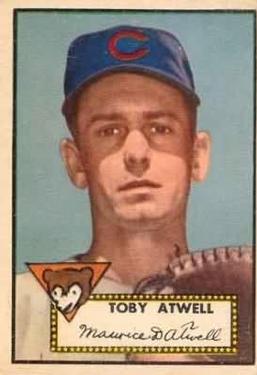
Until last week, I never thought about Toby Atwell, mid-1950s catcher, as either player or baseball card. He's just one of those guys you flip past in the collection. Toby's minor claim to collecting fame follows his "status" as 1952 Topps #356, one of its elusive high numbers, not that Toby seems to be enjoying the privilege.

1952 Topps #356 Toby Atwell Front
1952 Topps #356, Toby Atwell (RC)

After a week delving into 1950s Bowman and Topps, I found a second reason to care about Toby Atwell, and it's not thanks to high numbers or rookie cards. It's caring about the business value of using what you have and using it well. Let's start that work with 1954 Bowman #123, "serious Toby."

1954 Bowman #123 Toby Atwell Front
1954 Bowman #123, Toby Atwell

Side note: Toby's no-flap helmet reminds me of Pittsburgh's flirtation with fielding helmets throughout the 1950s, shown below protecting relief maestro Elroy Face. (Keith Olbermann shared several similar photos in his post about their helmeted era.)


Back to Toby, the baseball card, built from a hand-colored photo and purple autograph nameplate.

1954 Bowman #123 Toby Atwell Front

When assembling 1954 cards, Bowman laid a color stripe over each card's bottom edge and then added their player's autograph in black ink with a stamp-like printer's die. I think they rushed this part of things, leaving a cropped name for many players and quality issues on some adjacent cards. Back in 2009, former SCD catalog editor Bob Lemke profiled "extra loop" variations where #2 Jackie Jensen crossed onto #10 Carl Erskine...


...and #210 Jimmy Piersall intruded on #218 Preacher Roe.


While Bowman corrected these "extra loops" on later print sheets, I wondered about Toby Atwell's 1954 card and its floating double-line above the "T." Was that yet another player's autograph overlapping onto #123 from a different direction?


In this case, no. Autograph image searches show that Toby crossed that "T" with a wavy line throughout his life, as seen on this signed 1954 card. Bowman's odd trim job left it more mysterious than it needed to be.

"Atwell" shows floating line above "T"

Seeing 1954 Bowman lop off pieces of both "Y" and "Atwell" made me wonder if they even owned a proper signature for Toby at all. It took investigation of three sets to answer that question, starting two years earlier.

Bowman's first player autographs appeared in 1952. I think they compliment that year's artistic work, even if their cards feel "small" compared to the more sizable 1952 Topps.


I also think players produced one signature that Bowman reused whenever possible, saving card editors valuable time. This held true even for big stars with fixable issues like "Willie May" in 1952. Two years later, Bowman's aforementioned "loop trims" reduced the same stamped auto to "Willie Mau."


Toby didn't appear in 1952 Bowman, so they acquired a signature for on-card use sometime between then and 1954. Look at his 1952 high number again and note the "Maurice" signature.

1952 Topps #356 Toby Atwell Front

Toby had been on Topps cards for 1952 and 1953, before moving to Bowman for 1954 and 1955, perhaps on an exclusive contract. Jason Schwartz talks in detail about Bowman's skill at signing players to these contracts in SABR's 1954 Cardboard Crosswalk article. It's worth your time to read, now or later.

When Bowman folded after 1955 and Topps acquired their business assets, most recollections of the bankruptcy sale talk about the business value of existing gum card contracts. The nature of such a sale implies, without making explicit, that physical things like printing dies and plates also moved from Bowman to Topps.

1956 Topps #232, Toby Atwell (1954 Bowman overlay)

Toby's return to Topps cards after Bowman folded helps confirm the extent of what they handed over. That "ghost" label's where I overlaid his 1954 Bowman nameplate onto 1956's "Toby Atwell" autograph and got a perfect match, including the wavy crossed "T" circled in red.

While "Maurice D. Atwell" on 1952 cards, he became "Toby Atwell" for 1956. Unlike their former competition, Topps did this job without trimming pieces off the top and bottom. We can assume Topps did the same for a number of former Bowman players.


Summary: You can spend a lot of time and effort producing cards and some sets cut corners to save both. Bowman cut corners in a literal way, reducing the quality of their 1954 cards. There's some justice in how Topps improved on Bowman's dodgy choices with Bowman's own printing dies. If I were 1956 Topps Toby, I'd be smiling, too.