Thursday, September 23, 2010

How far have we come? How many cards remain?

This blog's approaching 350 articles and ~270 of them talk about actual #5 cards. Others ask poll questions, profile followers in the Type Site series, or note with disdain that the National charges $3 for a 20oz Diet Pepsi.

Here's the full breakdown by decade and subject.

  • Pre-1920: 9 posts
  • 1920 - 1929: 20
  • 1930 - 1939: 18
  • 1941 - 1949: 18
  • 1950 - 1959: 29
  • 1960 - 1969: 51
  • 1970 - 1979: 87
  • 1980 - now: 39 (most from 1980 alone)
  • Poll: 25 
  • Type Site: 20
  • Misc: 17

270 articles sounds like a lot--is a lot--of words about pieces of sporty cardboard. Will the well soon run dry? Using the 2010 SCD "big book" as reference, these #5 profiles remain unwritten.

  • Pre-1920: 11 (of 20 total)
  • 1920 - 1929: 16 (of 36)
  • 1930 - 1939: 15 (of 33)
  • 1941 - 1949: 8 (of 26)
  • 1950 - 1959: 26 (of 55)
  • 1960 - 1969: 36 (of 87)
  • 1970 - 1979: 138 (of 225)
  • 1980: 37 (of 76)

Sweet Mario Mendoza, that's 287 profiles to go. Not even halfway!


I'm as surprised as you, Bryan. Thanks to all y'all for reading along.

    Wednesday, September 22, 2010

    1925 Maple Crispette Baseball (V117) #5, Lee Fohl

    Gulf Coast residents, especially those near New Orleans, have a word for getting a little extra when you buy something: lagniappe. It's the 13th donut in your baker's dozen, special sauce on a po' boy sandwich, or extra "dipping sugar" from Cafe du Monde--and, let me tell you, Cafe du Monde adds plenty of bonus sugar.

    1925 Maple Crispette #5, Lee Fohl (Red Sox manager)

    Louisiana isn't the only French-speaking region with something extra. Back in the mid-1920s, Montreal candy maker Maple Crispette produced this baseball set, complete with lagniappe. Those patient enough to collect all 30 cards could exchange it for 1 of 3 sweet baseball goodies: an American Legion baseball, "high class" bat, or Scholastic Model glove. (Yesssssss.)

    Card back

    According to the offer text, kids could send in a mixture of cards from the 1925 baseball or 1924-1925 hockey set, shown below.
    1924-25 Maple Crispette hockey

    Unfortunately for buyers then and now, the candy maker printed a tiny number of #15 Casey Stengel. This kept 1920s kids from redeeming full sets and 21st century collectors from finding all 30 cards. (Hockey #15 Cleghorn is just as rare, so you're stuck trying to complete the set either way.) Folks don't even consider Stengel part of the "complete" set, as only 1 example's known to survive.

    Most price guides date this set to 1923, but Crispette expert Eric Eichelkraut places it at 1925. I agree, given the parallel offer with their hockey set, which itself came out in late 1924.

    UPDATE: Robert Edward Auctions sold a hockey near-set in 2012 that includes more info about that companion issue.

    Value: Mr. Fohl cost me $90, about right for a low-grade common. EX (and above) cards run a good deal more.

    Fakes / reprints: While not a well-known set, it does contain a Babe Ruth card and other players profitable to fake. Be very cautious and know your dealer when buying the big-money cards.

    Tuesday, September 21, 2010

    Blog Bat-Around: If I Were the Commish...

    Tribecards.net posted a challenge to fellow bloggers on Monday. MLB commissioner Bud Selig's plans to retire in 2012, 42 years after starting his baseball "career" by buying the bankrupt Pilots and moving them to Milwaukee. He might or might really not step down, having already worked beyond one announced retirement date (2009). But let's say it happened and you got the job. How should our national pastime's overseer carry the torch?

    Peanuts tribute to baseball's 1st commissioner

    I cribbed this list of events under Selig's tenure (1992-present) from Wikipedia.
    • 1994 players strike
    • Introduction of interleague play, wild card, and revenue sharing
    • 1998 realignment to 6 "unbalanced" divisions (16 NL, 14 AL, Brewers change to NL)
    • Helped organize World Baseball Classic in 2006
    • Montreal moved to Washington DC, first relocation since DC lost Senators to Texas
    • High level of support from baseball owners
    • Decried by MLB Players' Union for general policies
    • Criticized by public and political figures for ignoring rise of steroids
    • Credited with sport's financial turnaround (400% revenue increase, new attendance records)
    Some folks focus on a commissioner's philosophical stands--such as how to treat Pete Rose and whether to "penalize" rich or lousy teams--but most of the above are about money.


    I propose these 5 changes to re-tune baseball and make folks some extra money without throwing tradition and principles onto the dung heap.

    1. Invite foreign teams to play in spring training. Our Grapefruit and Cactus Leagues are already a mishmash of split squads, college exhibitions, and walk-ons. Adding foreign teams should improve scouting of international players, bring out a wider array of fans, and increase interest in otherwise low-impact games.

    2. Make DH available to both leagues, but only by managers agreement. Unless both say "yes," no DH for that game. Strategically, teams would still sign (and pay) these big-stick, no-glove players. Tactically, they might do a lot of pinch-hitting. Pitchers who can also hit become more valuable, since they increase the team's flexibility. (LaRussa's already on record against the DH, so you'd never get to use it against him.)

    3. Let stadiums set their own mound height. Higher mounds favor pitchers, just as closer fences favor hitters. Back in 1968, it stood at 15 inches and today it's at 10. Allowing teams to re-grade their mound between 10 and 15 inches on each off-day gives managers another way to match a lineup to its stadium and circumstances.

    4. Give a seasonal post-mortem on player safety. Football deservedly takes heat for recurring head injuries, which may cause earlier disease onset and even death. This is an opening to portray baseball as the "safer" sport for both fans and future players. Show how coaches, equipment, and medical staffs work now and plan to improve in the future. (This is a longer-team goal, so doesn't create revenue directly.)

    5. Here's one for us collectors! Create an online "team lineup" set for every game as an incentive to attend. Take pictures of all players who appear and create a card for each one, dated to that game. (MLB could do them in-house or by license to Topps.) Make them available within 24 hours for viewing and purchase by ticket-holders. Tying uniform or bat cards to specific games will also please higher-spending relic collectors.

    #1 and #5 would add new revenue, #2 and #3 are interesting rule permutations, and #4's most "important," since it covers the health of baseball's players.

    Thanks for the challenge, David, I had fun thinking through it!

    Monday, September 20, 2010

    1910 E93 Standard Caramel Baseball #5, Frank Chance

    100 years after its 1910 publication, "Tinker to Evers to Chance" (from Baseball's Sad Lexicon) remains one of the sport's most enduring refrains. Chicago's famous double-play combo named Frank Chance last because he manned 1st base, with Tinker at short and Evers at second. While decent players, the trio's simultaneous HOF induction in 1946 says more about post-WWII nostalgia for happier times than their particular playing skills.

    Card front

    Lancaster, PA's Standard Caramel Company produced this 30-player set in 1910. While its issue date coincides with the seminal (and massive) T206 cigarette set, tobacco and candy makers soon moved in different directions. Baseballers vanished almost entirely from cigarette packs by 1920, as their corporate magnates colluded to lower production costs by dropping sports cards and other high-cost promotions. Candy companies quickly filled the market with low-cost alternatives, capitalizing on America's growing sweet tooth and the rising economic power of children.

    Card back

    Each Standard Caramel card uses the same back, a checklist of all 30 players. They're numbered almost in alphabetical order--notice how the "C" players munge together, with Chance coming between Collins and "Coveleskie" (actually HOFer Stan Coveleski).

    Value: Not many E93s survived to the present day, so even low grades prove expensive. This poor/fair HOFer cost about $200 on eBay.

    Fakes / reprints: Folks have both "officially" reprinted this set and faked individual players. Genuine card stock closely matches T206s and other tobaccos, but has a much glossier front.

    UPDATE: Here are "clean" versions of the front and back. (Pretty sure they're scanned from a reprint set, with whiter card stock.)


    Saturday, September 18, 2010

    1975 Great Plains Greats Baseball #5, Allie Reynolds

    Oklahoma-born Allie Reynolds turned a career of great pitching, 6 All-Star games, and 6 titles into a spot in this souvenir 24-card set, published to promote the Great Plains Sports Collectors Association's 1975 convention. Its simple design reminds me of the 1954 Red Heart set, though without the nostalgic (and more expensive) hand-tinted fronts (Google images).

    Card front

    Allie helped New York win an unprecedented 5 straight World Series from 1949 to 1953. Could a team be that dominant in today's free agent era? Since 1973, the Yankees do lead baseball with 7 titles--but that's just 1 more than Reynolds picked up in less than a decade.

    Card back

    The 1975 convention took place in Des Moines, Iowa, hence the Sheraton underwriting. (Perhaps Great Plains SCA used the hotel itself for their show space.)

    Aside from his pitching accomplishments, Allie Reynolds was also the son of a preacher man. Alert Dusty Springfield!

    Value: This #5 cost $5 on eBay. Its bigger names (Feller, Maris, Berra) cost $10 or more.

    Fakes / reprints: Haven't seen any fakes in the market and assume the market's too small to be worthwhile.

    Thursday, September 16, 2010

    1980 SSPC Baseball Immortals #5, Honus Wagner

    Already covered oddballs this week for Babe Ruth (1980 Babe Ruth Classic) and Ty Cobb (1975 Praeger Publications), but here's one more legendary player, the incomparable Honus Wagner! I just wish he looked happier to be here.

    Card front

    According to Trading Card Central's excellent profile, collector-focused companies TCMA, Reneta Galasso, and SSPC all could've had a hand in this set. Its "1st printing" showcased the 173 members of baseball's HOF, current to its year of issue. Mid-80s updates added further inductees.

    Card back

    Back layout's a dead-ringer for 1954 Bowman, if you allow for color changes and "text stats" instead of a grid. I cribbed this comparative from CheckOutMyCards.com.

    1954 Bowman #101 back

    Value: I see these at most card show for a few dollars each. Such a recent set's unlikely to appreciate in value, despite exclusively featuring HOFers.

    Fakes / reprints: Haven't seen any reprints in the market, as the real thing's easy to come by.

    Wednesday, September 15, 2010

    1975 Praeger Publications Baseball #5, Captain Ty Cobb

    Not to be outdone by the Bambino's suit-and-tie look from yesterday's Babe Ruth Classic set, this uniformed shot makes even Ty Cobb nearly unrecognizable. Such a stately pose also belies his duties in America's chemical weapons unit, since restricted as inhumane for battlefields. (Wikipedia covers WWI use of poison gas specifically, dubbing it "the chemists' war.")

    Card front

    Cobb served only 2 months overseas, returning to play most of the 1919 season. He added managerial duties for Detroit starting in 1921, but failed to deliver a championship in 5 years, partly because of tight-fisted ownership. (The Tigers returned to prominence not long after, winning 1934's AL pennant and 1935's World Series.)

    Card back

    This 20-card, Cobb-only set helped promote John McCallum's eponymous book. It's not particularly attractive, but faux-frame borders make it stand out, even from other oddball issues.

    Before we forget the Babe, remember that his growing power career threatened to eclipse Cobb's finesse game, leading to personal conflicts both on and off the field. Wikipedia devotes a long paragraph to their competitive apex, as the Peach went on a slugging tear to prove a point.

    "After enduring several years of seeing his fame and notoriety usurped by Ruth, Cobb decided that he was going to show that swinging for the fences was no challenge for a top hitter. On May 5, 1925, Cobb began a two-game hitting spree better than any even Ruth had unleashed. He was sitting in the dugout talking to a reporter and told him that, for the first time in his career, he was going to swing for the fences. That day, Cobb went 6 for 6, with two singles, a double, and three home runs. His 16 total bases set a new AL record. The next day he had three more hits, two of which were home runs. His single his first time up gave him 9 consecutive hits over three games. His five homers in two games tied the record set by Cap Anson of the old Chicago NL team in 1884. Cobb wanted to show that he could hit home runs when he wanted, but simply chose not to do so. At the end of the series, 38-year-old Cobb had gone 12 for 19 with 29 total bases...for his part, Ruth's attitude was that 'I could have had a lifetime .600 average, but I would have had to hit them singles. The people were paying to see me hit home runs.'"

    Value: eBay turned up this #5 for $3. No single card stands out in this set, which you can find complete for under $30.

    Fakes / reprints: Don't think anyone would profit by faking this set, Cobb or no Cobb.

    Tuesday, September 14, 2010

    1980 Babe Ruth Classic Baseball #5, "On the Dotted Line"

    Before covering today's Babe Ruth #5, a quick word about "collector" sets.

    In the mid-60s, printing services became affordable enough for dealers and serious hobbyists--often one and same--to craft cards for fellow enthusiasts. Sport Hobbyist magazine made such a set in 1963, reprinting several rare cards in black-and-white (with their own ad backs) for subscribers. (Here's my #5 profile of their M101-5 Jack Barry).

    Industry pioneer TCMA focused their 1970s collector sets on retired players and defunct teams. They sold cards via mail order and at card shows, since "candy store" customers wanted the guys under MLBPA contract with Topps.

    With paper collecting no longer a mega-industry, this 21st-century collector "market" belongs to Internet custom-card makers. Bloggers like Slangon, White Sox Cards, and (SCD editor) Bob Lemke add to the long tail of sports fandom, filling in missing cards for their favorite teams and adding artistic flair where Topps went vanilla. It's a pretty sweet deal for you and me!

    Card front 

    Check out The Babe in action! Look at him grip that pen! Much of "Babe Ruth Classic" pictures him away from Yankee Stadium. It's really an 80-card photo story of the Bambino's life, which was probably cheaper to assemble than great game shots.

    Card back

    Pretty sure this set's a one-off from The Franchise, which I assume was a card shop or mail-order dealer. Add a comment if you know more about its fate!

    Value: Found this on eBay for $3, which was fine with me. The complete set's out there for under $50, if you're a patient shopper.

    Fakes / reprints: Many cards in this set reprise famous Ruth images, so I doubt it'd be worth re-reprinting.

    Monday, September 13, 2010

    1976 Rodeo Meats Commemorative Baseball #5, Cloyd Boyer

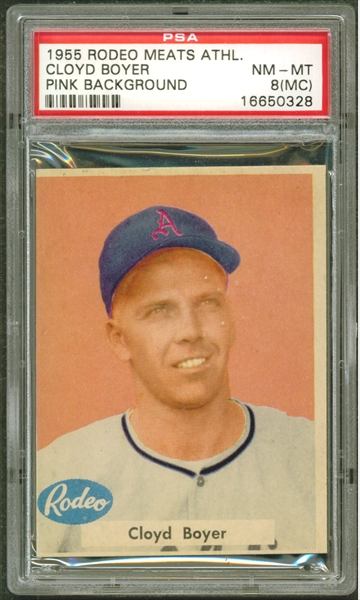
    Today's #5 calls back to one of the 1950s toughest sets, Missouri's own Rodeo Meats Athletics. The original's an attractive, 38-player issue celebrating baseball's debut in Kansas City. Its hand-tinted pictures echo 1954's Bowman and Red Heart sets, both stand-outs in the vintage era. But what makes it so hard-to-find for modern collectors?

    1. Topps churns out millions of cards annually, but regional producers like Rodeo Meats topped off in the thousands.
    2. Food-packaged sets picked up stains and odors easily, often making them better trash than collectibles.
    3. Fans saved their Mickey Mantle and Hank Aaron cards more often than Cloyd Boyer and Vic Power. Kansas City fielded decent players, but few memorable stars.

    At this 3-way nexus sits 1955 Rodeo Meats, an issue rare enough that there's only 1 complete set registered at PSA as of Sept 2010. By comparison, 21 collectors own graded 1952 Topps sets, with nearly 100 scarce high numbers and the Mantle rookie.

    Card front

    Oddly enough, this "commemorative" card uses a different picture than the original, which even had two poses to choose from.

    (original, blue background)

    (original, pink background)

    Cloyd's new pose isn't the only change between this "reprint" and Rodeo's original issue. Fronts (above) replace pastel colors with black-and-white photos. Backs (below) feature player bios instead of a mail-in offer for a collector's album. 38 unnumbered cards in 1955 become 28 numbered players in 1976. (A title card and checklist round it out at 30.)

    Card back

    Guides call this a reprint, but I have a different theory. JDM/JMC sold it directly to collectors at a time when few knew what real Rodeo cards looked like. No doubt acquiring a full set would've cost serious money, even in those days. Why not print pictures of KC players from 1955 and just name it after a notoriously rare regional issue to pique curiosity? A few photos match between the two, but it's clearly not an exact copy. That "commemorative" label is more accurate, if somewhat misleading.

    Value: Boyer cost me $5 on Beckett Marketplace. Several singles from the same set are on eBay for ~$7. (Search for Rodeo Meats.)

    Fakes / reprints: Don't know if anyone would fake this commemorative set. Card-for-card reprints definitely do exist for the 1955 Rodeo Meats, so seek those out if you want an original look without spending thousands of dollars.

    Friday, September 10, 2010

    1978 Olde Cards Baseball #5, George Stumpf

    Ah, the melancholy gaze of a bench player, forever playing games of pepper and hitting fungoes to outfield starters. I bet if George could undo that top shirt button, all his ennui would escape like helium from a balloon.

    Card front

    Mr. Stumpf played 19 pro seasons, with 14 of them coming at the AA level. He made spot appearances for the Red Sox in 3 seasons, maxing out at 79 games in 1932. George hit his only big league homer at Fenway Park on August 24.

    For those who like their ballplayers happy, this History of the St. Paul Saints page caught George in a lighter moment.

    Stumpf with the White Sox (1936)

    This 21-card set features stories of minor leaguers who suited up in Minnesota between the 30s and 50s. Olde Cards (the company) marked it as 1976, but the Twins actually offered it by mail order during the 1978 season. Five HOFers made the checklist: Ted Williams, Willie Mays, Hoyt Wilhelm, Roy Campanella, and Ray Dandridge. The other cards show 15 lesser-known players (like George) and a self-portrait of the set's illustrator.

    Card back

    I'm glad to read a story about a ballplayer and arm needles that doesn't result in testimony before Congress.

    Value: George cost $3 on Beckett Marketplace, about right for 1970s oddball singles.

    Fakes / reprints: Very few folks have even seen this set, let alone wanted it enough to make faking it worthwhile.