Wednesday, May 13, 2009

1957 Swift Meats Baseball #5, Ed Bailey

Today's oddball set ranks as one of the most bizarre marketing creations since "snails as food." Available only by mail from Swift Meats, the collection of 18 punch-out cards came in an envelope with a baseball game board.

Assembled card

Once opened and splayed onto the table, they must've looked disturbingly like a pile of butchered baseball players. Kind of like Re-Animator, you'd breathe new life into them by popping each piece out of the frame and following the tabbed instructions. In the end, you get a 3-D version of a 2-D tradition. I think it's very weird, and it would completely creep me out if the figures smelled at all like lunch meat.

Building both 9-man teams no doubt took some time, but Swift's tasty plan didn't stop at skeletal reconstruction. Plant your zombie baseball army atop its diamond-shaped game board and follow the instructions for a lite version of the spinner-based, Cadaco All Star Baseball experience. Unfortunately, there's no indication any single player performed better than another. Cadaco paid careful attention to each player's career performance and rendered it differently than all the others. This gave you a reason to pick different lineups and personalized the game. Swift's generic treatment of both it and the player pictures don't compare favorably. But hey, packaged meat products!


Card front (unassembled, blank back)


Credit Marty's PSA Graded Cards for the flattened picture of #10 Junior Gilliam and see a 2006 Robert Edwards auction for pictures of the unpunched set, envelope, and "field." My only example's the looming figure of #5, Ed Bailey, complete with hand-written digit above his name. Discarding the paper frame meant losing track of the checklist order, a curious design choice with all that extra space next to the player name and position. I'm sure it made sense at the time, when you're already dealing with the chopped-up bits of Frank Robinson. Oh, the humanity.

Monday, May 11, 2009

1961 Golden Press #5, Bill Terry

Today's card shows a Hall-of-Famer taking a nice, artistic cut with good follow-through. As a southpaw, Mr. Terry gets an extra step toward first base and probably used that edge to beat out a few of his record-setting 254 hits in 1930. Bill holds the all-time lefty record with a .341 average, but don't discount his power—the 2193 hits included almost 400 doubles and more than 150 homers.

(My own left-handed bat probably yielded an extra hit or two at the Little League level. It also helped that most 10 year-olds struggle to throw from third to first without a cutoff man.)


Card front

Although Bill's swinging at an imaginary ball in front of empty stands, the colored retouching makes the charade seem pastoral, like Kevin Costner playing catch with Joe Jackson in a corn field. “Build it...and Bill Terry will smoke line drives off the wall.”

This Golden Press set, their only issue, came in a 33-card album and featured exclusively retired HOFers. Big names include Ruth, Gehrig, DiMaggio, and Cobb, though students of the game should recognize the whole checklist. Cards from the front and back pages show more wear and command slightly higher prices, but it's relatively easy to build the set or find individual players. A friend gave me this #5 after finding it in a $1 bin in 2004.


Card back


Don Mattingly HOF supporters often mention today's guest as a comparison case. They both played well, but overall, it's a tough case to make. Their hitting stats match up well enough, but Terry also won multiple pennants (and a title) in NYC during his run as player-manager. You can't blame poor Yankee performance in the 80s on Don, but Bill gets an extra measure of respect for simultaneously handling strategic duties and logging big numbers at the plate.

Thursday, May 7, 2009

No - L@@K eBay card buying

One of the baseball blogs I follow, A Cardboard Problem, wrote on May 6 about card 'rare-ity' on eBay. To summarize, "RARE" shows up so frequently in card listings it means almost nothing these days. As a buyer, you're better off ignoring it entirely, like a "FINAL CLEARANCE" sign at a foreign rug merchant.

ACP's posting spurred me to consider eBay terminology and how it's thrown around these days. Isn't it obvious to sellers that they're shooting themselves in the foot? That somewhere beyond the critical mass is a critical detritus driving buyers away? (It's not just the lousy economy.)

The problem lies in what the seller's saying about their audience. Are they looking for sports buyers? Collectors? Investors? My money's on "people waiting in a supermarket checkout line."

Listing cards as "rare" (9,399 listings) or "L@@K" (1,622 listings) or "OLD" (842 listings) sounds like something culled from "eBay for Dummies." It made sense back when in-your-face marketing still worked. Today, a single minus sign will get your shouting out of my face.

As a buyer, I want rare stuff--indeed, that's my whole wantlist--but on eBay the term almost guarantees you're trying to make a silk purse out of a sow's ear. All of my wide-ranging searches specifically omit it and look for set names instead.

Briefly put, eBay's growth as a selling platform meant death to its former pool of accidental bargains. Away with the poorly described (but original) cards found in an attic that you won for no money! Here to stay, overproduced 80s and 90s cards listed as "eBay's greatest baseball card find!" Purchasing from a gaudy, overwrought listing doesn't guarantee a bad deal, but isn't the Internet here to save us from used-car salesmen? Cheap shoppers better serve themselves by looking for specific needs, side-stepping the vast, murky pool of description dreck.

If you're determined to tease out cards with bad descriptions, develop your search-fu to a fine, razor edge of misunderstood card text and malapropisms. Of course, whether you share them with others--your bidding competitors--is up to you. My favorite's the "T C G" abbreviation (for Topps Chewing Gum), printed on its older card backs in lieu of the full name. That search usually yields a grab bag of 50s, 60s, and 70s cards from all sports with well-meaning (if low-knowledge) sellers. It hasn't netted any bargains lately, but gives me a refreshingly small bin to sift through, compared to, say, "LOW POP" (2,106 listings).

Monday, May 4, 2009

1950 Bowman #5, Bob Kuzava

Bob Kuzava pitched professionally for 20 years, about two decades more than most of us. Cleveland signed him in 1941, but three years in a US Army uniform delayed his appearance in the major league version. He finally pitched regularly for the White Sox in 1949, going 10-6 and earning this first card, 1950 Bowman #5. As you can see from the image, someone did a number on this guy, rendering him The Man Without Eyes. I picture a back pocket trip through the clothes washer or many, many games of flipping.


Card front

Collecting maxim #23: “When you see a card with a messed up front, don't count on a pristine back.” As seen in the back scan, a previous owner tracked Bob's progress through the majors with his ink pen, updating the White Sox name on the card back to “Yankees.” He pitched there from mid-1951 to late 1954, netting three World Series titles, including game 7 appearances in both 1951 and 1952. Unfortunately, New York saw his last effective years as an MLB spot-starter and long reliever. Bob mopped up with the Orioles, Phillies, Pirates, and Cardinals, leaving the bigs for good at age 34 in 1957.


Card back

As of May 2009, Kuzava's still with us, and re-appeared as a signatory for the 2004 Bowman Heritage set, which replicates his 1955 color TV card. Many old school players rely on card and appearance-related revenue to bring home the bacon and I doubt Bob's an exception. When you meet older players at shows, make sure to give them your best and consider how much work it is to spend your golden years traveling between convention centers. If you see today's guest, ask about his disposal of the mighty Brooklyn lineup in 1952. As Don Larsen said when asked if he got tired of talking about his World Series perfect game: “Of course not! Why would I?”

Wednesday, April 29, 2009

1937 Goudey Thum Baseball Movies #5, Wally Moses

In the early 20th century, many Americans stereotyped movies as low-class entertainment, rife with sex and violence. (Perhaps that's changed and perhaps not.) Evolving camera technology and filming techniques allowed Hollywood to move further from small stage settings and put the people and situations right in your face.


This fast-paced change in entertainment style garnered negative attention from conservative groups, notably the Legion of Decency. Many large cities, including baseball towns Boston, New York, and Chicago, proved receptive to its influence, paving the road for industry change. (See the 1910 Tip-Top Pirates #5 for a similar story with the Temperance folks.)

The LoD's coordinated social and political pressure led movie studios to make concessions on script and film content, primarily via adoption of the Hays Code. Prior to its 1934 enforcement, studios tackled a wide variety of issues, from race relations to the ambiguity of crime and justice. Dozens of “classic” genres, stars, and directors established themselves prior to the Great Depression, but soon felt the pinch of behind-the-scenes censors who reviewed all American-made scripts and films. Out went racy scenes, language, and sympathetic bad guys. In came screwball comedies and the G-Men. Movies didn't stop being good, but they had to tap dance around major issues with ever-increasing subtlety.

Content enforcement lasted for some time, enough that studios completely remade several existing films in order to work around problems with their pre-Code version. Filmgoers know Dashiell Hammett's The Maltese Falcon as the classic 1941 film starring Humphrey Bogart. The little-seen 1931 version practically disappeared under the code's influence and picked up an alternate name (Dangerous Female) to avoid later confusion between the two.


As movies entered a decade of behind-the-scenes turmoil, baseball cards bloomed. Goudey even mixed the two with this “card” set, a series of marquee-style flip books. Zip through one to see a "live" player making a quick play, pitch, or batting move. Thum Movies cost 2 cents and included player bios and some commentary on the backside. The writing's pretty close to what you get from their standard card sets, but I liked the unintentionally humorous subscript of "Your Favorite Stars in Action! Pitching! Batting! Running! Catching! etc." (I assume scratching and spitting fall into the "etc." category.)

See the Old Cardboard set profile for a bit more info and Baseball Almanac's version for the full player checklist. It'd be fairly hard to build a full set these days, given the rarity of individual books. This issue also contains one of Joe DiMaggio's earliest appearances, a full year prior to the 1938 Heads Up set.


This scan shows the first page, with bat cocked and ready to swing. Each book zips through exactly 24 images, what folks now consider the standard speed for one second of movie projection. There's a problem with what you see here, though. If that's Wally at the plate, he's pulling a fast one on the movie man and swinging right-handed, even though he was a southpaw hitter and fielder. Personally, I think it's a different player altogether, something that happens from time-to-time on cards.

Update: Old Cardboard added details on a similar flip book set that's 30 years older than this Goudey set. Check out the 1906 Winthrop Moving Picture Postcards profile for details and an animated scan of the subject, HOFer Three Finger Brown's fastball.

Update #2: Red cover variation spotted on eBay.


Value: I bought this Moses book for $10 several years ago. Recent eBay actions are closing between $30-50 for Hall of Famers and probably half that for non-stars.

Fakes / reprints: It'd be a lot of work to fake a whole flip book, but beware of buyers selling single superstar pages, as copying them would be trivial. (I've seen separately graded individual pages of players like Joe DiMaggio, a dubious prospect at best.)

Friday, April 24, 2009

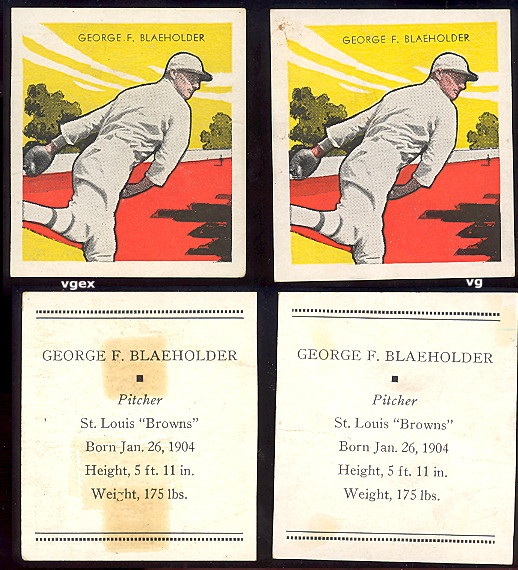
1921-1930 Major League Baseball Die-Cuts #5, George Blaeholder

It took me a while to give in and purchase this card. It’s got a pitching pose, but doesn’t resemble anyone in particular. Generic pants, lumpy shirt, and preternaturally stiff jersey sleeves complete the look of “five-minute sketch of man in woolen uniform.” At least it’s all done in sepia tones, matching the St. Louis Browns’ coffee stain history as an American League doormat in the 30s. Not too motivating, but I eventually found one for $5 and made the deal.

Card front (blank back)

The player in question, George Blaeholder, remained constant on the Browns from 1928 to 1934, taking the ball when asked and annually winning (and losing) at least 10 games. He moved on to the A’s in 1935, “achieving” a decent ERA+ mark but still going 6 and 10. That year, Philly beat St. Louis to the cellar by winning only 58 games under HOF manager Connie Mack. People often speak wistfully about players that play their whole career for one club; Mack served the A’s for half a century, helming the team from 1901 to 1950.

You deserve a more recognizable image of George Blaeholder, so check out his various cards from the 30s and 40s. The Goudeys and Diamond Stars look great as always, but I have a soft spot for the in-your-face color of the Tattoo Orbits. The high-contrast tones and action angle remind me of classic Soviet propaganda posters.


This particular set's actually pieces taken from a board game called "Major League Ball - The Indoor Game Supreme." (OldCardboard.com attributes the set to National Game Makers Company of Washington,D.C.) It kicked off in 1921 with at least five teams and a simpler design, listing only name, fielding and batting position, and team. Perforations, visible in the picture, connected the players horizontally and the maker post-fixed labels with name, position, and other details. Team sets (or label updates) came in an single envelope and were probably available through toy stores. The SCD catalog lists updates throughout the 1920s based on when players suited up for a given team. Blaeholder, for example, started pitching regularly in 1928, so only appeared after that time.

I started seeing these guys at shows more frequently in the last five years. It’s hard to recommend them unless you have a very specific interest, like a certain team, player, or (cough) type collection. The blasé player images and odd set construction do mean relatively low prices. This might be the cheapest way to recreate a classic lineup like the 1927 Yankees, though Ruth still runs hundreds of dollars in good shape. I point people back to the '33 and '34 Goudeys, since they're so much more attractive and informative.

Monday, April 20, 2009

1933 Rittenhouse Candy #5, Al Simmons

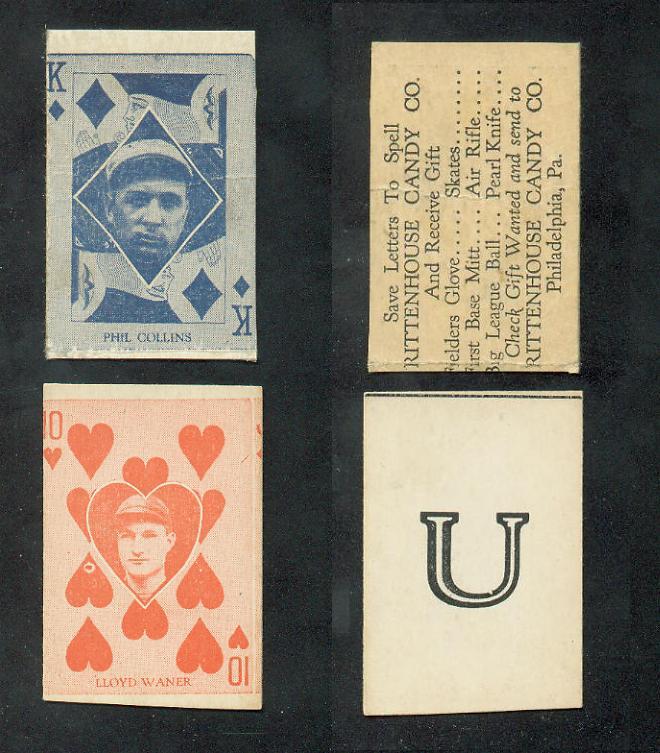
Reach back far enough into baseball’s misty past and you unearth marvels like HOFer Al “Bucketfoot” Simmons on this decidedly playful card. Printed on thick newsprint, it's a bit more than 2 inches high and bit less of that wide. That makes the actual player picture very small, slightly larger than a thumbnail. At least Al looks happy to be there.

As you might guess, the set numbers 52 cards total, with four suits of ace through king. The cherry red background would stand out almost anywhere, but cards also come in lime green and blueberry. See this list of pages for interesting E285 front and back variations.

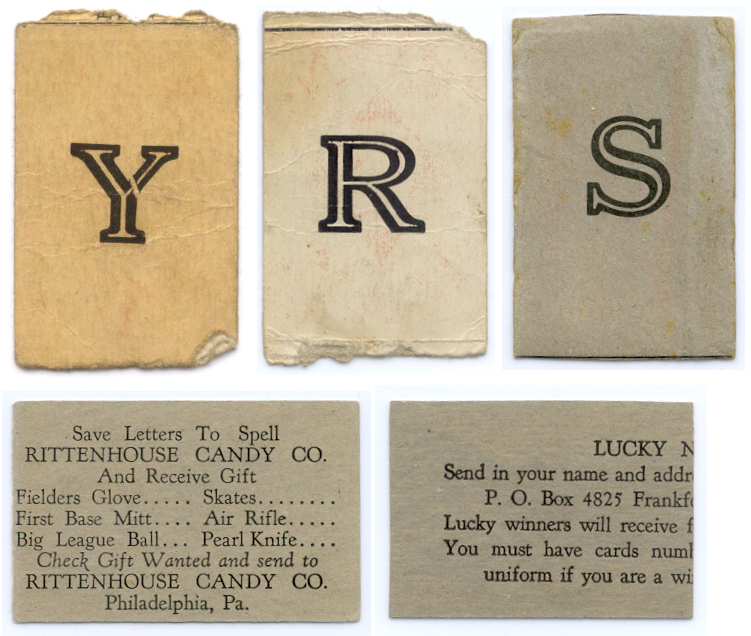
The set profile shows off most of the known card backs, which included a redemption contest. 1933 collectors that built the phrase “RITTENHOUSE CANDY CO” could send away for a fielder’s glove, first-base mitt, (roller?) skates, air rifle, pearl knife, or baseball. My inner child is now drooling.

This card appears in my blog because not every back included a letter. Mr. Simmons features the nice, big #5 pictured at right. Relatively few Rittenhouse cards made it into modern collections and this is the first I've seen with a number. Lots of reasons for set scarcity come to mind.

  1. Being strip cards, young collectors could easily cut them poorly and leave ragged edges
  2. The playing card design encouraged lots of use and handling
  3. I assume the production company kept anything sent back for redemption
  4. Goudey Gum produced an amazing baseball set the same year, with design and quality that far outpaced the E285s
  5. 1933 was a long time ago
You can see from the simple design that it’s one of 1930s’ lesser issues, but rarity keeps the value of Rittenhouse cards fairly high. Expect to pay $50 or more for a decent example. I recommend pursuing the 1933 or 1934 Goudeys (~$10 each in low grade) before you even think about building a set of these ugly ducklings.

Monday, April 13, 2009

1968 Atlantic Oil Baseball AL #5, Frank Robinson

This Atlantic Oil set, given away as an on-site promotion, reflects an explosion of late-60s licensing by the MLB Players Association. Clad in a blacked-out cap and generic jersey, Frank Robinson encourages you to pair him up with AL #4 (who I think was Tommy Davis) and win $100. Just like rare properties in McDonald’s Monopoly games, they printed the other card in significantly smaller quantities to avoid giving away money.


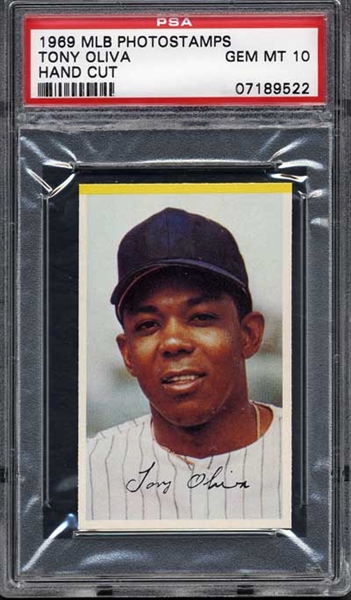
The lack of distinctive logos, team insignia, and player numbers reflects the changing nature of 50s and 60s product licensing. Major league players, through the MLBPA, used their emerging market clout and union strength to make two big steps. First, they negotiated a collective bargaining agreement with the team owners in 1968, a move that later dovetailed into full-scale free agency. Second, they signed a burst of licensing deals that paraded recognizable players across an ever-blander list of “collectibles.” One could argue the league and the players both diluted their brands with MLB’s 1969 expansion to 24 teams and oddities like MLBPA PhotoStamps, pins, and superballs.


In that vein, The Fleer Sticker Project profiled Topps’ on-again, off-again use of the Houston Astros name and logo in the late 60s, which follows from negotiation with baseball owners over their trademarks. For even more quality history, check out The Team That Topps Forgot by Dave Hornish. Both give a good sense of the cranks and characters trying to stay on top in a changing business and how that played out on the cards themselves. 

1967 Dexter Press set contains a more satisfying version of Frank's original photo for this Atlantic Oil card.


That's a Florida sky behind Frank, where Baltimore held 1960s spring training. This pre-press photo shows their 1965 team before a game in Winter Garden, Florida, preseason home to then-rival Washington Senators.


Find more contemporary shots of those Orioles at a spring training retrospective by The Baltimore Sun.

Frank Robinson and others in 1968 Atlantic Oil also appear with this back variation of a game picture instead of game rules. It includes the © MLBPA relevant to that era's changing licensing landscape at lower-left.


Atlantic Oil printed four different #5s for this contest and Frank's one of the easiest to find.

Value: Frank cost a few dollars in an oddball box, about average for low-grade oddball sets from this era. Fellow #5 Ernie Banks remains a white whale for my type collection, since Atlantic Oil short-printed him for the $100 contest prize and few survive today.

Fakes / reprints: Haven't seen fakes in the marketplace, but it's possible for rarities like Banks. Look for the perforated edges, as each player came on a sheet.

Saturday, April 11, 2009

Update on #5 type collection progress

This blog's type collection includes all known sets from baseball's majors, minors, and foreign issues. It limits the "target" to only sets with cards numbered 5. This significantly reduced the total count, since SCD "big book" listings number into the thousands, but still includes almost 450 different issues.

Topps represents more of those sets than any other single company. Oddball makers, such as TCMA and several regional food companies, also figure prominently. Note that "oddball" doesn't describe the player on the card, or we'd get a complete list of the recently mentioned Oscar Gamble afro cards.

Breaking the type collection composition into decades shows two things. First, the total number of sets started slowly and held steady though the 1940s. The rarest cards come from the pre-1920 era, including some sets that number beyond #5, but haven't identified that specific card yet. (Perhaps they'll eventually turn up, perhaps not.) Second, production totals rose sharply after WWII, roughly in tune with the maturing Baby Boom generation's buying power and westward league expansion. Many new industries tried out baseball-related promotions, including tea companies, cookie bakers, and potato chippers. With much smaller production runs than Topps, these cards prove hardest to track down, eBay or no eBay.
  1. Decade: # owned of # possible
  2. Pre-1920: 10 of 16
  3. 1920s: 16 of 29
  4. 1930s: 23 of 30
  5. 1940s: 21 of 26
  6. 1950s: 43 of 54
  7. 1960s: 61 of 84
  8. 1970s: 163 of 195
  9. Total: 337 of 434 (78%)
This blog profiles about 80 different sets so far, just under 20% of what's possible. Even one page per set would create quite a book by the time we're done. I plan to continue writing about two or three cards per week, which means another few years (at least) to address them all. Let me know if particular eras or aspects of the hobby appeal to you and I'll do my best to include them in the #5 profiles.

Sunday, April 5, 2009

1977 Bob Parker "More Baseball Cartoons" #5, Doug Flynn

Pro artist Bob Parker, known in baseball circles for cartoons he drew for classic Topps card backs, based several sets in the 70s and 80s on his own player drawings. This 1977 issue profiles a mix of players, 24 in all, spanning a number of baseball eras. The #5 features Doug Flynn, a decent shortstop best known as part of CIN's trade for Tom Seaver.

Like most of Parker’s other sets, "More Baseball Cartoons" comes on thin, over-sized card stock without finishing gloss and I assume he printed them for sale direct to collectors. The backs are blank, so what you see here is what you get.


Parker's art style evokes the second half of Goudey's 1938 Big League Gum, with batting and fielding poses encircling a portrait sketch. I find this homage charming and wish more contemporary issues did the same. This set uses a mix of formats, including full and multiplayer poses, giving you every animal in the barnyard to look at. (Gallery of a PSA set.)

Bob made this set avant garde by producing it himself during an era when few could. These days, artists can turn out a more polished product, given computer drawing tools and a quality inkjet printer. Publishing your own card sets really meant something in the President Carter years. While fellow artist Robert G. Laughlin created similar oddball sets in the same generation, Parker’s "Topps card back" style remains tough to beat.

Value: I found this #5 for a $2 at a show many years ago. Complete sets and singles also appear on eBay and elsewhere online.

Fakes/reprints: This set's scarcity insulates it somewhat from reproduction. Real cards are oversized and come on rough orange paper, two aspects almost unique to this set. Any examples sized like typical baseball cards won't be from the original set.