Monday, April 20, 2009

1933 Rittenhouse Candy #5, Al Simmons

Reach back far enough into baseball’s misty past and you unearth marvels like HOFer Al “Bucketfoot” Simmons on this decidedly playful card. Printed on thick newsprint, it's a bit more than 2 inches high and bit less of that wide. That makes the actual player picture very small, slightly larger than a thumbnail. At least Al looks happy to be there.

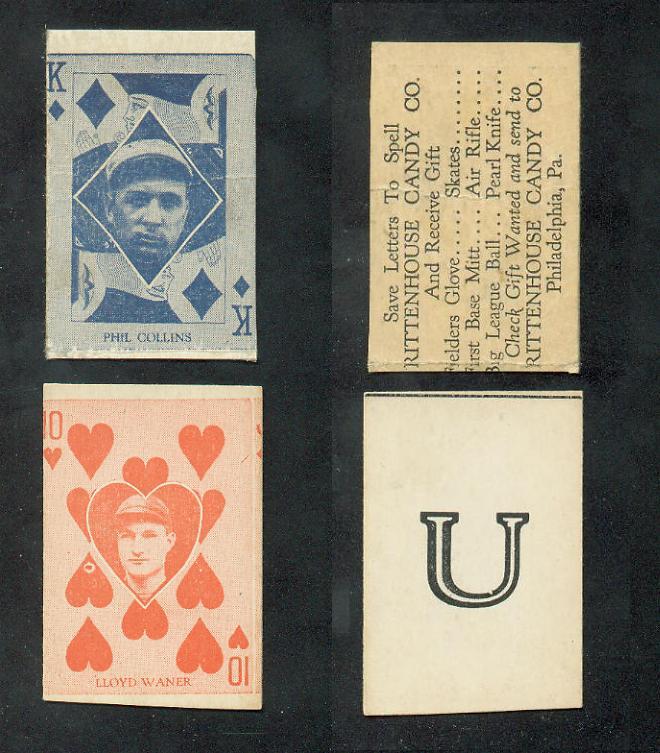
As you might guess, the set numbers 52 cards total, with four suits of ace through king. The cherry red background would stand out almost anywhere, but cards also come in lime green and blueberry. See this list of pages for interesting E285 front and back variations.

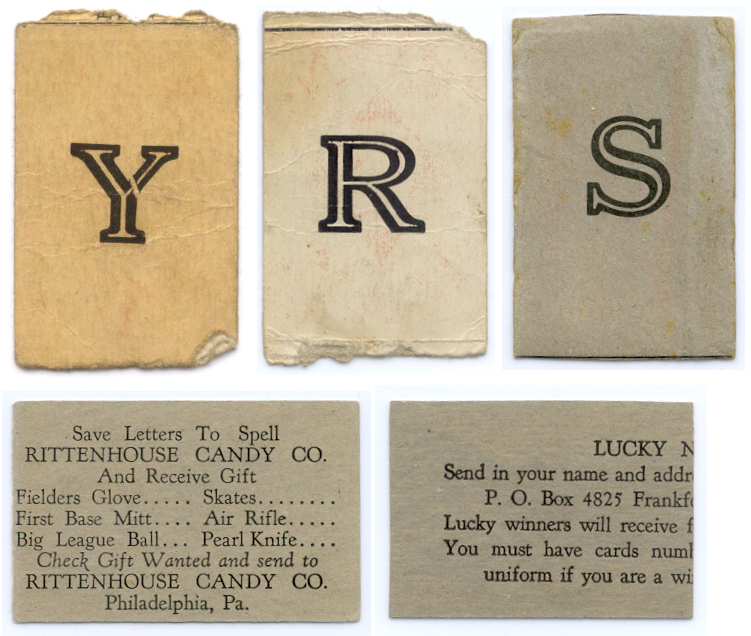
The set profile shows off most of the known card backs, which included a redemption contest. 1933 collectors that built the phrase “RITTENHOUSE CANDY CO” could send away for a fielder’s glove, first-base mitt, (roller?) skates, air rifle, pearl knife, or baseball. My inner child is now drooling.

This card appears in my blog because not every back included a letter. Mr. Simmons features the nice, big #5 pictured at right. Relatively few Rittenhouse cards made it into modern collections and this is the first I've seen with a number. Lots of reasons for set scarcity come to mind.

  1. Being strip cards, young collectors could easily cut them poorly and leave ragged edges
  2. The playing card design encouraged lots of use and handling
  3. I assume the production company kept anything sent back for redemption
  4. Goudey Gum produced an amazing baseball set the same year, with design and quality that far outpaced the E285s
  5. 1933 was a long time ago
You can see from the simple design that it’s one of 1930s’ lesser issues, but rarity keeps the value of Rittenhouse cards fairly high. Expect to pay $50 or more for a decent example. I recommend pursuing the 1933 or 1934 Goudeys (~$10 each in low grade) before you even think about building a set of these ugly ducklings.

Monday, April 13, 2009

1968 Atlantic Oil Baseball AL #5, Frank Robinson

This Atlantic Oil set, given away as an on-site promotion, reflects an explosion of late-60s licensing by the MLB Players Association. Clad in a blacked-out cap and generic jersey, Frank Robinson encourages you to pair him up with AL #4 (who I think was Tommy Davis) and win $100. Just like rare properties in McDonald’s Monopoly games, they printed the other card in significantly smaller quantities to avoid giving away money.


The lack of distinctive logos, team insignia, and player numbers reflects the changing nature of 50s and 60s product licensing. Major league players, through the MLBPA, used their emerging market clout and union strength to make two big steps. First, they negotiated a collective bargaining agreement with the team owners in 1968, a move that later dovetailed into full-scale free agency. Second, they signed a burst of licensing deals that paraded recognizable players across an ever-blander list of “collectibles.” One could argue the league and the players both diluted their brands with MLB’s 1969 expansion to 24 teams and oddities like MLBPA PhotoStamps, pins, and superballs.


In that vein, The Fleer Sticker Project profiled Topps’ on-again, off-again use of the Houston Astros name and logo in the late 60s, which follows from negotiation with baseball owners over their trademarks. For even more quality history, check out The Team That Topps Forgot by Dave Hornish. Both give a good sense of the cranks and characters trying to stay on top in a changing business and how that played out on the cards themselves. 

1967 Dexter Press set contains a more satisfying version of Frank's original photo for this Atlantic Oil card.


That's a Florida sky behind Frank, where Baltimore held 1960s spring training. This pre-press photo shows their 1965 team before a game in Winter Garden, Florida, preseason home to then-rival Washington Senators.


Find more contemporary shots of those Orioles at a spring training retrospective by The Baltimore Sun.

Frank Robinson and others in 1968 Atlantic Oil also appear with this back variation of a game picture instead of game rules. It includes the © MLBPA relevant to that era's changing licensing landscape at lower-left.


Atlantic Oil printed four different #5s for this contest and Frank's one of the easiest to find.

Value: Frank cost a few dollars in an oddball box, about average for low-grade oddball sets from this era. Fellow #5 Ernie Banks remains a white whale for my type collection, since Atlantic Oil short-printed him for the $100 contest prize and few survive today.

Fakes / reprints: Haven't seen fakes in the marketplace, but it's possible for rarities like Banks. Look for the perforated edges, as each player came on a sheet.

Saturday, April 11, 2009

Update on #5 type collection progress

This blog's type collection includes all known sets from baseball's majors, minors, and foreign issues. It limits the "target" to only sets with cards numbered 5. This significantly reduced the total count, since SCD "big book" listings number into the thousands, but still includes almost 450 different issues.

Topps represents more of those sets than any other single company. Oddball makers, such as TCMA and several regional food companies, also figure prominently. Note that "oddball" doesn't describe the player on the card, or we'd get a complete list of the recently mentioned Oscar Gamble afro cards.

Breaking the type collection composition into decades shows two things. First, the total number of sets started slowly and held steady though the 1940s. The rarest cards come from the pre-1920 era, including some sets that number beyond #5, but haven't identified that specific card yet. (Perhaps they'll eventually turn up, perhaps not.) Second, production totals rose sharply after WWII, roughly in tune with the maturing Baby Boom generation's buying power and westward league expansion. Many new industries tried out baseball-related promotions, including tea companies, cookie bakers, and potato chippers. With much smaller production runs than Topps, these cards prove hardest to track down, eBay or no eBay.
  1. Decade: # owned of # possible
  2. Pre-1920: 10 of 16
  3. 1920s: 16 of 29
  4. 1930s: 23 of 30
  5. 1940s: 21 of 26
  6. 1950s: 43 of 54
  7. 1960s: 61 of 84
  8. 1970s: 163 of 195
  9. Total: 337 of 434 (78%)
This blog profiles about 80 different sets so far, just under 20% of what's possible. Even one page per set would create quite a book by the time we're done. I plan to continue writing about two or three cards per week, which means another few years (at least) to address them all. Let me know if particular eras or aspects of the hobby appeal to you and I'll do my best to include them in the #5 profiles.

Sunday, April 5, 2009

1977 Bob Parker "More Baseball Cartoons" #5, Doug Flynn

Pro artist Bob Parker, known in baseball circles for cartoons he drew for classic Topps card backs, based several sets in the 70s and 80s on his own player drawings. This 1977 issue profiles a mix of players, 24 in all, spanning a number of baseball eras. The #5 features Doug Flynn, a decent shortstop best known as part of CIN's trade for Tom Seaver.

Like most of Parker’s other sets, "More Baseball Cartoons" comes on thin, over-sized card stock without finishing gloss and I assume he printed them for sale direct to collectors. The backs are blank, so what you see here is what you get.


Parker's art style evokes the second half of Goudey's 1938 Big League Gum, with batting and fielding poses encircling a portrait sketch. I find this homage charming and wish more contemporary issues did the same. This set uses a mix of formats, including full and multiplayer poses, giving you every animal in the barnyard to look at. (Gallery of a PSA set.)

Bob made this set avant garde by producing it himself during an era when few could. These days, artists can turn out a more polished product, given computer drawing tools and a quality inkjet printer. Publishing your own card sets really meant something in the President Carter years. While fellow artist Robert G. Laughlin created similar oddball sets in the same generation, Parker’s "Topps card back" style remains tough to beat.

Value: I found this #5 for a $2 at a show many years ago. Complete sets and singles also appear on eBay and elsewhere online.

Fakes/reprints: This set's scarcity insulates it somewhat from reproduction. Real cards are oversized and come on rough orange paper, two aspects almost unique to this set. Any examples sized like typical baseball cards won't be from the original set.

Monday, March 2, 2009

1939 Gum, Inc. "Play Ball America" Baseball (aka "Play Ball") #5, Luke Sewell

We've gone back to the future by including Luke Sewell, younger brother of previous #5 guest (and Hall of Fame shortstop) Joe Sewell. Though he lacked the elder's powerful stick, durability and defensive skills sustained Luke's 20-year career behind the plate. Several years of managing followed, when he notably led the 1944 St. Louis Browns to their only pennant. That year's World Series also marked the last time both league winners shared the same home stadium. The cross-town Cardinals beat them in a six-game World Series that drew little national interest, given WWII's distractions and the moribund talent levels league-wide.

Card front

Manufacturer Gum, Inc. used real black-and-white photos on this debut set, splitting the composition between portraits and Sewell-like action shots. This marked a real change from Goudey's colorful 1930s efforts and Play Ball's follow-up sets (1940 and 1941) continued with a very similar, newspapery look.

Dozens of card companies tried their hand with baseball in the 1930s, but America's war effort sucked up almost all the cardboard from 1942 to 1947. Only rag stock remained, which led to sets like the poorly regarded MP & Co (checklist at GFG.com). Bowman finally picked up the major league baton in 1948 with a 1939 Play Ball look-alike of 48 cards and Topps finally pushed everyone past the age of small pictures with their 1952 set.

Red overprints are Gum, Inc. salesman sample cards

Gum, Inc's salesmen brought these overprinted cards to candy stores as promos to build retailer interest. A small number remain in the market and some collectors even specialize in them, though I'm not sure if it's possible to build a full set.

UPDATE: Thanks to 1939baseball.com, we get a look at Play Ball's wrapper and box stylings.


Baseball put a lot of effort into celebrating 1939 as the centennial of baseball, so this wrapper included a parade of game uniforms.


Value: Low-grade, low series Play Ball commons like Luke Sewell cost a few dollars each. Major stars like Joe DiMaggio and Ted Williams will cost you whatever you have. Seriously, it's enough money that you should just put your wallet in the freezer now to accumulate as much cold, hard cash as possible. Unfortunately, pre-war star card values don't drop much in a down economy, since you only need a few well-heeled collectors to maintain competition and high market prices.

Fakes / reprints: Full set reprints do exist, but probably not singles of Mr. Sewell.

Friday, February 20, 2009

1955 Red Man AL #5, Bob Grim

Looking decidedly wistful here, and anything but "grim," today's guest kicked off his major league career with a bang, going 20-6 in 1954. This earned him AL Rookie of the Year and he followed with three more years of relative success, posting a 45-21 record in pinstripes before being traded to Kansas City.


Card front

His Wikipedia entry notes how arm troubles prompted a successful conversion to relief pitching, which no doubt prolonged his career in a sport where young players can fall off the planet in no time at all. Grim's career eventually ended in 1962 with the A's, but his stats change notably after those four seasons in New York. I wonder where today's pitching strategies and medical care would've taken him, compared to the 1950s and four-man rotations.

Like other Red Man issues I've covered, this over-sized, beautifully painted card design stands out among oddballs. They look a lot like Topps' 1953 cards, but repeated for several years running. Each tobacco pouch included a card ("for your boy!") with the chaw ("not for your boy!"), and printed one numbered set per league. See the RedManCards.com checklists for the full star power of the day and pictures of some ad placards. (Lest you think I made up the "for your boy" stuff.)

Thursday, February 12, 2009

1980 Topps Superstars #5, Jim Rice

Cheer up, Mr. Rice, you’re in the Hall of Fame! Some thought you’d make it, others held you shouldn’t, and it dragged on long enough that still others debated the debating. I just marvel that your hair looks so good on TV!


Card front (5" x 7")

I read through Jim’s Wikipedia entry to better understand all of the blather and palaver. The last section calls out a bunch of interesting similarities to fellow HOFer Ducky Medwick, who played for the Gashouse Gang in St. Louis. Unfortunately for Rice, people who know the political history of the Hall consider Ducky’s era (and even the Cardinals specifically) unfairly over-represented. Perhaps the linking’s meant to be supportive—their circumstances do align remarkably well—but peripheral issues take you in a different direction.

All this observed, I care much for cards and not so much for the Hall itself, so hey—1980 Superstars! Topps crafted these 5”x7” beauties as an oddball companion to the normal 792-card set. Each paper-wrapped pack contained a handful of big, sharp photos and the checklist includes 59 of the era’s best players…and Sixto Lezcano. (Zing!) Curiously, the back states only the player name and team, a dearth of data drowning in dreary grey newsprint.

Two things bother me about this issue. First, the pictures seem like spring training one-offs. Rice’s pose, a pretty uninspiring shot, looks better than 90% of his competitors. Everyone else is looking away from the camera, caught at odd angles, or just not feeling their best. Hey Topps, how about using all that real estate to show a nice action shot? Second, the card backs say almost nothing, a real waste of 35 square inches of space. How about using them to make a big All-Star roster puzzle like they did with 1977’s cloth stickers? A few strategic changes would’ve made them super Superstars.

Friday, February 6, 2009

1968 Laughlin Baseball World Series #5, 1908 (Cubs vs. Tigers)

Artist Bob Laughlin published a bunch of oddball card sets featuring his cartoons and caricatures during the 70s and 80s, including a cute series (1974 Sportslang) I covered last July. His earliest work, a series of single-panel highlight cards covering each World Series, shows up today. This first card featured the Boston American and Pittsburgh Pirates from 1903, the former beating the latter in a best-of-9. Recent type collection tangent John McGraw (and Giant team management) refused to play in 1904, so skip one year and add four to reach 1908, today’s card.

Card front

This plain-faced image, appearing humbly in black-and-white, relates to a great deal of baseball culture, old and new. Tinker, Evers, and Chance, most of the infield for Chicago’s dominant 1900s team, all played pretty well. Their social significance, however, looms over a simple stat line like the Colossus over Rhodes, casting shadows into the future. As multiple championship winners and poetic célèbre, the teammates became more than legend than substance. People knew them so well that their eponymous phrase came to mean “working smoothly and reliably.” This comes, however, with a mirror role as a sacrificial pop icon for modern critics. As individuals, none played up to Hall of Fame “standards,” itself a font of rich debate for baseball fans and writers throughout the sport’s history. The arguments back-and-forth are a reading snooze for me, but the line between Hall of Fame and Hall of Very Good really lights some people up.

Card back

To circle back to 1908, consider a few other Events of Significance surrounding that year’s World Series.

  1. Tender 19 year-old Fred Merkle mis-runs the bases (the Merkle Boner) and snatches defeat from the Giant jaws of victory. He went on to play for 20 years, but never outlived that infamous day. “GIANTS WIN LOSE THE PENNANT,” etc., etc.
  2. Gate attendance proved very low, partly from a Chicago ticket scalping scandal the ownership was implicated in. Sound familiar?
  3. “Take Me Out to the Ballgame,” written by two gentlemen who’d never seen a pro game, becomes a nationwide hit.
  4. The Chicago Cubs kick off a century of waiting for their fans.

Tuesday, February 3, 2009

1917 E135 Collins McCarthy Baseball #5, Fred Anderson

Today’s guest, John Frederick Anderson, is the first player I've written about who eventually took his own life. That tragic end came some forty years removed from Fred's half-dozen years in the game and a single 1917 World Series appearance, two brief and unremarkable innings in Game 2 against the Chicago White Sox. (The pale hose went on to win the series 4 to 2.)


Fred pitched his three New York seasons under legendary manager John McGraw. Apparently, he took a little something extra to the mound, frequently throwing spitters. Check out this colorful account of the team’s 26-game winning streak in 1916, which includes comments on Anderson’s “moist ball” and several good performances. The Baseball Crank blog adds a more statistical bent to the amazing run of Ws, noting he started three times and no doubt appeared in several others, as one of the league’s leading mop-up men.


E135 cards don’t show up very often. I finally purchased a trimmed #5 (with a blank back) from an online store last year for $30. It presents a little better in real life than what you see in the scan, given the ancient, plasticky gloss they used in the first quarter-century. Some include an advertising stamp for the Collins-McCarthy store on the back in black ink.

The whole set’s rare enough to counterfeit, something I originally feared of Fred. West Coast dealer Mark McRae helped add confidence to this particular example. Careful examination of the printing details shows the right kind of dot pattern, something handled differently by modern printers and presses. Modern gloss also holds up better, while the surface of a handled E135 appears to “fracture” into tiny pieces like a shattered mirror (or 1970s Kellogg’s card). I don’t expect PSA to ever pass judgment on Mr. Anderson, but if it happened, they’d look for similar indicators—right after cashing my large check, of course.