Thanks to everyone who nominated a "best core lineup" for Friday's giveaway of this three-man 1961 Topps #25!
Read all 19 comments for the full list, covering teams from the defunct Federal League up to modern Astros and Phillies. I'm partial to Night Owl and Spiegel's nomination of the 1950s Brooklyn Dodgers trio of Snider, Campanella, and Hodges, both for their golden age success and (*cough*) to make my Brooklyn-loving dad happy.
I fed all entrants into Random.org and it selected Greg Zakwin as the winner of this card and some moderns of his chosen team. (It looks like that'll also be the Dodgers.) Congrats to Greg and look for more giveaways soon!
Sunday, August 14, 2011
Friday, August 12, 2011
Friday Giveaway: Your Team's Best Power Trio?
This last featured pickup from the 2011 National in Chicago is cool for a few reasons.
First, just 50 cents netted me Frank Robinson, Gus Bell, and Vada Pinson in a nice pre-game shot from 1960. Second, those sleeveless Reds uniforms always mean classic baseball; who can forget Ted Kluszewski in 1957? Third, Topps reused Gus Bell's own uniform number (25) for the card itself.
Seeing these guys together--the top 3 in total bases for Cincinnati in 1960--made me wonder what the best 3-man slugging combos were for Seattle, my hometown team from ages 6 to 26. Who would I want anchoring their 2-3-4 or 3-4-5 lineup positions, year after year?
The Mariners are an easy franchise to build a best-ever trio for, given their inconsistent (i.e., lousy) 1970s and 1980s teams. By the mid 1990s, though...
HOW TO ENTER: Who do you think is the best lineup trio for another franchise? Just add a comment with team, players, and basic rationale.
[Greg Zakwin won the giveaway of this 1961 Topps #25, but feel free to add more "best lineups" to this post.]
UPDATE: Vintage Sportscards is also running a National-based 1952 Topps giveaway! Entering both is like the Doublemint gum of vintage contests.
![]() |
| Scan from COMC, where 1961 Topps #25 starts at $2 |
First, just 50 cents netted me Frank Robinson, Gus Bell, and Vada Pinson in a nice pre-game shot from 1960. Second, those sleeveless Reds uniforms always mean classic baseball; who can forget Ted Kluszewski in 1957? Third, Topps reused Gus Bell's own uniform number (25) for the card itself.
Seeing these guys together--the top 3 in total bases for Cincinnati in 1960--made me wonder what the best 3-man slugging combos were for Seattle, my hometown team from ages 6 to 26. Who would I want anchoring their 2-3-4 or 3-4-5 lineup positions, year after year?
![]() |
| This is how we all think about cards, right? |
The Mariners are an easy franchise to build a best-ever trio for, given their inconsistent (i.e., lousy) 1970s and 1980s teams. By the mid 1990s, though...
- Ken Griffey, Jr. hit 50+ homers regularly
- Edgar Martinez picked up the nickname "Dr. Double" (35+ of them 8 times)
- Alex Rodriguez started doing what he's always done
HOW TO ENTER: Who do you think is the best lineup trio for another franchise? Just add a comment with team, players, and basic rationale.
[Greg Zakwin won the giveaway of this 1961 Topps #25, but feel free to add more "best lineups" to this post.]
UPDATE: Vintage Sportscards is also running a National-based 1952 Topps giveaway! Entering both is like the Doublemint gum of vintage contests.
Thursday, August 11, 2011
Fourth round from the 2011 National in Chicago
Yesterday, I said that National show dealers divide along the modern and vintage line, with relatively little overlap; new stuff looks white and shiny, older stuff looks grey. Booths that sell those old cards and memorabilia further subdivide into the walled castle (look but don't touch), general store (c'mon in and look around), and rec room (wow, what a mess), with communication styles to match. Most of today's scans came from the last group, a bunch of messy tables I sifted through with good success. 99.9% of their low-grade boxes will be junk, but that just makes the hits feel twice as good.
Just about everyone knows the Dodgers moved to L.A. from Brooklyn. Their shortened version of "trolley dodger" was just one of several early team nicknames, though; Superbas also showed up regularly and that's what they're called on this 1909 T205 card, which came in pouches of Polar Bear, a brand of loose tobacco. (Scans of all 208 players at the Virtual Card Collection.)
Top-notch career achievements and HOF enshrinement don't mandate that your cards will cost a mint. Low-grade Al Kaline cards, for example, popped up all over for small money: 1960 and 1962 Topps for $5, this 1963 for $3, 1969 and 1971 for $1, and 1973 for 50 cents. I expect to find bargains in low-grade, but this bordered on a bonanza.
Topps added a 25-card "Venezuelan" insert set with Spanish text to their 2011 Lineage product. (Checklist at Baseballcardpedia.) They're based on 1960s cards like this Jose Cardenal, when Caracas-based publishers reprinted several sets for South American fans. Most local collectors glued their baseball treasures into albums like this one, which pulled away paper on later removal.
Card stock's pretty close to our American version, but backs look darker and those printed by C. A. Litoven include this HECHO EN VENEZUELA tag line.
I don't expect to complete a vintage Venezuelan set without hitting the lottery, but will always pay 50 cents for a single.
L.A.-native Duke Snider always takes a nice picture; find more set info in my profile of #5, Ernie Lombardi.
Check out those guns! Hodges knocked plenty of baseballs out of Ebbets Field onto Flatbush Avenue and now we know why. (See fellow Dodgers Campanella and Furillo at the 1977 TCMA/Galasso set profile.)
These purple-tinted 4" x 6" Exhibits come on thick, postcard-sized stock and cover both sport and non-sport celebrities. Hank Sauer wasn't the prettiest ballplayer, but slugged 288 career homers and won the 1952 NL MVP with Chicago, which is probably when this card came out.
Being a Seattle semi-native, I pick up oddball cards of former Seahawk quarterbacks. Jim Zorn couldn't win many games as Redskins head coach, but did plenty under center for my favorite team in their expansion era.
Spike Owen's my favorite player from Seattle's other 1970s expansion team and this came to me courtesy of a trading partner. (I've used "Spike" as a collector nickname and he's the reason why.)
Cool oddball card of the Iron Horse for half a dollar? Yes, please! The set itself celebrates player milestones like 300 wins, .400 average, and 500 homers. I like the choice by artist and publisher Bob Laughlin to include Lou's World Series dingers and help Lou crest the 500 milestone. (Set profile of #5, Christy Mathewson.)
This week's scans covered my favorite pick-ups of the 2011 National in Chicago, with one or two more set aside for tomorrow's vintage giveaway. Start thinking about your favorite team's best sluggers now!
![]() |
| 1909 T205 Polar Bear tobacco, Tony Smith (Brooklyn Superbas) ($8) |
Just about everyone knows the Dodgers moved to L.A. from Brooklyn. Their shortened version of "trolley dodger" was just one of several early team nicknames, though; Superbas also showed up regularly and that's what they're called on this 1909 T205 card, which came in pouches of Polar Bear, a brand of loose tobacco. (Scans of all 208 players at the Virtual Card Collection.)
![]() |
| 1963 Topps #25, Al Kaline ($3) |
Top-notch career achievements and HOF enshrinement don't mandate that your cards will cost a mint. Low-grade Al Kaline cards, for example, popped up all over for small money: 1960 and 1962 Topps for $5, this 1963 for $3, 1969 and 1971 for $1, and 1973 for 50 cents. I expect to find bargains in low-grade, but this bordered on a bonanza.
![]() ![]() |
| 1968 Venezuelan #102, Jose Cardenal (50 cents) |
Topps added a 25-card "Venezuelan" insert set with Spanish text to their 2011 Lineage product. (Checklist at Baseballcardpedia.) They're based on 1960s cards like this Jose Cardenal, when Caracas-based publishers reprinted several sets for South American fans. Most local collectors glued their baseball treasures into albums like this one, which pulled away paper on later removal.
Card stock's pretty close to our American version, but backs look darker and those printed by C. A. Litoven include this HECHO EN VENEZUELA tag line.
I don't expect to complete a vintage Venezuelan set without hitting the lottery, but will always pay 50 cents for a single.
![]() |
| 1976 Shakey's Pizza West Coast Greats #12, Duke Snider (50 cents) |
L.A.-native Duke Snider always takes a nice picture; find more set info in my profile of #5, Ernie Lombardi.
![]() |
| 1977-84 TCMA/Galasso, Gil Hodges (50 cents) |
Check out those guns! Hodges knocked plenty of baseballs out of Ebbets Field onto Flatbush Avenue and now we know why. (See fellow Dodgers Campanella and Furillo at the 1977 TCMA/Galasso set profile.)
![]() |
| 1950s Exhibit card, Hank Sauer (50 cents) |
These purple-tinted 4" x 6" Exhibits come on thick, postcard-sized stock and cover both sport and non-sport celebrities. Hank Sauer wasn't the prettiest ballplayer, but slugged 288 career homers and won the 1952 NL MVP with Chicago, which is probably when this card came out.
![]() |
| 1970s Seahawks team issue, Jim Zorn (50 cents) |
Being a Seattle semi-native, I pick up oddball cards of former Seahawk quarterbacks. Jim Zorn couldn't win many games as Redskins head coach, but did plenty under center for my favorite team in their expansion era.
![]() ![]() |
| 1990 Donruss Aqueous Test #102, Spike Owen (free) |
Spike Owen's my favorite player from Seattle's other 1970s expansion team and this came to me courtesy of a trading partner. (I've used "Spike" as a collector nickname and he's the reason why.)
![]() |
| 1980 Laughlin 300/400/500 #29, Lou Gehrig (50 cents) |
Cool oddball card of the Iron Horse for half a dollar? Yes, please! The set itself celebrates player milestones like 300 wins, .400 average, and 500 homers. I like the choice by artist and publisher Bob Laughlin to include Lou's World Series dingers and help Lou crest the 500 milestone. (Set profile of #5, Christy Mathewson.)
This week's scans covered my favorite pick-ups of the 2011 National in Chicago, with one or two more set aside for tomorrow's vintage giveaway. Start thinking about your favorite team's best sluggers now!
Wednesday, August 10, 2011
Third round from the 2011 National in Chicago
Year-in and year-out, card dealers at the National divide more or less along "modern" and "vintage" lines. New, UV-coated booths shine with an aura of clean, vibrant action, often protected by plastic slabs and grades with high numbers. Comparatively, vintage booths at the show look...grayer. Less uniform. More "assorted" than "organized." Faint smell of "office supply aisle."
Cards with quote-unquote nicknames of guys who are just happy to be here. (1940 Play Ball set profile.)
Fellow vintage enthusiasts from my trading group OBC gifted both of these blue backs from Topps' first big year of baseball cards. Thanks guys, much appreciated! If you enjoy old cards and don't care about condition, consider joining up. 20+ OBC members made it to the 2011 National; our annual swap session's a cardboard experience of its own.
I'm including prices to show that the vintage treasure hunt remains affordable, even for 1950s cards featuring two HOFers! (Despite the National being in their backyard, Chicago White Sox and Cubs carried no obvious price premium; find another White Sox player on 1959 Topps #5.)
Fan favorite and five-decade player Minoso also appears on 1952 Bowman #5, one of my favorite cards ever. (1961 Topps set profile.)
A paltry $2 to learn "his 61 homers set a new major league record season record for 162 games" in French? Oui, s'il vous plais. (1962 Post Canadian set profile, featuring runner-up Mickey Mantle.)
Thanks for reading thus far. Still more National cards to come on Thursday and then a three-player giveaway on Friday!
![]() |
| 1934-36 Batter-Up #54, Si Johnson ($8) |
So why collect pictures of guys who've long since retired and (often) shuffled off this mortal coil, knowing you'll never root for them to strike someone out or slug a game-winning homer? Introspection says it's the hunt for buried treasure, those artifacts that trap a sense of time and place otherwise lost to family albums and history books. Si Johnson, in long-sleeve undershirt and high socks, showing off his curve ball grip. (1934 Batter-Up set profile.)
![]() |
| 1940 Play Ball #163, Spud Davis ($5) |
Cards with quote-unquote nicknames of guys who are just happy to be here. (1940 Play Ball set profile.)
![]() |
| 1951 Topps Blue Back #42, Bruce Edwards (free) |
![]() |
| 1951 Topps Blue Back #8, Dick Sisler (free) |
![]() |
| 1951 Topps Blue Back |
Fellow vintage enthusiasts from my trading group OBC gifted both of these blue backs from Topps' first big year of baseball cards. Thanks guys, much appreciated! If you enjoy old cards and don't care about condition, consider joining up. 20+ OBC members made it to the 2011 National; our annual swap session's a cardboard experience of its own.
![]() |
| 1959 Topps #408, Keystone Combo (50 cents) |
I'm including prices to show that the vintage treasure hunt remains affordable, even for 1950s cards featuring two HOFers! (Despite the National being in their backyard, Chicago White Sox and Cubs carried no obvious price premium; find another White Sox player on 1959 Topps #5.)
![]() |
| 1961 Topps #380, Minnie Minoso ($1) |
Fan favorite and five-decade player Minoso also appears on 1952 Bowman #5, one of my favorite cards ever. (1961 Topps set profile.)
![]() |
| 1962 Post Cereal Canadian #6, Roger Maris ($2) |
A paltry $2 to learn "his 61 homers set a new major league record season record for 162 games" in French? Oui, s'il vous plais. (1962 Post Canadian set profile, featuring runner-up Mickey Mantle.)
Thanks for reading thus far. Still more National cards to come on Thursday and then a three-player giveaway on Friday!
Tuesday, August 9, 2011
Caribbean flavor at the 2011 National in Chicago
This is my second post on cards and experiences from the 2011 National in Chicago. Yesterday, I showed a smattering of cards from different eras; today, the focus is a trio of previously-unknown-to-me sets from the Caribbean winter leagues. I'm a fan of vintage cards from Central and South American countries, given their unusual look and those leagues' key role in breaking open MLB rosters for foreign-born players during the 40s and 50s.
Venezuela's close connection with 1960s Topps makes them the best-known offshore sets within our hobby, but pros in Cuba, the Dominican Republic, Puerto Rico, and Mexico also got cards. MLB signed a 1947 contract with Cuba's pro league to develop players during winter months, which led to this type card I plucked from a dealer's vintage box.
Brooklyn Dodger pitcher Ben Wade donned a Tigres del Mariana uniform for this 1949-50 Acebo tobacco set, whose checklist includes several names familiar to vintage fans. (I've enlarged his scan a bit for detail; the card's 1.5" square in real life.)
Only a couple of National dealers specialized in Caribbean or South American cards, but I saw singles from those 1960s Topps-licensed Venezuelans at several booths. What I didn't expect were two Dominican League cards that rarely turn up anywhere in any condition.
Amado "Sammy" Samuel, who has a nice profile over at SABR's biography project, broke ground as the first regular Dominican-born MLB shortstop and currently stymies my powers of set identification. Amado played winter ball regularly prior to his 1967 retirement, making this either Puerto Rican or Dominican. The cap logo looks like QC or GC, but I can't find an easy match for that team and era in either country's pro league. Looks like I'll need help from real Caribbean card experts.
While still obscure, this one's a little easier to pin down. Chilote (a.k.a., Winston) Llenas starred for Águilas Cibaeñas in the late 1960s and might be wearing the same uniform he donated to Cooperstown's Viva Baseball exhibit, so this is definitely Dominican. Winston also played several MLB seasons and Night Owl profiled his 1975 Topps card just a few weeks ago
Those three cards represent the obscure stuff, but there's more to come. I get excited when oddballs appear in a low-grade box or mixed lot because it means a learning opportunity. As a kid back in the 1970s, cards taught me a lot about reading and numbers. These days, it's more about history and business, both things that sports seems inextricably connected to...
If you're new to South American cards, see these Venezuelan set profiles for scans and more info.
Venezuela's close connection with 1960s Topps makes them the best-known offshore sets within our hobby, but pros in Cuba, the Dominican Republic, Puerto Rico, and Mexico also got cards. MLB signed a 1947 contract with Cuba's pro league to develop players during winter months, which led to this type card I plucked from a dealer's vintage box.
![]() |
![]() |
| 1949-50 Acebo Tobacco, Ben Wade ($12) | |
Brooklyn Dodger pitcher Ben Wade donned a Tigres del Mariana uniform for this 1949-50 Acebo tobacco set, whose checklist includes several names familiar to vintage fans. (I've enlarged his scan a bit for detail; the card's 1.5" square in real life.)
Only a couple of National dealers specialized in Caribbean or South American cards, but I saw singles from those 1960s Topps-licensed Venezuelans at several booths. What I didn't expect were two Dominican League cards that rarely turn up anywhere in any condition.
![]() |
| 1960s Puerto Rican or Dominican League, Amado Samuel ($5) |
Amado "Sammy" Samuel, who has a nice profile over at SABR's biography project, broke ground as the first regular Dominican-born MLB shortstop and currently stymies my powers of set identification. Amado played winter ball regularly prior to his 1967 retirement, making this either Puerto Rican or Dominican. The cap logo looks like QC or GC, but I can't find an easy match for that team and era in either country's pro league. Looks like I'll need help from real Caribbean card experts.
![]() |
| 1960s Dominican League, Chilote Llenas ($5) |
While still obscure, this one's a little easier to pin down. Chilote (a.k.a., Winston) Llenas starred for Águilas Cibaeñas in the late 1960s and might be wearing the same uniform he donated to Cooperstown's Viva Baseball exhibit, so this is definitely Dominican. Winston also played several MLB seasons and Night Owl profiled his 1975 Topps card just a few weeks ago
Those three cards represent the obscure stuff, but there's more to come. I get excited when oddballs appear in a low-grade box or mixed lot because it means a learning opportunity. As a kid back in the 1970s, cards taught me a lot about reading and numbers. These days, it's more about history and business, both things that sports seems inextricably connected to...
If you're new to South American cards, see these Venezuelan set profiles for scans and more info.
Sunday, August 7, 2011
First report from the 2011 National in Chicago
I was fortunate to spend three days at this year's National Sports Collectors Convention in Chicago, about a half of its week-long gathering of cards, memorabilia, and people from the sports world. Few shows can span the range of Bill Russell, Carlton Fisk, Bo Jackson, and Ric Flair under one roof; the National's pretty much it.
The convention hall's 600+ dealers covered a huge expanse of concrete, itself better suited to robots or airplane tires than tender human feet wearing normal shoes. Walking and shopping its quarter-mile span meant taking frequent breaks on chairs or the floor, lest you blow yourself out with blisters and limp around like a car accident victim. Visitors to corporate areas (Topps, Panini, Upper Deck) benefitted from carpeting underfoot, but few small-time sellers opted for the additional $600 price tag on top of their $4000 booth fee.
My legs did tire after hours of circling Chicago's convention center, but the pursuit of quality cardboard heals most ills and there's more than enough old or new stuff to go around. Many bloggers dig into fresh wax boxes offered up by the big-name companies; I stick to pre-1980 vintage, which now stretches back more than a century.
For this week, I'm going to break with tradition and profile National show pick-ups, some of which will be sets without #5s and thus outside the type collection. (Such standards to hold for a simple hobby! Well, I'm also picky about cookies. No raisins.)
The National's not strictly a card show, as most vintage dealers expand beyond these familiar 2"x3" rectangles of cardboard into related ephemera, be they books, player advertisements, gear, autographs, or what have you. One such postcard dealer provided two take-aways when I stopped by on Sunday afternoon.
![]() |
| You could hear Ric Flair's entrance from across the convention center |
The convention hall's 600+ dealers covered a huge expanse of concrete, itself better suited to robots or airplane tires than tender human feet wearing normal shoes. Walking and shopping its quarter-mile span meant taking frequent breaks on chairs or the floor, lest you blow yourself out with blisters and limp around like a car accident victim. Visitors to corporate areas (Topps, Panini, Upper Deck) benefitted from carpeting underfoot, but few small-time sellers opted for the additional $600 price tag on top of their $4000 booth fee.
![]() |
![]() |
| 1909-11 American Caramel, Red Dooin ($30) | |
My legs did tire after hours of circling Chicago's convention center, but the pursuit of quality cardboard heals most ills and there's more than enough old or new stuff to go around. Many bloggers dig into fresh wax boxes offered up by the big-name companies; I stick to pre-1980 vintage, which now stretches back more than a century.
![]() |
| 1934-36 Batter-Up, Chick Hafey ($15) |
For this week, I'm going to break with tradition and profile National show pick-ups, some of which will be sets without #5s and thus outside the type collection. (Such standards to hold for a simple hobby! Well, I'm also picky about cookies. No raisins.)
![]() |
| 1970s J.D. McCarthy postcard, Jamie Quirk ($10) |
The National's not strictly a card show, as most vintage dealers expand beyond these familiar 2"x3" rectangles of cardboard into related ephemera, be they books, player advertisements, gear, autographs, or what have you. One such postcard dealer provided two take-aways when I stopped by on Sunday afternoon.
- What looks like a postcard isn't always that. "Postcards" technically say POST CARD or POSTAL CARD on the back and demarcate a writing area from an address area. "Team issues" or business promotions often use postcard-sized paper, but lack any way to mail them.
- The above J.D. McCarthy postcard, a hard-to-find hit for my Jamie Quirk collection.
I'm not picky about condition and opt for affordable over presentable. This fact alone explains cards like this.
![]() |
| 1929 Zeenut PCL #29, Art Koehler ($8) |
Pacific Coast League baseball, baby. Hard to go wrong buying cards from the league that spawned a trio of DiMaggio brothers. If that image looks familiar, it might be because Poor Old Baseball Cards profiled his own Art Koehler just last year.
That's it for my first group of cards. Look for more this week and a vintage giveaway on Friday. If you attended the National, add a comment with your own thoughts or blog post links!
Friday, August 5, 2011
Blogging from the National
There's one hour left on Friday, my first day at the 2011 Chicago National. Lots of stuff seen on the show floor, including three-sport outfits (Yankees hat, Red Wings jersey, basketball hi-tops), fans wearing shirts festooned with team autographs, and every permutation on "collectible" you can imagine.
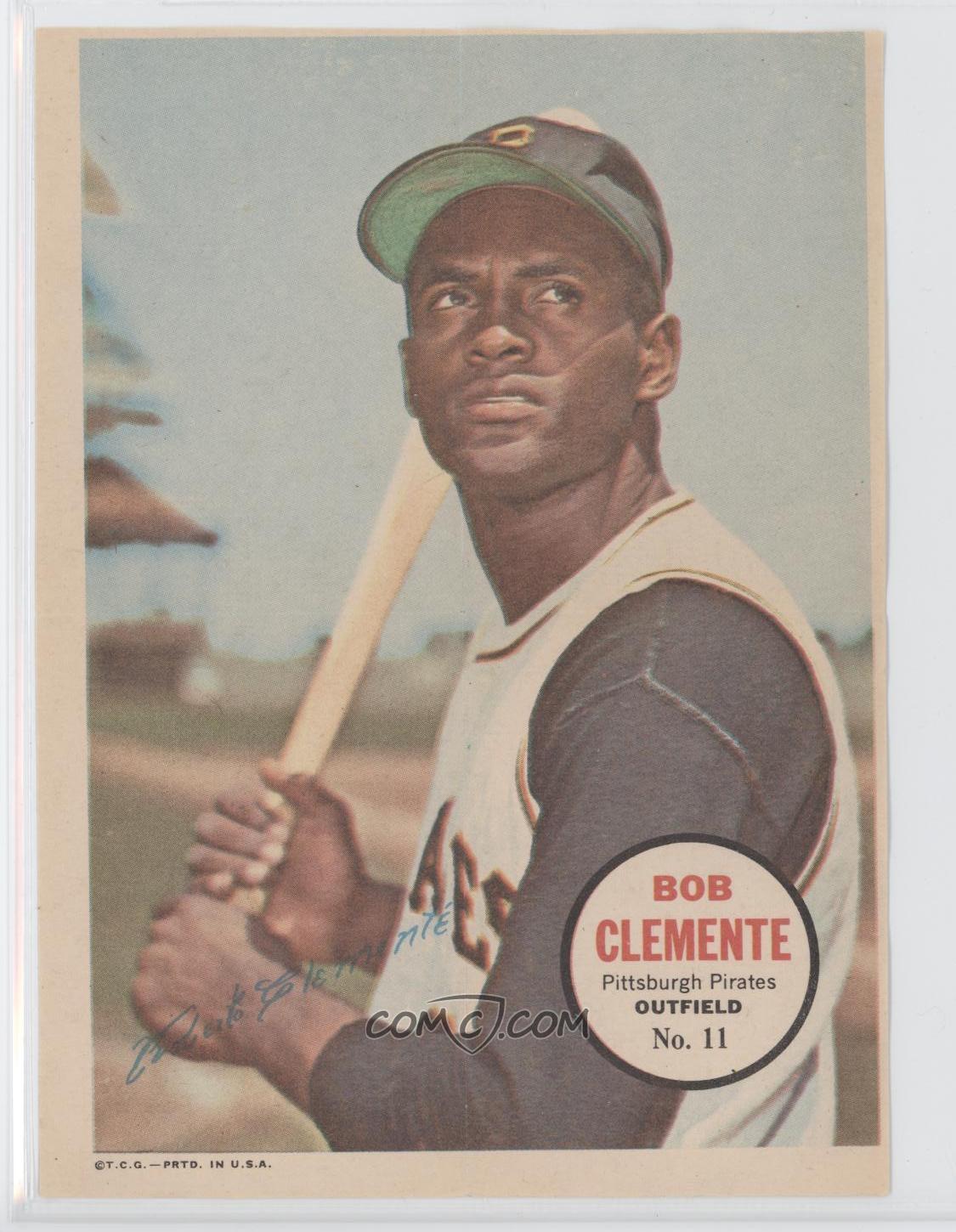
The one downside so far is concrete everywhere, which tires out one's feet quickly. You need a lot of sit-down breaks to contemplate doing this for multiple days. (I'm sitting down to type this, thanks to an unoccupied corner table.) Best purchase so far's this 1967 Topps pin-up of Roberto Clemente for $7, scan borrowed from COMC.
Saturday / Sunday show goal: meet other card bloggers. I talked with a couple at the Freedom Card Board booth, but hope to track down more. Add a comment if you'd like to talk cards and arrange a meetup spot. (I'm also findable on the floor Saturday in my Jake Woods #46 Mariners jersey, which has its own story.)
| Real product: "Mickey Mantle Isometric Minute-a-Day Gym" |
The one downside so far is concrete everywhere, which tires out one's feet quickly. You need a lot of sit-down breaks to contemplate doing this for multiple days. (I'm sitting down to type this, thanks to an unoccupied corner table.) Best purchase so far's this 1967 Topps pin-up of Roberto Clemente for $7, scan borrowed from COMC.
Saturday / Sunday show goal: meet other card bloggers. I talked with a couple at the Freedom Card Board booth, but hope to track down more. Add a comment if you'd like to talk cards and arrange a meetup spot. (I'm also findable on the floor Saturday in my Jake Woods #46 Mariners jersey, which has its own story.)
Thursday, August 4, 2011
1929 W560 Baseball 5 of Clubs, Jim Bottomley
Today's post covers that lurking danger for vintage and star player collectors alike: counterfeits. Those bits of paper and ink that pretend to be more than they really are. Artifacts of a hobby that, too often, turns out to be more of a cheap hustle than someone's true love of the game. This blog's covered a few of them, most recently this 1971 Bazooka Carl Yastrzemski, but another worth talking about recently came across my desk.
August 3 marked the start of 2011's National Sports Card Convention in Chicago and we can assume dozens (if not hundreds) of misidentified reprints litter the show floor, given the market for rare cards and vagaries of collector or dealer knowledge. Just this week, a fellow trader asked me to evaluate this purported W560 strip card of HOFer Jim Bottomley. His question: is it real or fake? If the latter, what should he look for to avoid bad ones in the future?
Covering a little of the set's history will help understand how to distinguish them, so let's cast back to the 1920s, when cheaply printed cards like these W560s made up most of the market. For this set, originals came on 4-by-4 sheets (and possibly 4-card strips), demarcated by solid black lines.
Kids cutting players off 4-by-4 blocks left black border remnants on most authentic cards. My scanned reprint's close to proper size, but there's no black edge to indicate it once had neighbors on a sheet. Sizes did vary in the 1920s, so provides supporting evidence more than certainty; the single-tone paper stock already convinced me it wasn't kosher.
Short story, this 5 of Clubs is faked. Someone took an original, probably a nice one, and then printed out some new scans using modern paper and equipment. Dark areas show splotchy edges, a characteristic of many inkjet printers, and it uses thin, single-layer paper not seen in 1920s strip card sets. (Clumsy attempts to age the card support the idea that someone reprinted an entire set in "low-grade" to avoid close inspection from high-grade buyers.)
Conversations about counterfeits should include grading services and their role in assurance of authenticity. Most provide high reliability, but graders remain human and limited by available research on a set, player, or rare variation. Those who know printing techniques, available paper stocks, baseball business history, and pre-Internet reprints (late 60s to early 90s) should outperform others who just compare cards to other cards.
Lest we forget about W560s themselves, Jim Bottomley's just one of many HOFers in this set. All-timer Rogers Hornsby even helped date the set's release, as it shows him with the Cubs, a team he joined in 1929. (Some catalogs list them from 1927, when he would've been a Giant or Cardinal.) The base design comes in a few colors, including red and black, as shown in this post. A two-tone version also exists, but probably represents an earlier, related issue. See this W560 Network54 forum discussion for more details and scans.
UPDATE: This Luke Sewell 5 of Hearts shows the odd edges and border remnants you'd expect from an original W560 strip card.
Value: Low-grade, lesser-known W560s ball players go for $10-20, depending on level of wear. HOFs can cost several times that.
Fakes / reprints: You've seen at least one of the reprints and I bet there's plenty more. Any set with lots of early HOFers risks the attention of counterfeiters.
August 3 marked the start of 2011's National Sports Card Convention in Chicago and we can assume dozens (if not hundreds) of misidentified reprints litter the show floor, given the market for rare cards and vagaries of collector or dealer knowledge. Just this week, a fellow trader asked me to evaluate this purported W560 strip card of HOFer Jim Bottomley. His question: is it real or fake? If the latter, what should he look for to avoid bad ones in the future?
Covering a little of the set's history will help understand how to distinguish them, so let's cast back to the 1920s, when cheaply printed cards like these W560s made up most of the market. For this set, originals came on 4-by-4 sheets (and possibly 4-card strips), demarcated by solid black lines.
Paper stock first made me suspect my friend's W560 as fake, since a real card's actually two layers, with thin bleached paper affixed to a cardboard backing. Note this authentic scan's difference in tone and texture, where his was a matching off-white on both sides.
![]() |
| Authentic W560, front and back |
Kids cutting players off 4-by-4 blocks left black border remnants on most authentic cards. My scanned reprint's close to proper size, but there's no black edge to indicate it once had neighbors on a sheet. Sizes did vary in the 1920s, so provides supporting evidence more than certainty; the single-tone paper stock already convinced me it wasn't kosher.
Short story, this 5 of Clubs is faked. Someone took an original, probably a nice one, and then printed out some new scans using modern paper and equipment. Dark areas show splotchy edges, a characteristic of many inkjet printers, and it uses thin, single-layer paper not seen in 1920s strip card sets. (Clumsy attempts to age the card support the idea that someone reprinted an entire set in "low-grade" to avoid close inspection from high-grade buyers.)
Conversations about counterfeits should include grading services and their role in assurance of authenticity. Most provide high reliability, but graders remain human and limited by available research on a set, player, or rare variation. Those who know printing techniques, available paper stocks, baseball business history, and pre-Internet reprints (late 60s to early 90s) should outperform others who just compare cards to other cards.
![]() |
| "Roger (sic) Hornsby, Chicago Cubs" at far left |
Lest we forget about W560s themselves, Jim Bottomley's just one of many HOFers in this set. All-timer Rogers Hornsby even helped date the set's release, as it shows him with the Cubs, a team he joined in 1929. (Some catalogs list them from 1927, when he would've been a Giant or Cardinal.) The base design comes in a few colors, including red and black, as shown in this post. A two-tone version also exists, but probably represents an earlier, related issue. See this W560 Network54 forum discussion for more details and scans.
UPDATE: This Luke Sewell 5 of Hearts shows the odd edges and border remnants you'd expect from an original W560 strip card.
Value: Low-grade, lesser-known W560s ball players go for $10-20, depending on level of wear. HOFs can cost several times that.
Fakes / reprints: You've seen at least one of the reprints and I bet there's plenty more. Any set with lots of early HOFers risks the attention of counterfeiters.
Tuesday, August 2, 2011
What would YOU do to get a #5?
It's football, but there's no way I ignore this Donovan McNabb story over at Can't Have Too Many Cards explaining how he obtained #5 from punter Chris Kluwe.
Ice cream versus the number #5 is a tough, tough question. Ice cream is so good! But #5 is so lucky! It's an impasse.
Fortunately, being from Wisconsin, I can safely root against McNabb without needing a logical reason. (PACKERS!)
Ice cream versus the number #5 is a tough, tough question. Ice cream is so good! But #5 is so lucky! It's an impasse.
Fortunately, being from Wisconsin, I can safely root against McNabb without needing a logical reason. (PACKERS!)
Monday, August 1, 2011
1980 TCMA Hawaii Islanders Baseball #5, Eric Mustad
I recently praised the excellence of large catcher's mitts on cards (1980 TCMA SLC Gulls #5), but am happy to expand my approval to their battery mates, like today's guest, Eric "Colonel" Mustad. That big Rawlings logo on his glove sparks my own memories of little league games, pitching mounds, and the last time I threw a serious overhand pitch toward the plate. (Don't remember exactly when that was, or the game situation, so let's just call it what it must've been: a title-winning strikeout.)
Those 1979 stats from Amarillo include highs in starts, innings, wins, and strikeouts for Eric, who pitched another five years in the minors without breaking into the bigs, ultimately retiring in 1984 at the "prime" age of 28. After a demotion from AAA to AA near season's end, I suspect he decided there was more to life and, like many a generation before, moved on to other things.
Value: This #5 cost $2 at MinorLeagueSingles.com, similar to other non-star TCMA singles.
Fakes / reprints: Haven't seen any in the marketplace.
Speaking of "mustard," check out how their uniform's warm color palette matches the stadium seating. If you didn't know they were from a sun-drenched locale before, there's no question now. This isn't quite the Andy Dyes beach towel look, but you can see it from there.
Those 1979 stats from Amarillo include highs in starts, innings, wins, and strikeouts for Eric, who pitched another five years in the minors without breaking into the bigs, ultimately retiring in 1984 at the "prime" age of 28. After a demotion from AAA to AA near season's end, I suspect he decided there was more to life and, like many a generation before, moved on to other things.
Value: This #5 cost $2 at MinorLeagueSingles.com, similar to other non-star TCMA singles.
Fakes / reprints: Haven't seen any in the marketplace.
Subscribe to:
Posts (Atom)