Showing posts with label california angels. Show all posts

Friday, May 24, 2024

1969 Topps Team Posters and A Padre To Be Named Later

Introduction

In mid-May 2024, Sports Collectors Daily published Roy Carlson's deep dives into 1969 Team Posters, one of my favorite vintage sets for sheer size and displayability. I profiled its #5, the Baltimore Orioles, back in 2012.

12"x20" at full, unfolded size

Each of Roy's articles shares original design mockups and quantifies how Topps coped with an absence of fresh photos for that year's cards.

Close inspection of Roy's work highlights how Topps made the best of an expansion era defined by rapid player movement. 1969 posters impress both in size and breadth of lineup, even for new squads in Montreal, KC, Seattle, and San Diego.

1969 Topps issues: Which came first? The chicken, egg, or team posters?

Topps added every animal to their barnyard in 1969, if you include standard and test issues.


I bet fan interest during an expansion year inspired this burst of marketing enthusiasm, in spite of the players union refusing to pose for new photos in 1968, pending better compensation from Topps. Their boycott led, in part, to infamous goofs like batboy Leo Garcia (left) standing in for Aurelio Rodriguez (right). Check out #653's profile from Collecting 1969 Topps to learn everything worth knowing about this card.

Keith Olbermann shared similar insights into 1969 images for SCD in 2010. If Topps bought their rookie Reggie Jackson and "Aurelio Rodriguez" photos from legendary photographer George Brace, #653's mistaken identity could stem from his own goof.

San Diego's expansion year poster shows further impact from players refusing to pose for Topps cameras: 10 hatless headshots and one airbrushed bill for Ron Davis. The Padres even traded Ron to Pittsburgh on March 28, so a proper hat logo would've been out of date by opening day.

The circled Padre, Bill Davis, achieved a measure of hobby fame by appearing on five straight multiplayer "rookie stars" cards, 1965-69, an unbreakable record given how Topps handles RCs today. Bill remained on the verge of breaking out for years, thanks to minor league power and fan popularity. Read Hope Springs Eternal for a look at every Davis base card.  (Don't confuse 1966 cardmate Tom Kelley with Minnesota's manager of similar name.)


San Diego acquired Bill in October 1968 for the classic "player to be named later" (PTBNL). This 1969 cardmate, Clarence "Cito" Gaston, is the future manager who led Toronto to back-to-back titles in 1992-93.

That Padres poster marked Davis's final Topps appearance, once again sharing the spotlight with (many) others. San Diego waited six weeks before sending former AL MVP Zoilo Versalles to Cleveland as their PTBNL, creating some interesting 1969 checklist anachronisms.


Note Zoilo's 1969 stamp says "San Diego shortstop" and his autograph graces their album, if upside-down. That tells us Topps designed and produced this set before they could react to late 1968 trades.

His first series card (#38) splits the difference, with Padres on the front and trade to Cleveland on the back! This shows Topps locked series one card fronts by December 1968, when San Diego sent him to Cleveland, and back text sometime later. (It should also say "N.L." under league, since Zoilo played for the Dodgers.)

Zoilo's hatless image from his "S.D. Padres" stamp appears on Cleveland's poster, so these came together sometime after that December swap. In echoes of Ron Davis, Cleveland shipped ðŸ˜® Lou Johnson to California on 4-April, so his poster and card team became out-of-date by opening day.


Card #367 fails to mention Johnson's trade, so Topps locked their poster layouts and third series of cards sometime between December & April. Zoilo and Lou each appear in multiple 1969 sets as players on teams they never quite played for.

INSIDE BASEBALL: Some collectors call these almost-played-for-you-but-didnt cards "Flood Warnings," in honor of Curt Flood's refusal to report to the Phillies after being traded in 1969, defying baseball's reserve clause and providing key inspiration for the establishment of free agency by 1975.

"Not just no, hell no."

Why did Topps invest in such gaudy team posters?

I think 1969's lack of fresh photos exacerbated a general laziness Topps showed toward their 1960s team cards. This 1961 White Sox card offers one mediocre option. So many shadows! Such red background!


Did someone realize there had to be a better way? Perhaps Topps hoped a larger, headshot format could satisfy fans, at least in regional markets, even as they dropped team cards from 1969's otherwise huge base set of 664 cards.

No logo-less caps here!

Also consider how 1969 marked the end of Mantle's career, a mainstay for Topps since 1952. He appears on the Yankees poster, its stamps and albums, rub-on decals, Super baseball, 4-in-1 stickers, and base card #500, all of them released after his April retirement announcement.


I wrote before about how superstars like Stan Musial & Ted Williams inspired Topps to make major set changes, like launching All-Star cards in 1958. If Mantle's gotta go out, these serve as terrific salutes!


Contemporary legend Hank Aaron missed out on that capstone, apart from being a post-retirement figure on 1977's Brewers team card. Just one more way Mantle stands out in Topps history.

In summary

I think 1969 team posters served at least three purposes for Topps.
  • Test alternative looks for team photos in lieu of cards in their base set
  • Help fans in expansion cities get familiar with new rosters
  • Give more Mick to Yankee fans during an otherwise moribund era for their franchise

Peccadilloes of offseason transactions like Bill-for-Zoilo show how Topps did their best to match current lineups to a production schedule that took several months to prepare 1969 releases. All these extra sets helped dust off dozens (hundreds?) of hatless photos from company archives, distinguishing that year from any other in hobby history. Thanks again to Roy's work for inspiring further research. If any other details stand out to you, let me know in the comments.

Saturday, August 19, 2023

Utah baseball stops in August 2023

I spent a chunk of August visiting family in and around Salt Lake City, a town with more than a century of minor league history. We made multiple baseball stops in the area and caught Tuesday's night game at Smith's Ballpark, home to the AAA Bees.

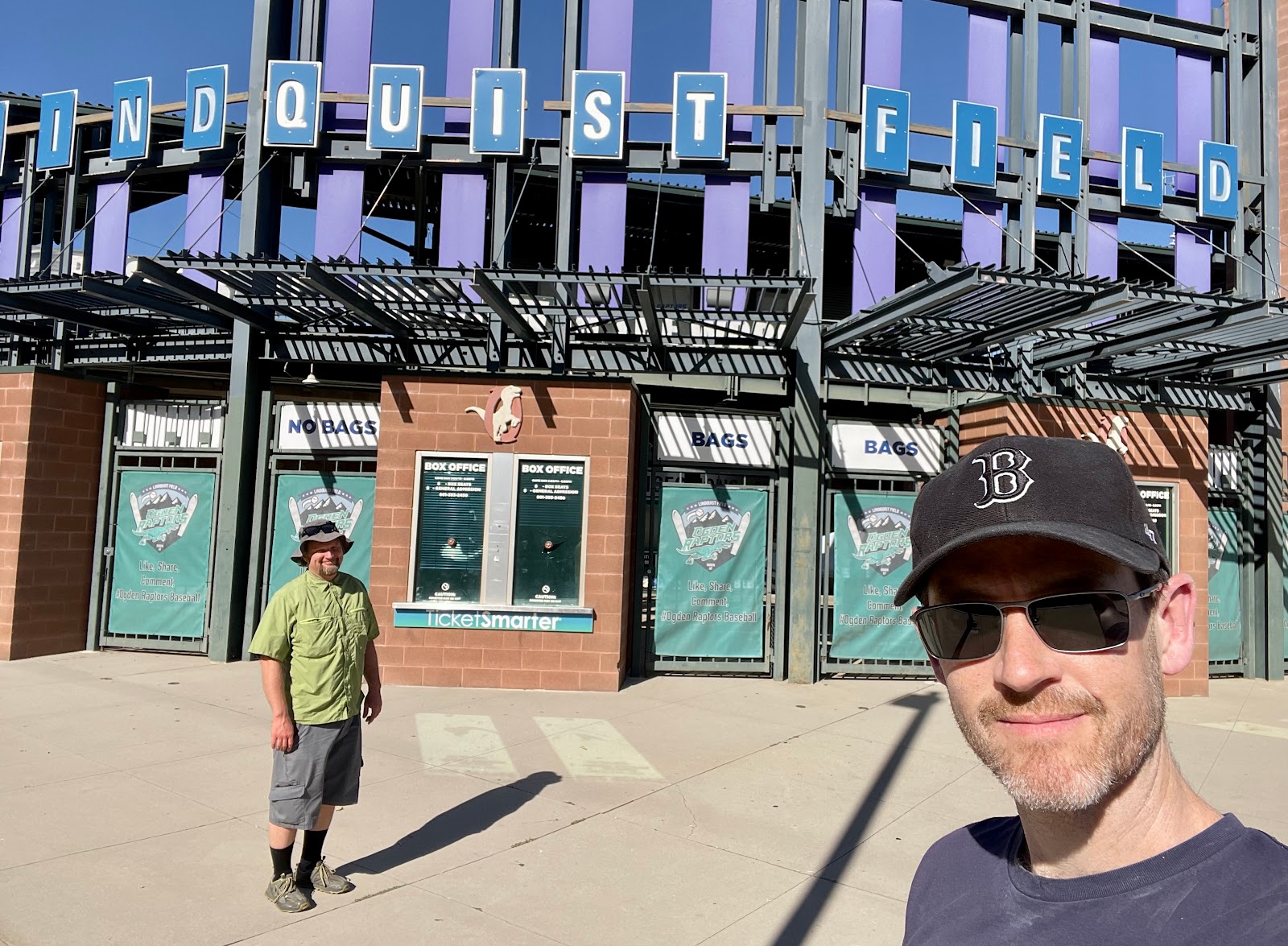
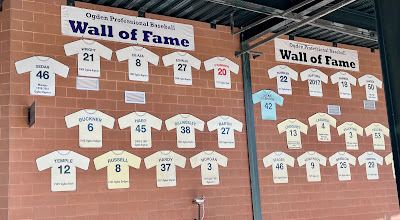
Stop one: Lindquist Field in Ogden

This current Ogden Raptors facility does its best to compress 100+ years into something approachable at the street level. My brother and I visited during a road series, so took photos along their park's main thoroughfare.

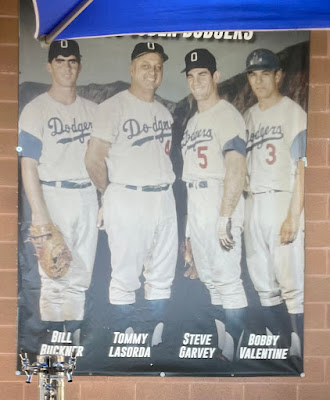
These three Dodgers cut their teeth in Ogden, winning multiple titles under Tommy Lasorda prior to his time as their MLB manager. The Salt Lake Tribune revisited those days in 2018.

As a Steve Garvey and #5 collector, it'd be amazing to find an Ogden jersey today. I'll accept this photo for now.

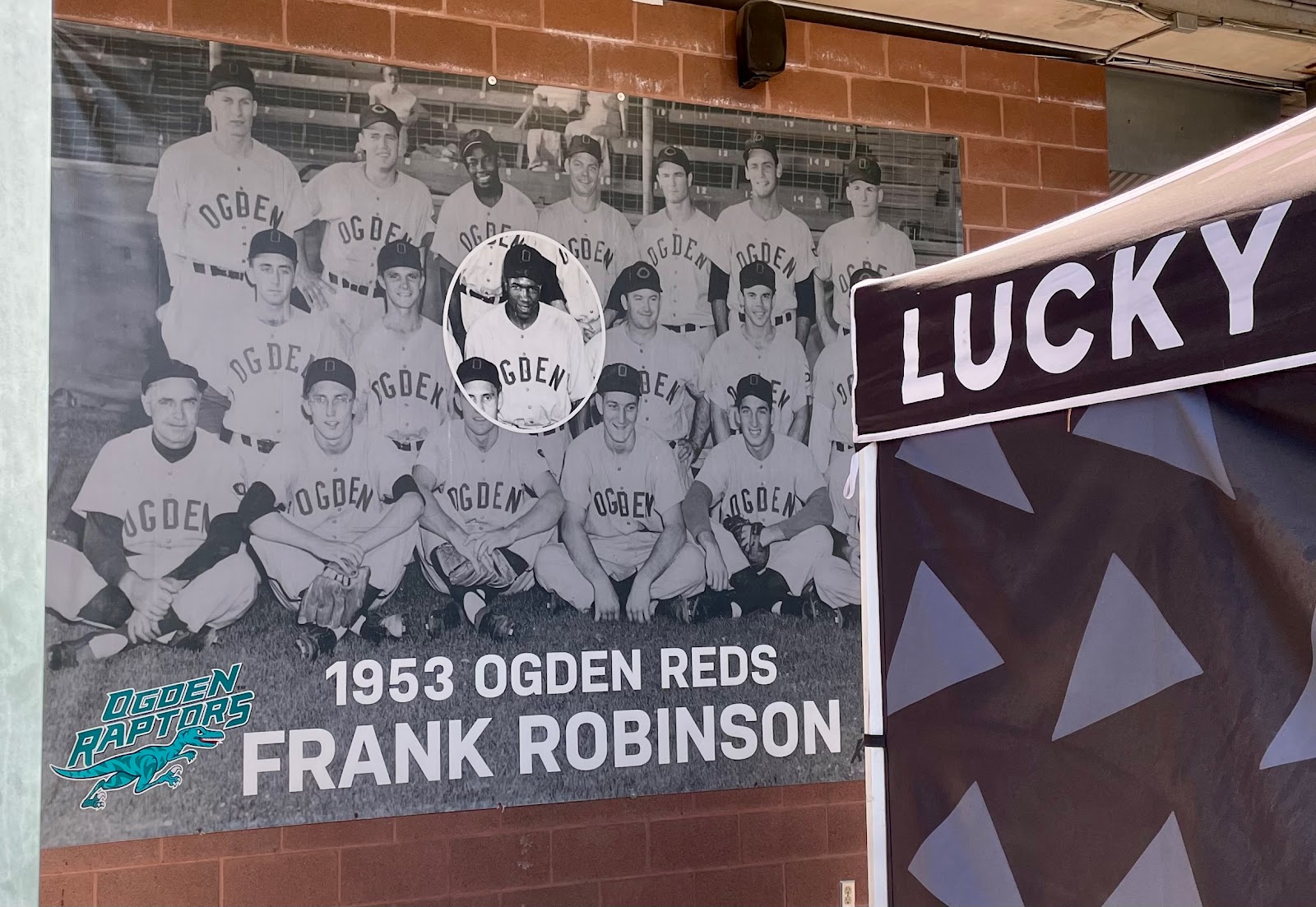
Frank (Frankie) Robinson also starred for Ogden way back in 1953 and "hit the horsehide" in a literal way.


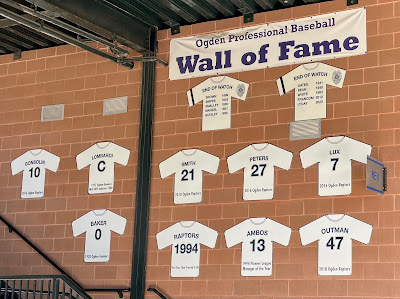
Lindquist's Wall of Fame spans HOF catcher Ernie Lombardi ("C" in 1927) to the Raptors debut (1994)...


...with several Dodgers, Reds, and Athletics in-between. While we missed the Raptors this time around, I look forward to catching games there in future years!

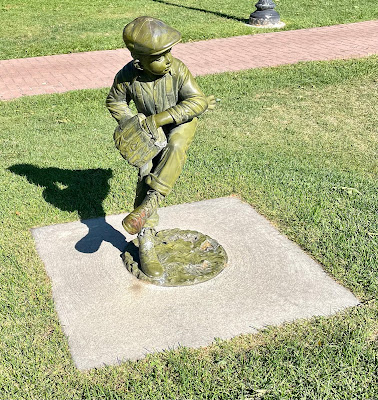
Stop two: Baseball Kid statue(s) in Ogden Park

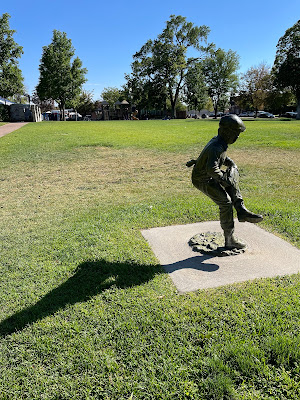
This park contained two statues at one point, one pitching and one batting, just outside the city amphitheater a few blocks south of Lindquist Field.


The batter's missing at the moment, perhaps undergoing repair, so I paid respects to this pitcher and his newsboy duds. I expect Ogden's batter to return at some point to that flattened patch of grass in the distance.


One statue or two statues, I'll nominate them for inclusion as a SABR baseball landmark.

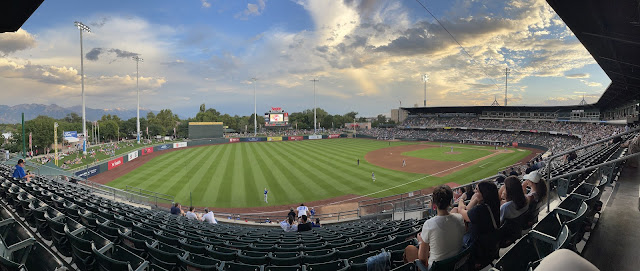
Stop three: Smith's Ballpark for a Salt Lake City Bees game

This pleasant SLC ballpark features a family-friendly circumference with grassy berms behind its outfield wall and Wall of Fame banners overlooking its warning track. As a Boston resident, three former Red Sox stood out to me.


We sat along the third base lane and avoided direct sunshine for its first few innings by hiding under this second-deck overhang. Attendance filled about half the park on a "discount Tuesday," where fans got four tickets for $20 plus $2.50 hot dogs & sodas.


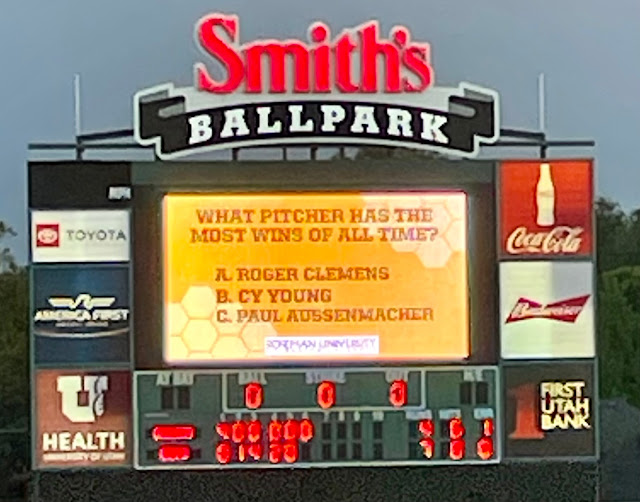
Smith's sixth inning trivia question gave Clemens (354 wins), Cy Young (511 wins), and Paul "Aussenmacher" (Assenmacher, 61 wins) as options.


Their fan contestant picked the right answer and won tickets to a future game. I wonder how Assenmacher ended up on that list.

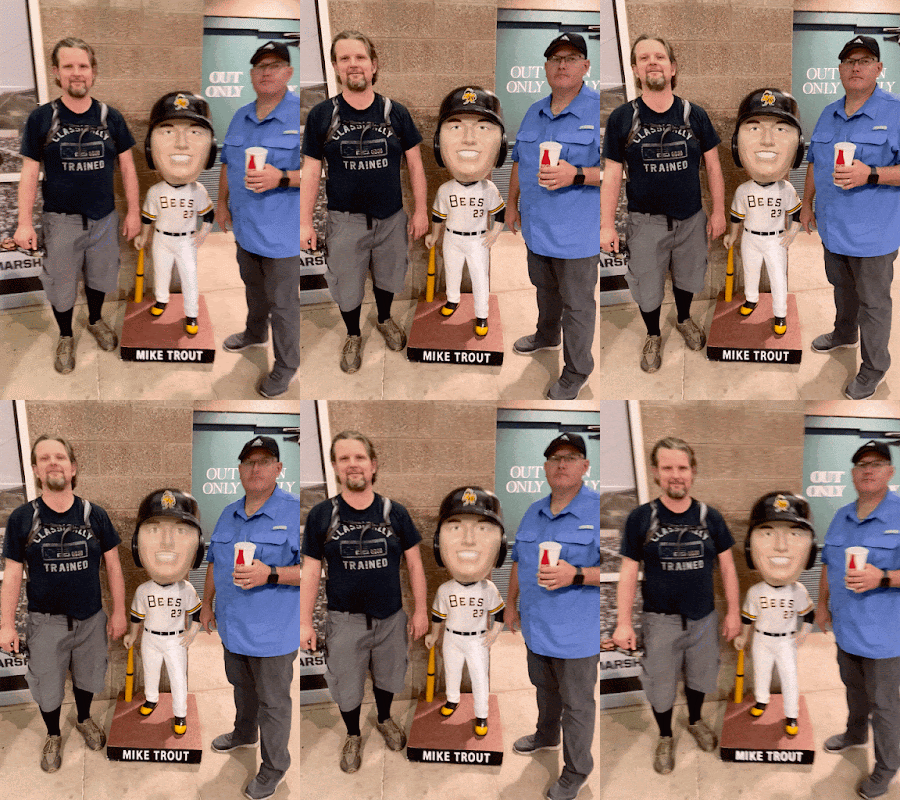
Did you know Mike Trout spent time as a Bee?


Oh, cool, just checking.

Tuesday, May 12, 2015

1976 Caruso Sacramento Solons Baseball #5, Bob Jones

Bob Jones the ball player or Bob Jones, your dad's bowling friend? Bob Jones could be anyone at first glance, so it's worth reading more about Bob's backstory on 1986 Topps #142 post. He was drafted by Washington twice, first by the Senators in 1967 and then by the military brass for Vietnam service in 1969. The combat left him deaf in one ear, but not dissuaded from his baseball career. Even a surfeit of sea foam green in Caruso's PCL team set couldn't hold him back.


This bicentennial-themed Sacramento Solons #5 came after Bob's 1974 MLB debut, but before his 1977 Topps #16 rookie card. Bob swung a good stick in just 26 games for Sacramento in 1976, slugging 10 homers and notching a 1.193 OPS, so they must've missed him when California called him up for half a season in halos.

Good penmanship & sweet shades

Bob flashed occasional power but low average in several seasons as a reserve outfielder, so didn't enjoy everyday duty until he switched to coaching. He's served that capacity in the Texas organization since 1988, with more than 1500 wins under his managerial belt and several tours as MLB base or position coach.


As of May 2015, Bob's the assistant hitting instructor for Texas wearing, yup, uniform #5. Above is a cameo with erstwhile Ranger owner (and President) Bush behind a lucky fan. ("Hey George, IS THAT REALLY BOB JONES?")

Value: 1970s Caruso singles cost a few dollars or $15-25 for the team set, assuming no future stars lurk within its checklist. Perfect game hurler Len Barker is the biggest name I recognize from this Solon set's checklist, so it won't break your bank. Guys with big-league experience in bold.
  1. Dave Criscione
  2. Keith Smith
  3. Dave Moharter
  4. Craig Skok
  5. Bob Jones
  6. Mike Bacsik Sr.
  7. Tommy Cruz
  8. Tommy Boggs
  9. Doug Ault
  10. Greg Pryor
  11. Charlie Bordes
  12. Art DeFilippis
  13. John Sutton
  14. Ed Nottle
  15. Jim Gideon
  16. Don Thomas
  17. Bump Wills
  18. Lew Beasley
  19. Jerry Bostic
  20. Len Barker
  21. David Clyde
  22. Rick Donnelly (Manager)
  23. Greg Mahlberg

Fakes / reprints: Haven't seen any Caruso fakes or reprints in the marketplace, though it'd be easy enough to do.

Friday, July 4, 2014

1976 TCMA Shreveport Captains Baseball #5, Luke Wrenn

I have complicated emotions surrounding Luke Wrenn, former OF farmhand and longtime scout for the Boston Red Sox.


On the upside, Wrenn sent several talented players to MLB success, including Tino Martinez, Mike Hampton, and more. His scouting work "stars" in the article, Can we tell a good scout from a bad one? (via SonOfSamHorn.net).

2003 Donruss World Series Champs #5, David Eckstein

If you like those celebrations of scouting, Rob Neyer also included Luke's evaluation of David Eckstein in Eight scouting reports that really nailed it.


One of the names on Wrenn's Boston scout resume: Nomar Garciaparra. Most fans know No-mah's long, successful career for the Red Sox, Cubs, and Dodgers. Along the way, he met and married Mia Hamm, pictured with their twin daughters.


So why the emotional conflict? I was this 8 year-old soccer forward in 1980, about the same time 8 year-old Mia took up the game in Italy, where her military father and their family was stationed.

I continued to play through my teens, as did she. Mia proved so good, she made the USA women's national team at age 15 and helped them win the World Cup at age 19, the first of her several trips to the Cup.

1991 World Cup Champions! USA! USA! USA!

I remained active in soccer and continued to moon after Mia for........ever.  Still play. Still moon. Still wish Mia and I had to run into each other at a shopping mall or fundraising event. Still wish Nomar had picked another line of work.


And I know I'm not the only member of the mooning-after-Mia generation. My younger brother asked why I was writing about Nomar and I said it was because this scout had found him for Boston, later enabling him to star on the national stage and get married to Mia Hamm.

His response: "Oh yeah, heck with that guy."

So heck with you, Luke Wrenn. Heck with you all to heck.

Value: Mia is a national treasure.

Fakes / reprints: There can be only one.

Friday, February 28, 2014

Poll: Which Game Set Would You Play?

I'm revamping my software coding skills and itching for a project. I've long thought about converting vintage game-themed baseball sets into playable online versions, so fans and collectors could spin through games on the web instead of doing responsible things with their time. But the $64,000 question is...which set first? Check the list below and cast a vote to push me in the right direction!

1. 1951 Topps Blue and Red Backs 

1951 Topps Red Back #5, Johnny Pesky

Topps began mass-producing baseball cards with this pair of game sets. They're not hard to find today, but few collectors risk the condition of either batch of 52 players by riffling, dealing, and flipping them competitively.

DIFFICULTY: Easy to find scans of all 52 cards and uncomplicated results ("OUT") make this one straightforward.

2. 1968 Topps Game

1968 Topps Game #5, Harmon Killbrew

17 years later, Topps made a second trip to the well with this "floating head" design that now reminds me of Allen & Ginter.

2007 Allen & Ginter #94, Charlie Manuel

DIFFICULTY: Easy to find scans of 1968's 33 players, but extra game situations like "Double (all runners score)" make this a bit more work than the 1951 version.

3. 1978 Topps "Regular"

1978 Topps #400, Nolan Ryan

This 792-card set moved its game to the back, a nice bonus that didn't interfere with face space on the front.

DIFFICULTY: It would take a bunch of time to collect the scans, but game logic is straightforward and similar that seen in 1951.

4. 1935 Goudey Knot Hole League Game & 1936 Big League Gum

1935 Knot Hole League Game #5 (score card)
1935 Knot Hole League #5 (back)

I dug into the history of Goudey's Knot Hole League and related promotions in late 2013. The text-only set's not much to look at, but remains interesting as an artifact of its era. Should be fun to combine with players and situations from 1936's Big League Gum.

1936 Big League Back, Oral Hildebrand (game back)

DIFFICULTY: Knot Hole League is obscure and finding all 24 scans online is tough, given low collector demand. It's not hard to put together a Big League Gum set, so starting with that and adding some of the score cards might be easier than Knot Hole League alone.

5. 1933-34 Goudey Sport Kings Varsity Football

1933-34 Sport Kings Varsity Football #5

A close cousin that predates Goudey's Knot Hole League (and also mentioned in its profile), this text-only football set's so rare that I hadn't seen a real card until 2013. This one's especially interesting for its glimpse into 1930s football plays, positions, and rules.

DIFFICULTY: I've found scans for half of the 24 cards so far. Goudey printed paper "fields" that connect with card play, but it's possible none survive in the modern marketplace, so I'd need to create my own or go without.

So what would you like to play most? I'll keep the poll running for awhile and update on decision/progress.