Showing posts with label atl-bos-mil braves. Show all posts

Thursday, April 10, 2025

April 2025 progress update: #5 type collection now at 90%+

This blog's type collection targets sets with at least one card numbered five from baseball's majors, minors, and foreign issues of the pre-1981 vintage era. Over 600 different sets fall into that camp! While Topps printed more than any other single company, many smaller makers also stand out. Johnston's Cookies printed one of the biggest in my collection, Hank Aaron's 1954 card from the season he wore uniform #5.

UER: 9 HRs & 61 RBIs for Eau Claire in 1952

It proved easiest to track overall type collection progress by decade, which also shows how total sets remained modest though the 1940s and then rose fast after WWII, echoing the growing buying power of children and baseball's own league expansion. Thanks to my 20+ year search, I own 90% of all qualifying vintage #5s.

Decade: # owned of # possible

  • Pre-1920: 19 of 31
  • 1920s: 28 of 39
  • 1930s: 32 of 36
  • 1940s: 28 of 32
  • 1950s: 53 of 59
  • 1960s: 105 of 118
  • 1970s: 198 of 213
  • Minor league: 148 of 152
  • Total: 611 of 680 (90%)

This blog profiled hundreds of different sets so far, as linked from the type wantlist. It goes well over a book in total length and my work since 2019 includes more in-depth research into notable players, card businesses, and other holes in our hobby that I wanted to fill in. Find more of my card stuff on Bluesky @number5typecard and thanks for reading along, however long you've been doing so!

Monday, July 17, 2023

1935 Goudey Big League Gum baseball: over the border line (for the SABR Baseball Cards blog)

Intro for my latest at the SABR Baseball Cards blog

I enjoy picking apart hard-to-explain details of vintage cards to see where that journey leads. This post puts three aspects of Goudey's 1935 Big League Gum baseball set, which most shorten to "1935 Goudey," under the microscope. It plays with definitions of "border" and considers how gum companies took advantage of legal gray areas to sell more gum to baseball fans. If you like learning about Prohibition's impact on greater society, this will be grist for your mill. You might even agree that "1935 Goudey" tells just half of its story.

Read the rest there!

Saturday, January 6, 2018

1946-49 W603 Sports Exchange Baseball series #5, Charlie Grimm and Billy Southworth

Back at the end of WWII, the closure of wartime industry meant the return of resources key to the making of baseball cards: paper for cards and plastic for gum. While the better-known Bowman and Topps didn't issue baseball sets until 1948, an interesting publisher tried their hand at war's end, on the strength of returning servicemen and America's boom for baseball: The Sports Exchange of Youngstown, Ohio.


This little-seen hobbyist newsletter, The Trading Post, featured articles similar to what you still see in modern publications, with allowance that almost all research and writing came from enthusiasts, not baseball professionals or sports critics. Here's a testimonial of sorts from the above issue, written by a cousin of HOF slugger Ralph Kiner.


Issues of The Trading Post are a collectible in their own right today and I plucked those scans from this 2014 auction. When hobbyists talks about "Sports Exchange" cards, however, they mean the photo packs sold to subscribers from 1946-49 and catalogued W603.


These Sports Exchange packs cost 50 cents and arrived in manilla envelopes. Their notepad-like, looseleaf pages used photos from International News, a major supplier of photos of all kinds. (The Sports Collectors Daily wrote this guide to identifying their work and that of other news agencies.) Many seen today include handwritten notes in the blank Facts and Figures footer.

Scan from Dave's Vintage Cards, as the watermark says

"Set Number 5" contains eight MLB managers of the time, each numbered as such on the lower-left corner.

  • Eddie Dyer
  • Charlie Grimm
  • Billy Herman
  • Ted Lyons
  • Lefty O'Doul
  • Steve O'Neill
  • Herb Pennock
  • Luke Sewell
  • Billy Southworth


The Veterans Committee inducted Billy Southworth in 2008, raising his profile among Hall of Fame collectors. I stand ready to accept your high-dollar offers for this hard-to-find collectible! :-)

Bought this on eBay for $10

The Sports Exchange printed 13 different photo packs between 1946 and 1949, with varying players and teams. Old Cardboard hosts a nice checklist of them all.

Some issues of The Trading Post came with a flyer hawking 36-player sheets of smaller, card-sized photos inside colored borders that buyers could cut out by hand. Due to these sets' relative size, they're catalogued as W602 Sport Exchange Miniatures (2.5" x 3").

Available for $10K OBO!

While both Sports Exchange set checklists include many great players, these pre-Bowman, pre-RC Stan Musial and Warren Spahn shots stand out as collector keys.


Spahn's wearing an early 1940s Braves uniform from his stint in Boston before spending 1943-45 in the service. By his 1946 return, they switched to block-letter BOSTON jerseys.

TRIVIA: The Old Cardboard mislabeled cards checklist notes that W602's photo of Ted Williams is, in fact, Bobby Doerr.

Value: Billy Southworth cost me $10 on eBay, as would many lesser-known players in VG-EX condition. Thanks to this set's scarcity, expect the bigger names in decent condition to cost bigger dollars.

Fakes / reprints: Haven't seen any in the marketplace. Cards use thin paper stock and low-quality photo reproduction, so be wary of counterfeit stars offered for cheap prices. They'd be easy to fake if you set your mind to it.

Saturday, December 2, 2017

Top Five Bowman Vintage Sets

Back before my dad's time, one Philadelphia company served as America's premiere gum card maker, creating a multitude of sets spanning the WWII era. Sport sets included baseball, football, and basketball. Non-sports included pop culture, war machines, and law enforcement. Kids liked all kinds of things, so they made all kinds of cards.

Founded as Gum, Inc. and later renamed Bowman Gum after founder Jacob Warren Bowman, the brand name ("Bowman, Home of the Rookie Card") lives today under the Topps umbrella. This post covers five vintage Bowman sets that proved key to card history and design. Baseball and sports cards didn't dominate the vintage gum card market like they do today, so I try to show how non-sport and sport blazed trails for each other.

#1: 1938 Horrors of War (as Gum, Inc.)

In the mid-1930s, fascist-led conflicts (Spain's Civil War, Italo-Ethiopian War, Sino-Japanese War) brought death and destruction onto headlines and into wax packs. Gum, Inc. led that effort by selling kids over 100 million colorful and shocking war cards on a size and card stock similar to Goudey's well-known baseball sets. Every card shows something happening, like this pilot thrown from the fuselage of his exploding plane.

1938 Horrors of War #5, China & Japan at war

Horrors of War's first series (#1-240) proved popular enough to spawn a second series highlighting the threat of Nazi Germany (#241-288). All cards professed, "To know the HORRORS OF WAR is to want PEACE."


"War Gum," as kids called it, sold so well that it remains available and popular today. Goudey Gum, their top 1930s competitor, responded with two middling sets of military themes. Based on what's available in the market today, neither matched the popularity of Horrors of War.

#2: 1939-41 Play Ball Gum (as Gum, Inc.)

Buoyed by the success of Horrors of War, Gum, Inc. soon pushed into the baseball market. I've profiled the Play Ball sets before and my Collecting Joe DiMaggio in Yankee Pinstripes post shows all three. They're clean and popular, best known for early cards of Ted Williams and the Clipper. My favorite card's another DiMaggio, "Patchwork Vince."

1941 (or 1942?) Play Ball Gum #61, Vince DiMaggio

1941 Play Ball's checklist numbers 72 cards, but modern researchers believe Gum, Inc. added 49-72 as a new series for 1942, reflecting the fan fever Ted Williams and Joe DiMaggio generated in 1941. That makes Vince part of its second series and reflects the practice (also used by Goudey & National Chicle) of selling and adding to the same set design across multiple years, rather than a single baseball season. See this article by Rich Mueller for more.

Mid-1940s: WWII and a change of name

Bowman's founder endured multiple lawsuits thanks to Gum, Inc's success and its drive to cut production costs. I suspect that for both legal reasons and wartime production needs, it made sense to rebrand as Bowman Gum, distinguishing them from other gum makers. When they reentered the market in 1948, Bowman's name appeared on all card backs: baseball, football, basketball, and non-sports.

From "1948 Bowman Baseball Packs Sell for $521,180"

The company's return to baseball in 1948 showed the same black-and-white look as 1939, dropping their hand-colored 1941 style. As the recent find of unopened packs show above, Bowman continued to use the "Play Ball" name in 1948. They changed to "Base Ball Bubble Gum" for 1949 and beyond.

#3: 1949 Wild West / 1950 Wild Man / 1951 Red Menace

I'm combining these sets into one sequence, given their evolutionary design impact. Like many vintage collectors, I discovered Bowman baseball through the artistic excellence of their 1950-52 sets. Unlike 1952 Topps and Sy Berger's kitchen table, Bowman's design didn't emerge whole cloth from a single source.

1950 Bowman baseball #19, Warren Spahn

Bowman's non-sport gum packs sold best during baseball's offseason and they developed this artistic look starting with 1949 Wild West, itself inspired by the post-WWII popularity of 19th century Western nostalgia.

1949 Bowman Wild West #C-5, Calamity Jane

Wild West used the same 2¹⁄₁₆ by 2½ size as their 1948 and 1949 baseball cards, with hand-painted art that mimicked existing Western art and photos.

Next up, the history and retrospective 1950 set "Wild Man." In the same way Bowman's 1948 baseball set harkened back to their 1939 design, Wild Man looked back to 1938 Horrors of War. Card fronts show humanity's history of murder, danger, and conflict. Card backs once again emphasize the need for peace.

1950 Wild Man #29, Concentration Camps

Third, there's 1951 Red Menace. Thanks to America's entry into the Korean War, the era didn't feel peaceful. Fear of the Communist "Red Menace" inspired Bowman to sell a set by the same name. Slightly larger (2½ × 3⅛) than their 1949-50 sets, this would be their last squarish design before making cards longer and rectangular.

1951 Bowman Red Menace, #2 General MacArthur

It's worth noting Topps competed with Bowman in war before they competed in sports. Red Menace came about in part because Topps struck a candy store hit with Freedom's War in 1950, a 203-card set of military hardware and figures active in WWII and Korea.

Topps used high quality art on Freedom's War and tested innovations like die-cuts to create tanks that could stand up. While this didn't push baseball design forward yet, it did push Bowman design forward.

#4: 1951 Jets, Rockets, and Spacemen

More great art appeared on new, bigger (2¹⁄₁₆ × 3⅛) Bowman cards in Jets, Rockets, Spacemen. You won't find any static, stoic poses in this set. #5's alive with the thundering moment of launch.


Jets, Rockets, and Spacemen told a story about Capt. Argo and his crew that covered nearly the entire 108-card set. Read them all via scans in the JRS section of Lowell's Place.


Their elongated look carried over to 1951 baseball -- or maybe the sets coexisted as nerds and jocks of the candy counter.


Even when Bowman's 1951 baseball cards reused 1950 pictures like Warren Spahn above, the different dimensions brought you closer to the player.

#5: 1952 Baseball

Bowman used hand-painted art again in 1952, swapping in autographs instead of block letter names. By this point, all those artistic innovations from 1948-1951 result in a beautiful finished product. You've got a card that fits in a kid's palm, looks great, and only suffers in comparison to Topps' larger breakout set. (There's no question Topps made a groundbreaking set in 1952; I like looking at the Bowman set more.)


My dad became a baseball fan in the 1950s because of this guy, Duke Snider, shown with his original photo, and I've been lucky enough to inherit some of his own Snider cards. Bowman's artist added clouds and tweaked the fence to accentuate Duke's placement in the top 2/3 of the card.


Topps' huge success with their 1952 set ended Bowman's baseball self-determination. They shifted to competing with Topps for player contacts and overextended financially trying to print bigger cards with better photos. Just four years later, they called it quits and sold all player contracts, designs, and trademark assets to Topps.

I'd like to see the alternative timeline where Bowman's artistic sets survived in the market alongside photo cards. Today, that might happen, given the age range and varied tastes of collectors. The nickels and pennies 1950s kids spent on chewing gum just couldn't support both.

Tuesday, June 13, 2017

Goudey's many "Babe" Hermans and George Herman "Babes"

If you wrote a book about Goudey Gum's 1930s trading card sets, at least one chapter would talk about the many, many times they squeezed multiple cards from a single photo. Here's a quick look at the guy who got that treatment more than any other, George Herman (Babe) Ruth.


Goudey reworked this on-deck photo four times in 1933 alone, from the above R309-1 Premiums stand-up to three different cards in the main set.

1933 Goudey #53 (yellow)

1933 Goudey #144 (full-length)

1933 Goudey #149 (red)

Ruth changed to a dugout pose later in 1933, perhaps after collectors complained they'd seen the same Babe three times.

1933 Goudey #181 (green)

That's five Babes from two photos in 1933 alone, but Goudey wasn't done. They got another card out of this pose for their 1935 4-in-1s. As with all players in that set, they're re-cropped from earlier Goudey cards. Babe's only meaningful change is "Braves."

1935 Goudey 4-in-1, Braves (Ruth)

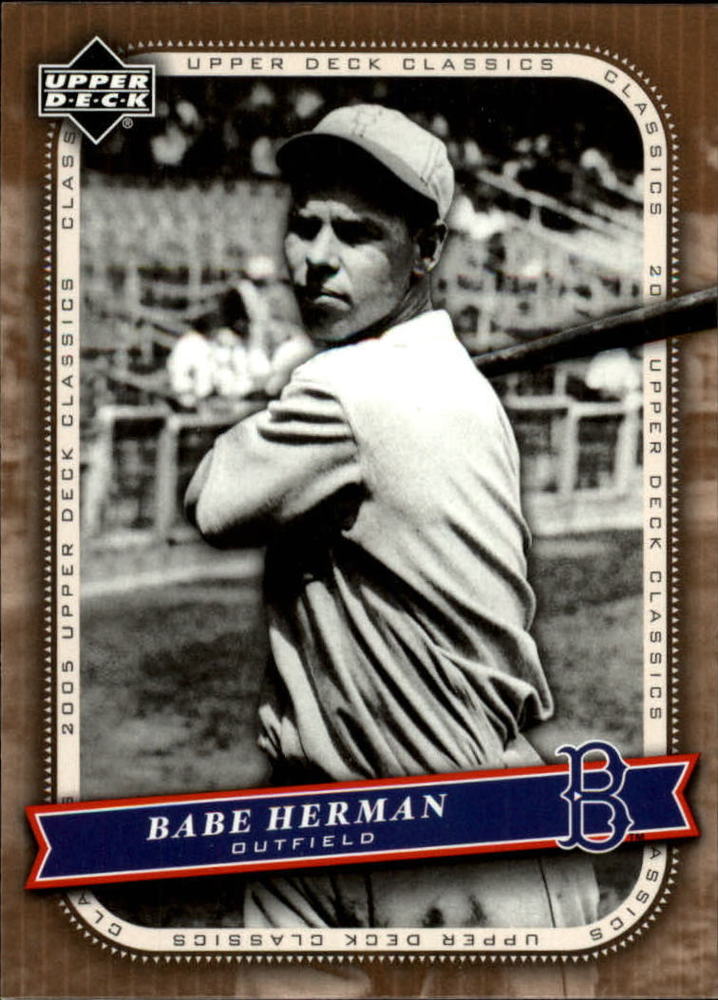
Close to my heart is the "other" Babe Herman, #5 in Goudey's 1933 set. It's not clear if this Babe, who was also a phenomenal hitter in the 20s and 30s, picked up the nickname from his Ruthian exploits.

1933 Goudey #5

Why stop there? Herman got the same cropped treatment for 1935 4-in-1.

1935 Goudey 4-in-1, Pirates (Herman)

I'm surprised they didn't blot out Herman's C(hicago) cap, given the move to Pittsburgh, but it was The Great Depression and selling gum packs meant more than minor details like "current team."


Babe's earlier days in Brooklyn included his infamous "double into a double play," explained well by the Parker Pioneer in "Three Men on Third Base."

Friday, October 16, 2015

1968 Topps Venezuelan Baseball #5, NL HR Leaders (Hank Aaron, Jimmy Wynn, Ron Santo, Willie McCovey)

Hank Aaron, Jim "Toy Cannon" Wynn, Ron Santo, and Willie McCovey? This who's-who of late-60s power hitters holds a special place in my heart as the last vintage Venezuelan on my #5 wantlist. It's got tape stains, missing paper, and creases, but you can't tell me it ain't beautiful.


It was such a pitching-friendly era, these guys were the only four to hit 30+ homers in the National League that year. Most credit tall pitcher's mounds with those late-60s depressed power numbers, enough that 1969 saw a lowering of the mound to 10", the height still used today. More details on the mound's history at "Why are pitcher's mounds higher than the rest of the baseball field?"


Most surprising player in a high spot on that HR leaders list? HOF speedster Lou Brock, who managed a career-best 21 big flies that year, even as he led the NL with 52 steals.

Venezuelan backs don't scan well, so here's a closer look at the printing credit, "Hecho en Venezuela, C.A. Lithoven."


Topps executives kept tabs on the Central & South American baseball market throughout the 50s and 60s, so I assume their periodic licensing to local printers like Lithoven made financial sense, especially as more native sons entered the MLB, spurring more national interest. Their 1962 set, for example, included Venezuelan-only cards for Elio Chacon (see my 1962 set profile) and Luis Aparicio (below).


The 1968 Venezuelan set tops out at 370 cards, a few hundred less than America's version, with Mickey Mantle, Nolan Ryan (RC), and Johnny Bench (RC) being the biggest names.

The Topps Archives article El Fin de Invierno includes more scans and info about this final Topps parallel, but the short story is that no Venezuelan set attempted the match USA's card size and presentation after 1968. A few 1970s sets copied American player fronts, but as knock-offs rather than the real thing.

One question never answered about Topps Venezuelan sets is why they skipped years through the 1960s. Rumors persist--with me as a willing participant--that many Topps unsold packs found their way to Caracas, Venezuela candy stores in the years between their licensed printings of 1960-62-64-66-68. Reselling leftovers to a baseball-hungry country seems a lot more likely than dumping stock into a nearby waterway, as the story of 1952's high numbers goes (here's a version with Sy Berger commentary). We might never know for sure, as few Venezuelan collections survived to the present day.

Value: After failing to win an earlier #5 at auction for $120, I pulled the trigger on a Buy It Now listing for the same price. That seems high in retrospect for its low grade, but anything in nice shape would sell for many times that.

Fakes / reprints: Venezuelan are in demand from speciality collectors and used lower-quality materials, so are at higher risk of counterfeiting than USA-made cards. Try to buy type cards from experienced foreign collectors or dealers and get to know the different back colors and other printing peccadilloes so you're adding the right thing to your collection.

Saturday, June 13, 2015

1968 Venezuelan Baseball #5, NL Home Run Leaders (Hank Aaron, Jim Wynn,Ron Santo, Willie McCovey)

A while back, I broke down the 1950-70s Venezuelan sets that started as Topps partnerships and evolved into local knockoffs of American issues (full list of set profiles). After years of hunting, my collection includes all those 1959-77 types except this white whale, a 1968 league leaders card starring 3 HOFers and the Toy Cannon in a black hat.


Jim Wynn's airbrushed portrait encapsulates multiple elements of the 1968 zeitgeist. First, Topps ran into union issues with the new MLBPA, denying access to new uniform photos usually taken in spring training. On the other side of the boardroom table, the revenue heyday of America's Space Race purportedly led the owner of the Astros to ask too high a price for his franchise name and logos. Those business snafus wouldn't have made sense to candy store collectors, so Topps did their best to retouch old pictures and went with "Houston" for a couple of years. All four photos on this #5, in fact, are cropped from earlier 60s Topps sets.


The white Spanish footer text identifies this as printed in Venezuela and those familiar with 1968 backs can tell the set uses darker yellow ink than American cards.


"Hecho en Venezuela, C.A. Litoven" is courtesy of the Caracas-based publisher that printed these cards. All Venezuelan-made sets are much rarer than real Topps, but some still turn up in large lots of 1960s vintage. I've found a half-dozen singles in low-grade show boxes over the last decade and you can generally flip quickly through backs looking for the darker ink.

Value: An eBay seller listed this for over $300, hoping to net a big fish. I'd probably buy one for $50 or under.

Fakes / reprints: This whole set is sort of a reprint and can be mistaken as American-made. It's more important not to overpay for real Topps as if they were Venezuelan.

Thursday, May 8, 2014

National Poster Stamp Society's 1944 Yankees and 1949 Eureka Sportstamps Baseball #5, Red Barrett

Eureka, it's a stamp! This 200-count set of MLB players stands out for two reasons. Most prominent are the full-color, Kodachrome photos, which bubblegum cards didn't premiere until 1953. Second, and less visible, the backs use lick-and-stick glue, a substance rationed during WWII, but back in public circulation by 1949.

Stamp front (blank back)

Vintage catalogs record these as "Eureka Sportstamps" because of the tiny print under that yellow bar.


"Eureka" doesn't appear on the album or packaging, so it's possible the stamps were printed under a separate company name for financial reasons. Thanks to its photo album and some deep investigation by a stamp collector (see Cinderellas and Poster Stamps of F. H. Dietz), we know an entity called National Poster Stamp Society designed the set itself, arranged on 10 sheets of 20 players each.

Brooklyn Dodgers and Chicago Cubs sheet

National Poster Stamp Society planned to release further Sportstamps sets, but stopped at this single run of 200 National Leaguers. Scans of the company-made album cover, pages, and "collectors' club" hint at what could've been.

Sportstamp cover
Brooklyn Dodgers pages
Join today -- it's free!

UPDATE: Return address on one of the original mailing envelopes. Sportstamp kept their offices in the Weightman Building on 1524 Chestnut Street, Philadelphia, PA.


The album itself echoes the Sportstamps text and claims a home in Scranton, PA.


Even with just the National League represented, this set's checklist features big HOFers like Jackie Robinson, Snider, Campanella, Spahn, and Musial. The first two stamps picture MLB executives Happy Chandler and Ford Frick, and then teams appear alphabetically. The Boston Braves come first, so right-hander Red Barrett gets the #5 between Johnny Antonelli and Clint Conaster.

A good wartime baseball performer, Red Barrett won 23 games in 1945 (career stats) and scored this April 1, 1946 cover of Life Magazine.


Barrett also set a baseball record for efficiency by completing a 2-0 win over Boston's Braves in just 58 pitches on August 10, 1944; Baseball-Reference covered both it and other quick games.

UPDATE: Terrific find by fellow OBC collector Greg, who pointed me to this October 1949 Poster Stamp Bulletin profile of the Eureka set. Its article states a 600,000 print run and August release date, with the whole set (plus album) costing just $1.

Poster Stamp Bulletin, Vol 15, #5

According to Alphabetilately.org, the National Poster Stamp Society was a hobbyist arm of the Mid-States Gummed Paper Company, making their 1949 printing one of the earliest direct-to-collector baseball sets. It's only preceded by another NPSS set, this 24-player 1944 sheet of New York Yankees that celebrates their 1943 World Championship.


NPSS credits longtime baseball photographer George Dorrill with taking these images and, as in 1949, they created an album to hold the stamps. Its design echoed the American air power theme familiar throughout WWII.


October 1944's issue of the Poster Stamp Bulletin priced the full set (with album) at thirty-five cents.


Full credit to Alphabetilately.org for tracking down all this extra info and providing scans!

Value: Single stamps are scarce but easily damaged, so come cheap in low-grade. Stars in good shape can run $20 and up, and albums with full sets cost hundreds.

Fakes / reprints: Haven't seen any in the marketplace, but it's worth being careful when buying stars, since sets with blank backs take half the energy to fake.