Showing posts sorted by relevance for query salada. Sort by date Show all posts

Monday, February 1, 2010

1962 Shirriff Baseball Coins #5, Woody Held (aka Woodie Held)

Today's picture of Woodie Held might look familiar--this blog already covered a nearly identical issue, the 1962 Salada Tea coins, in June 2009. Both sets feature hand-colored paper head shots inserted into plastic holders about the size of silver dollars. The international food packager Salada-Shirriff-Horsey, Inc. debuted this design for the NHL's 1961 hockey season (scans on Google Image Search) and started producing baseball sets in 1962.


It's hard to tell how much of each player picture is "real." Woodie's shoulders look suspiciously narrow for a 20HR-per-year slugger, so I assume they hand-drew a uniform below an actual head shot.


While the backs say "200 baseball coins," both Salada and Shirriff sets actually contain 221. Shirriff packaged individual coins in bags of potato chips and wrapped them in plastic slipcovers to prevent food stains, just like Kellogg's went on to do with their cereal cards. (Find the full 221-coin checklist at OldBaseball.com.)

Value: As of Feb 2010, eBay includes ungraded 1962 Shirriff baseball coins with Buy-It-Now prices from $15 to $50. That's significantly higher than recent completed auctions, which averaged $3 for commons and $15+ for HOFers. (I bought my Woodie Held coin for $3 in 2006.)

Fakes / Reprints: I can imagine someone faking the paper picture of a superstar and inserting into a real plastic back, but haven't seen it happen anywhere in the market and don't know of any reprints.

Sunday, June 7, 2009

1962 Salada Baseball Coins #5, Woody Held (actually Woodie Held)

Today's peripatetic guest served for 7 teams in his 14-year career, about half of them in a Cleveland uniform. Shortstop's his position on this coin, but his Wikipedia article noted a problem with fielding ground balls, prompting a move to the outfield. (I did OK with infield grounders, it was the HBP that bothered me enough to prompt a switch--to soccer.)


This set of plastic players came individually packaged in boxes of Salada Tea and Junket pudding, so appear in some catalogs as "Salada-Junket coins." Each one features a printed paper insert pressed into a plastic backing. Originally planned for 200 coins, expansion rosters in Houston and New York pushed the total to 221 by year end. These "update" printings also switched some players to new teams and dropped others altogether, creating a few dozen variations and rarities.


Woody played in Cleveland at the tail end of the Bill Veeck era, which featured adjustable outfield fences, the MLB debuts of Larry Doby and Satchel Paige, and the Indians' first championship. Unfortunately for Held, being after those good times meant several years of second-division finishes. Many 60s fans blame poor performance on a stream of productive players leaving town, including Norm Cash, Minnie Minoso, Rocky Colavito, and Roger Maris. Future home run king Maris is especially significant, as Held came to town as part of that deal. To quote Baseball-Reference.com:
June 15, 1958: Traded by the Kansas City Athletics with Vic Power to the Cleveland Indians for Roger Maris, Dick Tomanek and Preston Ward.
When the time came, Woodie went.
December 1, 1964: Traded by the Cleveland Indians with Bob Chance to the Washington Senators for Chuck Hinton.
Still a power hitter at age 33, Held hit 16 homers and slugged .452 for the Senators in 1965. Unfortunately, his power faded soon after, prompting three more trades before his final release by the White Sox in 1969. In turn, I'll leave you with this Held-attributed quote.

"Don't forget to swing hard, in case you hit the ball."

UPDATE: Unfortunately, today's guest passed away only days after this post. Coincidentally, I also recently encountered his 1965 Topps card in the excellent Great American Baseball Card Flipping, Trading and Bubble Gum Book, a recommended read for all card collectors. RIP, Woodie Held.

Tuesday, September 23, 2008

1963 Salada Tea / Junket Dessert Coins #5, Juan Marichal

This coin features an optimistic, youngish Marichal, only three seasons into his dominant Hall-of-Fame career. 1963 proved Juan's first outstanding season, with a league leading 25 victories and 2.41 ERA. (He did make an amazing 40 starts and finished another game for 41 total appearances and 321 innings. Yow.) This performance garnered a few MVP votes, but wait...no Cy Young support? Blame it on bad timing, as our friend Sandy Koufax won the award unanimously and netted an MVP by going 25-5 with a 1.88 ERA in LA. (Juan's famous high-kick went on win at least 25 games twice more during the 60s and more than any other pitcher in the decade overall.)


This issue does a nice job considering the small size provided by a dollar-sized coin. Its clean layout includes a full-color photo, some player text on the reverse, and a raised edge to protect the front from scratches and other shenanigans. Most oddball releases fall significantly below the bar in release quality or content, but the Salada / Junket amalgam turned out a nice product that rivals Topps own coins from the 60s and 70s.


The 63 different coins in their 1963 "All-Star" set comprise most top players of the day, Hank Aaron to Maury Wills (who still hadn't appeared in a Topps set). Only one complaint, really--could we get more action shots? I know head shots take up less space, but it's always excellent to highlight players with such an individual style like Marichal's. It gets you that much closer to the game and shouldn't be overlooked, even today.

Monday, November 21, 2011

1971 Topps Baseball Coins #5, Felix Millan

Various baseball makers tried out metal and plastic baseball coins during the 60s and 70s, such as Topps' debut issue in 1964 (#5 Dick Groat). Similar efforts include Coca-Cola's cap liners and the Salada/Shirriff plastic coins.


Topps punched these coins from a metal sheet and then rounded the edges to keep kids from cutting themselves. My scanner got hung up on Millan's knurled lip, so here's a clearer scan of one of his more famous teammates.


Topps packaged these coins in wax packs of their "regular" 2nd series and even printed a separate checklist as 1971 Topps #161, the first time they'd made such an overlap.


Find just about everything there is to know about 1971's coin color-coding and other set peccadilloes at The Topps Archives' coin posts. (Checklist scan borrowed from its feature article, Post Pattern.)


As the tag line says, Topps minted a set of 153 coins, which itself divided into three sheets of 51 players (3 rows of 17); uncut proofs pop up occasionally in auctions.

Value: Single coins are common; Felix cost 25 cents at a show several years ago.

Fakes / reprints: It'd be quite a feat to fake one of these coins and I haven't seen any in the marketplace.

Tuesday, November 30, 2010

1978 Papa Gino's Baseball Discs #5, Dennis Eckersley

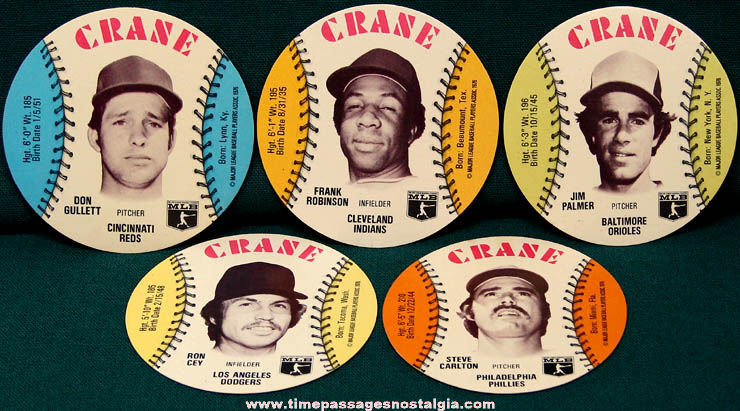
For most collectors, baseball means stackable, sortable 2" by 3" rectangles of cardboard. Topps prints an apparently unending supply these days, year after year, reliable as death or taxes, with competitors Panini and Upper Deck major factors in other sports. While this hardly excludes other shapes, even the word "card" implies something squared-off and angular. Today's #5 eschews both descriptions.

Card front

Rectangle cards remain primary, but aren't the only kid on our block. Turn back your clock a bit and remember that new discs turn up every decade or so--four specific eras come to mind.

Pre-war disc sets also exist, usually as dessert or snack lids that kids pulled off and (ideally) hung on to. They're close cousins of cereal box panel and other food promo sets, since nothing about Papa Gino's pizza or raisin bran explicitly says "baseball."

Card back

MSA (Michael Schechter Associates) is the same maker who licensed a larger version to advertisers in 1976-1977, including Pepsi's 1977 capliner cards (#5 Mike Hargrove profile). Papa Gino's sponsored this 40-player set and customers could get one (or more) with each meal. I assume it proved successful, since they turn up at shows and online frequently.

Value: Complete sets list for as little as $20, so singles should cost a few dollars at most.

Fakes / reprints: This would be a hard set to reproduce, given low collector interest and value. I haven't seen any in the marketplace.