Wednesday, December 1, 2010

30 Posts in November Wrap-Up

Thanks to all for reading (or at least paging through) my 30 articles in 30 days during National Blog Posting Month. It did include (*cough*) a half-dozen posts on Monday and Tuesday, not the first time I've busted out plenty of material at a project's end.

This being about baseball cards, let's look at some stats!
  • New #5 set profiles: 26
  • Cross-blog commentary: 2
  • Revisions to past entries: 2

Not gonna lie, I thought this month would include more non-profile articles! Hat tip to writer and fellow Dodger fan Night Owl, who inspired the cross-blog Oldest Card in My Collection and Top 5 Number Fives posts.

An up moment for Dodgers and #5s

Here's some article context breakdown.
  • Card scans: 69 (dudes)
  • Favorite card: 1938 Wheaties #5, Carl Hubbell
  • Food sets: 7
  • Most-read article: "Oldest Card in My Collection"
  • Robert Laughlin-drawn sets: 3
  • TCMA-related sets: 9
  • Topps / Bazooka sets: 5
  • Words written: 8088

What's next? Fortunately for me, more #5s.

Tuesday, November 30, 2010

1970 Topps Super Baseball #5, Tom Seaver

Today's photo catches Seaver right off 1969's Amazing Mets championship season and his own NL Cy Young award. Tom Terrific went on to average nearly 18 wins a year for the next decade in New York and Cincinnati, a phenomenal run rivaled by few of his contemporaries (just Steve Carlton and Nolan Ryan come to mind). 99% of HOF voters put him on their ballot in 1992, a great measure of the respect he earned over 20 seasons (career stats at B-R.com).


Topps followed their 1969 Super test issue (set profile) with this set of 42 postcard-sized cards. 1971 also used that larger size and it's what most people think of as "Supers," given 1969's scarcity. (See this scan gallery for 1970's full checklist.)


1970 Topps adopted this yellow-and-blue design for both regular and Super sets; Seaver's includes a cartoon about his early contract snafu with the Atlanta Braves, which Wikipedia expands on.
"In 1966, [Seaver] signed a contract with the Atlanta Braves, who had drafted him in the first round of the secondary June draft (20th overall). However, the contract was voided because his college team played two exhibition games (although Seaver hadn't played). Seaver intended, then, to finish the college season, but the NCAA ruled him ineligible. After Seaver's father complained to Eckert about the unfairness of the situation, and threatened a lawsuit, Eckert ruled that other teams could match the Braves' offer. The Mets were subsequently awarded his signing rights in a lottery drawing among the three teams (the Philadelphia Phillies and Cleveland Indians being the two others) willing to match the Braves' terms."
Hard to imagine Seaver in a Braves hat, but it could've (should've?) happened!

Value: Topps short-printed eight 1970 Supers, including this number five, pushing those prices up a bit. I found mine on eBay for $5 several years ago, but they're likely higher now. Non-star cards cost a dollar or two.

Fakes / reprints: Some of Topps' best vintage photography appears on Supers. It's likely they re-used some star player photos for modern sets, but I haven't seen any direct reprints.

1960 Nu-Card Baseball Hi-Lites #5, Johnny VanderMeer Pitches 2 No Hitters

Few modern collectors know of the Nu-Card company, who made a handful of sport sets in 1960 and 1961. Both of their baseball issues ("Hi-lites" and "Scoops") feature a newspaper format with single-game "stories," a mix of retired and active players, and trivia questions on the back.


Nu-Card probably chose this unorthodox format--postcard size, black-and-white photos, no stats--to avoid legal problems with Topps, who reigned supreme over cards after buying out rival Bowman in 1956. The company turned out a few hundred cards (if you include 1961's college football) of decent quality across two years, so it's surprising they vanished without a trace. (Collectors might've wanted the color photos and statistic grids available in Topps, so didn't buy them.)


Many of the set's 72 cards point elsewhere in the set. Number five redirects this Yankee Stadium question to #50, which covers its longest recorded homer.


Mantle's homer hit Yankee Stadium's upper facade, a near-miss to leaving the park itself, a feat no player achieved in a regulation game.

An alternate black-and-white printing of this set covered just the first 18 cards, came with blank backs (eliminating the trivia questions), and carried the CVC copyright instead of NCI in the "newspaper" header.


Price guides report CVC cards as scarcer than NCI, but both cost about the same thanks to the variation's crudity and low demand for this set in general.

Value: You can find individual "hi-lites" for $5 and less, with some superstars running several times that.

Fakes / reprints: According to the SCD catalog, someone counterfeited the 1961 Nu-Card Scoops set (released the year after this Hi-Lites issue), but I haven't seen any faked 1960 cards in the market.

1969-70 Bazooka Baseball #5, Lou Gehrig Hits 4 Homers

As you might guess by the name, Topps kicked off Bazooka brand gum following World War II. News coverage and Hollywood movies of that era featured all kinds of military hardware, with jeeps, guns, and ships proving especially popular with kids, so advertisers took advantage. Their parent company first cross-promoted its gum by printing baseball players on box panels in 1959 (here's one uncut panel) and Bazooka continues to the present day as an element of Allen and Ginter cards.

Card front (box panel, blank back)

This blog recently profiled Bobby Lowe as the first to hit 4 homers in one game (1970 SCFC #5 profile), but that happened in 1894, before baseball's "modern" cutoff of 1901. Several matched Lou's feat since; as a Seattle fan, my favorite's Mike Cameron in 2002.

Bazooka's printed 12 panels of black-and-white photos and achievements from the pre-WWII era.
  1. No-Hit Duel by Toney and Vaughn
  2. Alexander Conquers Yankees
  3. Lazzeri Sets AL Record
  4. Home Run Almost Out of Stadium
  5. Four Consecutive Homers by Gehrig
  6. No-Hit Game by Walter Johnson
  7. Twelve RBIs by Bottomley
  8. Ty Ties Record
  9. Babe Ruth Hits Three Homers in Game
  10. Calls Shot in Series Game
  11. Ruth's 60th Homer Sets New Record
  12. Double Shutout by Ed Reulbach

Full boxes include 4 more "All Time Greats" on its side panels, 2 visible in this scan (Frank Chance and Mickey Cochrane).

Full box #5

Value: Full boxes get pretty expensive, but I snagged this ragged-edge panel for $10 on eBay.

Fakes / reprints: Haven't seen any in the marketplace and I doubt modern collectors would buy an oversized, black-and-white set if Topps tried reprints.

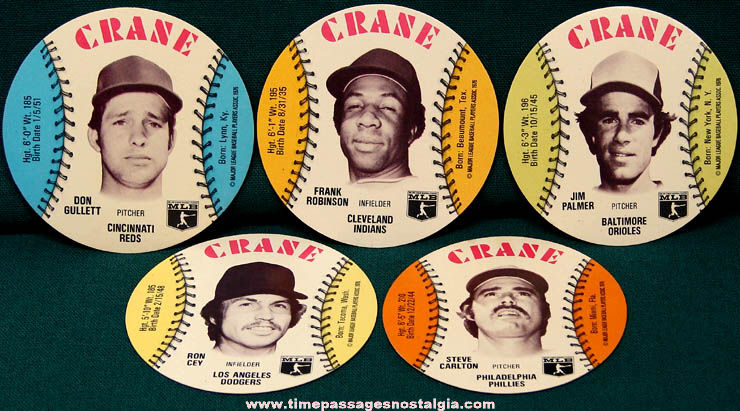
1978 Papa Gino's Baseball Discs #5, Dennis Eckersley

For most collectors, baseball means stackable, sortable 2" by 3" rectangles of cardboard. Topps prints an apparently unending supply these days, year after year, reliable as death or taxes, with competitors Panini and Upper Deck major factors in other sports. While this hardly excludes other shapes, even the word "card" implies something squared-off and angular. Today's #5 eschews both descriptions.

Card front

Rectangle cards remain primary, but aren't the only kid on our block. Turn back your clock a bit and remember that new discs turn up every decade or so--four specific eras come to mind.

Pre-war disc sets also exist, usually as dessert or snack lids that kids pulled off and (ideally) hung on to. They're close cousins of cereal box panel and other food promo sets, since nothing about Papa Gino's pizza or raisin bran explicitly says "baseball."

Card back

MSA (Michael Schechter Associates) is the same maker who licensed a larger version to advertisers in 1976-1977, including Pepsi's 1977 capliner cards (#5 Mike Hargrove profile). Papa Gino's sponsored this 40-player set and customers could get one (or more) with each meal. I assume it proved successful, since they turn up at shows and online frequently.

Value: Complete sets list for as little as $20, so singles should cost a few dollars at most.

Fakes / reprints: This would be a hard set to reproduce, given low collector interest and value. I haven't seen any in the marketplace.

Monday, November 29, 2010

1974 TCMA Baseball Autograph Series #5, Jesse Haines

TCMA printed this direct-to-collectors set of (then) living players with a blank box for autographs, encouraging fans to mail out or seek signatures in person. Pictures come from a range of eras, so I think TCMA assembled their "autographs from living former players" theme from a larger group of available photos.

Card front (blank back)

After 18 years pitching for St. Louis--still a franchise record--Jesse Haines spent 1938 coaching in Brooklyn, as pictured. This both explains the "B" on his cap and makes it a hard-to-find card for Dodger team collectors.

Haines passed away not long after issue, so an authentic signed #5 is nigh-impossible. While all 36 players in its checklist were alive at issue date, just Sandy Koufax remains with us as of 2021.
  1. Satchel Paige (d. 1982)
  2. Phil Rizzuto (d. 2007)
  3. Sid Gordon (d. 1975)
  4. Ernie Lombardi (d. 1977)
  5. Jesse Haines (d. 1978)
  6. Joe Cronin (d. 1984)
  7. Bill Terry (d. 1989)
  8. Bill Dickey (d. 1993)
  9. Joe DiMaggio (d. 1999)
  10. Carl Hubbell (d. 1988)
  11. Fred Lindstrom (d. 1981)
  12. Ted Lyons (d. 1986)
  13. Red Ruffing (d. 1986)
  14. Joe McCarthy (d. 1978)
  15. Bob Feller (d. 2010)
  16. Yogi Berra (d. 2015)
  17. Ford Frick (d. 1978) and Whitey Ford (d. 2020)
  18. Sandy Koufax
  19. Ted Williams (d. 2002)
  20. Warren Spahn (d. 2003)
  21. Al Rosen (d. 2015)
  22. Luke Appling (d. 1991)
  23. Joe Bush (d. 1974)
  24. Joe Medwick (d. 1975)
  25. Lou Boudreau (d. 2001)
  26. Ralph Kiner (d. 2014)
  27. Lloyd Waner (d. 1982)
  28. Pee Wee Reese (d. 1999)
  29. Duke Snider (d. 2011)
  30. Sal Maglie (d. 1992)
  31. Monte Irvin (d. 2016)
  32. Lefty Gomez (d. 1989)
  33. George Kelly (d. 1984)
  34. Joe Adcock (d. 1999)
  35. Max Carey (d. 1976)
  36. Rube Marquard (d. 1980)

Value: Unsigned cards like my #5 cost a few dollars or more for prominent HOFers. Signed versions of players who died in the 1970s run significantly more.

Fakes / reprints: I'd worry more about signature authenticity than a faked card, given the set's otherwise low profile and demand.

Update to 1976 Laughlin Jubilee Baseball #5, Frank Robinson

Back in 2008, I wrote up one of Bob Laughlin's most colorful sets, a 32-player "Diamond Jubilee" collection honoring the American League's 75th anniversary. Card number five commemorates Frank Robinson's debut as player/manager for Cleveland, which he topped off with career homer #575.

My original write-up claimed Diamond Jubilees came with blank backs, which proved wrong wrong wrong. Laughlin actually included a note about each AL honoree, "Diamond Cards" sketch logo, and card number. (Hard to be #5 without it, right?) With all apologies to Mr. Robinson, the updated post now includes both scans and an updated description: 1976 Laughlin Diamond Jubilee #5.

Here's my favorite modern Robinson card.


Nice auto and good close-up--that's some smoooooth card action.

Sunday, November 28, 2010

1936 Wheaties Series 5 Baseball #5, Joe Medwick

Wheaties published a pair of "how to" panel sets in 1936, one called "How to Star in Baseball" and today's, "How to Play Winning Baseball." Both show batting or fielding tips on cartoon panels adjacent to a large player picture, like today's shot of Gashouse Gang member Joe "Ducky" Medwick.

Card front (click for detail)

My favorite how-to cartoon is #3 ("look over your fielding area"), since pro parks today have almost no chance of ruts, holes, or anything save luscious greenery. (Of course, plenty of young players face that "bad field" problem, both then and now.) The complete set numbers 12 panels.
  1. Lefty Gomez
  2. Billy Herman
  3. Luke Appling
  4. Jimmie Foxx
  5. Joe Medwick
  6. Charlie Gehringer
  7. Mel Ott
  8. Odell Hale
  9. Bill Dickey
  10. Lefty Grove
  11. Carl Hubbell
  12. Earl Averill

Value: My scan trimmed away the ragged edges that make Medwick decidedly low-grade. He cost $15 on eBay in 2005, on the low side of a set filled with Hall of Famers. Complete boxes run much higher, since so few survive today.

Fakes / reprints: Haven't seen any fakes in the marketplace, but it's possible they exist, given the set's big names.

Saturday, November 27, 2010

1939 Wheaties Baseball Series 13 #5, Catcher's Mask

Today's #5 tracks the genesis of protective masks for catching, first donned by Harvard's backstop for a cross-state game in 1877. Catchers of all eras deserve respect for a willingness to field baseball's most hazardous position and their gear's nickname--"the tools of ignorance"--says more about the gritty mentality needed than any shortage of smarts.

Card front (click for detail)

This box panel looks esoteric to 21st century eyes, since most fans worry more about changing power numbers (scoring, homers, strike outs) than particulars of its equipment. Would Topps or Panini attract catch anyone's eye with something like this today? (Of course, anything's fair game for Allen and Ginter--they might prove me wrong.)

Wheaties published this "100 Years of Baseball" series assuming 1839 as its "creation," a year linked to Abner Doubleday. No less than commissioner Bud Selig recently brought this debunked starting point back to public commentary, leading many to question his knowledge of the game's history. (Read Keith Olbermann's summary at his Baseball Nerd blog--and remember that off-season's a time for debating stories we ignore during playoff races.)

I think of this set as an early poetic history, focusing on fan-visible shifts in play. Without recognized players, there's not much collector interest, but it does demonstrate Wheaties' willingness to try out different ideas. Its checklist numbers eight panels.
  1. Design of First Diamond
  2. Lincoln Gets Nomination News on Baseball Field
  3. Crowd Boos First Baseball Glove
  4. Curve Ball
  5. Catcher's Mask
  6. Baseball Gets Dressed Up
  7. Modern Bludgeon Enters Game
  8. Casey at the Bat

Value: This mid-grade panel cost $10 on eBay in 2006 and others should run the same, excepting perhaps Lincoln and his Americana appeal.

Fakes / reprints: Haven't seen any in the marketplace and it'd be an odd choice to reprint.

UPDATE: By request, here's a scan of #2, the Lincoln panel, from TimePassagesNostalgia.com.

1936 Wheaties Baseball Series 6 #5, Arky Vaughan

When Wheaties starting signing players to endorsement contracts in 1934, they certainly hoped for a future where their cereal and "sports" went together in the public consciousness. And here we are, with "better eat your Wheaties" and "Breakfast of Champions" still commonly-known phrases in the 21st century.

Card front (click for detail)

Today's set of box back panels includes positional playing tips, highlighted by this leaping shot of HOFer shortstop Arky Vaughan. This takes nothing away from Arky's hitting, which peaked at .385 (!) in 1935 and remained above .300 for 12 of his 14 seasons.

Everyone on this checklist made the HOF, save Zeke Bonura and Buddy Lewis. Wheaties usually featured established players, so that's not surprising--Zeke and Buddy were just young players who couldn't turn their early good performance into long-term success.
  1. Bill Dickey - How to Catch
  2. Red Ruffing - Pitching the Fast Ball
  3. Zeke Bonura - First Base: Make More Outs
  4. Charlie Gehringer - Second Base as the Stars Play It
  5. Arky Vaughan - Shortstop: Play It Right
  6. Carl Hubbell - Pitching the Slow Ball
  7. John "Buddy" Lewis - Third Base: Field Those Hot Ones
  8. Heinie Manush - Fielding for Extra Outs
  9. Lefty Grove - Pitching the Outdrop Ball
  10. Billy Herman - How to Score: base running
  11. Joe DiMaggio - Bat Like a Home Run King
  12. Joe Medwick - Batting for Extra Bases

Value: Low-grade panels like Arky run about, oh, "this much." (Picture hands held $10-15 apart.) Complete boxes cost many times that, being exceedingly rare.

Fakes / reprints: Haven't seen any faked panels in the marketplace, but be wary of buying superstars like DiMaggio unless you're already familiar with Wheaties issues.