Friday, November 3, 2023

Baseball's Best Fifth Round Draft Picks 1970 - 74

Thanks to Immaculate Grid game #212's new category (first round draft pick) for inspiring me to bone up on MLB's Rule 4 amateur draft, which kicked off in 1965. Baseball Reference's statistical history includes Rule 4's complete record, broken down by draft phase and pick. I already covered 1965-69 in my prior post and will keep looking at five-year blocks until we run out of steam.

Two of these names from the top of 1970's fifth round found similar overall success, right around WAR's break-even point.

Pat Scanlon, who shares his name with an uncle of mine, played parts of four seasons for Montreal and San Diego. He appeared on a pair of standard cards, one SSPC...

...the other, 1978 Topps, airbrushed his Montreal cap and uniform with a foreshortened SD.

Thanks to dedicated blogger and image updater WthBalls, we can enjoy one more Scanlon, based on a real Padres photo.

As good as those three cards turned out, Pat's -0.3 career WAR sits well below our best choice for 1970.

1970: Rick Waits (14.2 WAR)

Rick turned into a Cleveland innings-eater for five years before slowing in 1982 and closing his career as a Milwaukee reliever. His first appearance (September 17, 1973, for Texas) gave him a save that might not be granted today. He pitched the ninth, gave up one run, and finished ahead by seven runs.

Easy to pick my favorite Waits card, a "waiter" card, as marked up by BaseballCardVandals.com.

1971: Charlie Moore (10.3 WAR)

Charlie's name feels more familiar than most, as a Wisconsin native and 1980s card collector. Milwaukee's "tools of ignorance" looked great in blue and gold, with Moore wearing them on cards at least twice.

Moore also spent a lot of time in right field and batted well during a 1982 postseason that brought his Brewers to the World Series against St. Louis.

1972: Randy Jones (17.8 WAR, 1976 NL Cy Young, 2x All-Star)

Randy fell a few votes short of back-to-back Cy Young awards, finishing second to Seaver in 1975 before winning the following year. His flip side Jim Palmer managed that feat, joining the cadre who won at least two in a row.

These two cards show the significance of a great mid-1970s hairdo, whether you're feeling Randy or feeling Jim.

1973: LaMarr Hoyt (12.1 WAR, 1983 AL Cy Young, 1985 All-Star)

Hoyt also led the AL in wins twice (1982-83) and picked up a Cy Young of his own. He followed Randy's example with lofty curls and classic, vintage uniforms.

As inscribed by his own hand, LaMarr started that 1985 All-Star Game (for San Diego) and took the win-plus-MVP in a 6-1 NL victory.

1974: (tie) Steve Henderson (11.5 WAR), Jim Morrison (12 WAR)

For my first time so far, two players vie for the trophy. While Henderson remains closer to my heart as a former Mariner, I prefer his Buntin' Cub 1983 card's more interesting composition.

Jim Morrison started his teen years about when the famous Jim Morrison peaked and I bet he rode a rollercoaster of seeing that name in the papers, for reasons good, bad, and ugly. In an echo of Mr. Mojo Risin's animal magnetism, Topps used portraits of Jim's handsome mug on several cards.

I give the "best pick" edge to Jim over Steve for his three scoreless pitching appearances as a 1988 Brave. Remember his name the next time IG asks for an Atlanta Brave with season ERA under 3!


Wednesday, November 1, 2023

The Immaculate Grid and Baseball's Best Fifth Round Draft Picks, 1965 - 69

I'm a consistent Immaculate Grid player and use whatever cards litter my desk as "original sources" to plug in names. On Halloween 2023, the grid-makers added a curveball for game #212 with "First Round Draft Pick," something they introduced on earlier versions for football and basketball. I filled in six squares with familiar names and then observed the 1940s and 50s cards on my desk lacked any draft info, leaving me cold. I threw in three guesses, missing on Rick Ankiel and Keith Hernandez, and counted myself lucky to get Barry Zito.


One problem with high picks: many first show up as low picks in earlier years. Barry Zito's "first round pick" (Oakland, 1999) came after earlier attempts in the 59th (Seattle, 1996) and third (Texas, 1998). Many skilled draftees delay signing to play college ball or otherwise develop their skills, reentering the draft in later years.

Draft picks do show up from time-to-time on baseball sets, including something I pinched myself for forgetting, the 1985 Topps subset of active #1 picks.

Check out 30 Year-Old Cardboard's subset profile for all 12

I've used Shawn Abner for Immaculate Grid before at the intersection of Padres, Angels, or White Sox and the trick is that he never played in the bigs for New York. A trade of multiple players, including Kevin McReynolds, moved Abner to SD, where he debuted in 1987. Donruss went all-in by giving Shawn his own "Baseball's Best" card after just 16 games the prior year. The weight of great expectations!


Any memory of Abner's #1 pick card would've helped my IG score, since 2% is far better than the 100-point penalty for missed guesses.

My "what if" Mets row

Interesting that Abner qualified as a Met, since other Immaculate Grid categories require players log at least one team appearance in that uniform. It appears their "first round draft pick" considers selection alone, opening up more obscure answers for MLB draftees who reached the bigs with other clubs. (Most first-rounders get at least a cup of coffee, given how much teams commit to that pick.)

Roger moved fast, from 1983 #1 pick to 1984 in Boston

1985 Topps, and others like it, knit draft status into that tiny bio text. MLB's current amateur selection process ("The Rule 4 Draft") started in 1965 and Topps added relevant info to card backs a decade later in 1976.

1976 card for one member of the inaugural Rule 4 draft 

Those top-tier picks often achieve great things, in terms of stats and accolades, so let's hunt for hidden treasure by finding our best fifth-rounders from the amateur draft's initial years, 1965 to 1969.

1965: Amos Otis (42.8 WAR, 5x All-Star, 3x Gold Glove)

Otis ranked among baseball's best 1970s outfielders and helped KC reach the postseason five times. His cards also show off how good those powder blues can look, year after year.


1966: Dave Cash (25.6 WAR, 3x All-Star, 1971 World Series champ, "Action Dog" nickname)

Dave played almost every day 1971-78, first for Pittsburgh's title winners, and then for an improving Phillies team that won the NL East in 1976. Teammates often mentioned his reliable defense and esprit de corps in the clubhouse.


Dave appears at card shows these days and a trading friend came away with a dollar bill signed by Cash & (Don) Money at the same National. They each seemed amused by the pun.

1967: Dave Goltz (23.1 WAR, 1981 World Series champ)

Dave lingered in the low minors for several years before debuting in 1972 for a 77-77 Twins club by going 3-3. Goltz registered .500 W/L records three more times in the next four years before breaking through with 20 wins in 1977 and still ranks in Minnesota's franchise top-10 for strikeouts. (Remove numbers from the Washington Senators and he'd be even higher.)


My favorite Goltz cards hail from the same 1978 Topps set, first autographing something for a fan and then sharing space with three other excellent hurlers.


1968: Burt Hooton (35.5 WAR, 1981 All-Star, 1981 World Series champ)

Hooton split the 1970s between Chicago and LA, where he and Goltz ended up as teammates on the title-winning 1981 Dodgers squad. Burt spread his 151 career wins across 15 seasons and spring training card photos from Dodgertown, Florida come to my mind first.


His last name's pronounced /WHO-ten/, which led to a 1975 Hostess "Hooten" error, later corrected.


1969: Dwight Evans (67.2 WAR, 3x All-Star, 8x Gold Glove, 2x Silver Slugger)

"Get yourself someone who can do both," as the saying goes, and Evans sure could hit and flash leather in the outfield. He rates best of these 1965-69 fifth-round picks and many say Cooperstown-worthy. (Hall of Famers Al Kaline, Billy Williams, and Tony Perez all rank in Dewey's top-10 similarity scores.)


My favorite Evans cards sport the bushy mustache, eyebrows, and/or eye black. While one last year in Baltimore "spoiled" his 19 years in Boston for Red Sox fans, he continued to get on base ~40% of the time and ranks #29 all-time in walks (1391), leading the AL three times.

More picks coming!

I'll continue this theme and see what kind of team we can build from fifth-round draft picks, given this solid starting five.
  • SP: Goltz, Hooton
  • RP: TBD
  • C: TBD
  • 1B: TBD
  • 2B: Cash
  • 3B: TBD
  • SS: TBD
  • OF: Otis, Evans, TBD

Saturday, August 19, 2023

Utah baseball stops in August 2023

I spent a chunk of August visiting family in and around Salt Lake City, a town with more than a century of minor league history. We made multiple baseball stops in the area and caught Tuesday's night game at Smith's Ballpark, home to the AAA Bees.

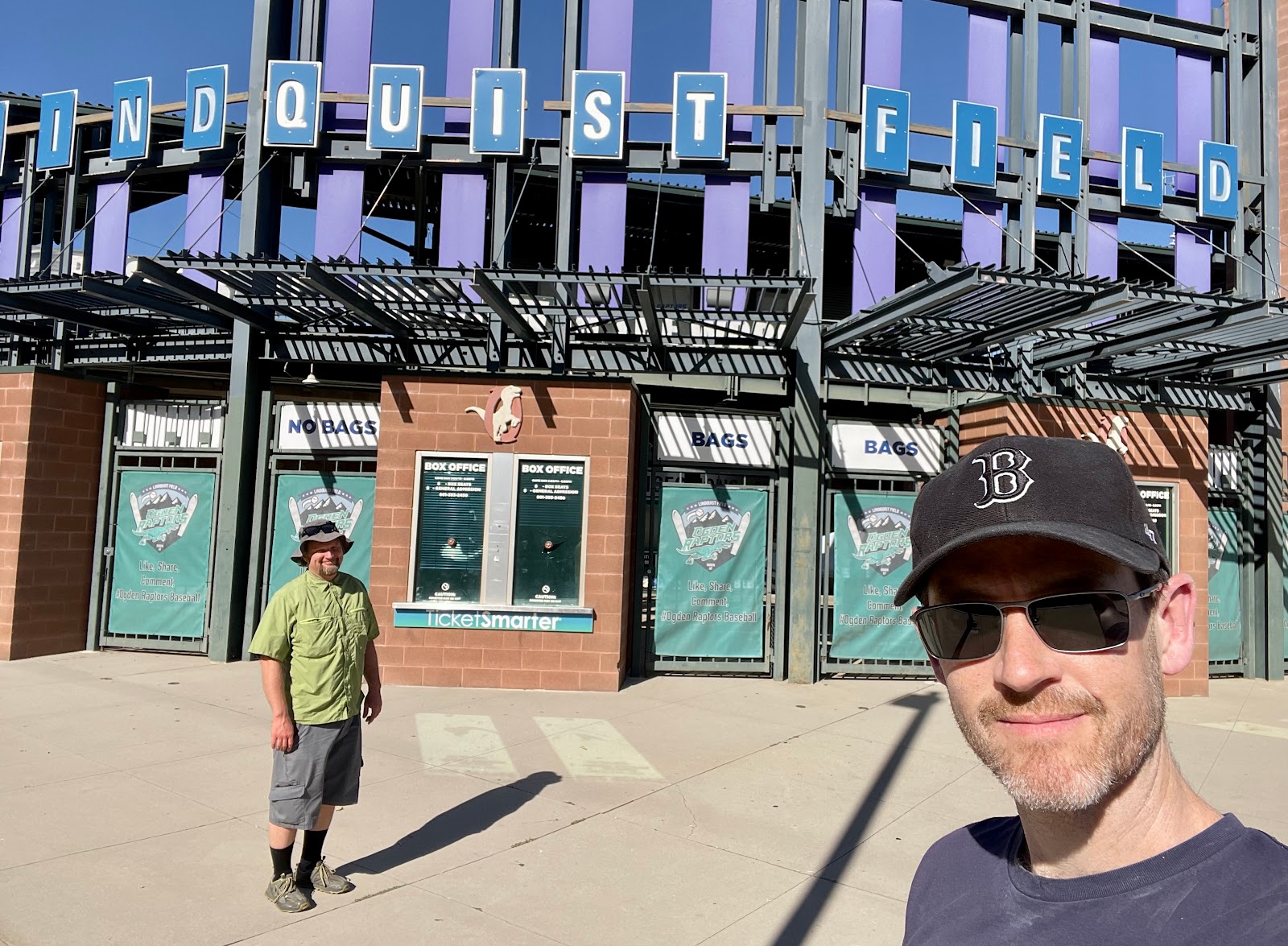
Stop one: Lindquist Field in Ogden

This current Ogden Raptors facility does its best to compress 100+ years into something approachable at the street level. My brother and I visited during a road series, so took photos along their park's main thoroughfare.

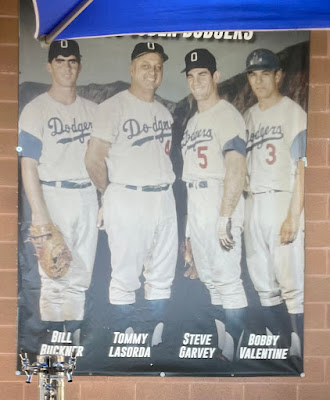
These three Dodgers cut their teeth in Ogden, winning multiple titles under Tommy Lasorda prior to his time as their MLB manager. The Salt Lake Tribune revisited those days in 2018.

As a Steve Garvey and #5 collector, it'd be amazing to find an Ogden jersey today. I'll accept this photo for now.

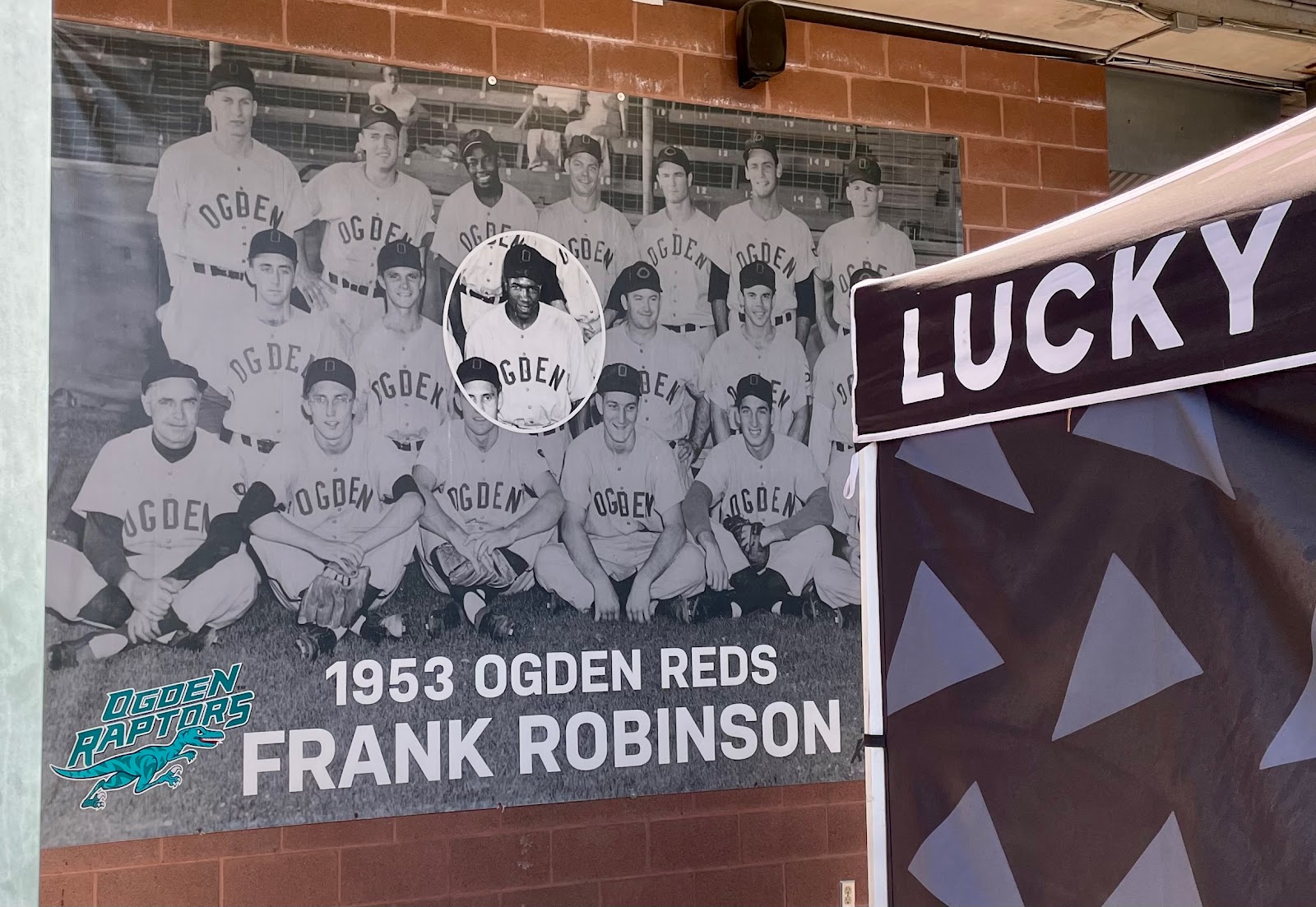
Frank (Frankie) Robinson also starred for Ogden way back in 1953 and "hit the horsehide" in a literal way.


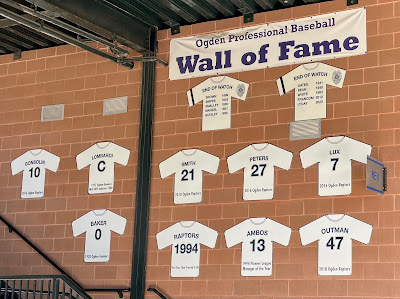
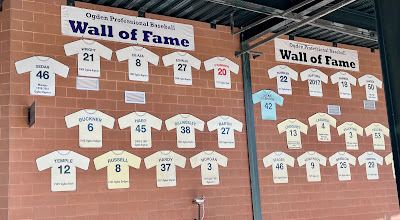
Lindquist's Wall of Fame spans HOF catcher Ernie Lombardi ("C" in 1927) to the Raptors debut (1994)...


...with several Dodgers, Reds, and Athletics in-between. While we missed the Raptors this time around, I look forward to catching games there in future years!

Stop two: Baseball Kid statue(s) in Ogden Park

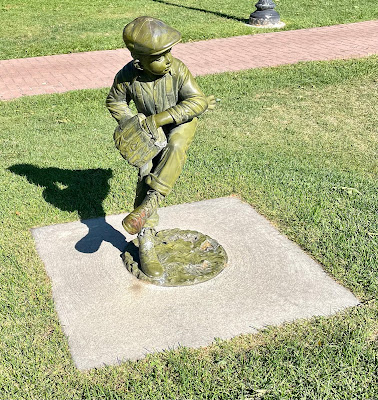
This park contained two statues at one point, one pitching and one batting, just outside the city amphitheater a few blocks south of Lindquist Field.


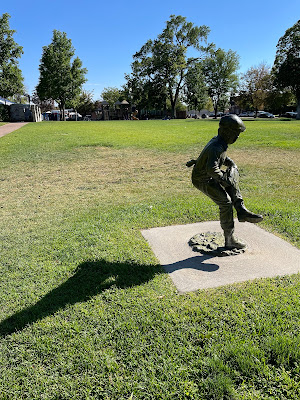
The batter's missing at the moment, perhaps undergoing repair, so I paid respects to this pitcher and his newsboy duds. I expect Ogden's batter to return at some point to that flattened patch of grass in the distance.


One statue or two statues, I'll nominate them for inclusion as a SABR baseball landmark.

Stop three: Smith's Ballpark for a Salt Lake City Bees game

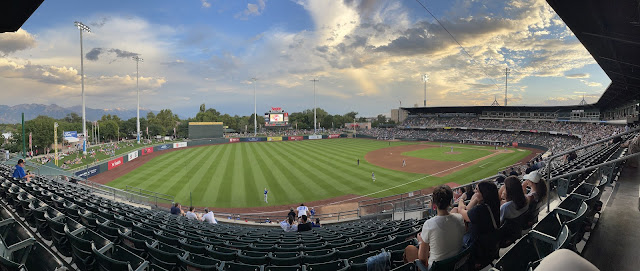
This pleasant SLC ballpark features a family-friendly circumference with grassy berms behind its outfield wall and Wall of Fame banners overlooking its warning track. As a Boston resident, three former Red Sox stood out to me.


We sat along the third base lane and avoided direct sunshine for its first few innings by hiding under this second-deck overhang. Attendance filled about half the park on a "discount Tuesday," where fans got four tickets for $20 plus $2.50 hot dogs & sodas.


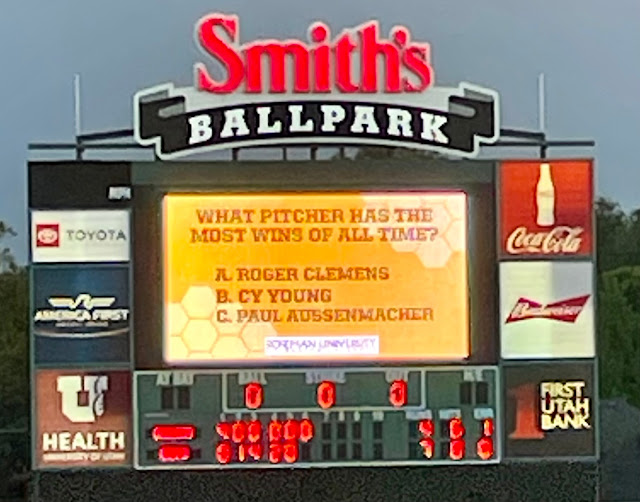
Smith's sixth inning trivia question gave Clemens (354 wins), Cy Young (511 wins), and Paul "Aussenmacher" (Assenmacher, 61 wins) as options.


Their fan contestant picked the right answer and won tickets to a future game. I wonder how Assenmacher ended up on that list.

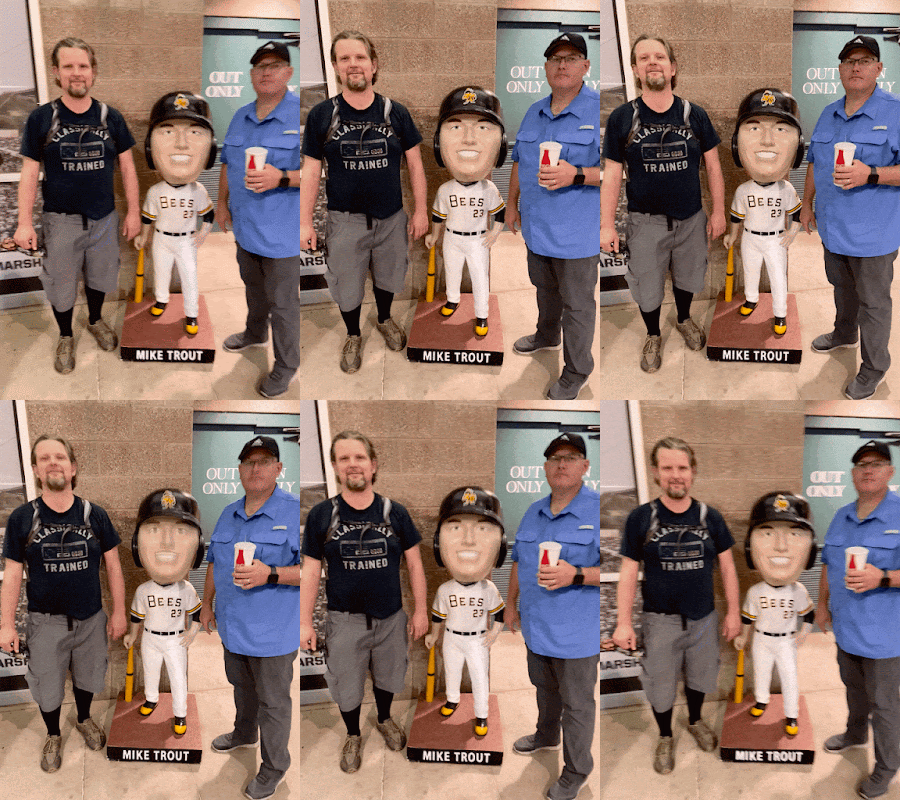
Did you know Mike Trout spent time as a Bee?


Oh, cool, just checking.

Tuesday, July 18, 2023

"Baseball in the Berkshires" exhibit in Lee, MA (July to August 2023)

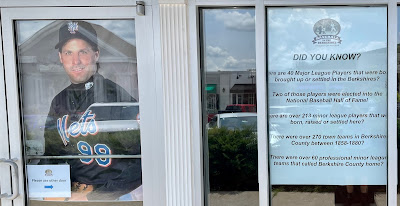
A long chain of events, fortunate and unfortunate, led me to factory outlet shopping in Lee, MA, over the weekend. I parked our car and turned around to see a local success story looking back.

DID YOU KNOW? I'M TURK WENDELL.

Earlier in July, a dedicated group of local historians opened a storefront museum featuring the many MLB, minor league, and amateur baseball teams that played local forms of our pastime since (by their count) at least 1791, with online details at Baseballinberkshires.org.

Jack Chesbro garnered a street-facing banner as half of their Cooperstown inductees.

African-American pioneer Frank Grant is their second HOFer

Local news coverage gave a good sense of the inside, including an on-camera chat with its curator: "Baseball in the Berkshires opens new exhibit in Lee" (July 6, 2023).

I spotted card sorting near the back, where they offered any visiting kids a free variety stack of 1960s to 2000s.

I hope those youngsters appreciate broadcasters well-known, lesser-known, and also Ron Salcedo.

Lots of recognizable names in those stacks, even in the minor league sets. Those exhibit hosts said all their cards came from local collectors and donors.

Their batch of hand-updated cards should be perfect for people playing Immaculate Grid. I've already used Jim Perry multiple times!


If you live anywhere near the Berkshires or take a roadtrip to Cooperstown, I recommend stopping by before the end of August. Tell them you heard about it from that guy holding a Calvin Klein bag!

Monday, July 17, 2023

1935 Goudey Big League Gum baseball: over the border line (for the SABR Baseball Cards blog)

Intro for my latest at the SABR Baseball Cards blog

I enjoy picking apart hard-to-explain details of vintage cards to see where that journey leads. This post puts three aspects of Goudey's 1935 Big League Gum baseball set, which most shorten to "1935 Goudey," under the microscope. It plays with definitions of "border" and considers how gum companies took advantage of legal gray areas to sell more gum to baseball fans. If you like learning about Prohibition's impact on greater society, this will be grist for your mill. You might even agree that "1935 Goudey" tells just half of its story.

Read the rest there!

Saturday, July 8, 2023

1923-24 Tomás Gutiérrez (Cuban cigars) Baseball #5, Dave Brown

While my type collection might never include this hobby rarity, it deserves a profile on its own merits and for those of its subject, Dave Brown.


First excelling on independent teams in the 1910s, Brown's star burned brightest for Rube Foster's American Giants, winner of the first three Negro National League titles (1920-22). He might well reach the Hall of Fame, given sufficient time and career examination by their election committee.

Havana-based tobacco company Tomás Gutiérrez published this set of 1923-24 winter league players and each back explains that collectors of complete sets could redeem them for a display album. Hake's Auctions sold one SGC-graded collection of all 84 known numbers in 2014. That listing and this Flickr album provide good pictures of most cards.


The collector album shows players by team, two pages each, with Brown's photo taken against a studio backdrop, while others stood next to an outdoor stadium or building.

1923-24 Santa Clara team (detail from Christie's album auction)

Gutiérrez released this set at a high point for Cuban winter league ball, as explained in Brown's SABR profile by Frederick C. Bush.

"[Dave] Brown, [Oliver] Marcell, and [Bill] Holland were three of the numerous Negro League players who joined the Santa Clara squad for the 1923-24 Cuban winter season...finishing in first place with a 36-11 record. In fact, this Santa Clara squad came to be “[c]onsidered as the most dominant team ever in the history of Cuban baseball by amassing an 11½ game bulge over their nearest rival." Bill Holland led the team and league in wins with a 10-2 record, Rube Currie contributed an 8-2 mark, and Brown finished with a 7-3 ledger.

The 1923-24 Cuban season was such a popular success that fans clamored for more baseball, and a special season, named Gran Premio, was quickly arranged. Santa Clara finished with a 13-12 record that enabled it to edge out Almendares by a slim half-game margin. Brown (4-2) and Holland (4-3) tied for the team lead in wins in this second season."

A handful of graded examples exist for almost #1-85, with none at all known for #84. I've seen just one #5 Dave Brown card in person. Given that scarcity, my shot at this type card will rest on good "chance" fortune, good "money" fortune, or some of each!

Value: In today's market, you can expect to pay hundreds for individual cards and far higher for Hall of Famers, reflecting its quality player selection and good images for that era. Brown will cost me thousands, if that opportunity even presents itself.

Fakes / reprints: I know of no official reprints. Many Negro League collectors possess considerable knowledge about this era's sets and players, making it risky to attempt fakery in such a niche market. Perhaps some exist that are good enough to slip by everyone!

Wednesday, April 26, 2023

1927 Honey Boy Ice Cream Baseball #5, William "Snake" Siddle

This Honey Boy set exists thanks to an ideal confluence of circumstances: baseball's growing popularity at all levels, recent success for a local Manitoba (Canada) team, and better refrigeration technology. Mix all three and you get this set of 21 cards recognizing local heroes, including Snake Siddle, alongside MLB stars like Babe Ruth and Grover Cleveland Alexander.


"Snake" played shortstop for 1926's Wesley Senior League champs, the Arenas (plural of Arena), who won several titles during Snake's era. Baseball-Reference.com searches for Siddle will come up empty, as that league played amateur ball on days off from work. Count us fortunate that Western Canada Baseball does a great job summarizing year-by-year results, including title series highlights of his game seven heroics.

"Home runs by Greig Warren and Bill 'Snake' Siddle accounted for three of the winners’ four counters. Siddle’s blast was a two-run clout but he also contributed significantly on a defensive level by igniting a pair of twin killings."

In 2005, Manitoba recognized Siddle's career achievements with induction into its sports hall of fame and picked him as the shortstop for its All-Century team. He also appears (as umpire) in a SABR game story from Satchel Paige's long exhibition career and did some barnstorming of his own, sporting a requisite beard, for The House of David.

Snake's The House of David look, circa 1929

I bet this set exists in large part because Winnipeg's 1926 club won that title in thrilling style. Its first nine cards feature Canadian amateurs (TCDB gallery), including Snake, followed by 11 major leaguers, almost all of whom later reached Cooperstown. This contrast reminds me of earlier prewar sets, such as T206, that mix top-tier Hall of Famers with minor leaguers who appear on their sole baseball card.


While you can still learn about Snake Siddle today using Google, the Purity Ice Cream name more-or-less disappeared in 1930. Major advances in refrigeration technology around this time helped dairy companies grow from family farms into industrial operations. A larger holding company acquired Purity not long after this set's release, folding its products into a nationwide umbrella of Canadian dairy producers.

A handful of contemporary sports sets exist with this "redeem a full set for prizes" model, including some other ice cream collectibles. I remain amazed that any of these cards survived past the 1920s, let alone 2023. Anything convertible into ice cream during my childhood ended up in mah belly sooner than later!

Some who suited up for amateur baseball did so for more than fun. Western Canada Baseball's 1926 season page shows that players could also win prizes, including these Regina home game bonuses from local businesses.
  • MVP - overcoat by Ware's
  • Top hitter - silk pyjamas by "Mac and Mac"
  • Best fielding average - suit case, Wood Hardware
  • Each player with a steal of home - meal ticket, Balmoral Cafe
  • First homer of the season - season pass, Capitol Theatre
  • Most homers - Stetson hat, R.H. Williams
  • Most stolen bases - ton of coal, City Coal Company
  • Most extra base hits - silk shirt, Warren and Wilkins
  • First perfect day at bat - box of cigars, Royal Billiards

Getting a ton of coal for stealing bases would encourage me to do more wind sprints, that's for sure. Even though our preferred sources of power have changed, would giving practical awards change how people played the game? Imagine if the MLB gave each SB league leader a solar farm!

Value: Some sets remain too scarce to predict a reasonable price. Several years into my quest for #5 type cards, Snake Siddle popped up on eBay for $200 and I pulled the trigger. Hall of Fame players could run several times that amount today and who knows how much Babe Ruth would cost?

Fakes / reprints: Take care when buying this kind of obscure regional set. It contains huge names that should sell for big money, so you want to be certain any card is genuine. Work with dealers you trust and get second and third opinions from other seasoned collectors before you lay down $$$$.