Showing posts with label milwaukee brewers. Show all posts

Wednesday, November 29, 2023

Top Five Vintage Team Cards for Player Collectors

Say Hey! What did I send you again?

In November 2023, I mailed some vintage Giants to a collector friend. When they arrived, he said, "thanks for the Willie Mays card!" That gave me pause. Did I package up a key card, a top-tier HOFer, and then forget about it? Is age catching up with me in a way that benefits others? (That'd be my preferred outcome for aging, to be honest.)

In truth, I sent a sort-of Willie Mays, and he clarified receiving my 1960 Topps Giants team card in the name of its biggest name.

1960 Topps #151: Say Hey! (lower right)

My own player collections (Spike Owen, Jamie Quirk, Steve Garvey, David Segui) focus on named cards 99% of the time. It's rare, if possible, for team cards to show off someone you need.

One "team card" that does belong in a Spike (or Wade) PC

If you collect specific players, do you try to fill every niche, including team cards with hard-to-identify faces? I've avoided group photos myself, since many vintage team shots came out indistinct, 1960 Topps included. Half of your battle as a player collector comes down to confirming your guy is on the card at all.

The new expert in vintage team cards

In 2023, hobby researcher Roy Carlson wrote a pair of exemplary 1951-1980 Topps team card overviews for Sports Collectors Daily. He's done the legwork to prove whether your collecting obsession did or didn't appear on any vintage Topps team cards.

Want a standout surprise? I had no idea Ted Williams kept popping up on 1959-64 Topps Red Sox team cards despite his exclusive 1959-1962 trading card contract with Fleer and after retiring as a player. Topps reused their 1958 photo each year and Fleer missed complaining about it. All these team cards for Ted fans!

  • 1959 Topps #248
  • 1960 Topps #537
  • 1961 Topps #373
  • 1962 Topps #334
  • 1963 Topps #202
  • 1964 Topps #579

I used Roy's excellent work as inspiration for five team cards that player collectors should know about.

Stan Musial: 1956 Topps #134 St. Louis Cardinals team

I propose two reasons that Topps first added team cards to their main set for 1956.

  1. Topps designed much of their 1956 set prior to Bowman's post-1955 collapse and wanted to test whether a group photo would violate exclusive contracts for stars like Mickey Mantle. Would a Yankees team shot gratify his fans, even if Mick's smaller than a thumbnail?
  2. Topps hoped to knit holdouts like Stan Musial, who refused all pre-1958 Topps contracts, into group shots that players wouldn't take seriously as "stealing their image."
The 1956 Cardinals card mentions Musial by name twice and he's easy enough to find at lower-right.


The 1956Topps blog notes just 13 of these 30 gentlemen appeared on individual cards in that year's set and exclusive Bowman contracts no doubt limited who Topps could include.


Its back text claims, "Later, Stan Musial made the Cards the number one team of the 1940s." Indeed, their .642 decade winning percentage outpaced all other franchises and they won three titles in five seasons (1942-46). I believe that Stan's reticence to sign with Topps or Bowman in 1954 explains why pitcher Memo Luna garnered a late season replacement card (see Memo to The Man for full details).

Musial appeared on two more Topps team cards, 1951 and 1957, prior to signing an individual contract in mid-1958, which triggered their first All-Star subset.

1951 Topps team cards, St. Louis Cardinals

I circled Musial (center) for context and a youthful Joe Garagiola (right) for fun. Look close and see how St. Louis cut-and-pasted their backup catcher into its second row after he missed its original team photo. 

1957 Topps #243, St. Louis Cardinals team

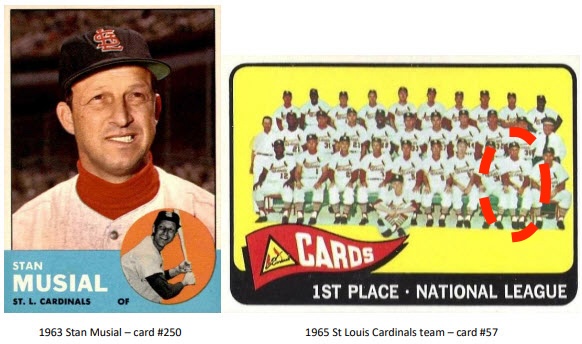
1957's muddier photo quality make this a tough card to love, with or without the circled Musial. I borrowed this image from Roy's first article to show how Musial's Topps on-card appearances continued beyond his retirement as a player. Topps reused a 1962 team photo (with Musial) for their 1965 set, a real twist of the knife considering St. Louis won the 1964 World Series!


While I consider 1965 #57 a curiosity with some Musial appeal, the 1956 team card's a great option for player collectors who want mid-career cards of The Man.

Carl Yastrzemski: 1965 Topps #403 Red Sox Team

The 1959-64 reuse of Boston's 1958 team photo that created extra Ted Williams cards also delayed Yaz's first appearance to 1965, years after his debut. (This kind of Topps laziness also postponed team photos with Pete Rose and several other 60s stars.)

Yaz sits at front right, between bullpen coach Al Lakeman and outfielder Lou Clinton.

Boston traded Lou Clinton to the Angels in June 1964, so this serves as his sole Red Sox team card, thanks to those 1959-1964 shenanigans. While 1965's flat backgrounds make individual faces tough to discern, it remains a decent choice for Yaz collectors as his first cardboard pose with teammates.

Hank Aaron: 1977 Topps #51 Milwaukee Brewers Team

By 1977, Topps improved print clarity enough to make Hank's legendary #44 visible without squinting.

I think most Hammer collectors know about this post-career appearance already, so consider this my bona fides for anyone seeing him there for the first time. It should be part of Aaron collections and costs little to acquire.

Yogi Berra, Jim Hegan, & Thurman Munson: 1980 Topps #434 New York Yankees team

This card meets three goals, two hobby-related and the other humane, each circled in red.

The two hobby-related details come from Roy Carlson's second article, where he shares that Yogi Berra (right circle in sunglasses) appeared on more vintage team cards (24) than any other HOFer, leading Red Schoendienst (23) by one. This card pushed him over the top! To build on that achievement, Jim Hegan (center circle) leads everyone in team card appearances with 28! Zounds.

Last but not least, vintage fans will remember Yankee captain and star catcher Thurman Munson (left circle) died in an August 1979 plane crash. Topps chose not to produce his individual 1980 card, so 1980 #434 capped his career cardboard appearances.

Many modern collectors made custom Munson cards in that double-banner style to recognize his personal importance to them. This is my favorite.

1980 Munson by When Topps Had Balls

Munson collectors should grab that team card if you missed it up to now.

Tim Raines: 1980 Topps #479 Montreal Expos Team Card

1981's most exciting rookies included Fernando Valenzuela and Tim Raines, just in time for Topps, Donruss, and Fleer to battle for the first competitive card crown in decades. Donruss won my heart with its strong borders, bold team names, and unusual back highlights. Rock's performance that year can claim real influence on our hobby's enthusiasm for rookie cards.

...but did you know Raines appeared on 1980's Expos card, circled in red? I suspect they considered him for the major league roster late enough in spring training to attend team photos. My young head woulda popped off to know this card connection back then.

What's your take on team cards, do you include them in player collections? If so, does your guy need to be in the photo itself?

Friday, November 3, 2023

Baseball's Best Fifth Round Draft Picks 1970 - 74

Thanks to Immaculate Grid game #212's new category (first round draft pick) for inspiring me to bone up on MLB's Rule 4 amateur draft, which kicked off in 1965. Baseball Reference's statistical history includes Rule 4's complete record, broken down by draft phase and pick. I already covered 1965-69 in my prior post and will keep looking at five-year blocks until we run out of steam.

Two of these names from the top of 1970's fifth round found similar overall success, right around WAR's break-even point.

Pat Scanlon, who shares his name with an uncle of mine, played parts of four seasons for Montreal and San Diego. He appeared on a pair of standard cards, one SSPC...

...the other, 1978 Topps, airbrushed his Montreal cap and uniform with a foreshortened SD.

Thanks to dedicated blogger and image updater WthBalls, we can enjoy one more Scanlon, based on a real Padres photo.

As good as those three cards turned out, Pat's -0.3 career WAR sits well below our best choice for 1970.

1970: Rick Waits (14.2 WAR)

Rick turned into a Cleveland innings-eater for five years before slowing in 1982 and closing his career as a Milwaukee reliever. His first appearance (September 17, 1973, for Texas) gave him a save that might not be granted today. He pitched the ninth, gave up one run, and finished ahead by seven runs.

Easy to pick my favorite Waits card, a "waiter" card, as marked up by BaseballCardVandals.com.

1971: Charlie Moore (10.3 WAR)

Charlie's name feels more familiar than most, as a Wisconsin native and 1980s card collector. Milwaukee's "tools of ignorance" looked great in blue and gold, with Moore wearing them on cards at least twice.

Moore also spent a lot of time in right field and batted well during a 1982 postseason that brought his Brewers to the World Series against St. Louis.

1972: Randy Jones (17.8 WAR, 1976 NL Cy Young, 2x All-Star)

Randy fell a few votes short of back-to-back Cy Young awards, finishing second to Seaver in 1975 before winning the following year. His flip side Jim Palmer managed that feat, joining the cadre who won at least two in a row.

These two cards show the significance of a great mid-1970s hairdo, whether you're feeling Randy or feeling Jim.

1973: LaMarr Hoyt (12.1 WAR, 1983 AL Cy Young, 1985 All-Star)

Hoyt also led the AL in wins twice (1982-83) and picked up a Cy Young of his own. He followed Randy's example with lofty curls and classic, vintage uniforms.

As inscribed by his own hand, LaMarr started that 1985 All-Star Game (for San Diego) and took the win-plus-MVP in a 6-1 NL victory.

1974: (tie) Steve Henderson (11.5 WAR), Jim Morrison (12 WAR)

For my first time so far, two players vie for the trophy. While Henderson remains closer to my heart as a former Mariner, I prefer his Buntin' Cub 1983 card's more interesting composition.

Jim Morrison started his teen years about when the famous Jim Morrison peaked and I bet he rode a rollercoaster of seeing that name in the papers, for reasons good, bad, and ugly. In an echo of Mr. Mojo Risin's animal magnetism, Topps used portraits of Jim's handsome mug on several cards.

I give the "best pick" edge to Jim over Steve for his three scoreless pitching appearances as a 1988 Brave. Remember his name the next time IG asks for an Atlanta Brave with season ERA under 3!


Monday, February 17, 2014

Baseball's Top 5 Non-All-Stars (Pitching Edition)

How many trips to the mound must a man walk before you call him an All-Star? Some do it a hundred thousand times without ever getting in. Others suit up for the Rays, do not-so-bad for a year, and nab that one-player-per-team selection.

Your 2003 Tampa Bay All-Star, Lance Carter

There's no magic solution to getting chosen at the midyear break, but steady performance, peer recognition, and a little "Frankie Zak" all help. Today's post salutes the hurlers who stretched, warmed up, and threw the pill, year after year, without coalescing the intangibles into an All-Star berth. I took the All-Star ERA (1933-present), queried for pitchers who'd never been selected, and sorted by a common equalizing measure, WAR. Here are the top 5; full results at B-R.

1. Tom Candiotti (42.6 career WAR)

1984 Topps #262, Tom "Candy Man" Candiotti

Wins Above Replacement (WAR), what is it good for? It's good for Tom Candiotti, who ranks highest in career total for pitchers without an All-Star resume. Critics would say most of it (30 WAR from 1988-93) came from franchises who needed more help, but few pitchers had better stuff than Tom Candiotti's knuckler in its prime. (And few collectors have better cards: check out his prewar collection in Tom's "Best of the Best" at PSA.)

These days, Candiotti does commentary for the Diamondbacks, telling stories between game action. One curiosity is whether Ramon Martinez plunked Jeff Kent for Tom's rotisserie league, cited as a reason the Candy Man stopped playing fantasy sports. Is it true? Did Ramon send New York's red-hot second-baseman to the infirmary to improve his teammate's chances at pretend baseball? No, not exactly.

Tom said this story happened in an early 90s New York road game and LA pitcher Ramon Martinez did hit Kent in the second inning on April 30, 1994 (box score). That's still his first at-bat, so we can forgive Tom's "first inning" muff, but our real question is whether Ramon heard a bullpen conversation and decided to knock Jeff out. Unfortunately (for the story), Ramon hit Jeff on on the 5th pitch, hardly a sign of killer intent, and the at-bat followed a Bobby Bonilla homer, itself a more likely brushback trigger. Kent went on to finish the game without apparent ill effects and there's nothing to imply Ramon's countrymen went on a spree of targeting him thereafter.

But speaking of hit batsmen, who did plunk Jeff Kent with pitches more often than anyone else? Yup, it was yarn-spinner Tom Candiotti.

2. Danny Darwin (40.6 career WAR)

1991 O-Pee-Chee #666, Danny Darwin

Guys with high WAR totals but no All-Star appearances tend to be above-average, well-traveled, and durable, which fits Darwin to the letter. I even see it in his face: "Oh, I'm with the Red Sox now? OK, let's go."

Danny turned great 1990 numbers with Houston (5.3 WAR & NL ERA title) into a 4-year, $10 million free agent contract with Boston, where he managed one more excellent year in 1993, posting 5.7 WAR. Perhaps those peak seasons came late enough in Darwin's career (age 34 and 37 respectively) that they didn't stand out to managers when filling out their All-Star rotations.

3. Fritz Ostermueller (34.5 career WAR)

1934 Goudey Big League Gum #93, Fred (Fritz) Ostermueller

This lunchpail 1930s & 40s pitcher might ring a bell because his name resurfaced in the Jackie Robinson biopic 42. Near the end, Jackie pays back Ostermueller's racist beaning with a dramatic homer, the essence of skill trumping discrimination that's both satisfying and very Hollywood.

Fritz's daughter protests today that "[i]t didn't happen that way," as her father expected to pitch inside on May 17, 1947 (box score), despite Jackie's own habit of crowding the plate, and brought no racial animosity to the mound. Robinson's mid-September homer off Ostermueller (box score) came well after Brooklyn wrapped up the pennant, so it's a stretch to connect both moments without artificially linking them to some larger issue, something movies have a deserved reputation for doing.

Making Fritz an on-screen goat is a cheap choice, but the writers might've lacked options once they decided to stick with 1947 as Jackie's only celluloid season. (As an inherited Dodgers fan, I was hankering for a stretch into 1955, when Brooklyn won its only title.)

The real Ostermueller's career peaked early (11.6 WAR from age 26-28) and late (14.9 WAR from 36-40). Fritz changed teams and pitching roles several times, which would've reduced visibility at All-Star time and explains his third spot here.

4. John Tudor (34.3 career WAR)

1985 Topps Traded #124, John Tudor

In 1985, Tudor led the NL in shutouts (10), posted career-highs with 185 ERA+ and 8.1 WAR, and in any other year would've carried home the NL Cy Young (career stats). Unfortunately for John, his best efforts coincided with this guy.

1985 Topps #620, Dwight Gooden

Doc was 1985's unanimous NL Cy Young award winner, posting a 12.1 (!) WAR and foiling John Tudor's best shot at the lasting notoriety and higher profile that helps in future All-Star selection. For his career, I suspect Tudor was OK with winning a ring (1988 Dodgers), earning several million dollars throwing baseballs, and not riding Gooden's cocaine roller coaster across the sports pages.

5. Charlie Leibrandt (34.3 career WAR)

1987 Topps #223, Charlie Leibrandt

Leibrandt faded into my mental background after Kansas City won their 1985 title. He became one of those guys you think will always stick around, always pitch, always fill out the back end of a staff. Then, one day, he's on the list of first-year HOF eligibles, and then he gets no votes, and that's about it for baseball pitchers like Charlie Leibrandt. Work hard for a couple decades, get your MLBPA union pension, and pick out some post-career interests.

Charlie didn't possess the shutout threat of John Tudor or longevity of Danny Darwin and his best awards finish, #5 on the 1985 AL Cy Young ballot, trailed two guys on the same KC staff. Consider his footnote a nutshell version of today's list, as last in a line of pitchers who were good enough for long enough that being 25th-best Royal of All-Time is the suit that fits best.

Tuesday, September 10, 2013

1976 Caruso Spokane Indians Baseball #5, Ron Jacobs

The first time I bought today's #5, it seemed like one of those minor league type cards that turns out to be unnumbered and gets filed in the trade box. Ron looks like a nice 1970s guy, but my type collection does adhere to one standard. It needs the number.

Card front (blank back)

Sometime later, I (accidentally) bought a second, lighter-inked Jacobs card.

Oh, there it is. Subtle.


Ron Jacobs might have the #5, but probably confused young collectors by never appearing for Spokane. My hunch is that Milwaukee thought about sending Ron to AAA after the 1976 collegiate draft and ultimately farmed him to single-A Newark and AA Berkshire for the summer. He reached AAA by 1979 with Vancouver without quite making the final step to the bigs (career stats).

Caruso created numbered team sets for most of the Pacific Coast League in 1975 and I assume they covered the league again in 1976, but this is the first set I've seen in person. The bunting around Ron's picture is a nod to America's bicentennial, much like Hostess went red, white, and blue.

1976 Hostess #5, Bob Watson

Caruso's Spokane set covered 21 players, many who reached the majors and several well-known to 70s-80s Topps card collectors (in bold).
  1. Bobby Sheldon
  2. Jimmy Rosario
  3. Sam Ceci
  4. Tom Widmar
  5. Ron Jacobs
  6. Bob Ellis
  7. Juan Lopez
  8. Kevin Kobel
  9. Bob Strampe
  10. Moose Haas
  11. Perry Danforth
  12. Art Kusnyer
  13. Frank Howard, Manager
  14. Gary Beare
  15. Kurt Bevacqua
  16. Tommie Reynolds
  17. Bob Hansen
  18. Steve Bowling
  19. Len Sakata
  20. Toby Bianco
  21. Rick Austin

That's the same Kurt Bevacqua Topps immortalized for his off-field skills.

1976 Topps #564, Bubble Gum Blowing Champ

And lest you think Bevacqua shies away from his 1975 celebrity moment, check out Cardboard Gods' Books, Bubbles, and Bevacqua.

Value: This #5 cost $2 at MinorLeagueSingles.com, typical for non-star type cards. Team sets remain affordable at $15-30, given Spokane's lack of big names. (Manager Frank Howard's arguably the best-known player.)

Fakes / reprints: Haven't seen any in the marketplace.

Monday, February 4, 2013

1980 TCMA Utica Blue Jays Baseball #5, Felix Feliciano

Pro baseball in Utica has a long history, including eras as both MLB affiliate and independent team (more at Wikipedia). Many fans know these Blue Jays better as the Blue Sox, the single-A squad that author (and team owner) Roger Kahn profiled in Good Enough To Dream, his up-close-and-personal look at running an independent team. Kahn's storytelling makes a good minor league companion to the player's perspective captured in Dirk Hayhurst's recent books.


Felix is...resting his eyes? Just one more reason to snap multiple pictures on team photo day.


If we believe Baseball-Reference, "rookie" describes Felix's entire career, just 7 games of low-A ball in Utica. That makes today's #5 his only known baseball card and twice the bummer that it's a lousy photo.

1988 Fleer #159, Juan Castillo

TCMA printed 33 cards for Utica, but just 3 of Felix's teammates eventually reached the bigs; Juan Castillo got the most MLB service time with 199 total games over 4 seasons.
  1. Larry Hardy, Manager
  2. Rich White
  3. Carlos Cabrera
  4. Jim Baker
  5. Felix Feliciano
  6. Rafael Harris
  7. Tom Norko
  8. Siverio Valdez
  9. Jon Woodworth, Trainer
  10. Bob Wilbur, Coach
  11. Hector Torres, Coach
  12. Tomas Castillo
  13. Juan Castillo
  14. Roberto Cerrud
  15. Jose Escobar
  16. Tony Gilmore
  17. Luis Guzman
  18. Toby Hernandez
  19. Mark Holton
  20. Dennis Howard
  21. Miguel Ortiz
  22. Tom O'Dowd
  23. Al Montgomery
  24. Bob McNair
  25. Tom Lukish
  26. Herman Lewis
  27. Carlos Leal
  28. Paul Langfield
  29. Mike Hurdle
  30. Bill Reade
  31. Rafael Rivas
  32. Miguel Rodriguez
  33. Rico Sutton

Value: This #5 cost $2 at MinorLeagueSingles.com. Few MLB stars means team sets top out at $20-25.

Fakes / reprints: TCMA reprinted several team sets for "collectors kits" in the late 1980s. Those reprints used black ink on the backs and originals have the blue ink shown above.

Tuesday, October 30, 2012

2002 SP Authentic Prospects Baseball #P-MS, Marco (Marcos) Scutaro


Born in Yaracuy, Venezuela on October 30, 1975, World Series champion Marco Scutaro. Like many good glove infield journeymen before him, this year's success follows ten years spent in a multitude of uniforms, cities, and hotels; even his Prospects card can't decide between the Brewers and Mets.


Today's card shows Marco as a Brewer because he spent 2000-01 in their farm system, but names him as a Met, where he debuted as a big leaguer in 2002. Not sure how Upper Deck planned this release, as Scutaro's signature is just a white card under that windowed cut-out; collectors almost always want on-card signatures with photos that match the team. I suspect card makers anxious to get rookies on the market try to get autographs from everyone with a pro contract and put less concern into the set design itself.


Scutaro's 14-for-28 hitting and solid fielding against St. Louis netted the 36 year-old his first hardware, the 2012 NLCS MVP, a nice shelf companion to the Giants championship ring. March's go-ahead knock in game 4 was the first World Series RBI in extra-innings by a Giants player since Dusty Rhodes in 1954, who won game 1 with a walk-off homer (box score). Topps honored his august accomplishment with their first card in 1955.

1955 Topps #1, Dusty Rhodes

Topps had good reason to salute Dusty, as they and the Giants were both still in New York. Putting a relocated team hero like Marco on 2013 card #1 is wishful thinking, but would make a nice birthday present. Congrats to San Francisco fans; the rest of us look forward to next spring!