Thursday, February 6, 2014

Happy Birthday, Babe Ruth!

Born on Feb 6, 1895, Babe Ruth, although he got both day or year wrong for his WWI draft card. (I assume better records came to light afterwards.) Though never called to serve during wartime, he did enlist and appear in uniform as encouragement for others to join the Armed Forces.

Private Babe Ruth and General Pershing (National Archives)

Babe figures prominently in the type collection, thanks to his massive popularity and marketability. He first appears over and over in the 1920s, and later filled out post-war nostalgia sets. Here's my highlight reel, with links to full set profiles.

1. 1920 W519


Bad strip card scissor work can't mask those Ruthian good looks.

2. 1921 W521


Same picture, reversed image (note the right-buttoned shirt collar). Still smiling!

3. 1924 Williard's Chocolates Sports Champions


Ruth became so famous, he personified baseball to the world. Babe's one of just three such players (alongside Ty Cobb and Eddie Collins) in this multi-sport set from Canada.

4. 1928 Fro-Joy Ice Cream


If you've seen the grip, you better see the swing!


Booooooom.

5. 1928 Babe Ruth Candy


This wasn't THE Baby Ruth bar, which facetiously claimed to be named for a deceased Presidential daughter, but a chocolate licensed through Ruth himself. No matter, that more famous bar blocked Ruth's "real" candy from sticking around, thanks to "potential name confusion." Nice job, legal system.

6. 1948 Swell "Babe Ruth Story" movie cards


These cards focused on a lackluster movie adaptation of Babe Ruth's life, so the whole set sort of qualifies as "Ruth." This one showed the purported link to Ruth's early baseball experience, Brother Matthias, an instructor at his Catholic boys school.

7. 1979 CMC Talking Baseball Cards

Babe's final public address at Yankee Stadium ended up on this square 7" that was half-record, half-card.


The set itself capitalized on the boom in kid-friendly record players, which I owned a couple of during my younger years. Nothing like borrowing some Tom Petty vinyl from the public library and spinning "Refugee" on the ol' Fisher-Price turntable. (Kids, ask your parents about record players...and Tom Petty.)

8. 1980 The Franchise "Babe Ruth Classic"


This "Classic" set's another run of Babe Ruth nostalgia, mixing on- and off-field photos into a direct-to-collector set that's nothing special to look at, unless you like to compare his right-handed writing to his left-handed swinging.

9. 1980 TCMA All-Time Yankees


All-time eyebrows. All-time nose. All-time eatin'. All-time everything!

Many happy returns to fans of The Sultan of Swat and check out BabeRuth.com for 100% more Babe.

Tuesday, February 4, 2014

My "history of marketing to children" essay for a job application

I've been unemployed since my MA-based, high-tech employer off-shored their (my) local team last Sept. When I applied for a job today, the on-line application said cover letters were optional. That would normally save me the work of writing one, but I decided instead to add something different: an essay on a topic of personal interest, the evolution of marketing to children. Why do it? Who knows, maybe it'll stand out in the sea of sameness that all piles of resumes become. If not, at least I've outlined ideas worth diving into later.

Dive, Pedro, dive!

Collectors will see how this intertwines with baseball cards, since most of us started plunking down money for packs at a young age. I started at 8, but I've talked to some who were building sets at 5. If you collected cards a century ago, though, you weren't buying the cards, at least not directly. You were buying tobacco. When kids managed to squirrel away savings, they often spent them on life-shortening cigarettes in pursuit of colorful cards. If there's one thing I love about the modern era, it's that we're so far removed from cigarette marketers controlling the hobby.

Rocky and his chaw, friends to the end

So here's what I wrote, interspersed with blog-only card images.

---

Hi [company],

While the application page says a cover letter's optional, one of my favorite interview questions is to ask the candidate to teach me something about a topic they know deeply that others don't. In that spirit, here's a brief history, for good or ill, of how companies began marketing to children.

Back in the late 19th century, few credited children with the "potential" that we do today, often sending them into class-delineated factories or menial trades they could do for less pay than adults. What little money children earned went back to families, as the thinking went, so advertisers didn't consider them potential customers. They aimed at two other groups: professional men (or farmers) and women who made household purchasing decisions.

The dominant luxury industry of that time was tobacco, both in popular use and in advertising. Cigarettes, rolling tobacco, chaw, cigars, snuff, pipes, and so on. We know from legal history how cynically 20th-century tobacco marketers targeted everyone, clandestinely attracting new teen smokers with a purportedly adult product. While early tobacco makers didn't "discover" children as a market intentionally, they set the wheels in motion for advertisers to target what's now a quarter of America's buying power.

In the 1880s, tobacco growers turned two technologies, mechanical packaging and color lithography, into a landmark promotional campaign, the first mass-produced, in-pack trading cards. These cards enthralled both adults and kids, transporting people who rarely left their home town to distant, exciting lands.

Duke's Cigarettes "Rulers, Flags, and Coat of Arms"

Promotional cards covered dozens of subjects and proved massively successful. While aimed at adults, resourceful children also purchased (and learned to smoke) their own packs in search of cards. The money that flowed into tobacco coffers fed more and "better" marketing. In cities with baseball teams, cigarette makers inked the sport's early stars to promotional contracts, drawing in still more smokers of all ages. Prior to the dissolution of several tobacco trusts, their enduring business success meant advertisers from all industries looked to cigarettes as the example to follow.

Various T206 tobacco card backs

While spiraling costs (and their military supply business) pushed tobacco makers out of "kid-friendly" trading cards prior to WWI, by that time they'd been the dominant force in marketing for two generations.

When candy and ice cream companies entered the 1920s trading card market, they appealed to kids directly, reflecting a shift in their buying power.

1928 Fro-Joy Babe Ruth #5, Babe Ruth's Grip

Expanded programs of public education added a layer of uniformity to schoolchildren that allowed more and more marketers to use the same approaches seen in tobacco's success. First, find something children aspire to (like a baseball or movie career). Second, cross-promote that goal with a cheap, mass-market product like caramel or chewing gum. Third, make your product familiar in the media through sponsorship. Wheaties, for example, built their "Breakfast of Champions" name by signing dozens of 1930s athletes to endorsement deals, a great achievement for what's otherwise unremarkable cereal.

1930s Wheaties cereal box panel

By the 1950s, food marketers established lookalike ad practices for candy, soda pop, cereal, and a host of other nonessential goods, which now addressed children directly. (Tobacco continued to live at the fringes, targeting adults but attracting teens to an extent the public didn't appreciate until state-led lawsuits made details available in the 1990s.)

Is the cap for you or your boy? How about the tobacco?

The evolution of marketing to children, even when they're the indirect target, helps us understand why some governments prohibit or circumscribe such advertising today. Many adults struggle to separate a directed message from its personal consequences, whether or not the product is beneficial. Those who look to us for leadership deserve help in making decisions that impact what they'll enjoy as both customers and kids.

Kind of heavy at the end, but it's a subject that deserves careful thought. I hope there was something new to you in that marketing chronology. I bring deep curiosity into any subject, work included, and look forward to talking with you about how this can help [company].

Matthew

---

Longer than I usually spend on a cover letter, that's for sure!

Tuesday, January 28, 2014

Baseball's Top 5 Non-All-Stars (Hitting Edition)

Some years, it doesn't take much to be an All-Star. Every team gets at least one rep, after all, even the crappy rebuilding franchises riddled with injuries, inexperience, and low expectations. Toronto's Alfredo Griffin took his 48 OPS+ onto the AL's 1984 squad. Pittsburgh closer Mike Williams was a NL rep in 2003 despite a dodgy 25-of-39 save rate. It happens.

1962 Topps #263, Richie Ashburn

But being a questionable choice doesn't mean the team had nowhere else to go. New York's pitiable expansion Mets still had the privilege of sending future HOF Richie Ashburn to 1962's pair of All-Star games. (More on Richie's performance at Paul's Random Baseball Stuff.) The Seattle Mariners of my youth sent a quality starter each season despite otherwise uninspired play. Mediocre All-Stars seem as likely to be situational picks; Griffin made the 1984 roster as an injury sub because he was already at the game with teammate Damaso Garcia.

What about the guys who post great numbers year-in and year-out, but circumstances otherwise conspire against them? They might play a crowded position (talent-wise), lose a close fan vote, or excel in a year the league coaches didn't like them. Here's my top 5 list of those guys, the men whose "good" was never quite "good enough" for a voting public or team manager (sorted by OPS+).

1. Travis Hafner (12 seasons, 134 OPS+)

2007 Topps Turkey Red #156, Travis Hafner

How does a guy with two 1.000+ OPS seasons (both top-10 MVP finishes) miss the All-Star Game? Oh, he played for 4th place Cleveland? Yeah. :-(

2. Bob Nieman (12 seasons, 132 OPS+)

1960 Topps #159, Bob Nieman

Nieman garnered his own top-10 MVP finish in 1956 and posted a handful of other quality seasons, but might've moved around too much to get consistent respect for his solid hitting (career stats).

Sept 14, 1951: Bob Nieman starts his career with two straight homers, baseball's first hitter to do so. He added a single and OF assist for good measure. The Browns lost anyway.

3. Hal Trosky (11 seasons, 130 OPS+)

1934 Goudey Big League Gum #76, Hal Trosky

Since 100 is "average," Trosky's 130 career OPS+ means he reached base or slugged 30% better than middle-of-the-pack hitters. Hal posted a pair of top-10 MVP finishes and 6 seasons with 25+ homers, so he wasn't invisible by any means, just not able to crack 1930s All-Star lineups in a decade replete with future Hall of Famers.

4. Tim Salmon (14 seasons, 128 OPS+)

2002 Fleer Tradition #323, Tim Salmon

Salmon's known in trivia circles as baseball's career home run leader (299) for guys who never played in the All-Star game, so it's no surprise to also see him here. Tim hit like crazy throughout the 1990s, but suffered by playing in an era crowded with excellent All-Star outfields. Still, a unanimous Rookie of the Year award and two more top-10 MVP finishes makes his exclusion stand out.

5. Oscar Gamble (17 seasons, 127 OPS+)

1977 "Topps" White Sox custom card, Oscar Gamble

It's easy to forget (I sure did) that Gamble was both well-traveled and produced everywhere he suited up. After some early-20s growing pains, Oscar consistently hit .260-.290 with power, despite changing addresses almost every off-season (career stats).

The official Topps sets managed to miss Gamble's monster year in Chicago by airbrushing him into a Yankees uni for 1977 and San Diego for 1978, but Oscar posted 31 homers and a .974 OPS for the White Sox anyway. Because to heck with those guys--All-Star voters included--who don't respect the afro.

It was nice to find some surprises in that list, as I'd never considered Nieman or Trosky as consistent career performers prior to building the post. Are there other All-Star Game exclusions that get your goat? And do you think players should only be judged by their first-half numbers or should performance from other seasons also play a role in voting?

Thursday, January 23, 2014

1977 Chong Modesto A's Baseball #5, Ricky (Rickey) Henderson

Today's hazy black-and-white set is an ugly duckling that became, at least for collectors, the beautiful swan. Many minor league collectors even consider this 1970s rarity their Mona Lisa. With an estimated 500 team sets printed (and many discarded since 1977), singles go for four figures in the current marketplace; PSA's article on Rickey notes that one team set sold for over $1300 in 2007.


1970s card publisher Chong Enterprises included a lot of bat in Henderson's photo and didn't quite get his name right, but captured Rickey's squinty focus. ("Rickey might have bad days, but Rickey would never spell Rickey without the 'e.' Don't worry, Rickey, you're still the best.")

This particular image isn't well-known, but it reappeared in a 1980s "Klector's Mints" series by NYC cab driver and baseball fan Bernard Kleckner. He recolored black-and-white sports photos with chalk and printed cards for taxi customers as a way to generate repeat business.


Kleckner handed out 400 of each card in his series, similar to the print run of Chong's Modesto team set, but demand and cost for the 1977 original runs far higher, the hobby being what it is.


Chong printed a 22-card team set for Modesto, Oakland's affiliate in the single-A California League, and players in bold went on to appear in the majors.
  1. Ted Smith
  2. Barry Wright
  3. Craig Minetto
  4. Dominic Scala
  5. Ricky (Rickey) Henderson
  6. Jesse Wright
  7. Mike Rodriguez
  8. Ernie Camacho
  9. Pat Dempsey
  10. Randy Green
  11. Mike Patterson
  12. Mace Harrison
  13. Rod Patterson
  14. Monte Bothwell
  15. Bart Braun
  16. Rich Oziomiela
  17. Tom Trebelhorn, Manager
  18. Rod McNeely
  19. Ron Beaurivage
  20. Brian Meyl
  21. John Eisinger
  22. Juan Gomez / Tom Trebelhorn

#22 shows both Juan Gomez and team manager Tom Trebelhorn, but it's not clear to me whether this Gomez is the same Juan Gomez drafted out of a New Jersey high school in June of 1977 by Detroit. (That Juan Gomez didn't appear in a pro game until 1978, so I assume this Juan Gomez was a trainer or team official.)

Value: Lew Lipset auctioned a "Ricky" for $750 in 2011. It's fair to say you'll pay hundreds, if not more, for one of the few that remain in the open market. (The latest one I saw was a Buy-It-Now listing on eBay for $15K+ and hasn't been sold; completed auctions are hard to come by.)

Fakes / reprints: As a Hall of Fame pre-rookie, Henderson's at high risk for fakery. Chong also reprinted this card (with a new border and back text) for their 1989 Modesto Alumni set, so anything that says "alumni" is from that issue.

Wednesday, January 22, 2014

Top Five Interesting Things About 1958 Topps

1958 marks a point of significant transition for modern set design. Here are five things that distinguish this one for baseball fans and collectors.

1. California adds first MLB franchises at New York's expense

Brooklyn Dodgers in LA...
...and New York Giants in SF

2. A little too much yellow ink

Thirty-three of the first 108 cards have yellow player or team names, giving variation fans some extra work. Best-known is #30, Hank Aaron.


3. First All-Star cards (#474-495) & the return of Stan Musial

This Topps set debuted All-Star Game lineups (from 1958's game in Baltimore) and its late-season series featured the first mass-produced Stan Musial card since Bowman's 1953 photo set. It's even possible Topps added this All-Star subset thanks to Musial's return; they made it a regular feature soon after.


TRIVIA: Given the 1958 All-Star Game's proximity to Washington, D.C., MLB invited Vice President Richard Nixon to throw out its first pitch, a task he repeated many times as President.

4. Ed Bouchee, You're Outta Here (no #145)

Major League Baseball suspended Ed Bouchee for most of 1958, so Topps did the same.


While Ed appears on this checklist at #145, no card of Bouchee exists outside of hobby creations like the one by SCD editor Bob Lemke.

5. Team Card are Checklists and Checklists are Team Cards

#44 above is also the Washington Senators team card, as Topps first integrated set tracking into the "regular" series.


Topps left 1956 & 1957 checklists unnumbered, assuming kids would discard them after filling all the boxes. Customers might've requested this change, or at least responded well to it, because Topps made it a part of numbered sets going forward.

The Hall of Thanks

OldBaseball.com friends Wes Shepard, Mark Zentkovich, Lynn Miller, Sal Domino, Kevin Martens, and Don Rice all aided my upgrade quest; several hits shown below.


Jan 22: four-pack of upgrades from Mr. Haverkamp!


For posterity, here's the Walt "Moron" card he upgraded. Ouch.


Aug 4: Upgraded #227 Vern Stephens at the 2014 National!

July 30: Five six upgrades from OldBaseball.com brothers at the 2015 National!

Tuesday, January 21, 2014

1969-70 Transogram Baseball Figures #5, Jose Cardenal

Every now and then, a company produced actual baseball statues, just right for collectors to build little ballparks on their desks and bedroom floors. Toy company Transogram produced just such a lineup in 1969, crafting 60 different 3.5" plastic players in all.


Each one came in a cellophane display box and, over time, jostling could leave figures in unsettling poses. Arms are not supposed to flap like wings, even for guys named after a bird species.

Card number and photo from box flap

Numbers appear on the inside top flap and back panels included a trim-away card, which are easier to find than the boxes or statues.


The actual statues look generic, apart from a player name slapped on the back (full checklist).

Al Kaline statue with glued-on label

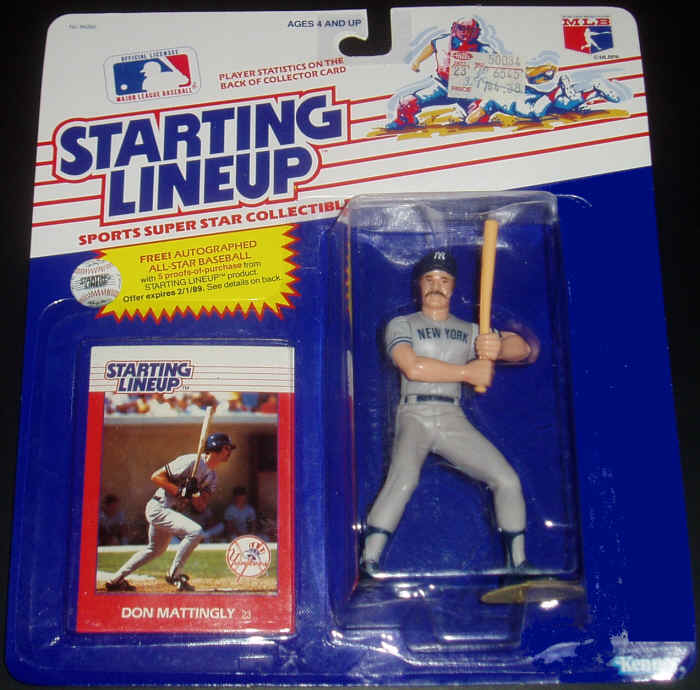
Transogram statues came out a few years before my time, so I know Kenner's similar line of "Starting Lineup" sets much better. They debuted in 1988 and most collectors picked up at least a few of their favorite players.

1988 Starting Lineup, Don Mattingly

Value: Transograms should be much rarer than Starting Lineup, but I found many of the players on eBay for affordable money. What you'll spend depends on how you want to collect them.
  1. Full boxes start at $25 and go up quickly. Mantle can push $1000 in NM condition.
  2. Cards trimmed from the box cost a few dollars for "commons" and $20+ for stars
  3. Statues alone price about the same as cards, though fewer of them survive
  4. Numbered card flaps cost $1 (commons) to about $20 (Mantle)

Fake / Reprints: Haven't seen reprints in the market, but it would be fairly easy for both cards and box flaps, so familiarize yourself with the set first if you're going to buy ungraded superstars.

Friday, January 17, 2014

1921 W516-2-1, W516-2-2, and W516-2-3 Baseball #5, Ty Cobb

I've written in the past about the strip cards dubbed W516, four classifying characters in a hobby whose apex of collectibles is the sprawling T206 set, dubbed "The Monster" by those who attempt it. While filled with variety, this umbrella covers a much smaller patch of ground.

On close inspection, W516 contains two different checklists (of the same 30 players) with two or three hand-written and typeset design permutations, for five total subsets. The #5 card for W516-1's checklist (two subsets) is Tris Speaker and for W516-2 (three subsets), it's Ty Cobb.

Thanks to eBay and auction listings, I've located scans for all three W516-2 Cobb variations. They're Ty's cheapest cards to acquire from his active career, due to limited collector interest in strip cards, so-called because most were bought in (and cut from) multi-card strips from vending machines at 1920s fairs and arcades.

W516-2-1: Typeset name, flipped image and IFC © 


W516-2-2: Hand-written name, flipped image and IFC © 


W516-2-3: Typeset name, correct image and IFC © 


Of these variations, only W516-2-3 correctly shows Cobb as a righty. The "IFC ©" points to William Randolph Hearst's International Feature Service, which I talk about more in my W516 Tris Speaker profile.

It'd be interesting to build the W516 subsets and might be the most affordable way to add legends like Ruth and Cobb to your collection. Good luck to any who accept that challenge! Find a thorough subset breakdown and galleries at OldCardboard.

UPDATE: As noticed by Commishbob, the W516-1-* subsets moved Ty Cobb to #6 with otherwise similar designs.

W516-1-1: Hand-written name, correct image and IFC © 


W516-1-2: Hand-written name, flipped image and IFC © 


Value: I bought a beat-up W516 Cobb for $20 not many years ago, so hold to the thought that $50 or less is reasonable for low-grade versions (with bad trimming or other damage). Some dealers assume any Ty Cobb card is worth hundreds of dollars, so prices vary significantly.

Fakes / reprints: I make the blanket assumption that all vintage Cobbs have been reprinted or faked in the past, so recommend working with a dealer you trust for these kind of purchases.

Monday, January 6, 2014

1951 Packard Sports Library #5, Baseball's 1924 World Series (Giants vs. Senators)

2014 marks two World Series "anniversaries" for John McGraw. First, it's been 110 years ago since he turned down a post-season series against AL pennant-winners Boston, calling his NY Giants champion "of the only real major league."


NL executives later realized how much they stood to gain financially by staging post-season exhibitions and McGraw went on to manage in several World Series, winning three. His final such appearance (1924 vs. Washington) is captured on #5 in this "Sports Library" series of digests produced by Packard Motor Cars. (McGraw is at lower-left, opposite Washington manager Bucky Harris.)

In 1924, New York marked the first time a team had played in 4 straight World Series, with the Giants winning in 1921-22 and losing to the AL in 1923-24. The series itself went a full seven games and the photo below captures Washington on the cusp of winning it all, as Earl McNeely's grounder bounced over third and scored Muddy Ruel in the bottom of the 12th inning. (It'd be Washington's only franchise title until after their move to Minnesota.)


Packard Motors printed their 5"x7", 16-page magazines for placement in showroom lobbies and service stations from 1951 to 1957 and this #5's from the initial year. Its 2-hole punch implies it came in a binder with other Sports Library issues or car sales info. Issues without punches, like Babe below, probably went out by mail.

1952 Packard Sports Library #15, Babe Ruth

Packard customized most magazines with a business address and many issues in the hobby today survive thanks to collectors who obtained autographs from 1950s stars like Ted Williams and Jackie Robinson on their covers.

1955 Packard Sports Library #4, autographed by Jackie Robinson

While not exactly cards, these issues make for interesting Americana, as an overlap of the post-WWII boom in automobiles and sports fandom. Individual articles read like time capsules from an era of classic sportswriting and are worth checking out just for that sweet 1950s art style.


Value: Single issues are easy to find on Amazon or eBay and non-baseball covers generally cost less than $20. Baseball stars in decent shape, like the Ruth cover above, might run more.

Fakes / reprints: Haven't seen any reprints in the marketplace.