Showing posts with label washington senators. Show all posts

Monday, January 8, 2018

1927 American Caramel Baseball (E126, set of 60) #5, E.T. Cox

Between the 1910s tobacco era and Goudey's landmark 1930s gum sets, candy and toy companies made most of America's baseball cards. Pennsylvania's own American Caramel Company produced several and this #5 comes from their 1927 "set of 60" issue, designated by collectors as E126. There's more to it than meets the eye, which I examine after name-checking E. T. Cox.


Ernest Thompson Cox pitched a single MLB game for Chicago on May 5, 1922. He faced 6 batters, walked 2 of them, gave up a hit, allowed 2 runs, and...that's it. E. T. never appeared in another White Sox game and, according to available stats, didn't play in the minors either following his 1922 big league appearance.

310 Pythian Place, a blog about Birmingham, Alabama history, provides a play-by-play account of Cox's single MLB appearance in "One Game -- One Inning." (It also mentions teammates mislabeled him as "Elmer," which is significant later.)

How and why did Cox pitch just one inning? I compared rosters for that year's AL teams and Chicago shuttled a lot of pitchers through their 1922 staff. The 1st place Yankees used a grand total of 8 pitchers for all 144 games. Cellar-dwelling Boston used 10. The White Sox used 18 and most made less than 5 appearances. All that roster shuffling speaks to oddities in the front office. Chicago endured the Black Sox trial and banning of eight players in 1921, so I imagine player management and finances proved chaotic in 1922. Chicago could've trimmed travel costs or other expenses by signing in-town players to the briefest of contracts. Perhaps something even more obscure was going on.


The 1927 E126 card back promotes their collectors album for "60 of the most prominent baseball players in the country." Since E. T. Cox hadn't played in 5 years, they're playing fast and loose with the truth. In fact, American Caramel's 1927 set is 90% re-cropped player photos from 1922, numbered #1-60. Match names in these galleries and you'll see what I mean.

Could a mistaken name or photo be how "E. T. Cox" ended up on a card? As mentioned above, American Caramel reused many photos and he first appeared in 1922 as "Elmer."


Did American Caramel get the right "Cox?" We have a few other 1920s candidates.

Future MLBer Elmer Joseph "Dick" Cox played outfield for Brooklyn in 1925-26, but toiled in the PCL as a Portland Beaver in the years American Caramel would've obtained this photo. An Oregon-based outfielder wouldn't strike pitching poses for the 1922 White Sox. No real chance that's our guy.

Plateau Preston Rex "Red" Cox hurled three games for Detroit in early 1920, with some minor league years thereafter. I can't find any evidence he played for Chicago.

Leslie Warren "Les" Cox pitched two career games for Chicago, both in September 1926, so he's a peripheral match for someone named Cox appearing in this 1927 set. It's believable an American Caramel employee reused this 1922 card based on Chicago's 1926 roster containing a guy named "Cox."

George Melvin Cox pitched a full 1928 season for Chicago, six years too late to be on a photo from 1922 or earlier. If American Caramel printed E126 in 1928, they could've again picked E. T. based on last names alone.

Back in 2004, collectors on the Net54 baseball card discussion board asked similar questions about E. T. Cox in the thread, "E126: Who is card #5?" They arrived about where we are now, with a smattering of overlapping baseball stats and one enigmatic photo of a White Sox pitcher.


That Net54 conversation hints at another reason American Caramel dusted off their 1922 photos and revamped them for 1927: stars Ty Cobb had just joined the Philadelphia A's, and Tris Speaker, the rival Washington Senators.


Cobb and Speaker weathered game-fixing allegations following the 1926 season (see Cobb's SABR bio for details) and both announced plans to retire. When baseball commissioner Mountain Landis declared them innocent of the gambling allegations, they followed lucrative contracts to new cities for the final years of their legendary careers.

It's a good bet that Pennsylvania-based American Caramel capitalized on Cobb's arrival in Philly to rush out a smaller version of their earlier sets, updating current teams and adding album-based encouragement for collectors to get all 60 cards. I can't find an E126 album online (yet), so expect they adapted these similar E120 albums from 1922.

1922 E120 "set of 240" AL and NL albums

As mentioned earlier, I think E. T. reappeared for 1927 because American Caramel might've referenced a recent White Sox roster with a pitcher named "Cox" (Les in 1926 or George in 1928, depending on actual year of printing) and mistook them for E. T., so he got a second card out of it.


I also have a theory about why E126 cards prove so scarce today. That on-card (IF)S copyright by Cox's foot stands for International Features Service, a William Randolph Hearst-owned source of news wire photos and publisher of baseball strip cards from the 1910s and 1920s. (IFS also appears in my W516 post about Cobb and Speaker.)

When American Caramel printed their 1922 E120 "set of 240," photo attribution appears on every card, some for IFS and some for other photo sources. None of their re-cropped 1927 E126 "set of 60" photos show these attributions, which could've raised legal issues and cut short the distribution of cards.

Value: 1927 American Caramel cards don't come along very often. Legendary Auctions sold a graded set for $15,000 in 2007 and low-grade commons go for $50. This fair-good Cox card cost me $40 on eBay.

Friday, December 30, 2016

Top 5 Photos from R313 National Chicle "Fine Pen" Premiums

The 1930s produced great vintage sets, including some of my favorite individual cards.

1933 Goudey #155, Joe Judge

Those blue lines and bloused uniform, wow. Such clean, outstanding work.

Hand-tinted, line-heavy figures like this Joe Judge reflect similar Art Deco stylings of the era.

Laurence Fellows (1885-1964) - 1930s Fashion

Boston gum competitors National Chicle and Goudey, top card makers of the 1930s, each took a shot at on-card Deco, possibly sharing the same on-card artists, since both companies operated just a few miles apart in Boston and Cambridge, MA. National Chicle made "Diamond Stars Gum" in that style and it still looks great.

1934-36 National Chicle #9, Mickey Cochrane

Artists hand-painted each player from photos, adding spirit and depth to black-and-white originals. As with Mickey Cochrane, they often swapped out realistic backgrounds for something more artistic.

But painted pieces don't tell the whole story. As the Great Depression deepened and fewer fans had pocket change for luxuries, card makers cut costs by creating less "artistic" options to offer alongside their fancier packs. Both companies printed batches of postcard-sized "premium" photos later catalogued as R313 (National Chicle) and R314 (Goudey). Collectors swapped their card wrappers for these photo premiums in stores or via mail.

Since R313 and R314 black-and-white premiums aren't as familiar to modern collectors, let's look at five of them to get a feel for their style.

1. Chicago City Series, Washington Safe

Most R313s show player portraits, but several were action shots with descriptions scrawled on the front. I had to Google "Chicago City Series" for more context on this play at first.


"Chicago City Series" would've been familiar to 1930s fans, but it's a tradition that's gone by the wayside. It alludes to a postseason matchup between the Cubs and White Sox that ran 26 times between 1903 and 1942. After many of those regular seasons, both teams faced off in a World Series-like best of 7. (See SABR's overview of this particular city series.)

I'm not aware of play-by-play from these games, so can't say for sure what play this photo shows, apart from White Sox OF George Washington about to beat #14 (Cubs P Larry French) to first base, as French searches for the bag with a raised foot.

2. Glenn Uses Football Play At Plate

The play below's much more dramatic than #1's infielder grounder and could easily send a guy to the locker room for x-rays. I mean, look at that knee, ouch.


This play's from a preseason exhibition, given its rural background and long woolen sleeves on the runner. "Glenn" is Yankee Joe Glenn, a part-time backstop for several seasons in the Bronx and elsewhere (career stats). Not sure who the runner or umpire would be, but remember the shape of that tree on the left...

3. Joe DiMaggio Slams It, Erickson catching

This 1936 photo shows a dynamic Joe DiMaggio tracking his shot to left field and headed for first. It's one of Joe's earliest pro images and perhaps his first card in a real Yankee uniform. We know this is spring training in part because Joe entered Yankee camp as #18, but changed numbers by Opening Day.


"Erickson catching" is Reds backstop Hank Erickson, who played sparingly in 1935 and failed to stick in the bigs for 1936 (career stats). This is Hank's only card in a Cincy uniform and he appeared on just one other during his career, as a minor-league Toronto Maple Leaf on Goudey's aforementioned R314 Premiums.

Remember that tree earlier? Look behind Joe and you'll recognize the same limb and leaf structure. Also compare the angled roof above that umpire to the circular inset on this postcard from New York's St. Petersburg training site. It confirms where we are: the ball fields at Crescent Lake Park.


Given the similarity in camera angles, I suspect both card photos come from the same 1936 Yankees vs. Reds spring training game. It wouldn't be the first or last time a card maker saved money by creating several cards from the same game!

TIP: Want a DiMaggio card from his playing days? This R313 remains his most affordable, running $100-300 in low grade.

4. Oswald Bluege for WGN


This candid of lifelong Washington Senator Oswald Bluege holding a WGN microphone is ahead of its time and would be right at home in a modern Topps set. High five to National Chicle for including something so whimsical at a time when baseball served as an important distraction from the Great Depression for many Americans.

5. Honus Wagner

The immortal Honus holding a baseball. That works for me.


Wagner turned 62 in 1936 and was inducted that year as part of baseball's "first Hall of Fame class" with Ruth, Cobb, Mathewson, and Walter Johnson. He's shown in uniform as the Pirates hitting instructor and continued in that capacity through 1952.


If you're ever in Pittsburgh and stop by its terrific PNC Park, you can still touch history by visiting the Honus Wagner statue. The Flying Dutchman himself attended its unveiling in 1955 and his likeness followed the Pirates to a pair of new ballparks since. The past is never far away!

Thursday, March 24, 2016

Comparing the Rookie Stars of 1959 and 1960 Topps All-Star Rookie Teams

This article profiles the first Topps All-Star Rookie Team, selected and announced in late 1959. I've researched Topps subsets and on-card advertising recently, but hadn't found an easy reference for the 1959 "rookies," especially the subset of rookie trophies that first appeared on 1960 cards. Topps appears to have promoted it using both Topps Chewing Gum and Bazooka brands, first referring to it as "Young America's All-Star Rookie Team" on ballots.

Young America's All-Star Rookie Team ballot (from Bob Lemke's post)

The ballot's fine print offers key details: "See the winning team on 'World Series Special'--NBC-TV Network--Tuesday, Sept. 29." September 29 was the expected eve of 1959's first World Series game, so All-Rookie Team balloting drove attention toward NBC's broadcast, not to cards per se. I assume All-Star Rookie balloting took place late in the season to focus collectors on that date. It's possible Topps targeted balloting to big media markets or teams still in the pennant race (LA, Milwaukee, SF, Chicago, Cleveland, NY) to capture maximum interest.

Some of the Topps All-Star Rookie Team also appeared on 1959 cards. Here's the full list, as shown in both the year of election and with their 1960 Topps All-Star Rookie trophy, their first year for on-card trophies.

CATCHER: John Romano (Chicago 1959, Cleveland 1960)

1959 Topps #138, John Romano (Chicago)
1960 Topps #323, Johnny Romano (Cleveland)

Johnny won't be the first to swap teams for 1960 and won't be the last guy from Cleveland.

FIRST BASE: Willie McCovey (no 1959 card, SF 1960)

1960 Topps #316, Willie McCovey

Willie won the 1959 NL Rookie of the Year award after a torrid second half. He appeared in just 52 games, the fewest ever by a non-pitcher ROY winner, but served a key role in keeping SF close to LA and Milwaukee through the season's final week. McCovey debuted too late for a 1959 Topps card, but thanks to the late-season nature of their All-Rookie Team, became a shoo-in at first base.

SECOND BASE: Pumpsie Green (no 1959 card, Boston 1960)

1960 Topps #317, Pumpsie Green

Pumpsie Green's best-known as the guy who integrated MLB's last team to integrate, the Boston Red Sox, when he took the field on July 21, 1959. Like McCovey, his debut came too late for the 1959 set, which would've been printed by that time.

THIRD BASE: Jim Baxes (LA 1959, Cleveland 1960)

1959 Topps #547, Jim Baxes
1960 Topps #318, Jim Baxes

Jim played enough in LA to garner a high-numbered 1959 card, but switched teams before the year was out, becoming our second Cleveland player with a 1960 trophy. Jim never returned to the bigs after 1959, so these are his only two Topps cards.

SHORTSTOP: Joe Koppe (Philadelphia 1959-60)

1959 Topps #517, Joe Koppe
1960 Topps #319, Joe Koppe

Koppe's striking a pitching pose on his 1959 card, but played infield throughout his career.

OUTFIELD: Bob Allison (Washington 1959-60)

1959 Topps #116, Bob Allison
1960 Topps #320, Bob Allison

Bob won 1959's AL Rookie of the Year, finishing just ahead of fellow All-Star Rookie Jim Perry.

OUTFIELD: Ron Fairly (LA 1959-60)

1959 Topps #125, Ron Fairly
1960 Topps #321, Ron Fairly

Ron's two career All-Star appearances were for Canadian teams (Montreal 1973, Toronto 1978). Trivia bonus!

OUTFIELD: Willie Tasby (Baltimore 1959-60)


1959 Topps #143, Willie Tasby
1960 Topps #322, Willie Tasby

Willie moved to Boston early in 1960 and enjoyed the best hitting of his career. Washington selected him in their 1961 expansion draft, but moved him to Cleveland in 1962, ultimately splitting his six year career across four AL franchises.

RIGHT-HANDED PITCHER: Jim Perry (Cleveland 1959-60)

1959 Topps #542, Jim Perry
1960 Topps #324, Jim Perry

Not just any right-handed pitcher, this is the elder brother of HOF Gaylord Perry and was almost as good, winning 215 career games. Thanks to team changes by Johnny Romano and Jim Baxes, Perry was Cleveland's third representative on the ten-man Topps All-Star Rookie team.

LEFT-HANDED PITCHER: Jim O'Toole (Cincinnati, 1959-60)

1959 Topps #136, Jim O'Toole
1960 Topps #325, Jim O'Toole

Jim is just one of several guys with Topps rookie cards before their Topps All-Star Rookie card.

Wrapping It Up

Thanks to the breadth of The Sporting News Rookie Stars subset (1959 Topps #116-146) and high series additions (Jim Baxes, Jim Perry, Joe Koppe), the 1960 Topps All-Star Rookies mark the first card for only two guys, Pumpsie Green and Willie McCovey.


Topps All-Star Rookies weren't the only rookies in 1960. SPORT Magazine also sponsored a rookie subset, with this Yaz RC its best known, but the tradition of Topps All-Star Rookie trophies won out thereafter.

If 1960 Topps #316 wasn't enough McCovey, he picked up a second card in 1960's high series as a SPORT Magazine All-Star Selection.

1960 Topps #554, Willie McCovey SPORT Magazine '60 All-Star

Note the 1960 Topps All-Star subset was chosen by SPORT Magazine, not MLB itself. Willie didn't appear on either roster for the 1960 MLB All-Star games (July 11 and July 13). Trivia double bonus!

Thursday, June 12, 2014

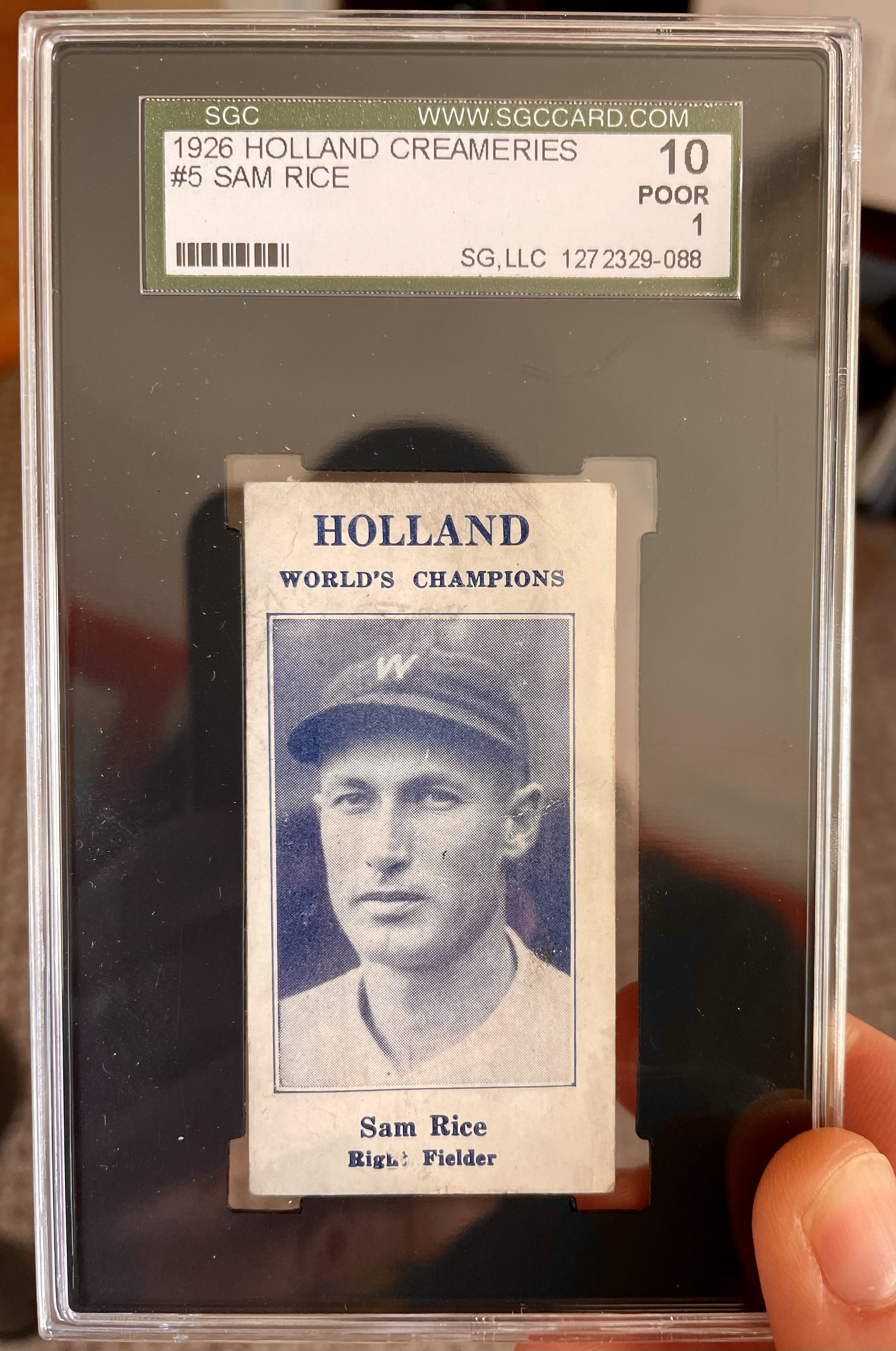
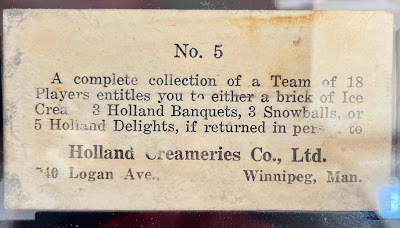
1925 Holland Creameries World's Champions Baseball #5, Sam Rice

I've already written about the 1924 World Series, thanks to the 1951 Packard Sports Library series of car dealership sports magazines. Reportedly a candidate for "best-ever" Series, it's one of a handful to end in game seven's extra innings, as Muddy Ruel scored the winning run on a bad-hop single in the bottom of the 12th. For HOFers Sam Rice and Walter Johnson (and many of their Washington Senators teammates), it'd be their only year as "World's Champions." (While SGC slabbed this as 1926, it makes more sense as issued in 1925, one year after their 1924 title.)


Beyond the Series and players, what do we know about the card set? First off, "Holland" is Holland Creameries, a Winnipeg-based milk and ice cream distributor. Their small set, similar in size and design to 1920s candy issues, is that entity's most enduring creation and its PSA collection registry comes in at the top of their Google results. It's hard to imagine any other way you'd discover that kind of defunct corporation, unless you're a fan of Canadian ice storage journals.

If you did want to find the company, the earliest mention I came across refers to Holland Creameries executives exploring expansion into new facilities in and around Winnipeg.

Refrigerating World, April 1921

Prospective expansion gives an air of corporate health, but by mid-1928, fellow dairy Canada Pure Milk took over Holland's in-city deliveries, probably as a new owner of its assets and customers. Thanks to Google, I even found their transition notice in local papers.
"STARTING FRIDAY, JUNE 1st, a fleet of 15 wagons will commence delivering to customers in Winnipeg and St. Boniface. This service will be extended, as development warrants, to cover the city and suburbs. Pure Milk is the product of Canada Pure Milk Ltd., a new Winnipeg firm which has taken over the plant of the Holland Creameries Co., Ltd., which includes up-to-date pasteurization and homogenizing equipment...We will continue to serve all former patrons of the Holland Creameries, and as soon as conditions warrant, will extend our service to all parts of the city." - ad from Winnipeg Tribune, May 31, 1928

Prior to its demise, I imagine kids obtained cards from Holland delivery drivers or stores that carried their products. On-card promotions invited local collectors to redeem all 18 for a selection of ice creams, but Holland limited giveaways by short-printing #16, Roger Pickinpaugh, and stamping all redeemed cards to prevent "re-use." This #5 shows no redemption marks, so never made it to the factory.


That a Manitoba dairy saw money to be made from an American team says a lot about the reach of pro baseball in those days, but it wasn't their only dalliance with sports promotions. Earlier in the 1920s, Holland first printed what you'd expect of a Canadian company, a collection of hockey stars.


Based on the careers of its 10-player checklist, Holland distributed this set in or after 1920, as pictured players had Winnipeg connections beginning at that time. Most catalogs and grading companies date Holland's hockey set to 1924. I think sports ephemera was less "seasonal" in those days, so it's entirely possible they started printing cards in 1920 and just didn't stop, even after players like Frank Frederickson left town; he skated for Victoria by 1925, but was likely still remembered by local fans.


Here's an apparent full-set redemption, with hole punches as evidence that a kid got their ice cream.


UPDATE: More scans from this rare set, including Walter Johnson and several "utility men."


Value: Holland Creameries baseball and hockey sets are rare and valuable, so expect to pay $100+ for cards in any condition. I bought my #5, one of this set's key HOFers, for $1400 from another collector in 2022.

Fakes / reprints: I imagine fakes and reprints exist, with the caveat that only advanced collectors are likely to seek out this set, so hopefully wouldn't be taken in by a forgery.

Monday, January 6, 2014

1951 Packard Sports Library #5, Baseball's 1924 World Series (Giants vs. Senators)

2014 marks two World Series "anniversaries" for John McGraw. First, it's been 110 years ago since he turned down a post-season series against AL pennant-winners Boston, calling his NY Giants champion "of the only real major league."


NL executives later realized how much they stood to gain financially by staging post-season exhibitions and McGraw went on to manage in several World Series, winning three. His final such appearance (1924 vs. Washington) is captured on #5 in this "Sports Library" series of digests produced by Packard Motor Cars. (McGraw is at lower-left, opposite Washington manager Bucky Harris.)

In 1924, New York marked the first time a team had played in 4 straight World Series, with the Giants winning in 1921-22 and losing to the AL in 1923-24. The series itself went a full seven games and the photo below captures Washington on the cusp of winning it all, as Earl McNeely's grounder bounced over third and scored Muddy Ruel in the bottom of the 12th inning. (It'd be Washington's only franchise title until after their move to Minnesota.)


Packard Motors printed their 5"x7", 16-page magazines for placement in showroom lobbies and service stations from 1951 to 1957 and this #5's from the initial year. Its 2-hole punch implies it came in a binder with other Sports Library issues or car sales info. Issues without punches, like Babe below, probably went out by mail.

1952 Packard Sports Library #15, Babe Ruth

Packard customized most magazines with a business address and many issues in the hobby today survive thanks to collectors who obtained autographs from 1950s stars like Ted Williams and Jackie Robinson on their covers.

1955 Packard Sports Library #4, autographed by Jackie Robinson

While not exactly cards, these issues make for interesting Americana, as an overlap of the post-WWII boom in automobiles and sports fandom. Individual articles read like time capsules from an era of classic sportswriting and are worth checking out just for that sweet 1950s art style.


Value: Single issues are easy to find on Amazon or eBay and non-baseball covers generally cost less than $20. Baseball stars in decent shape, like the Ruth cover above, might run more.

Fakes / reprints: Haven't seen any reprints in the marketplace.