Wednesday, January 22, 2014

Top Five Interesting Things About 1958 Topps

1958 marks a point of significant transition for modern set design. Here are five things that distinguish this one for baseball fans and collectors.

1. California adds first MLB franchises at New York's expense

Brooklyn Dodgers in LA...
...and New York Giants in SF

2. A little too much yellow ink

Thirty-three of the first 108 cards have yellow player or team names, giving variation fans some extra work. Best-known is #30, Hank Aaron.


3. First All-Star cards (#474-495) & the return of Stan Musial

This Topps set debuted All-Star Game lineups (from 1958's game in Baltimore) and its late-season series featured the first mass-produced Stan Musial card since Bowman's 1953 photo set. It's even possible Topps added this All-Star subset thanks to Musial's return; they made it a regular feature soon after.


TRIVIA: Given the 1958 All-Star Game's proximity to Washington, D.C., MLB invited Vice President Richard Nixon to throw out its first pitch, a task he repeated many times as President.

4. Ed Bouchee, You're Outta Here (no #145)

Major League Baseball suspended Ed Bouchee for most of 1958, so Topps did the same.


While Ed appears on this checklist at #145, no card of Bouchee exists outside of hobby creations like the one by SCD editor Bob Lemke.

5. Team Card are Checklists and Checklists are Team Cards

#44 above is also the Washington Senators team card, as Topps first integrated set tracking into the "regular" series.


Topps left 1956 & 1957 checklists unnumbered, assuming kids would discard them after filling all the boxes. Customers might've requested this change, or at least responded well to it, because Topps made it a part of numbered sets going forward.

The Hall of Thanks

OldBaseball.com friends Wes Shepard, Mark Zentkovich, Lynn Miller, Sal Domino, Kevin Martens, and Don Rice all aided my upgrade quest; several hits shown below.


Jan 22: four-pack of upgrades from Mr. Haverkamp!


For posterity, here's the Walt "Moron" card he upgraded. Ouch.


Aug 4: Upgraded #227 Vern Stephens at the 2014 National!

July 30: Five six upgrades from OldBaseball.com brothers at the 2015 National!

Tuesday, January 21, 2014

1969-70 Transogram Baseball Figures #5, Jose Cardenal

Every now and then, a company produced actual baseball statues, just right for collectors to build little ballparks on their desks and bedroom floors. Toy company Transogram produced just such a lineup in 1969, crafting 60 different 3.5" plastic players in all.


Each one came in a cellophane display box and, over time, jostling could leave figures in unsettling poses. Arms are not supposed to flap like wings, even for guys named after a bird species.

Card number and photo from box flap

Numbers appear on the inside top flap and back panels included a trim-away card, which are easier to find than the boxes or statues.


The actual statues look generic, apart from a player name slapped on the back (full checklist).

Al Kaline statue with glued-on label

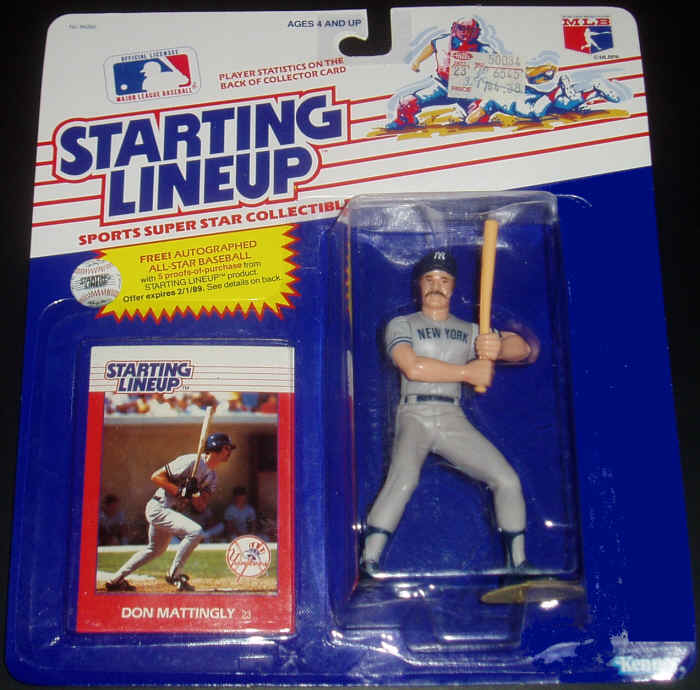
Transogram statues came out a few years before my time, so I know Kenner's similar line of "Starting Lineup" sets much better. They debuted in 1988 and most collectors picked up at least a few of their favorite players.

1988 Starting Lineup, Don Mattingly

Value: Transograms should be much rarer than Starting Lineup, but I found many of the players on eBay for affordable money. What you'll spend depends on how you want to collect them.
  1. Full boxes start at $25 and go up quickly. Mantle can push $1000 in NM condition.
  2. Cards trimmed from the box cost a few dollars for "commons" and $20+ for stars
  3. Statues alone price about the same as cards, though fewer of them survive
  4. Numbered card flaps cost $1 (commons) to about $20 (Mantle)

Fake / Reprints: Haven't seen reprints in the market, but it would be fairly easy for both cards and box flaps, so familiarize yourself with the set first if you're going to buy ungraded superstars.

Friday, January 17, 2014

1921 W516-2-1, W516-2-2, and W516-2-3 Baseball #5, Ty Cobb

I've written in the past about the strip cards dubbed W516, four classifying characters in a hobby whose apex of collectibles is the sprawling T206 set, dubbed "The Monster" by those who attempt it. While filled with variety, this umbrella covers a much smaller patch of ground.

On close inspection, W516 contains two different checklists (of the same 30 players) with two or three hand-written and typeset design permutations, for five total subsets. The #5 card for W516-1's checklist (two subsets) is Tris Speaker and for W516-2 (three subsets), it's Ty Cobb.

Thanks to eBay and auction listings, I've located scans for all three W516-2 Cobb variations. They're Ty's cheapest cards to acquire from his active career, due to limited collector interest in strip cards, so-called because most were bought in (and cut from) multi-card strips from vending machines at 1920s fairs and arcades.

W516-2-1: Typeset name, flipped image and IFC © 


W516-2-2: Hand-written name, flipped image and IFC © 


W516-2-3: Typeset name, correct image and IFC © 


Of these variations, only W516-2-3 correctly shows Cobb as a righty. The "IFC ©" points to William Randolph Hearst's International Feature Service, which I talk about more in my W516 Tris Speaker profile.

It'd be interesting to build the W516 subsets and might be the most affordable way to add legends like Ruth and Cobb to your collection. Good luck to any who accept that challenge! Find a thorough subset breakdown and galleries at OldCardboard.

UPDATE: As noticed by Commishbob, the W516-1-* subsets moved Ty Cobb to #6 with otherwise similar designs.

W516-1-1: Hand-written name, correct image and IFC © 


W516-1-2: Hand-written name, flipped image and IFC © 


Value: I bought a beat-up W516 Cobb for $20 not many years ago, so hold to the thought that $50 or less is reasonable for low-grade versions (with bad trimming or other damage). Some dealers assume any Ty Cobb card is worth hundreds of dollars, so prices vary significantly.

Fakes / reprints: I make the blanket assumption that all vintage Cobbs have been reprinted or faked in the past, so recommend working with a dealer you trust for these kind of purchases.

Monday, January 6, 2014

1951 Packard Sports Library #5, Baseball's 1924 World Series (Giants vs. Senators)

2014 marks two World Series "anniversaries" for John McGraw. First, it's been 110 years ago since he turned down a post-season series against AL pennant-winners Boston, calling his NY Giants champion "of the only real major league."


NL executives later realized how much they stood to gain financially by staging post-season exhibitions and McGraw went on to manage in several World Series, winning three. His final such appearance (1924 vs. Washington) is captured on #5 in this "Sports Library" series of digests produced by Packard Motor Cars. (McGraw is at lower-left, opposite Washington manager Bucky Harris.)

In 1924, New York marked the first time a team had played in 4 straight World Series, with the Giants winning in 1921-22 and losing to the AL in 1923-24. The series itself went a full seven games and the photo below captures Washington on the cusp of winning it all, as Earl McNeely's grounder bounced over third and scored Muddy Ruel in the bottom of the 12th inning. (It'd be Washington's only franchise title until after their move to Minnesota.)


Packard Motors printed their 5"x7", 16-page magazines for placement in showroom lobbies and service stations from 1951 to 1957 and this #5's from the initial year. Its 2-hole punch implies it came in a binder with other Sports Library issues or car sales info. Issues without punches, like Babe below, probably went out by mail.

1952 Packard Sports Library #15, Babe Ruth

Packard customized most magazines with a business address and many issues in the hobby today survive thanks to collectors who obtained autographs from 1950s stars like Ted Williams and Jackie Robinson on their covers.

1955 Packard Sports Library #4, autographed by Jackie Robinson

While not exactly cards, these issues make for interesting Americana, as an overlap of the post-WWII boom in automobiles and sports fandom. Individual articles read like time capsules from an era of classic sportswriting and are worth checking out just for that sweet 1950s art style.


Value: Single issues are easy to find on Amazon or eBay and non-baseball covers generally cost less than $20. Baseball stars in decent shape, like the Ruth cover above, might run more.

Fakes / reprints: Haven't seen any reprints in the marketplace.

Friday, December 20, 2013

Goudey's 1934 Big League Gum Baseball Trivia

This post isn't trivia about a 1934 Goudey baseball set. This post is trivia FROM a 1934 Goudey baseball set. Already deep into that year's release, the company's designers added some late-season Q-and-A to their follow-up on 1933's successful debut, perhaps to spice up what was otherwise a parade of marginal players. (That's one reason I consider 1934 an "update" to 1933; more details in A Closer Look at 1933-34 Big League Gum.)

1934 Big League Gum #73-96 sheet + "1933" Lajoie

Goudey published several "series" of Big League Gum cards in 1934, four runs of 24 players each, for 96 cards total. The above 5x5 card sheet comprised that final group, #73-96, with an extra spot for the "1933" #106 Nap Lajoie (green background near upper-right).

Goudey often switched numbers between series to leave gaps, hoping kids would buy more cards to fill them, but #73-96 looks to be all there. (Perhaps they realized there wouldn't be a fifth series to swap numbers with.)

1934 Big League Gum #73, Ed Wells

One can guess that a fourth run of cards would come out mid-season, but Goudey's inclusion of trivia questions, some from 1934 itself, narrows the release window to "post-May" and perhaps after that year's All-Star Game on July 10th. Let's start with its first card, Ed Wells, and flip him over to find this question.


Hall of Fame manager John McGraw passed away in early 1934, so this question's a tribute of sorts. It's pretty esoteric to know who he "turned down," though. Big League Gum #85, Adam Comorosky, has the answer, or at least the factual part of it.


OK, McGraw didn't get every call right. But according to Giants team historians, he passed sight-unseen on the Cooperstown talent of Lefty Grove thanks to bad feelings over missing out on Babe Ruth in 1914. The moral: don't hold grudges, kids.

Each of the first twelve cards in that series (#73-84, all American Leaguers) asked a question answered by the final twelve (#85-96, all National Leaguers). Singles from the whole series are scarce and it's a pricy proposition to acquire all 24, so here's its full trivia list for hobby posterity, with relevant notes and links.

  • #73 Ed Wells, Q: What pitcher was turned down by John McGraw?
  • #85 Adam Comorosky, A: Lefty Grove in 1926

  • #74 Bob Boken, Q: Who was the most consistent base-stealer last year? [i.e., 1933]
  • #86 Lloyd Johnson, A: Pepper Martin, 26 out of 35

Martin's 26 thefts led the NL, earning him a "most consistent" title. Today, we might pin that on the guy who stole bases at the highest percentage of success above a certain threshold.

  • #75 Bill Werber, Q: Who struck out the greatest number of times last year? [1933]
  • #87 George Darrow, A: Jimmy [sic] Foxx, Philadelphia A's, 93

  • #76 Hal Trosky, Q: What NL player has already played in over 2000 contests?
  • #88 Homer Peel, A: Frankie Frisch of the St. Louis Cardinals

  • #77 Joe Vosmik, Q: Who hit into the first triple play this year? [i.e., 1934]
  • #89 Linus Frey, A: Irv Jeffries, Phillies vs. Braves, off Frankhouse May 29th [box score]

That May 29th "triple play game" dates Goudey's fourth series to June, if not later.

  • #78 Pinky Higgins, Q: Who has the highest lifetime batting average?
  • #90 Ki-Ki Cuyler, A: Ty Cobb .370 [still MLB's all-time leader; correct figure is .366]

  • #79 Eddie Durham, Q: What noted player has taken part in the most World Series games?
  • #91 Dolph Camilli, A: Babe Ruth, 41 games [now Yogi Berra, 75]

  • #80 Marty McManus, Q: What was the longest game ever played?
  • #92 Steve Larkin, A: Brooklyn & Boston 1920, 1-1 tie in 26 innings [still the record; box score]

  • #81 Bob Brown, Q: What was the greatest number of scoreless innings pitched last year and who pitched them?
  • #93 Fred Ostermueller, A: 46 innings by Carl Hubbell, July 13th - August 1, 7 games


  • #83 Jim Mooney, Q: Who holds the record for driving in the most runs in a single season?
  • #95 Myril Hoag, A: Hack Wilson of the Cubs, 190 in 1930 [since corrected to 191]

  • #84 Paul Derringer, Q: What pitcher holds the record for most consecutive games won?
  • #96 James DeShong, Q: Rube Marquard, 19 with the Giants in 1912

Marquard started his 1912 season by winning 19 in a row for John McGraw's Giants, the eventual NL pennant winners, and still holds this record. Check out "Winning Streaks by Pitchers" from the SABR archives for plenty more on the subject.

1909-11 T206 Piedmont Tobacco, Rube Marquard (portrait)

BONUS RUBE: Marquard was the last living player from another seminal set, T206 tobacco. He passed away on June 1, 1980, just long enough to appear in (and sign) the 1979 Diamond Greats set of then-living former players.

1979 Diamond Greats #26, Rube Marquard

As noted in my Diamond Greats set profile, Marquard appeared on vintage cardboard sets nearly 70 years apart, which might itself be another record. Trivia on top of trivia! Such was baseball and collecting, even back in the 1930s.

Wednesday, December 11, 2013

A Closer Look at National Chicle's 1934-36 Diamond Stars Gum (and #5, Tom Bridges)

I've been delving into old gum and candy companies for more than a month, reading from dusty online forums about All-Star Games and World Expos and crusty candy factories. Spend enough time poring though the history of 1930s baseball cards and you'll forget that other decades and companies even exist. (Topps, Donruss, and Fleer? Is that a New York law firm?)


Great Depression or no Great Depression, one reason to get lost in that seminal decade is today's profile, the Diamond Stars baseball set made by National Chicle. Nothing but color-saturated, Art Deco glory packaged with gum for a penny each.

Before we dive any deeper into how this particular set came to be, I'll note gum-and-card packs in general didn't just "happen" 80 years ago. They reflected a business-savvy combination of food technology, fan technology, and finance technology.

First, you needed gum and paper mixes that didn't destroy each other. Topps cards are infamous for picking up stains during packaging, but early commercial chewing gum (based on tree sap) stuck to anything and the plasticity of 1930s formulations lessened this impact. Second, the national growth of broadcast radio meant most fans didn't attend games in person, so baseball cards made an attractive visual companion. Finally, 1933 marked America's departure from the strict gold standard, freeing investment for new lines of business...like marketing cards with gum.

Wagner cigar box from a history of tobacco cards

Returning to baseball, tobacco companies produced baseball's first generation of cards, roughly 1890 to 1910, but eventually abandoned them as marketing tools, given spiraling costs of paper and printing. I think their artistic apex was the Turkey Reds set of "cabinets," large pastoral images printed on cardboard stock (more info at T3TurkeyRed.com). It's a quality predecessor for Diamond Stars' painted look.

1910-11 Turkey Red Tobacco #5, Sam Crawford 

Once tobacco left this market, candy makers and strip cards took over for the next 20 years, churning out low-end baseball promos in an era that evolved from Dead Ball to Babe Ruth. Fast-and-loose production yielded cruder images, but also makes them affordable for modern collectors looking to buy a legend.

1919 W514 Strip Card #2, Babe Ruth

The tail end of that candy era included two sets that either inspired or reflected card designs for the next decade. First, as candidates campaigned in 1932, the Boston-based U.S. Caramel Co. capitalized on stateside political fervor with a set of 31 "American Heroes" (the presidents), from George Washington to a newly-elected Franklin Delano Roosevelt.

U.S. Caramel "American Heroes" (Presidents)

U.S. Caramel reused the Presidents size (2-3/8" by 2-7/8") and basic design for their "Famous Athletes," a 32-card set of baseball players (27), boxers (3), and golfers (2). These wider cards added some protection to malleable slabs of candy, the reverse of tobacco's need for slimmer cards that fit vertically in cigarette packs.

1933 U.S. Caramel Famous Athletes #5, Earl (Earle) Combs

I've already profiled this Famous Athletes set, but it fits here because Boston-based trading card competitors Goudey and National Chicle adopted a similar card size, packaging, and back layout for their own gum sets, starting in 1933. U.S. Caramel, in turn, copped its back design (but on wider stock) from other candy makers, like this 1930 Schutter-Johnson Candy "I'm Going To Be" set of aspirational cards.


While technically a non-sport set, #19 is "baseball player." Compare this chronological back progression from Schutter-Johnson...


...to U.S. Caramel's #5 (including text and prize giveaway)...


...to George C. Miller, a Boston candy maker who exchanged sets for a fielder's mit (sic), grandstand ticket, or baseball...


...to Goudey's 1933 Big League Gum #5, Babe Herman, which drops the prize giveaway...


...to National Chicle's aviation-themed Sky Birds Gum set, released in late 1933...


...to the back of 1934-36 Diamond Stars #5, which adds more player bio and a pro-written baseball tip. (That's the tiny signature of Austen Lake, a sportswriter for the Boston American newspaper in those days.)


Diamond Stars Gum's text-heavy look debuted in 1934, but ensuing years added stat updates to some cards. The "In 1934 won 22, lost 11 games" text on my #5 points to a 1935 release. Some printings, including this 1936 version, use blue ink.

1936 Diamond Stars #5 (note "Won 21, lost 10 in 1935")

National Chicle advertised a target of "240 major league players," but stopped at just 108, probably thanks to The Great Depression and fading sales. A master set of stat variations, green/blue ink backs, and error corrections ("Earnie" vs. "Ernie" and "Greenburg" vs. "Greenberg") from all three years totals 168 cards.

National Chicle's 1933-34 Skybirds #43, Juan de la Cierva

Diamond Stars predecessor Skybirds Gum introduced National Chicle's Art Deco look and is one of the hobby's most appealing non-sports sets. Its wrappers offered promotions similar to Diamond Stars, swapping wrappers for aviator wings and a flight handbook.


U.S. Caramel required that you mail in an entire set of 31 cards for their freebies, so National Chicle's switch to candy counter wrapper exchanges saved kids a lot of trouble, especially given the 100+ set sizes. (See all 8 Diamond Stars wrappers in OldCardboard's gallery.)

1934 Diamond Stars wrapper (7 photos)

National Chicle packaged these postcard-sized "photographic art pictures" (collectors call them Premiums) with in-store promotional plaques encouraging gum buyers to make the swap.

Diamond Stars store promo (checklist #7-11)

Premiums represented a two-fold marketing strategy. First, convince kids to spend at least 15 cents on Diamond Stars and keep their money in one brand. Second, bring kids back to the same store for repeated exchanges, so they felt invested in both the gum and its seller. Cataloged R311 and nicknamed "glossy" or "leather" depending on the photo gloss, 1934-36 Premiums remain plentiful on eBay today.

Goudey 1939 Diamond Stars Premium, Joe DiMaggio

Goudey acquired the "Diamond Stars" name after National Chicle's bankruptcy in 1937. They produced two sets of Premiums under that brand, now cataloged as R303-A or -B, and a similar design for Canadian distribution via their World Wide Gum subsidiary. Collectors agree they're attractive pieces, if a bit pale in comparison to Chicle's cards of many colors.

I hope this tells you more than you knew before about a great 1930s set. More about Goudey's Canadian operations in a future post!

Value: I was lucky to receive today's #5 gratis from a collecting friend. Low-grade Diamond Star commons run about $10 on eBay, but stars and high numbers cost several times that.

Fakes / reprints: Many reprint sets exist, and people have probably faked the stars, too. Several "modern retro" sets reproduced its hand-painted style with both vintage and active players.

Sunday, December 8, 2013

1933 U.S. Caramel "Famous Athletes" Baseball #5, Earl (Earle) Combs

As a young collector I knew "Topps" meant baseball cards with gum and gum with baseball cards; the two came as one, often because they were stuck together. You chomped on the gum and relished its 30 seconds of sugar flavor, about long enough to riffle through the players themselves.

Topps wax pack gum: our friend and our enemy

Unfortunately for 21st-century collectors, those chalky pink slabs calcify after a year or two, leaving a bad taste in the mouth of anyone brave enough to try a piece from the 1980s.

"Wax Mark" Langston

Most Topps packs compounded the "sticking" problem with wax-sealed paper, which often stained the card surface, so rubbing residue off with a sock is one of the earliest things I learned about their "maintenance." (Just in case, here are some more ways to remove wax stains.)


There's no gum on Mr. Combs, partly because Boston-based United States Caramel Company packaged these high-contrast players with slabs of caramel, each package containing one card and one piece of candy.

Not every card survived the candy packaging process unscathed. I assume that's a gooey caramel streak across the face of #28 Ed Brandt, perhaps from being stacked under another candy pack.


U.S. Caramel produced this scarce set of 32 sportsmen (included 27 baseball players) and offered a baseball or glove in exchange for complete sets. Like other promotions, the "catch"--no pun intended--was #16 Lindstrom, who they severely short-printed. Very few of his cards survive today, a white whale for what's already an expensive hunt.

The ultra-scarce #16 Lindy Lindstrom

Collectors consider this set complete at 31 cards, leaving a gap at #16. It's the same attitude taken by most in building the 1933 Big League Gum set, which Goudey originally issued without #106 (details in my Closer Look at Goudey for 1933-34).

Once sent to the company for a redemption, U.S. Caramel stamped (and sometimes hole-punched) each card to prevent their reuse for another prize.

Canceled Lefty Grove, courtesy Net54Baseball

The Net54Baseball.com discussion on canceled Caramel cards includes this detail on two known Lindstroms. Click through for the provenance and pricy details.


1932 or 1933? Early catalogs dated U.S. Caramel's Famous Athletes to 1932, thanks in part to their lookalike 31-card run of American Presidents, which capitalized on the 1932 election fervor. Card backs reference events during and after that season, though, so the set's properly dated 1933. See this discussion for more.


Based on context, I believe American Presidents debuted during the 1932 campaign (with newly-elected FDR added as #31) and Famous Athletes followed in the spring of 1933, but I doubt they fared well against Goudey's beautiful 1933 Big League Gum cards. U.S. Caramel never attempted another baseball set and might've been sucked up in a 1930s wave of acquisitions by candy conglomerates that knocked most small businesses out of the market.

The Famous Athletes set proves so rare that I've been unable to find my own #5 and today's front/back scans come from a (super expensive) eBay listing. If you've got a Combs to trade, let me know!

Value: Low-grade cards run at least $30 and will vary considerably, given their short supply. Superstars like Ruth and Gehrig go off the charts, well into the thousands. #16 Lindstrom is one of the hobby's rarest and most expensive cards.

Fakes / reprints: Unfortunately, plenty of fakes exist for Ruth and probably most of the others. Be very careful when purchasing Caramel cards; expert forums like Net54Baseball.com are one place to seek guidance in rare card shopping.