Tuesday, December 3, 2013

A Closer Look at Goudey's 1933 and 1934 Big League Gum Baseball

My last post on Goudey Gum tracked the evolution of their baseball customer loyalty program, The Knot Hole League, as one example of how trading cards and strategic guile helped one company survive a Depression that finished off most of its competition.

Today's follow-up examines two business strategies common to Goudey's many trading cards: photo reuse (to save money) and playing with numbers (to add revenue). Both figure into their Big League Gum marketing and say a lot about Goudey's perspective on their seminal 1933-34 sets.

First up, an iconic card of the Iron Horse, Lou Gehrig, from Goudey's baseball debut.

1933 Big League Gum #92, Lou Gehrig

Next up, an iconic card of The Iron Horse, Lou Gehrig, from Goudey's baseball debut.

1933 Big League Gum #160, Lou Gehrig

Photo reuse: Yep, that's the same card front repeated just 68 numbers apart. Goudey's Big League Gum averaged 48 new cards (two series of 24) per month during 1933's baseball season, so maybe they thought Gehrig's clone would escape detection, or at least no one would care. After all, they were working on the most ambitious gum set yet attempted and the more Gehrig cards, the better. Who knew how successful it would all ultimately be?

1933 Big League Gum #53, Babe Ruth (yellow)

Goudey gave Babe Ruth a similar treatment on two of his cards, as only backgrounds distinguish them.

1933 Big League Gum #149, Babe Ruth (red)

Playing with numbers: Goudey's infamous Nap Lajoie card only exists because customers complained of their (intentional) numbering gap. Kids bought card-after-card in search of the elusive #106, a player that never existed in 1933. As also seen in my Knot Hole League profile, Goudey finally printed this Lajoie with their fourth series of 1934 Big League Gum and mailed them, a year later, to customers who requested one.

"1933" Big League Gum #106, Nap Lajoie

Photo reuse: Goudey's successful 1933 foray into baseball made further sets inevitable and they didn't change design tactics. 1934 Big League Gum's first series looked an awful lot like 1933.

1934 Big League Gum #1, Jimmy Foxx
1933 Big League Gum #29, Jimmy Foxx

Photo reuse: All 24 players in 1934's first series repeat their 1933 pose over a ballpark silhouette and "Lou Gehrig says..." tagline. And speaking of diamond backgrounds and Lou Gehrig, note 1934 Big League Gum's similarity to this 1933 set published by DeLong Gum, a one-year competitor founded by their former treasurer, Harold DeLong. Not sure whether to call Goudey's 1934 version "inspiration" or "rip-off," but it's not a coincidence.

DeLong's 1933 Play Ball Gum #7, Lou Gehrig

1934's Big League Gum virtual gallery shows how much star power Goudey repurposed for #1-24, including Foxx, Carl Hubbell, and a half-dozen other future Hall of Famers. Only a handful of big names (Lou Gehrig included) appear in the set's other 72 cards.

I think Goudey changed this set's purpose after #24, perhaps due to customer complaints about 1934's player repetition and copycat design. More on that below, but first, let's look at a change to their numbering.

1933 Big League Gum (back tagline)

Playing the numbers: Apart from their aforementioned #106, Goudey printed its entire "series of 240 Baseball Stars" in 1933, but they didn't follow the simple process you'd expect. See that "originators of Indian Gum" tagline? PSA's dive into Goudey's multiyear, multifaceted Indian Gum set details the skip-numbering, staggered series, and changing checklist sizes typical of Goudey's set design. Indian Gum started as one series of 24 hand-tinted portraits, but ballooned into a 300+ card effort kids could still find at candy counters in the early 40s. We can assume a similar approach to their Big League Gum sets.

1934 Big League Gum (back tagline)

As seen above, 1934 Big League Gum dropped its set count from card backs ("Series of pictures of Big League Baseball Stars," with no number) because Goudey was still selling 1933 packs alongside 1934's new series and would continue to for as long as the gum kept moving.

Once gum companies found a trading card "hit" with customers, they squeezed that stone for blood by omitting or overstating the number of available cards, obscuring just how many made for a complete set. If a set continued to sell, great! Otherwise, collect your money and move to the next project.

"By arrangement with Christy Walsh"

Based on a closer look at my 1934 Big League Gum set, I suspect that Christy Walsh, Lou Gehrig's business manager, convinced Goudey to make several design changes in support of their new Knot Hole League spokesman after their first series.

Change 1: Gehrig's signature and "By arrangement with Christy Walsh" appear on every card back for #25-96. (On #1-24, player stats were quoted without this attribution.) Walsh's byline even appears on the "Chuck Klein says..." cards seen in series four, so he's not exclusive to Gehrig.

1934 Big League Gum #37, Lou Gehrig

Change 2 (and photo reuse): As noted above, 1934 Big League Gum switched to mostly new players after #24. Knot Hole League spokesman Lou Gehrig became one of the few 1933-to-1934 carry-overs, gaining a new portrait in the process. (But don't worry, Goudey repurposed his smiling mug for in-store promos.)

1934 Knot Hole League ad (same photo as #37)

Change 3: In 1933, Goudey saddled Gehrig with the identical cards seen at the start of this post, but not so in 1934, where he picked up new poses on both #37 (series two) and #61 (series three).

1934 Big League Gum #61, Lou Gehrig

Change 4: The serious "Lou Gehrig says..." from #1-48 switched to a happier "Lou Gehrig says..." for #49-96. That "happy Gehrig" is simply a reversed version of the #37 portrait, which Goudey also used on other Knot Hole League promos. Note the tiny "by arrangement with Christy Walsh" under Lou's portrait below. I suspect Walsh liked to see his name in print.

1934 Knot Hole League store promo

Change 5: This set is Ruthless. Was the Babe's own asking price too high? Did Gehrig and Ruth's icy off-field relationship mean no "Lou Gehrig Says..." endorsement for his embittered teammate? For whatever reason, Goudey left him out of 1934 entirely after devoting four spots to Babe in 1933.

1934 uncut sheet, #73-96 + #106 Lajoie

Big League Gum's final series (#73-96) replaced Gehrig's name on National League players with a red banner for Cubs slugger Chuck Klein, while Lou Gehrig's blue banner continued to endorse American Leaguers. As discussed in the Knot Hole League profile, Klein could've been more marketable to Midwestern fans or kids found it confusing for an American Leaguer like Gehrig to comment on players from the other league. It might've even been Goudey's cost-saving measure to feature Lou on fewer cards, if Chuck's endorsement cost less.

1934 Big League Gum #90, Ki-Ki Cuyler

Ki-Ki ("KAI-kai," shortened from "Cuyler") is one of just seven repeated players from 1933 Big League Gum after their all-rerun series (#1-24). Everyone else from #25-96 was new to Goudey baseball cards, often youngsters with underwhelming careers. (Christy Walsh gamely continued to supply quotes for these short-timers, typically highlighting their promising minor league achievements.)

1934 Big League Gum #85, Adam Comorosky (Reds)

All seven of the 1933-to-1934 repeats received new poses, three with new teams, three after a recent All-Star appearance, and the last being Knot Hole League spokesman Gehrig.
  • #37 & #61 Lou Gehrig (above)
  • #44 Tom Bridges (1934 All-Star)
  • #56 Mark Koenig (moved to Reds)
  • #80 Marty McManus (moved to Braves)
  • #82 Bill Hallahan (1933 All-Star)
  • #85 Adam Comorosky (moved to Reds)
  • #90 Ki-Ki Cuyler (1934 All-Star)

But what does it all mean? 1934 Big League Gum doesn't stand alone the way that 1933 did, nor do I think Goudey intended it to. After publishing 240 cards with only minor player reuse in 1933, I'm impressed they found another 60+ players for 1934, even if it lacked star power from today's perspective. At the time, no trading card "tradition" mandated that baseball sets had to stop one year and start over again the next. Rather, they tried to print what would sell and came up with new plans when customers stopped buying. Above all, companies wanted to make money.

1934 Diamond Stars Gum #7, Mickey Cochrane

Interviews with 1930s collectors recalled Diamond Stars Gum (by Goudey competitor National Chicle) as 1934's hottest release, so Goudey's commitment to including so many newbies and an occasional trade makes 1934 Big League Gum feel like what modern collectors call an "update set" for their 1933 debut. These days, Bowman ("Home of the Rookie Card") might've printed this in the same circumstances, mixing a handful of established stars among dozens of raw prospects.

Goudey's 1933-34 omnibus release is close to what we think of as the "modern baseball card," with stats, player demographics, and a comprehensive selection of players and teams. But remember, Goudey found this market untenable just one year later and scaled back new baseball production, effectively ceding the stat-back card market to National Chicle, who was bankrupt by 1937 and barely remembered today beyond their trading cards.

Goudey card and gum sales, courtesy Bob Lemke

Thanks to an aggressive move to undated sets with a long shelf life, in-store pack redemptions, and revenue from other gum products, Goudey Gum ran lean enough to last beyond WWII and into the 1960s, barely touching new baseball cards in that span. Their Great Depression endurance makes these 1933-34 sets all the more remarkable, where companies took similar designs and goals, but failed to survive more than a year or two.

Future posts on the 1930s trading card industry will look more at Boston's gum companies, including Goudey, National Chicle, U.S. Caramel, and DeLong, and how they played off (or stole from) each other during baseball's first era of gum packs.

Wednesday, November 27, 2013

1955 Red Man Tobacco NL All-Star Baseball #5, Johnny Logan

A past post about 1953 Red Man #5 Nellie Fox included a guess that his card background included Comiskey Park's upper-level seats, as the card artist might match Fox to his home stadium. Commenters to that post pointed out that Red Man card backgrounds look somewhat generic and could easily be another park, or no specific stadium at all.


I'm not ready to abandon that idea, though, and today's example gives us a little more to go on, as Milwaukee Brave Johnny Logan poses in front of a tiered porch overhanging a low outfield wall.

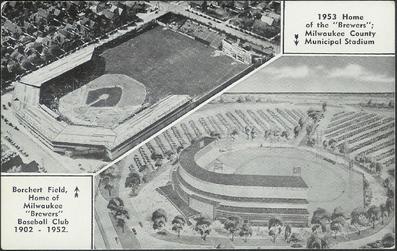
Postcard of Milwaukee Braves stadiums

Looking for positives, this could be Milwaukee County Stadium, home of the hometown Braves from 1953 to 1965. The concept postcard with no outfield stands and large parking lots beyond roughly matches what we see behind Logan. A roof-mounted American flag would further sync up to the card, but no stadium pictures I could find had one. Summary: encouraging, if not certain.


The card-and-stadium conversation reminded me of a 1955 contemporary set, the Topps Doubleheaders. That set's artist upped the ante by including contiguous ballparks on backgrounds of consecutive cards. A turn through the Net54 baseball forums turned up three different scans that show off this creativity.

First, an uncut portion shows the flow across a half-dozen players. (Follow the link to see larger versions.)


Second and third, check these scans from a Baseball Cards Magazine article by Bill Bossert in 1984. Note how each line of players flows across stands, a batting cage, and other stadium features. The full set includes several actual parks, including Yankee Stadium and Fenway, with 5 or 6 backgrounds spanning the full "image."


UPDATE: This tobacco box (picture from eBay) shows at least one way that Red Man distributed these sets. Note that card size roughly matches package size, bigger in both dimensions than today's typical card.

Tobacco box and sleeve with card
Tobacco box (front)

Value: Low-grade (but artistically impressive) Red Man type cards cost $5 or less. A card with its original package would run many times that, especially if you find one with good provenance.

Fakes / reprints: All of the Red Man sets were reprinted in modern times, many with thinner, whiter card stock and a glossier finish. (Originals used brown cardboard and typical 1950s gloss.) Modern card makers have also done Red Man-style cards of modern players, in homage to what proved popular sets in their day.

Tuesday, November 26, 2013

Anatomy of 1938 Goudey Baseball #250 and #274, Joe DiMaggio

Born a scant 99 years ago, future Yankee Clipper, husband to Marilyn Monroe, and Mr. Coffee: Joseph Paul DiMaggio.

ACME wire photo, dated Nov 21, 1934

Raised on the sandlots of his native California--one of three sons who chose pro ball over fishing for their father--DiMaggio's success as a teenager in the Pacific Coast League spurred New York to send four (!) players to his first pro team, the San Francisco Seals, in trade for young Joe's services. (The Yankees added $5,000 when one of them, infielder Doc Farrell, refused to join the Seals.)

1934 photo with DiMaggio trade details (back)

That 1934 ACME picture is a head-on shot from the same Seals photo session that celebrated Joe's trade and became the source for several Goudey cards (below). Gum companies often appropriated news photos to save money and time, either with or without paying the wire service, and I think Goudey used this one because his Seals uniform could also pass for New York, once you hazed out the background and darkened its pinstripes.

1937 Goudey Premium (Type 4, portrait), Joe DiMaggio

Goudey offered these "Premiums" (better described as paper-thin photo postcards) at candy stores in exchange for pack wrappers, an early "customer loyalty program" I covered in The Knot Hole League set profile. The following year, a face-only version of this photo appeared on a cartoon body for Goudey's first 1938 Big League Gum series, which ran #241-264, "extending" 1933's set of 240.

1938 Goudey Big League Gum #250, Joe DiMaggio

Many collectors and dealers call this 1938 version DiMaggio's "rookie," but it only qualifies as his first American gum card. OldBaseball.com notes his appearance in two larger 1936 photo sets: Goudey's R314 "Wide Pen" Premiums (with manager Joe McCarthy) and National Chicle's R312 Color Tints. He also appeared in World Wide Gum's own 1936 Big League Gum, an obscure Canadian issue printed near Montreal (and financially affiliated with Goudey).


Sharp eyes will recognize this as a match for the Joe DiMaggio card Mr. Burns gave to Homer Simpson.


Mark this as the only time I've seen "adjudged" and "poled" on a baseball card.

Whatever "rookie" opinion you ascribe to, kids didn't have to wait long for more DiMaggio.

1938 Goudey Big League Gum #274, Joe DiMaggio

1938 Big League Gum repeated the same 24 players for their second series (#265-288), so Joe appears again, this time with four hand-titled cartoons.
  • "Considered one of the greatest outfielders of all time" (in just 3 years!)
  • "He's a member of the Yanks' Murderers' Row and flirts with the home-run record"
  • "$25,000: pretty fair salary for a young fellow!"
  • "Baseball's Hall of Fame: Joe rated a niche in this place from the first year in the major league."

Joe's last cartoon hints at how "Hall of Fame" meant something more poetic to fans in 1938. It was just five years after Cooperstown opened its physical location, so brick-and-mortar visions of enshrinement seemed interchangeable with legend and euphemism. Notable players and achievements rated Hall of Fame status in their own time, instead of waiting for others to "make a case for inclusion," in the language of today.

SF Seals and brothers, Vince, Joe, and Dom DiMaggio

Like other native Italians, the DiMaggio parents suffered state persecution during WWII and Joe himself lost three prime years to military service, leaving him quietly (and I'd say "justly") bitter about the war's effect on his family and career. Esquire writer Gay Talese captured Joe's demeanor in retirement with "Silent Season of a Hero," considered one the best essays on baseball and, given its subject, fame.

Goudey's 1938 Baseball Movies & 1937 Thum-Movies

Goudey featured DiMaggio at every opportunity following his 1936 debut, so it's possible ACME's 1934 wire photo saw additional use along the way in other ephemera since lost to time. While not an exhaustive look at his history on cards, it shows how one image can (and will) make its way around the hobby. Buon compleanno to Joe and his many fans.

Friday, November 22, 2013

Goudey Gum's Knot Hole League Baseball (and 1930s Customer Loyalty Programs)

Today's 1935 story starts in 1933, the year vintage collectors link inextricably to Goudey Gum, whose 240-card Big League Gum set features every star of the era--including 4 Babe Ruths--and mark a point where gum cards became both serious business and cultural touchstones. Many collectors (me included) call 1933 baseball their favorite pre-WWII set and its hand-painted photos stand out like few others.

You can keep your Ruth; I like #155 Joe Judge best

PSA's closer look at 1933 hits the set's high points, but also read their History of the Goudey Gum Company to understand why this debut looms so large. Goudey spent most of the 1930s falling from their first big hit, unable to outpace the economic realities of America's Great Depression. Everything they made afterwards trailed in set size, design quality, and collector appeal, including today's type card profile of The Knot Hole League Game, a set as obscure and bland as they come.

1935 Goudey Knot Hole League (front)

Your eyes don't deceive you, there's no player on this card. These "series of 100" Knot Hole League cards are a scorecard-style promotion linked to a Goudey collector's club (i.e., customer loyalty program) of the same name. The set's hard to complete and hard to love, but its origin helps explain how Goudey survived an otherwise terrible time to be in business. The concept began with a tie-in for their 1933 Sport Kings set called Varsity Football.

1933-1934 Goudey Sport Kings Varsity Football (back)

Varsity Football backs list 18 colleges on framing pennants, including Centre College, my parents' alma mater (and no longer the collegiate sports power it once was). Fronts show six standard football situations with results that vary from card-to-card.

1933-1934 Goudey Sport Kings Varsity Football #5 (front)

Varsity game players started with a stack of face-down cards, flipped one over, and picked a "play" based on their game situation. Pick a rush before flipping this card and you'd lose 5 yards. Boooooooo.

The Knot Hole League set copies this game concept for baseball, with scoring moved to the card front's 9-inning grid. Baseball varies less than football, so backs need just two results (e.g., STRIKE and WILD PITCH) and players use the one that's upright when flipped.

1935 Goudey Knot Hole League (back)

Varsity Football deserves a separate blog post explaining how to play. More relevant now is its marketing letter, which explains Goudey's distribution for both it and Knot Hole League cards.

Shop instructions for Varsity Football & its "Score Charts"

In other words, Goudey included both Varsity Football cards and Football Score Charts (no scan known) with boxes of Sport Kings, so retailers could give them out as in-store bonuses to pack buyers. It must've been successful enough that they repeated this practice for Big League Gum beginning in 1935. (I assume a similar letter exists for the Knot Hole score cards.)

1935 Big League Gum wrapper with ring coupon

Goudey also created in-store placards explaining how Knot Hole members could redeem Big League Gum wrappers for Premiums and other memorabilia. (More about the club itself below.)

1935's two-stage Big League Gum wrapper promo

Today's game set first appeared in 1935, but The Knot Hole League debuted in 1934, when Goudey hired superstar Lou Gehrig to promote a new collecting club that rewarded members with special cards and baseball equipment in exchange for pack wrappers. Gehrig himself hawked the League on wrappers...

1934 Goudey Big League Gum wrapper

...shop window promos...


...and Gehrig's own Big League Gum card, #61 in the 1934 series.

1934 Big League Gum #61, Lou Gehrig

Despite Gehrig's presence, that season's first three series of Big League Gum (24 cards each, #1-72) sold poorly compared to 1933, as trading card competitors and the Great Depression squeezed Goudey from both sides.

At some point, Goudey realized they stood no chance of repeating 1933's standout success and cut Big League Gum's set size by more than half, from 240 (ten 24-card series) in 1933 to just 96 (four 24-card series) in 1934. This printing sheet for 1934's fourth series, what we now call the high numbers, made several tweaks that reflected this economic reality.

1934 Big League Gum high series and "1933" #106 Lajoie

This uncut 5x5 sheet includes 1934 Goudey #72-96, half red and half blue, with a green Nap Lajoie card added to satisfy customers who complained about the missing #106 from 1933 Big League Gum. (Just one of Goudey's many ploys to keep kids buying cards in search of a complete set; see Goudey Gum history and remember that their card-printing decisions started with one question, "what will make us more money?")

1934 Goudey #90, Ki-Ki Cuyler

That red "Chuck Klein says..." tagline replaced a blue "Lou Gehrig says..." for the 12 NL players pictured #73-96. Gehrig's tagline appeared on every card up to #72--including Chuck Klein's card--but I suspect Goudey made the change in series 4 for two financial reasons.

1934 Wheaties Flakes box panel

First, Wheaties also signed Gehrig to an endorsement deal in 1934, making Lou their first baseball Champion. This competition probably increased his endorsement cost and might've even precluded his appearance on other products. (Note that Gehrig doesn't appear on any Goudey-made sets or photo Premiums after 1934.)

1936 Goudey Premium, Chuck Klein

In addition, Chuck Klein was the NL's batting champion and Chicago made big news when they acquired him from Philly prior to 1934. This would make Chuck more marketable in the Midwest and fans from National League cities would see Klein each time they faced the Cubs, but never Gehrig unless the World Series or All-Star Game came to town.

1933 Big League Gum premiums (Ruth, AL & NL All-Stars)

Goudey created a handful of oversized photo Premiums in 1933 as mail-order customer incentives. With falling card sales, however, they cut Big League Gum set sizes and expanded the cheaper-to-print Premiums. By 1936, Goudey created just 25 new cards (and tied backs to the Knot Hole game), but offered up to 200 player photos in return for Big League Gum wrappers.

It's fiscally reasonable to see Goudey planning smaller releases throughout the mid-30s, as American struggled through the Great Depression. The Knot Hole League and in-store redemptions functioned like today's frequent-flier miles, as add-on loyalty programs they hoped would retain customers in uncertain times.

Reported sales in 1965 FTC case, courtesy Bob Lemke

Those mid-1930s baseball card doldrums might explain why another Boston-based card-and-gum company, National Chicle, declared bankruptcy in 1937. Chicle invested significant money in its Art Deco Diamond Stars and photographic Batter-Up sets, attractive sets that no doubt stole 1934-36 sales from Big League Gum, but couldn't overcome America's larger economic woes.

Goudey, on the other hand, resold existing inventory from year-after-year, creating smaller issues 1935-36 to keep their cash flow moving. Once Chicle folded, Goudey purchased their remaining assets; note 1937's rise in gum revenue, due in part to this acquisition. (I'll dive deeper into their business relationship in future posts.)

Undated (1936) Big League Gum wrapper

That walk through Goudey's early baseball history explains their evolving business strategy and growing need to land repeat customers via The Knot Hole League after the steep drop from 1933's Big League Gum sales. From 1935 forward, Goudey distributed their sets series-by-series, 24 cards at a time, printing more as revenue came in. Years first disappeared from Big League Gum cards (1935-) and then wrappers (1936-), supporting a "dateless marketing" that would feel alien in today's market.

That takes us back to The Knot Hole League's simple flipping game between the 1934 pennant-winning St. Louis Cardinals and Detroit Tigers (every card showed the same two teams). While some catalogs date it to 1937, its "COPR. 1935" text and face off between 1934 World Series foes indicate otherwise. (Thanks to Dave Weisner of Net54 for these #5 scans and set dating rationale; more about the set dating below.)


Once the Knot Hole card's inning grid was filled in, though, scorecards were only good for their backside game situations, so I assume kids threw them away. This would explain both their scarcity in the modern market (compared to 1936 photo cards) and why Knot Hole cards you find today aren't written on.

1936 Big League Gum, Oral Hildebrand (front)

The card-flipping aspect reappeared on the backs of 1936 Big League Gum, perhaps because customers liked the game or plenty of Knot Hole League scorecards remained to be handed out at retailers.

1936 Big League Gum, Oral Hildebrand (back)

1936 Big League Gum has 25 different fronts--all re-cropped photos from Goudey's Premiums--but each player comes with several play variations (e.g., OUT!! & ERROR!!!).

Dave Weisner's pursuit of a front & back master set identified 175 total combos, implying the set used seven 5x5 sheets like the one used for 1934's 4th series, revisited below.


But did 1936 Goudey use 5x5? 4x6? I've since identified a 176th different front/back combo in my own collection that fills a hole in Dave's master set research. 176 doesn't divide evenly into a 24-card sheet, so Goudey double-printed a few of their players on a 4x6 sheet or added at least one variation to 5x5 sheets. Unless we discover an uncut 1936 sheet, the true answer remains elusive.

Goudey's stated Knot Hole set size ("series of 100") stopped well short at just 24 cards, telling us something about how hard the Depression hit companies from 1934-1937, when penny gum sales significantly outpaced trading cards. Knot Hole cards likely proved unpopular as a promotion and Goudey stopped printing them to save money. These days, I assume Topps sets their print run well in advance, but 1930s candy and gum makers had no such luxury. Many changed plans mid-year or simply closed up shop when cash ran out.

Note packs sold in 1937, 1939 & 1942, despite no new "release"

Some catalogs (and grading companies) date The Knot Hole League Game to 1937, which makes sense if you consider Goudey resold its Big League Gum packs for years after their original printing, making it easy to munge release dates. As noted above, thousands of packs sold in years they didn't create new gum sets.

Knot Hole League card photos appear in a collection find from 1933-35 (article courtesy George Vrechek), but shopkeepers were still handing out their scorecards in 1937, so you can understand the confusion in assigning a date. Given their ties to 1936 Big League Gum's game backs, I'm surprised no one assigned them that year.

It's no accident that Goudey's Knot Hole League set connected to several other aspects of their business and competitive environment. I'll dig further into those related sets and business context in future posts.

UPDATE: Goudey acquired this patent for "Knot Hole Club" (as connected to chewing gum) on July 24, 1934. It auctioned with similar company papers for $275 in 2009.


Value: A complete SGC graded set of 24 Knot Hole League cards auctioned for $510 in 2008 and low-grade singles close for $5-10 each on eBay.

Fakes / reprints: Haven't seen any and it'd be hard to make money faking non-player cards.

Wednesday, November 13, 2013

Garvey Garvey Garvey Garvey Garvey Garvey Cey Russell Lopes

I've been a Steve Garvey fan since the early 80s and made him the subject of my first player collection many years ago. Decades later, check out how obscure my "active career" wantlist looks. At this point, I'm lucky to follow more advanced collectors in their pursuit of things like his Gafline Microfiche "card," and Long Beach Telegram cutouts, never mind spending my modest collecting budget on real ones.

1981 Long Beach Telegram, Garvey & Carew (newspaper cutout)

Given that rare shot at vintage hits, I've been happy to expand into modern retro Garveys and who else but GCRL sent a six-pack that arrived yesterday. Check out the shiny!


It's hard to pick one favorite, but I'll go with 2002 Fleer's gold-bordered photo of a classic Garvey batting pose (upper right). The back recalls his 1981 World Series hitting in LA's win over NY.


That 10-for-24 World Series hitting line didn't knock anyone in, but not because Tom Lasorda used Garvey any differently, it was because the 1-2 batters rarely got on base in front of him. Ultimately, Ron Cey, Pedro Guerrero, and other late-order guys contributed enough big hits that LA came back with 4 straight wins after starting 0-2.

1981 champs Guerrero, Valenzuela, & Garvey in 2006

1981 also marked my first televised World Series, having been radio-only (and too young to pick a favorite) for the 1979 and 1980 Pennsylvanian championships. I'm sure LA's exciting win had more than a little to do with Garvey (who shared my Little League position at first) becoming a favorite.

Thanks again, GCRL, and go Dodgers!