 |
| Fenway's left field wall & seats (future Green Monster), as first built |
Boston built two new stadiums in that decade (Fenway Park, 1912 and Braves Field, 1915). Crosstown competition for money and prestige included a run of World Series championships, four by the Red Sox (1912, 1915, 1916, 1918) and one by the Braves (1914). Since this article focuses on its centennial, we'll look at American League cards from that first year at Fenway.
T202 Hassan Triplefolder
This 132-card tobacco set remains my 1912 favorite, based on its combo of player portraits, action center panel, and detailed back text. (Find that set's gallery at PSA.)


So few examples exist that more might emerge, as with many of that era's tougher sets! See the known checklist at Old Cardboard.


Each of these Red Sox cards show a pair of players on their fronts, framing an action photo titled "Close at Third" that focuses on different runners, one on offense (Speaker) and its other on defense (Wagner).


I'll include a National League card for catcher Johnny Kling and pitcher Cy Young, each stars of their day, who came to town via mid-1911 trades and appear here as implied batterymates. In practice, Young preferred pitching to younger backstop Bill Rariden, so Kling caught Cy just once, this 3-3 tie on September 18, the second game of a doubleheader. Despite teams playing at a rapid pace to squeeze in two games, Young's start was called on account of darkness after six innings, leading to the deadlock.

This T202 pairing anticipated a return as teammates in 1912. While Kling took over as Boston's player/manager, Young decided to retire to the family farm at age 44.
Boston Garter
This eccentric men's hosiery set featured future Hall of Fame outfielder Tris Speaker each season, 1912-14. They prove so rare that this 1914 version of Speaker appears to be its highest-res online image!

An ad board for retail locations also showed aforementioned Braves player/manager Johnny Kling.

Surviving singles from the Boston Garter set cost thousands each, so enjoy images in this vintage forum thread, if that's beyond your price range, and see its Old Cardboard profile for checklists.
1912 J=K Candy
1912 J=K Candy
J=K Candy, an unconventional name inspired by its owner's first and last initials, printed blank-backed player photos on the outside of their candy boxes for collectors to clip and save.
J=K's checklist contains seven known Boston AL players, with more possible. Their lack of clear indica no doubt left many cards buried in stacks of family photos!
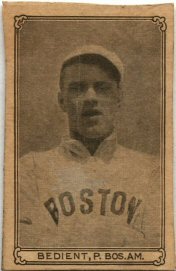 |
| 1912 J=K Candy Type 1, Hugh Bedient |
J=K's checklist contains seven known Boston AL players, with more possible. Their lack of clear indica no doubt left many cards buried in stacks of family photos!
Plow's Candy
This obscure Plow's Candy set used attractive 3" x 4" images that PSA considers "one of the most difficult, if not impossible, sets to assemble completely." While Carrigan and Speaker represent the Red Sox, those images remain tough to find online, so enjoy this unusual pose of Philly's catcher Ira Thomas!
This obscure Plow's Candy set used attractive 3" x 4" images that PSA considers "one of the most difficult, if not impossible, sets to assemble completely." While Carrigan and Speaker represent the Red Sox, those images remain tough to find online, so enjoy this unusual pose of Philly's catcher Ira Thomas!

So few examples exist that more might emerge, as with many of that era's tougher sets! See the known checklist at Old Cardboard.
Summary
Baseball's greatest strength might be knowing how players of today play the game on many of the same fields used by their forebears. Know of another set featuring 1912 players who called Fenway Park home? Let me know in the comments.

4 comments:
Great post!
I now know that I can find candy and garters here. Great. Hope that my ISP doesn't block me.
Oh, to purchase a box of licorice with baseball cards on the box. There are times when progress just isn't.
Funny they call the licorice "a penny package that is making good." Maybe "local boy makes good" was already a sports saying back in those days?
Post a Comment