This would be a disturbing sort of TV show to catch in the 1950s. "Jim Robertson Mimes Sports of the World." The old Athletics uniform hangs loosely on his veteran shoulders, blue cap concealing hair thinning earlier than his 27 years deserves. A producer stands to one side, hands on hips and jowls clamped down on an ego-sized wad of flavorless gum. A baseball sits firmly in the mitt pocket, held in place with sealing tape for the camera's benefit. After two hours in make-up, an art still evolving for color TV, the star looks slack-jawed and distant. Is this the rest of my life? Can't we even afford a catcher's mask?
1955 marked Bowman's final year, as they sold out to Topps in early 1956. Its "competitive gimmick" occupied a great deal of the card face and reflected the American fascination with moderne wood-grain televisions. With such an about-face from the uncluttered 1953 and 1954 designs, I'm not crazy about the fronts. Thumbs up for resurrecting color photos, but a hearty "meh" for the TV motif. At least the variety of park backgrounds adds some architectural and historical interest.
Much more intriguing to me are the card backs. Plenty of them include ghost-written fluff, but Mr. Robertson's shows a great concept, "My Favorite Baseball Memories." As a 13 year-old collector, I often wrote to retired players and wanted to know exactly that kind of thing. What was their favorite memory? Best day on the field? (Kiko Garcia, for example, recalled a good hitting performance for the Orioles in the 1979 World Series.) Even Jim, who played all of 69 career games, gets to tell a couple of stories. He includes Phil Rizzuto in both, as a former Yankee farmhand prior to getting on the field for Kansas City in 1954. Given the design, the most surprising part of this card is the comment near the bottom.
"My advice to youngsters. Play ball, don't watch it on TV."
That's right, children of the 1950s, get the heck off your duff and go start a civil rights movement or something.
Thursday, July 31, 2008
Wednesday, July 30, 2008
1974 Broder Popcorn Seattle Rainiers #5, Dick Aylward
Dick Alyward of Seattle's PCL club, the Rainiers, shows us all how to wait out a rain delay and look dapper at the same time. Unfortunately, the front-and-center team logo also makes him look like the beer delivery guy. Dude, kegs go in the back.
Aylward spent 99% of his career in the minors. He made the big-league Indians briefly in 1953 and went hitless in four games. A catcher throughout, he has the rare distinction of making a first-base putout. Quoth the CPC trivia page:
I picked up this card a couple of years ago and didn't really know what I had. They resemble the Seattle Popcorn issues from the 1950s and 1960s, before the MLB Angels bought the Rainiers from the Red Sox and changed their name to the Seattle Angels. Aylward played for them in 1957 and cards from that year don't turn up often, so this is probably a reprint. Indeed, the card back includes a simple inscription to that end.
"Alyward" misspelling aside, Beckett's collection tools helpfully ID it as "1974 Broder Popcorn," a set of 235 cards that includes luminaries like Maury Wills, Sparky Anderson, and Joe Black. Most likely, it's a compilation of popcorn cards reprinted for collectors who couldn't find the originals. Unfortunately, that makes it another set for player collectors to obsess over, given that it doesn't turn up very often and is hard to identify even when you have it. Ah, the joy of the hunt!
Card front
"As a rookie catcher with the Tulsa Oilers of the Texas League, Aylward retired a runner at first base. It happened April 21, 1947 in Oklahoma City. Pitcher Len Gilmore, batting for the home team, hit a roller past pitcher Tom Warren. Second baseman Jim Shilling and first baseman Jack Richards both charged the ball. Aylward, running toward first base to back up the play, realized the base was uncovered. Sprinting ahead of Gilmore, he got to the base first and caught Richard's toss for the out, scored 3-2."
You think the opposing pitcher took exception at being beaten to the bag by a rookie catcher? We hope Aylward was extra careful on his next trip to the plate.
I picked up this card a couple of years ago and didn't really know what I had. They resemble the Seattle Popcorn issues from the 1950s and 1960s, before the MLB Angels bought the Rainiers from the Red Sox and changed their name to the Seattle Angels. Aylward played for them in 1957 and cards from that year don't turn up often, so this is probably a reprint. Indeed, the card back includes a simple inscription to that end.
Card back
"Alyward" misspelling aside, Beckett's collection tools helpfully ID it as "1974 Broder Popcorn," a set of 235 cards that includes luminaries like Maury Wills, Sparky Anderson, and Joe Black. Most likely, it's a compilation of popcorn cards reprinted for collectors who couldn't find the originals. Unfortunately, that makes it another set for player collectors to obsess over, given that it doesn't turn up very often and is hard to identify even when you have it. Ah, the joy of the hunt!
Tuesday, July 29, 2008
1936-37 World Wide Gum Baseball (V355) #5, Johnny Vergez
Zounds, is this a card from the depression era or what? It's hard to tell if Johnny Vergez needs a sandwich or some sleep. We'll save him a YMCA cot down on East 47th St and keep a BLT warm in the Polo Grounds clubhouse to cover all the bases.
If there's anything to enjoy about the photo, it's Johnny's snazzy cap. Witness the scalp-hugging form that preserved 1930s head warmth and compare it to today's raised-crown, vented mesh version. Also remember their wool, full-body uniforms! Some of those players must've cooked beyond al dente for most of the summer.
In 1933 and 1934, Montreal's World Wide Gum (WWG) adapted Goudey Gum's USA baseball sets for a Canadian audience, echoing their basic design and translating some cards into French. This 1936-37 set's exclusive to Canada and is pretty much as you see, with sparse detailing and headline-style lettering. (For whatever reason, this photo makes me think J. L. VERGEZ HITS ICEBERG, SINKS IN NORTH ATLANTIC! Must be the Titanic fan in me.)
World Wide Gums feature text-heavy backs typical of the 30s and prove challenging to complete, even for those with deep pockets. I went into much greater depth on this set and the relationship between World Wide Gum and Goudey in my 2019 article, 1930s World Wide Gum and "Canadian Goudey."
Values: This #5 cost about $10 on eBay in 2004. I expect V355 commons to run $20 in low grade today.
Fakes / reprints: I believe people have faked V355's rookie card for Joe DiMaggio and other big names from the set like Lou Gehrig, so buy from dealers you trust if you want type cards of star players from this era. Familiarize yourself with the differences in 1930s print technology and bring a black light and loupe if you plan to examine cards in person. David Cycleback wrote a valuable book on this kind of card authentication.
Monday, July 28, 2008
1980 TCMA 1957 Milwaukee Braves #5, Bob Buhl
"Deer in the headlights," meet "Buhl in the camera lens."
This TCMA set picked a world champion in field performance, the 1957 Milwaukee Braves, but their photo quality leaves something to be desired. Even Bob's Wikipedia page shows off Topps' more humanizing 1958 version. Today's card (scan culled from my eBay win) self-consciously minimizes the pain by dedicating almost a third of the card to non-photo details. Still, that's a heck of a gaze...or stare...or flashback to some failed Bill Veeck promotion.
The late 50s Braves won pennants in consecutive years, '57 and '58. This 42-card set profiles the players from the former year, their only Milwaukee championship. (They lost the 1958 series in 7 games to the Yankees.) Hammerin' Hank and Warren Spahn represent the key cards, though the set's obvious shortcomings make it affordable as a unit despite a relatively small print run. (I've seen them on eBay for a $5 opening bid.)
My dad turned 10 on a Wisconsin dairy farm the year they won the series and knows this team inside-and-out. In the history of fatherly gift-giving, kids often default to ties, cologne, or gas for the lawn mower. About a decade ago (and on the spur of the moment), I picked up the 1957 Topps team set and put it into 3-by-3 card frames. The cards still hang next to his desk and, as far as I know, they're the top present from my 30-something years on the planet. Not sure if it works on every old man out there, but it sure breaks up the monotony of never knowing what the heck to get for someone.
Card front
This TCMA set picked a world champion in field performance, the 1957 Milwaukee Braves, but their photo quality leaves something to be desired. Even Bob's Wikipedia page shows off Topps' more humanizing 1958 version. Today's card (scan culled from my eBay win) self-consciously minimizes the pain by dedicating almost a third of the card to non-photo details. Still, that's a heck of a gaze...or stare...or flashback to some failed Bill Veeck promotion.
The late 50s Braves won pennants in consecutive years, '57 and '58. This 42-card set profiles the players from the former year, their only Milwaukee championship. (They lost the 1958 series in 7 games to the Yankees.) Hammerin' Hank and Warren Spahn represent the key cards, though the set's obvious shortcomings make it affordable as a unit despite a relatively small print run. (I've seen them on eBay for a $5 opening bid.)
My dad turned 10 on a Wisconsin dairy farm the year they won the series and knows this team inside-and-out. In the history of fatherly gift-giving, kids often default to ties, cologne, or gas for the lawn mower. About a decade ago (and on the spur of the moment), I picked up the 1957 Topps team set and put it into 3-by-3 card frames. The cards still hang next to his desk and, as far as I know, they're the top present from my 30-something years on the planet. Not sure if it works on every old man out there, but it sure breaks up the monotony of never knowing what the heck to get for someone.
Wednesday, July 23, 2008
1970 Kellogg's Baseball #5, Mel Stottlemyre
Today's guest recently served as pitching coach for my Seattle Mariners, though most know him as you see him, in a New York uniform. Ten years as a Yankee sinkerballer and a few decades educating pitchers around the bigs built a good reputation for senior Mel. His sons found varying degrees of success on the hill, though any career is still more than the rest of us.
Though their history with sports promotions reaches as far back as the 1930s, collectors know Kellogg's for these cereal box cards with 3-D backgrounds and slick, easily cracked fronts. They created the illusion of distance by cross-hatching the gummy front surface and gluing it to a photo on papery (but still plastic) back.
Being made of different materials, the fronts and backs fight a religious war for tensile dominance. The hatched side usually wins by curling the card into a parchment-like roll. When you try to "fix" this by unrolling it, the card rewards you with a series of cracks at the least flexible points. Many, many Kellogg's cards bear the scars of this schism.
The real way to get around this is to put the curly card on top of something warm, like an oven or radiator. Assuming you keep it out of actual flame, the front will relax and return to its somewhat original shape. (We can assume the same straightening practice works on curly fries, but I never leave them around long enough to find out.)
Mel's got a top-shelf glare going in this shot, not too far from a Steve McQueen or James Coburn. Could he be the lost eighth member of The Magnificent Seven? (At least he's not forced to squint the sun from his eyes like other Yankees I could name.) On the rare occasion I catch an M's game this year, these eyes peer out from their bench, sifting for gold in Carlos Silva's sluggish right arm or Washburn's trick knee. There's always a notebook close at hand. I imagine it covered with freehand sudokus, one-liners, and other distractions from the looming 100-loss season. Maybe he should take up card collecting. I bet he could get 10 - 15 autographs per game, easy. More, if he signs between innings.
Though their history with sports promotions reaches as far back as the 1930s, collectors know Kellogg's for these cereal box cards with 3-D backgrounds and slick, easily cracked fronts. They created the illusion of distance by cross-hatching the gummy front surface and gluing it to a photo on papery (but still plastic) back.
Being made of different materials, the fronts and backs fight a religious war for tensile dominance. The hatched side usually wins by curling the card into a parchment-like roll. When you try to "fix" this by unrolling it, the card rewards you with a series of cracks at the least flexible points. Many, many Kellogg's cards bear the scars of this schism.
The real way to get around this is to put the curly card on top of something warm, like an oven or radiator. Assuming you keep it out of actual flame, the front will relax and return to its somewhat original shape. (We can assume the same straightening practice works on curly fries, but I never leave them around long enough to find out.)
Mel's got a top-shelf glare going in this shot, not too far from a Steve McQueen or James Coburn. Could he be the lost eighth member of The Magnificent Seven? (At least he's not forced to squint the sun from his eyes like other Yankees I could name.) On the rare occasion I catch an M's game this year, these eyes peer out from their bench, sifting for gold in Carlos Silva's sluggish right arm or Washburn's trick knee. There's always a notebook close at hand. I imagine it covered with freehand sudokus, one-liners, and other distractions from the looming 100-loss season. Maybe he should take up card collecting. I bet he could get 10 - 15 autographs per game, easy. More, if he signs between innings.
Tuesday, July 22, 2008
1980 Cramer Legends Baseball #5, Joe DiMaggio
Joltin' Joe provides a worthy competitor to our recent spate of Ted Williams. Next year, Yankee Stadium might move down the street and reopen for business like an Oriental rug merchant, but DiMaggio's shadow still lingers. I know, Mantle did his own good work in center for which Topps remains eternally grateful. (Oh wait, their gratefulness lasted ten years.) In the public mind, though, the Clipper owned the most important position for the most important team. An All-Star every year he played, the Yankees won titles in 9 of his 13 seasons, and retired his uniform number (surprise surprise, #5) in 1952. Hard to beat that with a fungo bat.
As excellent the player, I have to question the photographer for today's shot. It's got it all, unflattering pants, EW YORK, and painful solar glare. The last point impacts the whole oeuvre of baseball pictures. How many of these turkeys take nothing but "sun directly overhead" pictures? Is it any wonder people look squinty? Or wear sunglasses? Or limit what shows up on cards made decades later? He's even leaning away from the sun like an anti-flower, probably to save his eyes. SMILE! yells the hack. SQUINT! replies Joe.
My cardboard habit kicked off in 1980, but Twin Peaks candy shops only stocked Topps, Fleer, and Donruss. I didn't catch the Cramer Legends until 1982, when we moved a little closer to Seattle. The set was all classic players on an odd, coonskin cap-era shingle design. The old names and faces interested me, but only in passing, like girls to a fourth-grader. What I did know was crappy Mariner shortstops, inside and out. Trade my Mel Ott for your Todd Cruz? That'll give me both sides of the Cruz Connection! You've got a deal, my friend.
Card front
As excellent the player, I have to question the photographer for today's shot. It's got it all, unflattering pants, EW YORK, and painful solar glare. The last point impacts the whole oeuvre of baseball pictures. How many of these turkeys take nothing but "sun directly overhead" pictures? Is it any wonder people look squinty? Or wear sunglasses? Or limit what shows up on cards made decades later? He's even leaning away from the sun like an anti-flower, probably to save his eyes. SMILE! yells the hack. SQUINT! replies Joe.
My cardboard habit kicked off in 1980, but Twin Peaks candy shops only stocked Topps, Fleer, and Donruss. I didn't catch the Cramer Legends until 1982, when we moved a little closer to Seattle. The set was all classic players on an odd, coonskin cap-era shingle design. The old names and faces interested me, but only in passing, like girls to a fourth-grader. What I did know was crappy Mariner shortstops, inside and out. Trade my Mel Ott for your Todd Cruz? That'll give me both sides of the Cruz Connection! You've got a deal, my friend.
Monday, July 21, 2008
1959 Fleer Ted Williams #5
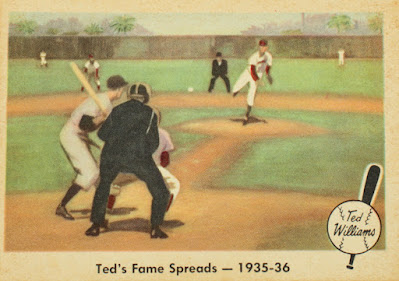
Being one of the all-time greats, Ted Williams turns up on more cards than most. In fact, if you're not familiar with 1959 Fleer, this set's all Splinter, all the time. A vintage set feature one player's unusual enough, but its #5 features something peculiar.
The peculiar: Wait, Ted seems to be batting right-handed. Whaa? Although a natural rightie, Williams hit from the left side, perhaps to get an extra few inches toward first. (The Kid wasn't the fleetest of foot.) So did Fleer reverse a negative, like Topps did on their 1957 Hank Aaron? Was this a flirt with switch-hitting? Not so. Turns out he's pitching in this shot. Though a two-way star for his San Diego high school, Ted had little patience for the finer points of pitching and fielding in the bigs. ("Ah, screw it," he'd famously say, "let's go hit!")
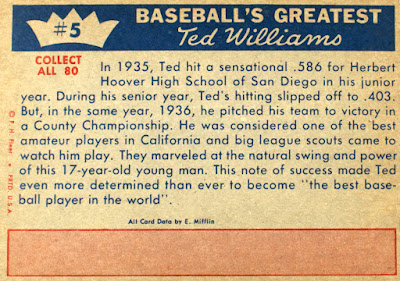
The unusual: For 1959, Fleer signed Williams to an exclusive contract and created an 80-card biographical set based on his life, career, and military service up to that point. #5 "Ted's Fame Spreads" covers his growing renown as a teen-aged ballplayer.
The peculiar: Wait, Ted seems to be batting right-handed. Whaa? Although a natural rightie, Williams hit from the left side, perhaps to get an extra few inches toward first. (The Kid wasn't the fleetest of foot.) So did Fleer reverse a negative, like Topps did on their 1957 Hank Aaron? Was this a flirt with switch-hitting? Not so. Turns out he's pitching in this shot. Though a two-way star for his San Diego high school, Ted had little patience for the finer points of pitching and fielding in the bigs. ("Ah, screw it," he'd famously say, "let's go hit!")
That Ted could carry a set on his own speaks to the heroic status accorded someone who proved his mettle for decades on the field and across two wars in the air. Fortunately for budget-minded folks, '59 Fleers are the cheapest way to get his career-era card. Some collectors like the color-tinted look, though it's measurably inferior to similar Topps sets from the early 1950s. I'd be more interested in the concept now if modernity hadn't eclipsed it with an explosion of flashy mod-retro issues.
Friday, July 18, 2008
1941 Goudey Baseball #5, George McQuinn
Card front (blank back)
After dominating the hobby with its creative, eye-catching sets a decade earlier, Goudey's blasé 1941 effort tells us more about the company itself than the game of baseball. They printed its austere 33 cards on scrap rag paper due to shortages. Mel Ott and Carl Hubbell are the only superstars and each card in the set is blank-backed, so what you see is what you get. Four fruit colors serve as the set's only "innovation" and create a very challenging master set. (I'm not one for grading companies, but note the #1 PSA set entry isn't even complete, let alone in good condition.)
While no Mel Ott, McQuinn was a decent player. He made 7 All-Star games, placed 6th in the MVP voting for the title-winning 1947 Yankees, and hit the only World Series homer in Browns history. He produced the rare feat of double-digit 2Bs, 3Bs, and HRs in back-to-back years and almost always walked more than he struck out. This maintained his run production despite below-average teammates and George dipped below 100 OPS+ only once in 11 full seasons.
Goudey did me two favors by mis-cutting this #5. First, it's affordable, a magic word in my world. Second, we get some insight into the printing setup, as the top of #19 Posedel appears below McQuinn; compare the hat brim on both.
Cutting problems plague the 1941 set, given its "stacked" process. Sheets near the top would cut cleanly, but the bottom would slide out slightly and deliver the final product you see here.
The set's an alluring pre-war target, with only 33 cards and no huge names. However, heed the words of my trading friend (and SCD contributor) George Vrechek.
"Category 4 – Nice cards but impossible, Double Black Diamonds in ski terminology. Forget ‘em. Just not available much even though book prices may not be ridiculous. A type card would be nice though. (emphasis added)"
UPDATE: This 1988 reprint shows what a well-cut card looks like.
UPDATE #2: Here's the yellow version of Mr. McQuinn.
UPDATE #3: Red version.
UPDATE #4: Blue version.
Thursday, July 17, 2008
1980 Police San Francisco Giants #5, Jim Lefebvre
I can coach anyone, thinks Jim's disembodied voice. Look at me, I'm hitting balls from a tee. WHACK. You think anyone can hit balls from a tee? I managed Seattle for three years and let me tell you, those turkeys would need God's own fencepost in their hands just to pop it up. WHACK. Kept begging McCovey to stop by and give 'em a few pointers. He said he wouldn't work with little leaguers. WHACK.
Lefebvre's a switch-hitter, so I assume right is his "power" side for the tee-ball shot seen here. The photo shows good timing for a real swing, or exceedingly corny composition for a pose. Why do this? Was no one else around to toss a ball to him? Were they worried people might confuse him with an active player? If he's really standing on the third base line, hitting off a tee into the dugout, this seems unlikely. (No offense, Jim! Still a believer! Heh heh.)
Based on my experience as a small town eight year-old, you'd get the "police" sets by talking with officers or walking up to cruisers and asking them for cards. Sounds like a nice deal for the community, right? Kids learn that the police are there to do nice things and the grown-ups get some positive attention. In my neighborhood, that's how we built sets of Mariners and Seahawks, rosters safely stocked with people you've never heard of.
Naturally, I wouldn't let on to my other method of "collection expansion," swiping wax packs from the local drug store. That kind of talk would just spoil the mood. Kind of like how bringing up former boss Tommy Lasorda might suck the joy out of Lefebvre.
"Sept 17, 1980: While taping separate interviews at KNBC-TV studios in Burbank, CA, Giants coach Jim Lefebvre and Lasorda trade punches after a brief argument, bloodying Lasorda's lip. Lefebvre had been a Dodger coach in 1979 until Lasorda gave him the sack."
Thanks, Wikipedia!
Card front
Lefebvre's a switch-hitter, so I assume right is his "power" side for the tee-ball shot seen here. The photo shows good timing for a real swing, or exceedingly corny composition for a pose. Why do this? Was no one else around to toss a ball to him? Were they worried people might confuse him with an active player? If he's really standing on the third base line, hitting off a tee into the dugout, this seems unlikely. (No offense, Jim! Still a believer! Heh heh.)
Based on my experience as a small town eight year-old, you'd get the "police" sets by talking with officers or walking up to cruisers and asking them for cards. Sounds like a nice deal for the community, right? Kids learn that the police are there to do nice things and the grown-ups get some positive attention. In my neighborhood, that's how we built sets of Mariners and Seahawks, rosters safely stocked with people you've never heard of.
Naturally, I wouldn't let on to my other method of "collection expansion," swiping wax packs from the local drug store. That kind of talk would just spoil the mood. Kind of like how bringing up former boss Tommy Lasorda might suck the joy out of Lefebvre.
"Sept 17, 1980: While taping separate interviews at KNBC-TV studios in Burbank, CA, Giants coach Jim Lefebvre and Lasorda trade punches after a brief argument, bloodying Lasorda's lip. Lefebvre had been a Dodger coach in 1979 until Lasorda gave him the sack."
Thanks, Wikipedia!
Tuesday, July 15, 2008
1956 Topps Baseball #5, Ted Williams
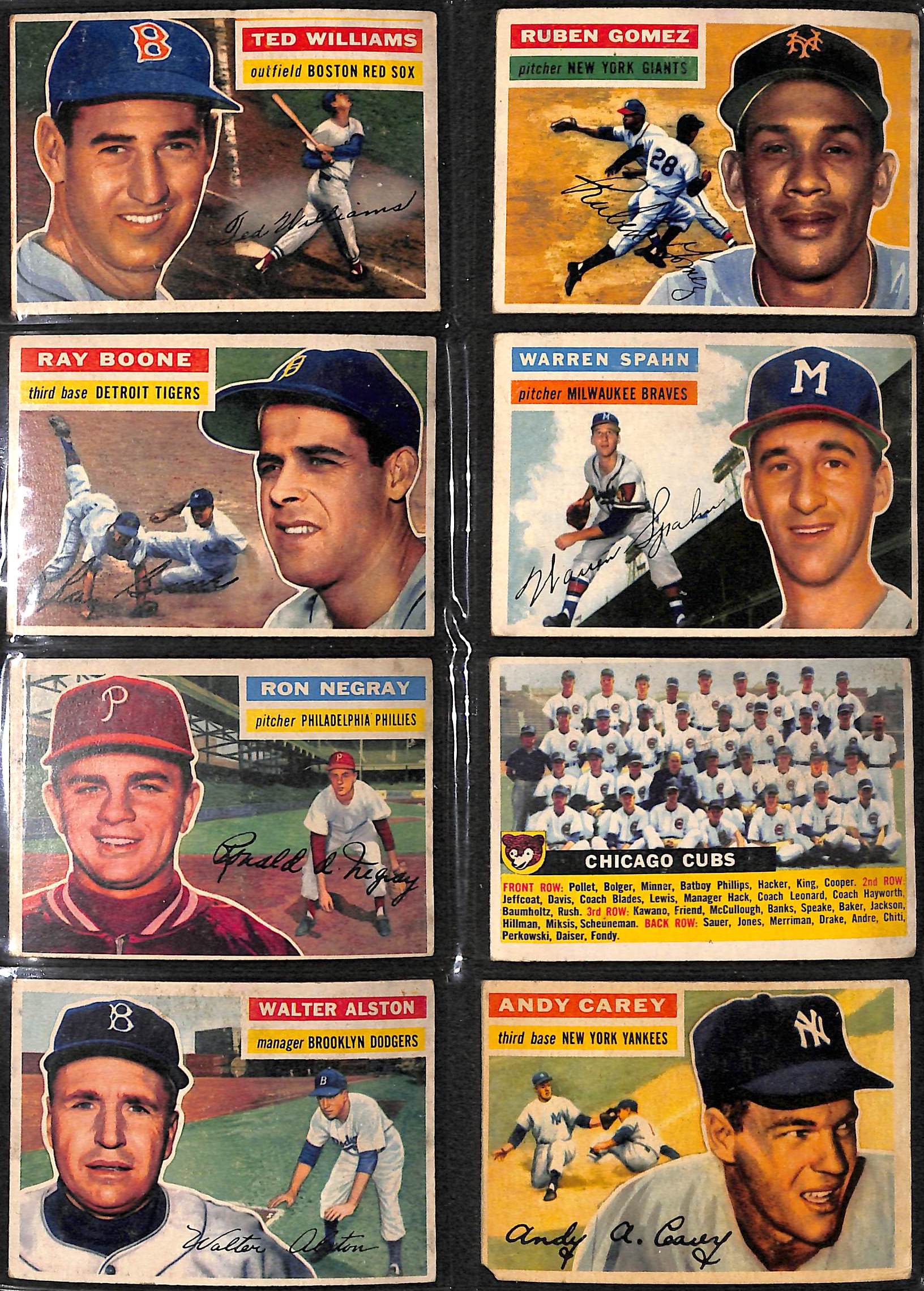
Any talk of classic vintage cards includes 1956 Topps and its 340 high-quality cards replete with star power (Jackie, Mantle, Aaron, Mays, Clemente, Ted Williams, etc.). Most cards feature in-game action shots and eye-popping colors as on this #5.
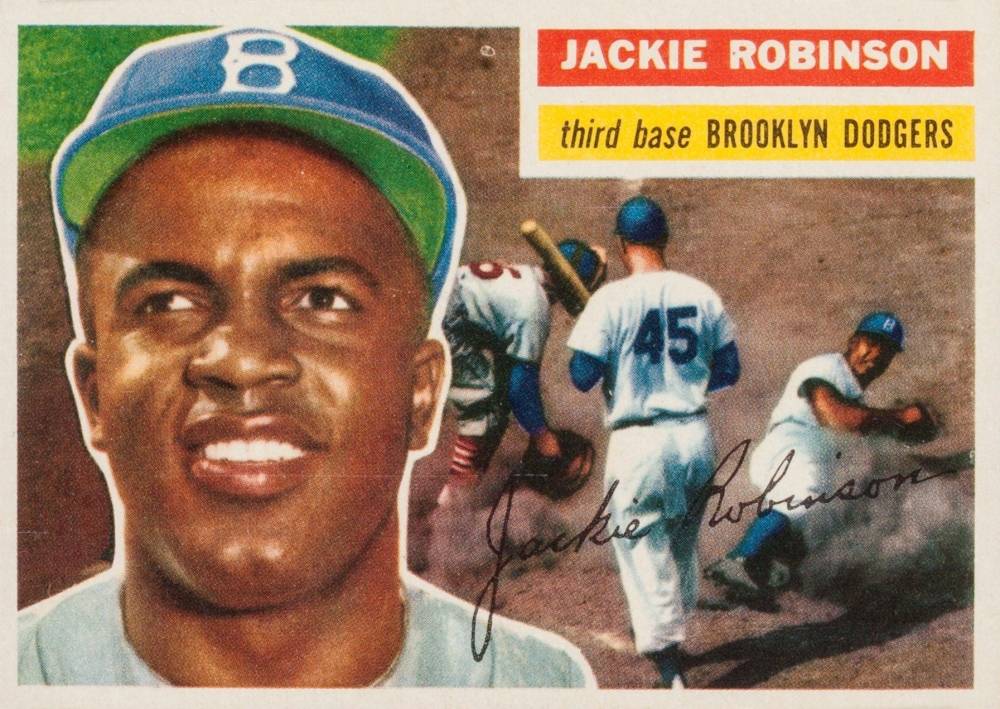
While Ted's great, my first 1956 card was #30 Jackie Robinson, spotted atop a stock of vintage consignments in a Seattle shop back in 1998. It transported me. My collection contained no Jackie cards at the time--but here was one from when he played, with a great portrait, and an action shot of sliding into home! Who can resist that combo?
This Ted belongs in any quality collection, not just a type set of #5s. My only nit to pick is the photo, where Ted's looking way up in the air. Is that just a lazy fly to right off the bat of the greatest hitter who ever lived? Harumph.
It's tough for sets of any era to match 1956's design and I love how it looks in 8-count pages.
Topps designed their 1956 set with serious competition in mind, given their pitched 1952-55 rivalry with Bowman. Details like the portrait halo, on-card autograph, and varied nameplate colors no doubt took extra time to assemble and still look great today. They also integrated team cards into its checklist for the first time, after test-marketing standalone team photos in 1951 (gallery at PSA).
1956 proved a swan song for serious competition when Bowman waved a white flag early that year before releasing a set, shuttering baseball production and selling all player contracts to Topps. I argue that card-as-art ended with this set, seeing how Topps themselves moved to color photos in 1957 and back cartoons shrunk in favor of larger player stat blocks.
The original photo is a fair match for how Topps used it on the card.
That's Jackie stealing home against the Cardinals on August 29, 1955. Johnny Podres (45) watches catcher Bill Sarni try to handle the ball with HOF umpire Jocko Conlon behind the plate. I wonder if modern baseball fields would kick up that much dust? A great moment either way.
Value: Even low-grade Williams cards can cost $100+ these days and often much more.
Fakes / reprints: The 1956 Topps design is so classic, it's been reprinted and repurposed repeatedly. Ted also gets faked from time-to-time, so I recommend buying a common as your 1956 type card. If you decide to get an ungraded #5, familiarize yourself with the feel and look of authentic cards from the set first, so you feel confident in a purchase.
Subscribe to:
Posts (Atom)