Showing posts with label ny-sf giants. Show all posts

Tuesday, February 4, 2025

1973 Topps Baseball #273 Chris Speier, Photo Identified from July 15, 1972

Many baseball card blogs from our hobby's history cover the full, eccentric range of 1973 Topps photography. Many card shots originate from spring training, with chain link fences galore. While Topps picked a few bad apples, they also found some great ones. Based on box score research, I think #273 Chris Speier shows baseball's most exciting play, an inside-the-park homer, from July 15, 1972. Catcher #6 John Bateman sprawls in the dust and Phillie relievers look on from their left field bullpen. (Those empty box seats reflect the poor midseason records for both teams.)


I think we can agree Speier's slide is a dozen times better than 1973 cards like "Joe Rudi" showing teammate Gene Tenace.

What's more, Speier faced off against peak Steve Carlton, during the Cy Young winner's mid-season streak of 15 straight wins. The two-run scamper put SF in front 4-0 and would be the most runs Carlton allowed all month. Despite Steve's departure after five innings, Philly found victory by scoring 11 runs in their top of the seventh, creating this 5% to 99% win probability cliff.

11 runs set Philly's high water mark for any 1972 game, let alone for one inning, and Topps benefited from a shot of Speier's standout play. Oh, for another 100 in that set anywhere near as good!

Friday, August 16, 2024

When it rains Batter-Up, it pours Batter-Up

Last week, a friend at Net54 helped me drive the golden stake into a long-running project: rebuild National Chicle's pair of 1936 #81-192 baseball print sheets. While we lack any surviving uncut material from this set, you can use its dodgy edge cutting like a jigsaw puzzle and put everything together by computer or hand. Watch the SABR Baseball Card blog for a future rundown of the whole effort.

This week, the friend (Doug) sent a five-pack of Batter-Up cards to celebrate our achievement! Right in the middle, one of my favorite #5s, Carl Hubbell.

1934 Batter-Up (#1-80) printed cards in several colors and this motivates me to go after all the Hubbell variations. Carl's been part of my Top Five Number Fives since way back and my set profile shows all six ways to find a player from that series. I call this one "black-and-white," so need its more colorful alternatives.

Thanks, Doug!

Friday, March 22, 2024

1956 Topps baseball #171 "Jim Wilson, if that is your real name"

I researched game situations for several 1956 Topps cards in my 17-March post, including #171 Jim Wilson. This post revisits and revises my initial take and then updated it again on 2-May. This might be the most ink spilled about his card since Jim's retirement in 1958.

Baltimore purchased Jim from Milwaukee a few days into the 1955 regular season and he proved their most dependable pitcher, even if going 12-18 meant leading the AL in losses.


I guessed this #171 action photo shows Richie Ashburn running to first, with someone other than Jim catching that high throw. Pittsburgh's Paul Smith, perhaps?

Another writer encourged me to look at the Giants instead, given Topps penchant for photos in New York stadiums, so #25 Whitey Lockman could be a better choice for that fielder. Compare "Jim Wilson" to Whitey's own card of Dodgers #3 Billy Cox trying to beat out a throw to first.

1956 Topps #205, Whitey Lockman

Our runner's sleeve stripe means Brooklyn wore road jerseys, placing us at Giants home turf, the Polo Grounds.


Pittsburgh fielders wore safety helmets in that era, as on #116 Ed O'Brien (left). I think the first baseman reaching behind Ashburn for an errant throw lacks that headgear, so Whitey Lockman seems our guy instead of Paul Smith.

Fielding helmet on Pirates 2B

No helmet on Giants 1B

Lockman and the Giants hosted Philly many times in the 1950s, so picking out a single play will be tough until we locate this card's original photo. Their long undershirts imply a chilly spring evening, making the second game of a doubleheader on April 25, 1954, our possible match.


Topps #171's action shot might indeed be Giants 3B Hank Thompson tossing wide of first on Richie Ashburn's grounder from 1954. Our peripheral evidence supports that location and play result.

One other game, a 6-5 Giants win on May 30, 1955, shows Ashburn legging out a leadoff single to third that became Philly's first run.


Either scoring decision could fit this leaping throw to first, so correcting its players proves more satisfying than nailing an exact moment in time.

Did Topps make twice the error?

My earlier post showed how an artist added anachronistic red details for Pudding' Head Jones. Philly's used sleeve and neck stripes on pre-1950 uniforms, which also featured blue hat and stockings. Topps painted those details in red for his 1956 card.


Consider the action shot for #171 "Jim Wilson" one more time.


Since Topps card editors worked from black and white photos, that could be Brooklyn's #1 Pee Wee Reese (blue sleeves) instead of Philly's #1 Richie Ashburn (red sleeves). Dodgers uniforms would look similar on contemporary pictures, unless dated or described well. They already struck out on player identification, so retain a critical eye.

MAY 2024 UPDATE: Did Topps make thrice the error?

Mea culpa! I missed this lookalike card (#91 Gail Harris) during my initial research into #171 Wilson, which uses our same image apart from its runner wearing a blue cap.


Gail did play first several times for New York during his 1955 rookie season. Our problem comes down to that uniform number, #25 Lockman vs. #15 Harris. Blue cap or not, #91 also got our first baseman wrong.

Confusion conclusion

1956 cards #91 and #171 feature a Hall of Fame cameo either way, with Ashburn or Reese dashing past Giants first baseman Whitey Lockman.


Thanks to several resources for research help.

Sunday, March 17, 2024

Identifying background photos in 1956 Topps baseball

Introduction

I spent this week inspecting 1956 Topps baseball cards in more detail than usual. Many cards with background action show actual games and some contain enough context to suss out date and situation.

Play at the plate for ol' Puddin' Head, but which one?

Today's post investigates several of them, seeking clear dates and situations. I rely on Baseball-Reference.com for box scores, Dressed to the Nines for uniform design, and compare my take to the 1956 Topps blog, which wrote in detail about all 340 player cards.

Things to consider when investigating 1956 cards

Photos for 1956 cards came from wire services or professional photographers. As a New York company, pictures from Yankee Stadium, Ebbets Field, and the Polo Grounds could be convenient for Topps, so I lean toward New York ballparks when location's otherwise unclear. Spring training, regular season, postseason, and staged photos all appear, with many taken before 1955. 

Card editors touched up images as needed, such as this terrific shot of Pope's leap for a game-winning drive by Dusty Rhodes in 1954's World Series opener, one best known for "the catch" by Willie Mays two innings earlier. (Rhodes earned 1955 Topps #1 honors thanks to his postseason heroics.)

Topps removed "Cleveland" from Dave's jersey and painted that ball onto his glove as partial redemption.

1956 Topps #154 Orioles OF, Dave Pope

One wonders what Pope himself thought of the change, as I bet he remembered that moment!

#132 Bobby Avila and the hidden Hall of Famer 

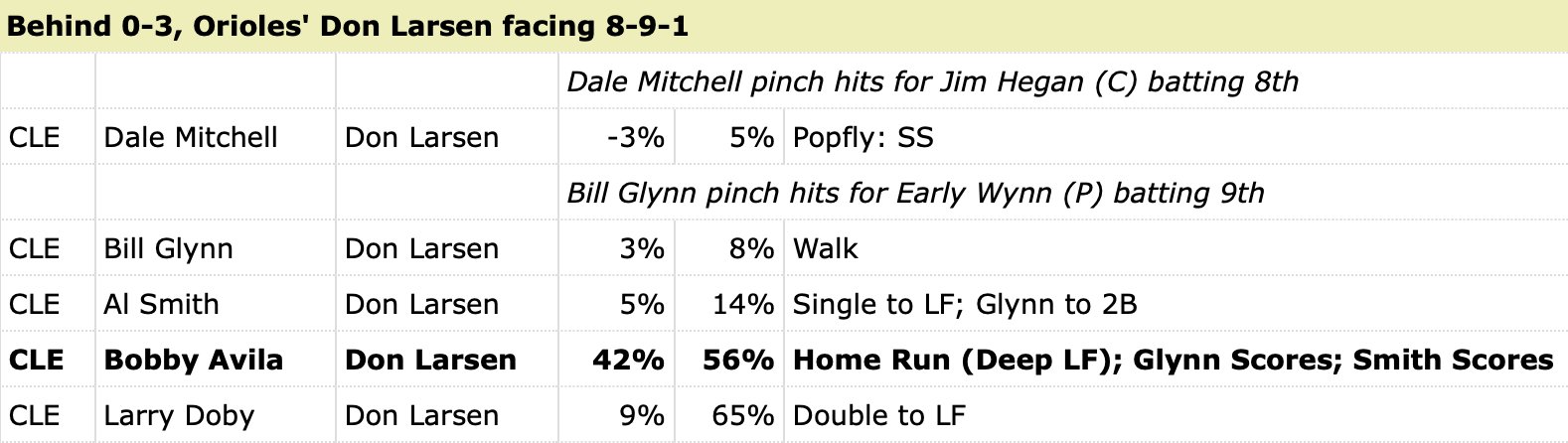
Bobby Avila's enjoying post-homer congratulations. With all those numbers crowded around home plate, can we nail down what just happened? Easy enough, it turned out, based on Avila's home run log and teammate uniforms.

That's #6 Bill Glynn and #32 Al Smith greeting Avila after his game-tying home off Baltimore's Don Larsen on August 14, 1954. #14 Larry Doby waits on deck for his chance to chase Larsen from that game. (Cleveland won 4-3 in extras.) 
Image

The 1956 Topps blog post about #132 agreed on this play and its cameo by Hall of Famer Larry Doby.

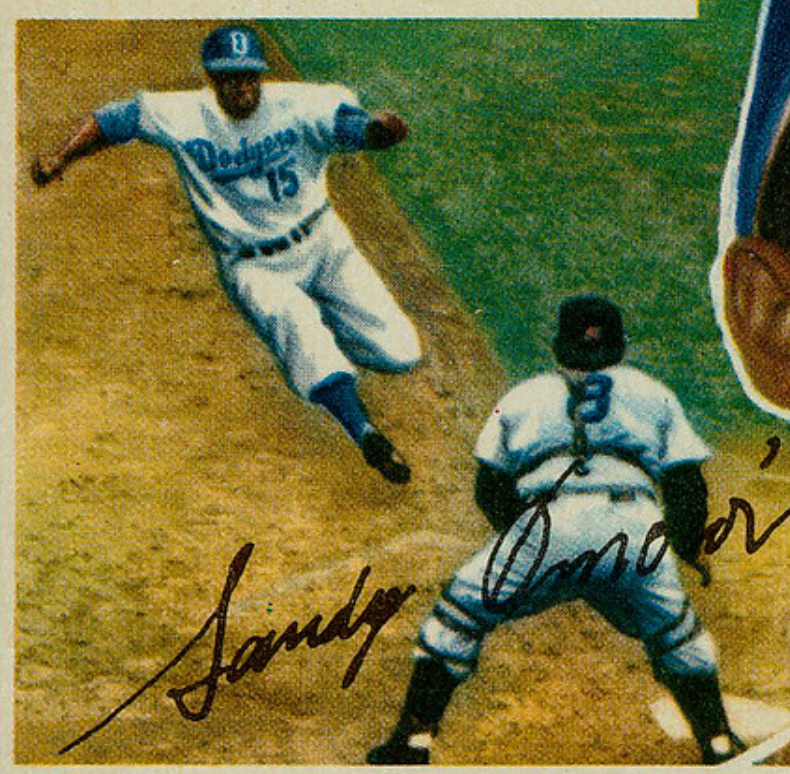
#42 Sandy Amoros: Yogi and the Series

Sandy's about to score Brooklyn's first run of 1955 World Series game four, a preface to overcoming the Yankees 8-5, as Yogi Berra receives his relay too late to make a play.
Image

Alternate angles expand our scene to include #1 Pee Wee Reese (on deck) and batboy Charlie "The Brow" DiGiovanna, who collects Flash Gilliam's bat after his double scored Amoros.


Umpire Frank Dascoli left no doubt about his call and the 1956 Topps blog agrees on this play.

Sandy's card back calls out his catch of Yogi's game seven drive against the left field fence and key hitting in that series.

#26 Grady Hatton: Two more Hall of Famers

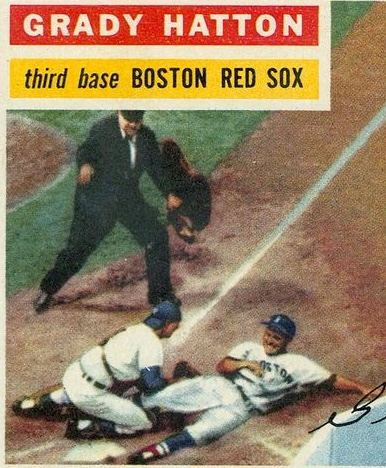
Grady's wearing his road uniform and sliding past Yogi Berra in Yankee Stadium, which tells much about how to identify the play.
Image

Hatton spent less than three years in Boston, so I checked each game he reached base in Yankee Stadium for contested plays at the plate. One candidate stands out, July 7, 1954, when he scored from first on a bases-clearing double off Marlin Stuart.

While the 1956 Topps blog leaves #26 open to showing Detroit based on the catcher's uniform, I'm confident we see New York and Yogi again. Home umpire Nestor Chylak reached the Hall of Fame in 1999, adding another cameo from Cooperstown. This proved its final play before rain the game with New York ahead 17-9. If correct, Yogi's plate block either failed to stop Grady or Berra missed his tag.

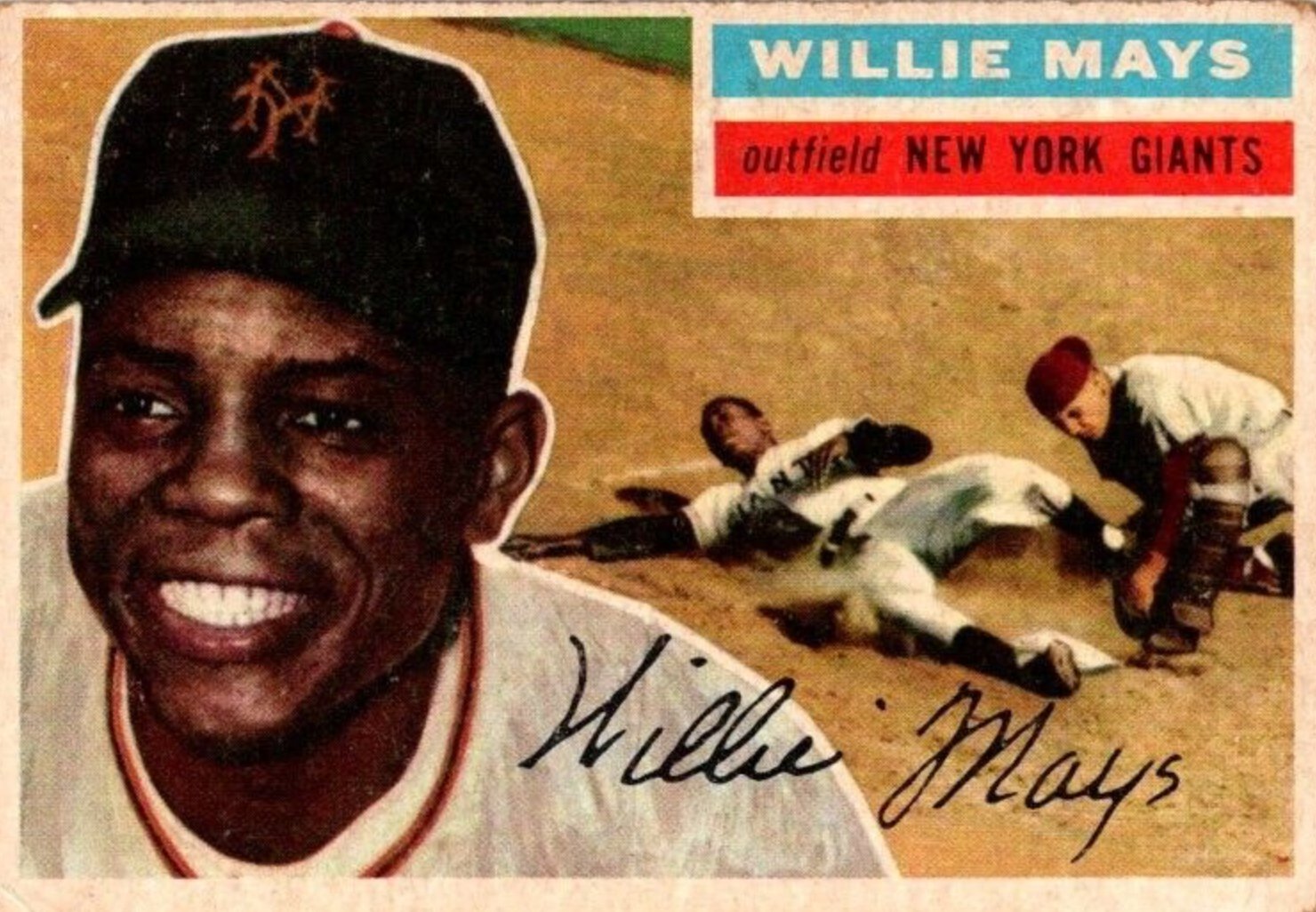
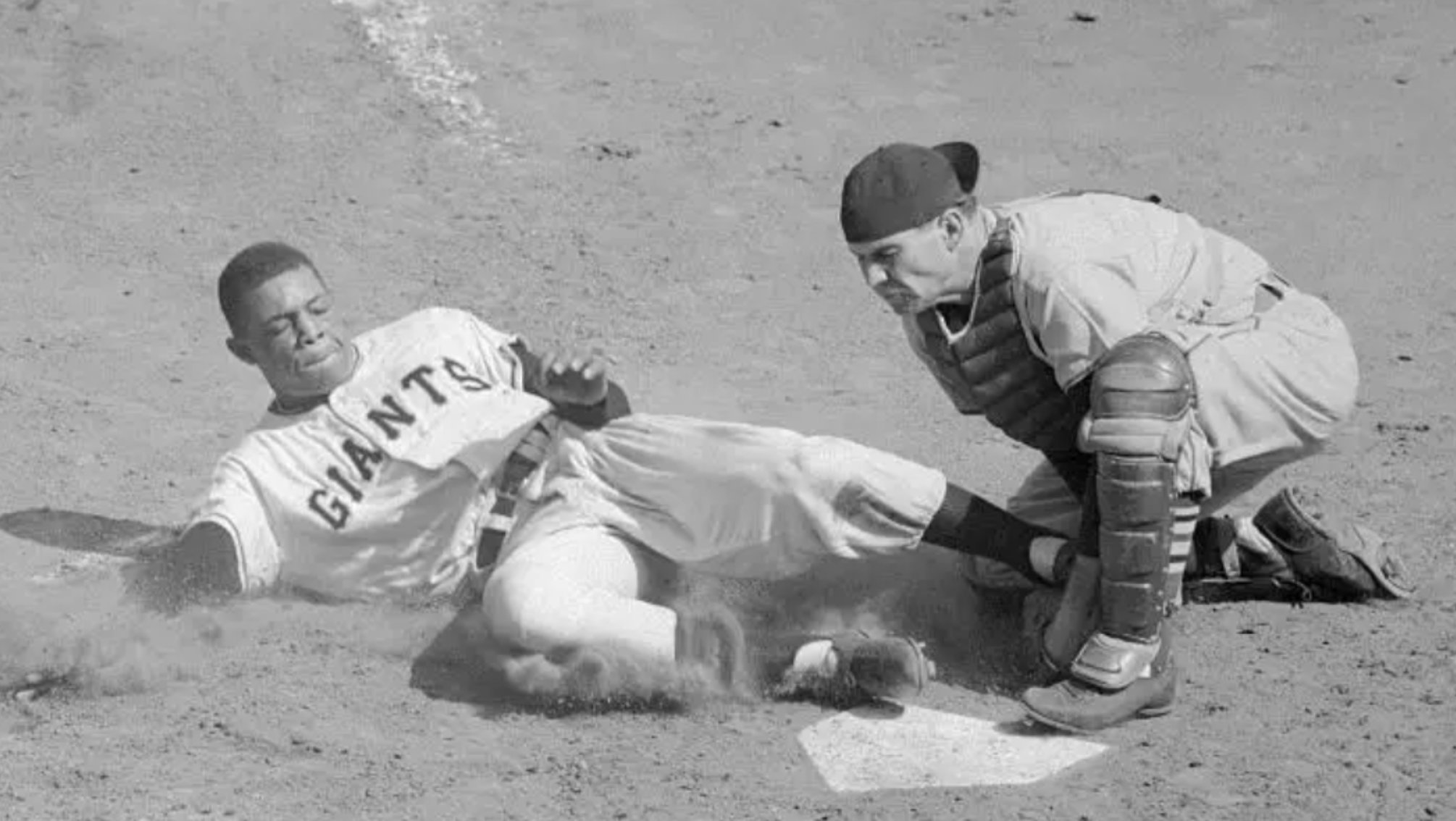
#130 Willie Mays: Out at home

This sweet slide went for naught, as Cardinal catcher Bill Sarni tagged Mays out attempting to score from first on a Don Mueller double, Sept 13, 1954, at the Polo Grounds.
Image

Image

This photo from a split-second before shows Sarni making the bang-bang play. Their box score reveals Willie already scored in the first inning and Johnny Antonelli's shutout made it stand up for a 1-0 Giants victory. This time, the 1956 Topps blog for #130 proved inconclusive, and I used wire photo research to locate a similar shot with helpful details.

Back to #127 Puddin' Head


The striped collar and sleeves on Willie tell us its original photo comes from 1947-49, when Philly wore that kind of jersey flair. His socks, hat, and undershirt all show up as solid red, which points to 1949, yet exposes a problem. Dressed to the Nines claims they went with blue!


Puddin' Head's problem could be the age of its source photo. Compare his 1956 card to this 1949 slide behind Cardinals catcher Joe Garagiola.


How would a Topps artist add color to this black-and-white scene for their 1956 card? You might look at Philly's latest uniforms.


Paint that 1949 uniform (left) with 1955 colors (right) and you get his 1956 slide. Now consider that catcher's uniform, dugout, and umpire.


Ebbets Field used a square dugout design, backing up my earlier lean toward New York stadiums.


Brooklyn's 1949 catcher looks more like Bruce Edwards than Roy Campanella, narrowing us to two games with Jones, Edwards, and a reason to slide at home, each sacrifice flies.
My gut says we're looking at August 17 because rookie Mike Goliat advanced to third, implying a play elsewhere: at the plate. Puddin' Head beat Gene Hermanski's throw en route to Philly's 11-7 win.

#171 Jim Wilson: Lost on Arrakis

Check out on the second player on Wilson's card. Those red sleeves and #1 jersey belong to Hall of Famer Richie Ashburn, who ducks by on his safe dash to first base.


In context, it looks like the first baseman fielded a ball away from the bag and threw to second for a force out, followed by a wide return throw to Wilson covering. Where would Baltimore and Philly face off, though?
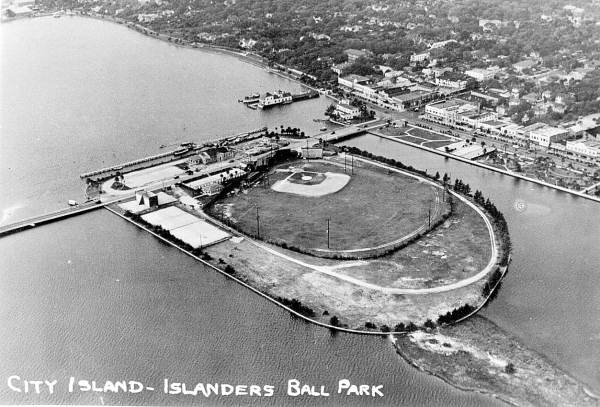
City Island Ballpark, 1940
Baltimore's 1955 spring training site

These teams held spring training in Florida for 1955, whose parks contained enough infield sand to support Jim Wilson's background image. A problem for this scenario: Baltimore aquired Wilson two games into the regular season on April 13, 1955, after he played all of spring training as a Brave.

Coverage of Wilson's first game for the birds

Look closer at the fielder and his partial "2" jersey number, plus piped uniform pants.


Wilson wore #19 for Milwaukee and #36 for Baltimore, so I believe they misidentified its team as well as its player. His pants piping looks more like the Pirates or Giants. Which works better?


Summary

That's six or seven 1956 cards identified, depending how you count Pope. I'm sure to go after more in the future! Any that you've wondered about?

Wednesday, November 29, 2023

Top Five Vintage Team Cards for Player Collectors

Say Hey! What did I send you again?

In November 2023, I mailed some vintage Giants to a collector friend. When they arrived, he said, "thanks for the Willie Mays card!" That gave me pause. Did I package up a key card, a top-tier HOFer, and then forget about it? Is age catching up with me in a way that benefits others? (That'd be my preferred outcome for aging, to be honest.)

In truth, I sent a sort-of Willie Mays, and he clarified receiving my 1960 Topps Giants team card in the name of its biggest name.

1960 Topps #151: Say Hey! (lower right)

My own player collections (Spike Owen, Jamie Quirk, Steve Garvey, David Segui) focus on named cards 99% of the time. It's rare, if possible, for team cards to show off someone you need.

One "team card" that does belong in a Spike (or Wade) PC

If you collect specific players, do you try to fill every niche, including team cards with hard-to-identify faces? I've avoided group photos myself, since many vintage team shots came out indistinct, 1960 Topps included. Half of your battle as a player collector comes down to confirming your guy is on the card at all.

The new expert in vintage team cards

In 2023, hobby researcher Roy Carlson wrote a pair of exemplary 1951-1980 Topps team card overviews for Sports Collectors Daily. He's done the legwork to prove whether your collecting obsession did or didn't appear on any vintage Topps team cards.

Want a standout surprise? I had no idea Ted Williams kept popping up on 1959-64 Topps Red Sox team cards despite his exclusive 1959-1962 trading card contract with Fleer and after retiring as a player. Topps reused their 1958 photo each year and Fleer missed complaining about it. All these team cards for Ted fans!

  • 1959 Topps #248
  • 1960 Topps #537
  • 1961 Topps #373
  • 1962 Topps #334
  • 1963 Topps #202
  • 1964 Topps #579

I used Roy's excellent work as inspiration for five team cards that player collectors should know about.

Stan Musial: 1956 Topps #134 St. Louis Cardinals team

I propose two reasons that Topps first added team cards to their main set for 1956.

  1. Topps designed much of their 1956 set prior to Bowman's post-1955 collapse and wanted to test whether a group photo would violate exclusive contracts for stars like Mickey Mantle. Would a Yankees team shot gratify his fans, even if Mick's smaller than a thumbnail?
  2. Topps hoped to knit holdouts like Stan Musial, who refused all pre-1958 Topps contracts, into group shots that players wouldn't take seriously as "stealing their image."
The 1956 Cardinals card mentions Musial by name twice and he's easy enough to find at lower-right.


The 1956Topps blog notes just 13 of these 30 gentlemen appeared on individual cards in that year's set and exclusive Bowman contracts no doubt limited who Topps could include.


Its back text claims, "Later, Stan Musial made the Cards the number one team of the 1940s." Indeed, their .642 decade winning percentage outpaced all other franchises and they won three titles in five seasons (1942-46). I believe that Stan's reticence to sign with Topps or Bowman in 1954 explains why pitcher Memo Luna garnered a late season replacement card (see Memo to The Man for full details).

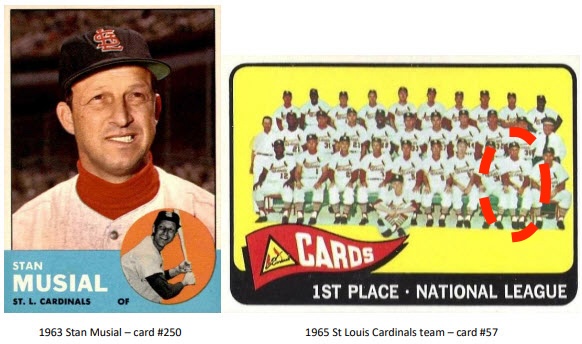
Musial appeared on two more Topps team cards, 1951 and 1957, prior to signing an individual contract in mid-1958, which triggered their first All-Star subset.

1951 Topps team cards, St. Louis Cardinals

I circled Musial (center) for context and a youthful Joe Garagiola (right) for fun. Look close and see how St. Louis cut-and-pasted their backup catcher into its second row after he missed its original team photo. 

1957 Topps #243, St. Louis Cardinals team

1957's muddier photo quality make this a tough card to love, with or without the circled Musial. I borrowed this image from Roy's first article to show how Musial's Topps on-card appearances continued beyond his retirement as a player. Topps reused a 1962 team photo (with Musial) for their 1965 set, a real twist of the knife considering St. Louis won the 1964 World Series!


While I consider 1965 #57 a curiosity with some Musial appeal, the 1956 team card's a great option for player collectors who want mid-career cards of The Man.

Carl Yastrzemski: 1965 Topps #403 Red Sox Team

The 1959-64 reuse of Boston's 1958 team photo that created extra Ted Williams cards also delayed Yaz's first appearance to 1965, years after his debut. (This kind of Topps laziness also postponed team photos with Pete Rose and several other 60s stars.)

Yaz sits at front right, between bullpen coach Al Lakeman and outfielder Lou Clinton.

Boston traded Lou Clinton to the Angels in June 1964, so this serves as his sole Red Sox team card, thanks to those 1959-1964 shenanigans. While 1965's flat backgrounds make individual faces tough to discern, it remains a decent choice for Yaz collectors as his first cardboard pose with teammates.

Hank Aaron: 1977 Topps #51 Milwaukee Brewers Team

By 1977, Topps improved print clarity enough to make Hank's legendary #44 visible without squinting.

I think most Hammer collectors know about this post-career appearance already, so consider this my bona fides for anyone seeing him there for the first time. It should be part of Aaron collections and costs little to acquire.

Yogi Berra, Jim Hegan, & Thurman Munson: 1980 Topps #434 New York Yankees team

This card meets three goals, two hobby-related and the other humane, each circled in red.

The two hobby-related details come from Roy Carlson's second article, where he shares that Yogi Berra (right circle in sunglasses) appeared on more vintage team cards (24) than any other HOFer, leading Red Schoendienst (23) by one. This card pushed him over the top! To build on that achievement, Jim Hegan (center circle) leads everyone in team card appearances with 28! Zounds.

Last but not least, vintage fans will remember Yankee captain and star catcher Thurman Munson (left circle) died in an August 1979 plane crash. Topps chose not to produce his individual 1980 card, so 1980 #434 capped his career cardboard appearances.

Many modern collectors made custom Munson cards in that double-banner style to recognize his personal importance to them. This is my favorite.

1980 Munson by When Topps Had Balls

Munson collectors should grab that team card if you missed it up to now.

Tim Raines: 1980 Topps #479 Montreal Expos Team Card

1981's most exciting rookies included Fernando Valenzuela and Tim Raines, just in time for Topps, Donruss, and Fleer to battle for the first competitive card crown in decades. Donruss won my heart with its strong borders, bold team names, and unusual back highlights. Rock's performance that year can claim real influence on our hobby's enthusiasm for rookie cards.

...but did you know Raines appeared on 1980's Expos card, circled in red? I suspect they considered him for the major league roster late enough in spring training to attend team photos. My young head woulda popped off to know this card connection back then.

What's your take on team cards, do you include them in player collections? If so, does your guy need to be in the photo itself?