Showing posts with label boston red sox. Show all posts

Friday, December 19, 2025

The Natural: Honoring Robert Redford, Eddie Waitkus, and the Sandlots of Cambridge

My favorite movie theater, The Brattle (Cambridge, MA), holds a special place in movie history thanks to their deep well of cinema knowledge and reputation for helping generations of students find new meaning in familiar films. Pictures like Casablanca and It's a Wonderful Life enjoy reliable, regular screenings for nearby students from Harvard and MIT, who then evangelize a culture of rewatching that remains key to loving classic cinema.

I seek out these "max legroom" balcony spots at each show

This theater will honor the recent passing of Robert Redford with several screenings during the 2025 holidays, including The Natural (1984) on December 19.

Redford's selection to play farm boy and baseball phenom Roy Hobbs fits how many fans saw him on screen, as a man born to portray memorable characters from our American mythos. The movie's outstanding supporting cast helps Hobbs hit every note, from striking out "The Whammer" (Joe Don Baker, who also passed this year), to his obsessive and deadly fan (Barbara Hershey), to Glenn Close as his Lady in White. This Cambridge screening complements two pieces of its history, as The Natural borrowed from the life of local boy Eddie Waitkus and happens on a date close to its "triggering event," gun pun intended.

How Cambridge Shaped its "Natural"

Future two-time All-Star and superlative gloveman Eddie Waitkus grew up in East Cambridge in the 1930s, a time of Depression economies and ever-present ballgames, when players of all ages filled sandlots to hone their skills. On December 14, 1949, the Cubs accidentally set The Natural in motion by trading Waitkus to the Phillies. This fine episode of Phillies Baseball Cards lays out what happened next.

Waitkus saw industry all around him, as East Cambridge held an almost endless supply of manufacturing and shipping companies. Eddie's SABR biography cites Cambridge Field as his proving ground, excerpted here from the city's outstanding 1930 Bromley atlas.


Cambridge Field sat two dense city blocks from Boston Woven Hose and Rubber Company, the Boston & Albany Railroad Station, and dozens of other manufacturers. (Eddie's mother died young of pneumonia, perhaps "aided" by this background environment of soot and smoke that locals inhaled every day.)


The pastoral, farm-grown youth imagined for Roy Hobbs in its 1984 film presents talent as something elemental and untouched. East Cambridge in the Depression era played a dense and crowded game, with boys striving alongside men on ballfields and factory floors. Eddie started playing baseball without a glove and those games became a forge for his physical abilities, making any "natural" swing a reflection of that workmanlike environment. (Joe Jackson emerged under similar conditions, playing for his South Carolina mill team by age 13.) 

A cinematic version of East Cambridge neighborhood ball would emphasize their broken fingers, calloused skin, and grit under everyone's nails, a true departure from bucolic backdrops in The Natural and Field of Dreams. 

In a Hollywood twist, Waitkus himself appears as Gary Cooper's action double during several scenes from Pride of the Yankees (1942). Anytime the camera's far enough back, you might being watching Eddie instead of this handsome guy (and the Redford of his day).


This climactic farewell from Pride of the Yankees features another collision of American myths between Lou Gehrig and baseball itself, encapsulated by that sleeve patch.

The 1939 "Baseball Centennial"

Those late 1930s felt so hard for so many Americans that owners looked for a reason to celebrate baseball, invented or not. On screen, Roy Hobbs and his Knights sport this 1939 jersey patch, honoring that purported centennial and perhaps as a cinematic nod to Pride of the Yankees.


The year 1939 bridged America's Great Depression and WWII fervor, so helps ground The Natural in an era of temptation and desperation, as owners worked in dark offices to shape what fans would see under ballpark lights.

Recovery and Reframing

Shot by a young woman in June 1949, Eddie healed from his injuries well enough to reappear in public life later that year. Those who read The Natural as a novel when released in 1952 and associated it with Waitkus would also remember he played a full season in 1950 and helped Philly's "Whiz Kids" win their NL Pennant. The novelized version of this attack by Harriet Bird, a woman of education and theatrics, thus transforms this life-threatening event into a necessary part of Roy (and Eddie's) struggle, instead of its interruption and possible bookend.

Eddie's status as a decorated war hero who survived a stateside shooting now seemed doubly mythic, as anyone who linked Waitkus to The Natural could reassign his experiences of violence into symbolic acts, rather than reflections on war or fanaticism. His 1955 Bowman card shows a new shape to that storyline.

As with The Natural, Bowman's card simplifies this complex history into a handful of challenges to be overcome. In one sense, the deranged girl shoots Waitkus to "aid" an American hero's journey, he finds a woman who understands human nature, she inspires him to success, and they enjoy a happy home together. Eddie's story ends about as neat as the movie that followed, sans exploding ballpark lights.

Finding the Fenway Faithful

Baseball myth flows both ways, as Curt Schilling's bloody 2004 World Series sock reminded many of Roy Hobbs bleeding through his jersey before hitting The Natural's climactic homer. Each felt like destiny, once achieved!

Whether or not you can attend Brattle's screenings in person, their latest podcast dedicated two hours to Redford's retrospective and is worth the time of any cinephile.

Sunday, December 22, 2024

Baseball Backgrounds : Reggie Jackson's Glasses on 1982 Topps #300

Last week, I got into a Bluesky chat over the reflection in Reggie's glasses on 1982 Topps card #300. New York often wore these pregame warmup tops, so it's common enough to see them in photos of that era. Few guys wore glasses like Reggie, so interesting reflections prove harder to come by.

Zoom closer to spot a guy in a lighter uniform talking to Reggie at the batting cage.

Topps also gave Reggie an All-Star card (#511) taken from the same photo series, which shows scalloped second deck bunting around Yankee Stadium above his helmet.

Most years, bunting alone says little. It's used for patriotic holidays and special events as well as postseason games. That year's work stoppage, however, split the 1981 season into two halves, narrowing things down. No games took place in Yankee Stadium during Memorial Day week or near Independence Day, but New York did reach the playoffs as its "first half champs." (More on that year's Jeckyll & Hyde results.) 

Given context, I speculate this red/white/blue bunting anticipates New York's upcoming playoff series, making it best suited for display during late-season home games. Boton came to town for a September 11-13 series and wore these light-colored uniforms.

1981 Boston Red Sox uniforms

Boston's 1981 roster included one Joe Rudi, who got card #388. The team relegated him to pinch-hitting duties by late season, so it made sense to find Joe at the batting cage before games.

Joe Rudi and Reggie Jackson shared the glory of Oakland's 1972-74 World Series titles side-by-side in the A's outfield and continue to appear together today when those champs get recognition.

Joe Rudi, Sal Bando, Reggie Jackson, Mike Epstein at Oakland Coliseum, 1972

There's a decent chance Topps caught Joe and Reggie chewing the fat during warmups before a mid-September NYY/BOS game at Yankee Stadium, giving Joe a reflected cameo in Reggie's glasses.

What do you think, do the details match up? Have someone you like as Reggie's reflection even better

Update: Readers pointed me to Cleveland's All-Star Game for Reggie's card photos and I found an even better pick than Joe Rudi for part II of this investigation. Thanks!

Saturday, August 24, 2024

"It's a Nice Night for an Evening" -- 2024 Oldtime Baseball in Cambridge, MA

My high school friend Max, a youthful Steven Wright of our Seattle classroom, often said things like, "it's a nice night for an evening" and "'Do I want cherry in my Coke?' That's something a jerk would say."

"Thanks, jerk."

Max's evening aphorism came back to me on Thursday during a beautiful night at my neighborhood's annual Oldtime Baseball, which brings dozens of amateurs and former pros to a public ballfield in Cambridge, MA, for a nine-inning combo of game, fundraising, and community. Headliners included Lou Merloni and Jonathan Papelbon, who each dressed in their Red Sox finest, played an inning, and posed for photos.

This event kicked off 30 years ago during a baseball strike, with added inspiration from a large collection of classic uniforms of all leagues, eras, and teams. Their sale table of fitted hats includes a chunk of what fans saw on the field.


I like big hats and I cannot lie -- since anything smaller than 7 5/8 is right out.


You can get as close to game action as you like and we started along the third base line.


This guy in the Seattle Pilots uniform got guff from left field fans every time he took the field and it's for reasons beyond their one year of existence. (I'll explain why soon.)


Pitchers handled about one inning each and managers cycled through lots of players, with pinch-hitter announcements a regular part of the night, most of them sponsored by a local business. (I suspect raising sufficient money for their charity gets you an at-bat.)

Former Red Sox catcher Lou Merloni started the game, squatted for an inning, and gave way to younger knees like Mr. Flexible in this bullpen. We stuck around to see Papelbon, who entered in the eighth. Sure enough, his second batter was pinch-hitter and sportswriter Jared Carrabis, who started this beef about 12 hours before game time.

As predicted, here's Papelbon firing a pitch into Jared's ribs.

Jared tossed his bat, took a couple "angry" steps toward Jonathan, and they put on a brief show of invective. Papelbon's 6" height advantage made their exchange even funnier and we fans laughed it up. One of many highlights that night.

My S.O. Sunny loves to spend money on a good cause, so bid successfully on this signed celebratory 1967 photo of Jim Lonberg. Will see if can add Yaz in the future! (Carl turned 85 the same day of this game. Concidence???)


I snapped this closer photo of our aforementioned Seattle Pilots outfielder. He caught so much crap from fans because you're looking at Jeff Maier, infamous for his catch of Derek Jeter's playoff homer against Baltimore. (Maier himself played ball at Wesleyan and wore this Pilots uniform in honor of ESPN's Jim Caple, who passed away last October and sported it for Oldtime Baseball back in 2006.) He must inspire quite a range of fan reactions.


Already looking forward to our return to Gooch's Corner next year! And always bring your glove to the park!

Sunday, March 17, 2024

Identifying background photos in 1956 Topps baseball

Introduction

I spent this week inspecting 1956 Topps baseball cards in more detail than usual. Many cards with background action show actual games and some contain enough context to suss out date and situation.

Play at the plate for ol' Puddin' Head, but which one?

Today's post investigates several of them, seeking clear dates and situations. I rely on Baseball-Reference.com for box scores, Dressed to the Nines for uniform design, and compare my take to the 1956 Topps blog, which wrote in detail about all 340 player cards.

Things to consider when investigating 1956 cards

Photos for 1956 cards came from wire services or professional photographers. As a New York company, pictures from Yankee Stadium, Ebbets Field, and the Polo Grounds could be convenient for Topps, so I lean toward New York ballparks when location's otherwise unclear. Spring training, regular season, postseason, and staged photos all appear, with many taken before 1955. 

Card editors touched up images as needed, such as this terrific shot of Pope's leap for a game-winning drive by Dusty Rhodes in 1954's World Series opener, one best known for "the catch" by Willie Mays two innings earlier. (Rhodes earned 1955 Topps #1 honors thanks to his postseason heroics.)

Topps removed "Cleveland" from Dave's jersey and painted that ball onto his glove as partial redemption.

1956 Topps #154 Orioles OF, Dave Pope

One wonders what Pope himself thought of the change, as I bet he remembered that moment!

#132 Bobby Avila and the hidden Hall of Famer 

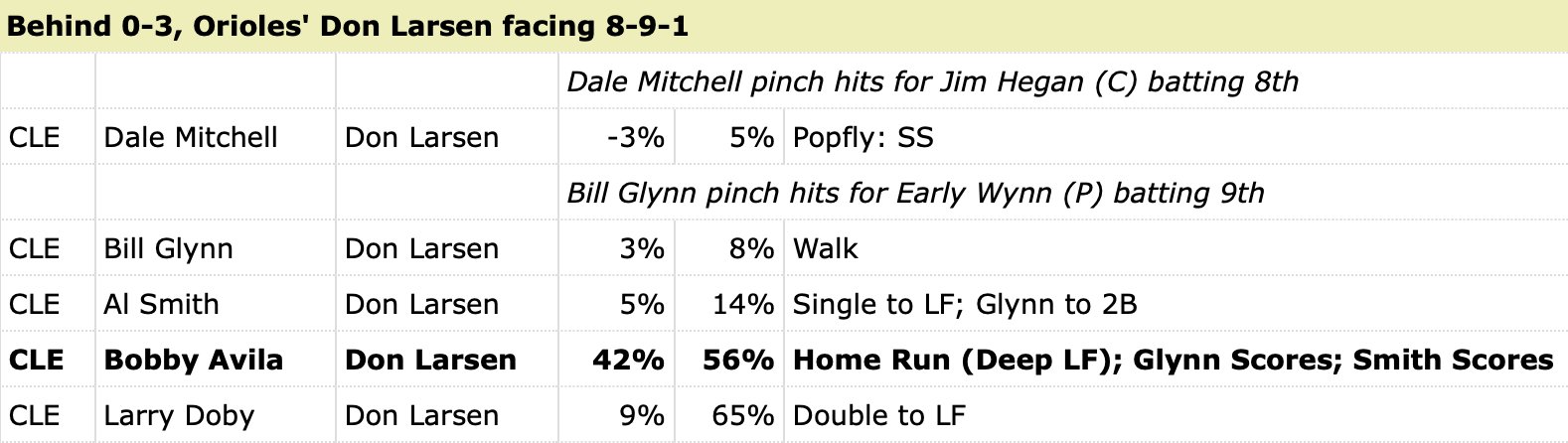
Bobby Avila's enjoying post-homer congratulations. With all those numbers crowded around home plate, can we nail down what just happened? Easy enough, it turned out, based on Avila's home run log and teammate uniforms.

That's #6 Bill Glynn and #32 Al Smith greeting Avila after his game-tying home off Baltimore's Don Larsen on August 14, 1954. #14 Larry Doby waits on deck for his chance to chase Larsen from that game. (Cleveland won 4-3 in extras.) 

Image

The 1956 Topps blog post about #132 agreed on this play and its cameo by Hall of Famer Larry Doby.

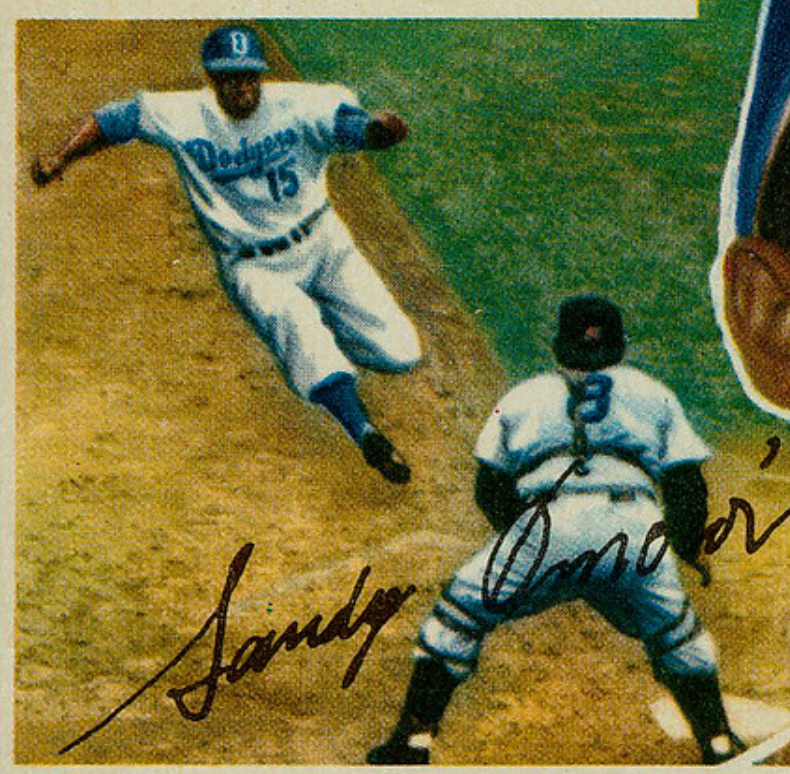
#42 Sandy Amoros: Yogi and the Series

Sandy's about to score Brooklyn's first run of 1955 World Series game four, a preface to overcoming the Yankees 8-5, as Yogi Berra receives his relay too late to make a play.

Image

Alternate angles expand our scene to include #1 Pee Wee Reese (on deck) and batboy Charlie "The Brow" DiGiovanna, who collects Flash Gilliam's bat after his double scored Amoros.


Umpire Frank Dascoli left no doubt about his call and the 1956 Topps blog agrees on this play.

Sandy's card back calls out his catch of Yogi's game seven drive against the left field fence and key hitting in that series.

#26 Grady Hatton: Two more Hall of Famers

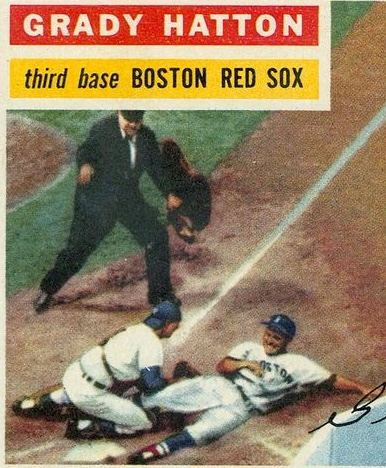
Grady's wearing his road uniform and sliding past Yogi Berra in Yankee Stadium, which tells much about how to identify the play.

Image

Hatton spent less than three years in Boston, so I checked each game he reached base in Yankee Stadium for contested plays at the plate. One candidate stands out, July 7, 1954, when he scored from first on a bases-clearing double off Marlin Stuart.

While the 1956 Topps blog leaves #26 open to showing Detroit based on the catcher's uniform, I'm confident we see New York and Yogi again. Home umpire Nestor Chylak reached the Hall of Fame in 1999, adding another cameo from Cooperstown. This proved its final play before rain the game with New York ahead 17-9. If correct, Yogi's plate block either failed to stop Grady or Berra missed his tag.

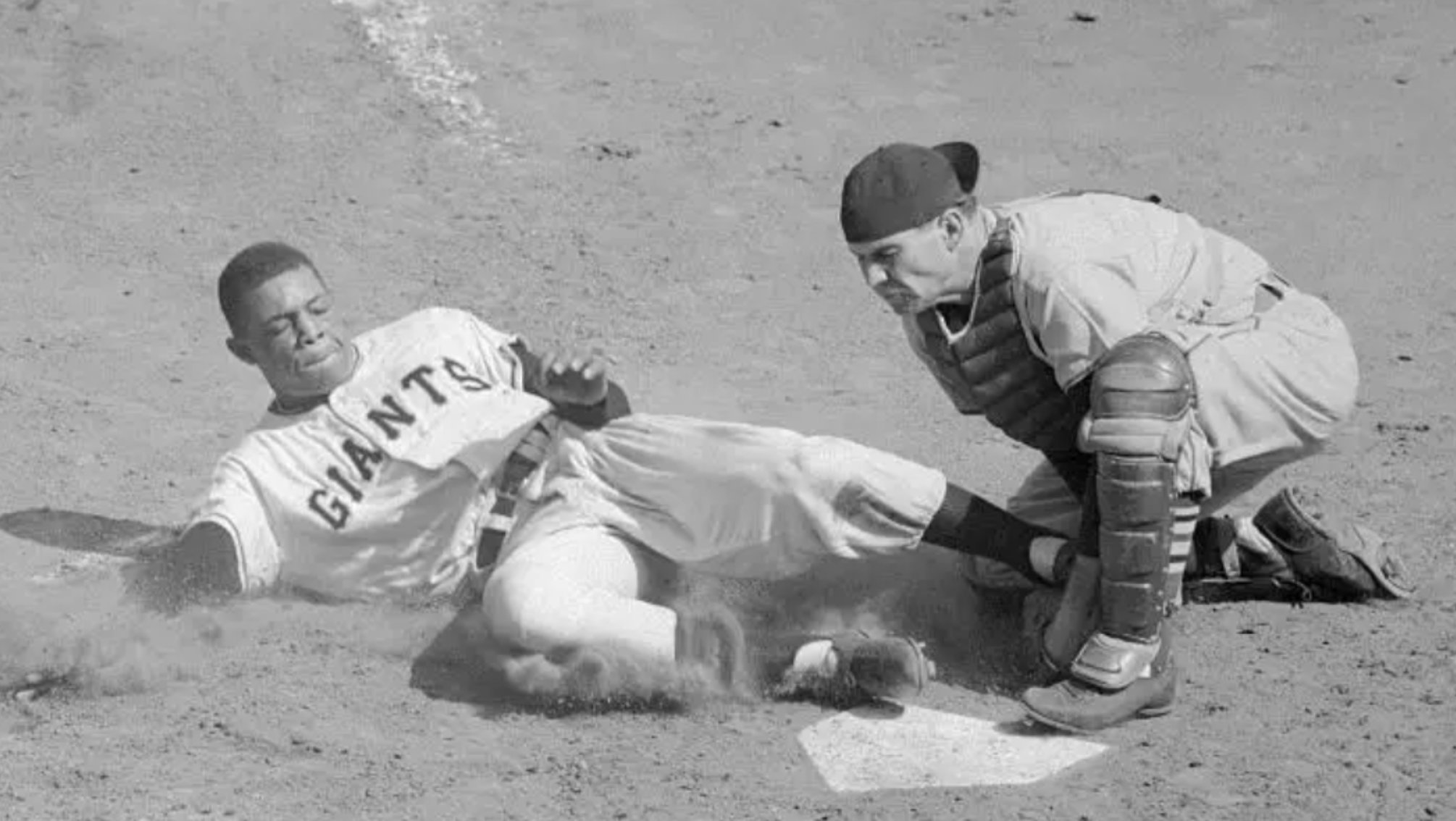
#130 Willie Mays: Out at home

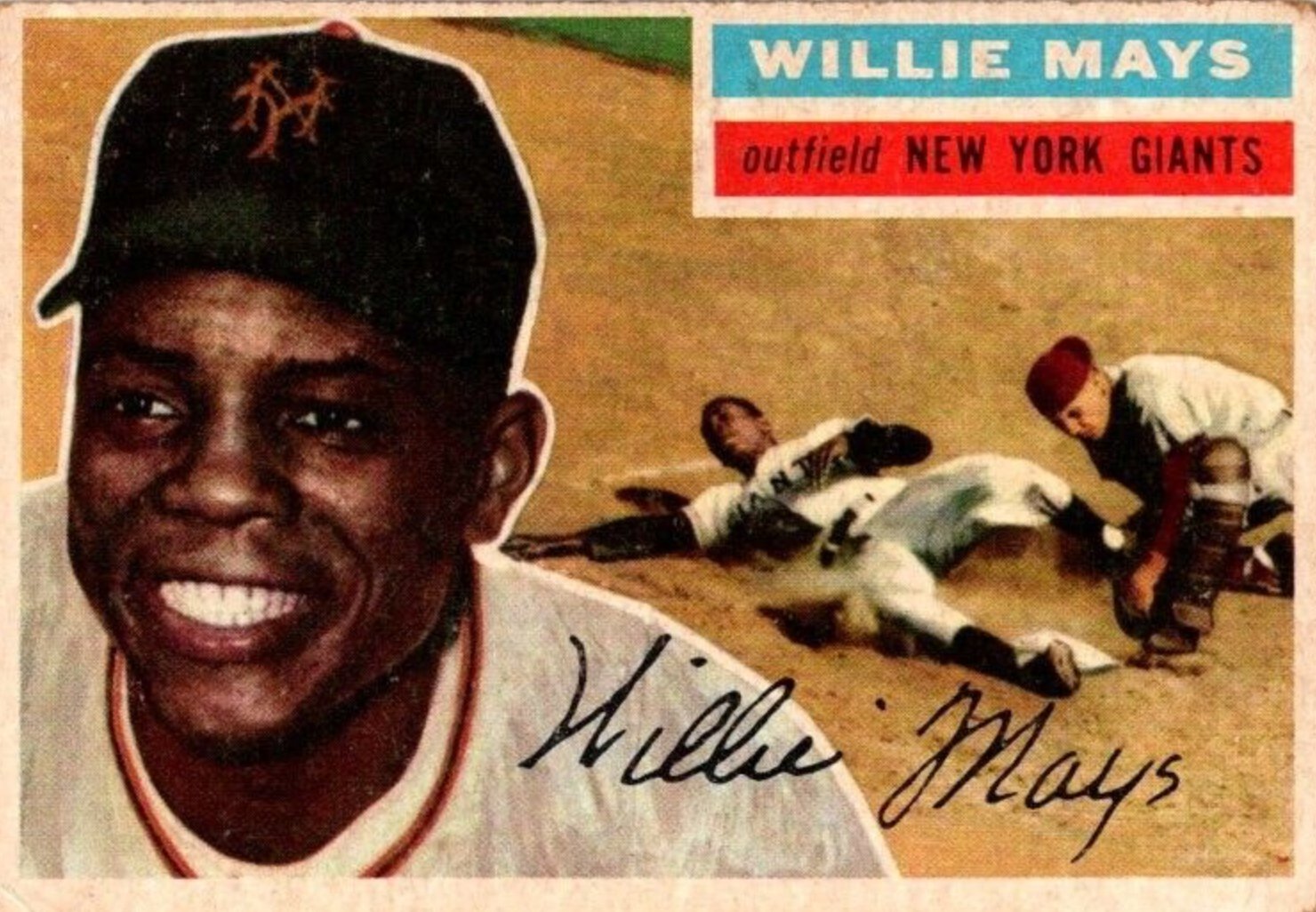
This sweet slide went for naught, as Cardinal catcher Bill Sarni tagged Mays out attempting to score from first on a Don Mueller double, Sept 13, 1954, at the Polo Grounds.

Image

Image

This photo from a split-second before shows Sarni making the bang-bang play. Their box score reveals Willie already scored in the first inning and Johnny Antonelli's shutout made it stand up for a 1-0 Giants victory. This time, the 1956 Topps blog for #130 proved inconclusive, and I used wire photo research to locate a similar shot with helpful details.

Back to #127 Puddin' Head


The striped collar and sleeves on Willie tell us its original photo comes from 1947-49, when Philly wore that kind of jersey flair. His socks, hat, and undershirt all show up as solid red, which points to 1949, yet exposes a problem. Dressed to the Nines claims they went with blue!


Puddin' Head's problem could be the age of its source photo. Compare his 1956 card to this 1949 slide behind Cardinals catcher Joe Garagiola.


How would a Topps artist add color to this black-and-white scene for their 1956 card? You might look at Philly's latest uniforms.


Paint that 1949 uniform (left) with 1955 colors (right) and you get his 1956 slide. Now consider that catcher's uniform, dugout, and umpire.


Ebbets Field used a square dugout design, backing up my earlier lean toward New York stadiums.


Brooklyn's 1949 catcher looks more like Bruce Edwards than Roy Campanella, narrowing us to two games with Jones, Edwards, and a reason to slide at home, each sacrifice flies.
My gut says we're looking at August 17 because rookie Mike Goliat advanced to third, implying a play elsewhere: at the plate. Puddin' Head beat Gene Hermanski's throw en route to Philly's 11-7 win.

#171 Jim Wilson: Lost on Arrakis

Check out on the second player on Wilson's card. Those red sleeves and #1 jersey belong to Hall of Famer Richie Ashburn, who ducks by on his safe dash to first base.


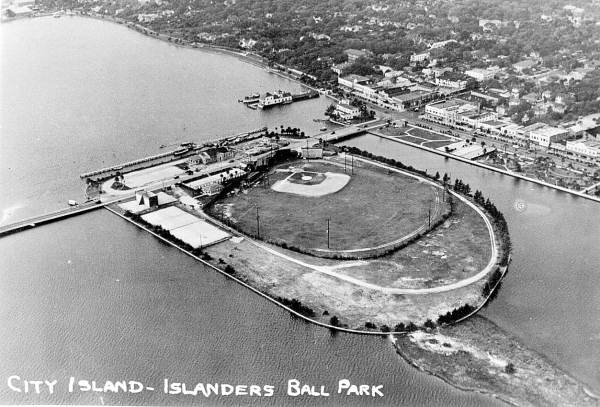
In context, it looks like the first baseman fielded a ball away from the bag and threw to second for a force out, followed by a wide return throw to Wilson covering. Where would Baltimore and Philly face off, though?

City Island Ballpark, 1940
Baltimore's 1955 spring training site

These teams held spring training in Florida for 1955, whose parks contained enough infield sand to support Jim Wilson's background image. A problem for this scenario: Baltimore aquired Wilson two games into the regular season on April 13, 1955, after he played all of spring training as a Brave.

Coverage of Wilson's first game for the birds

Look closer at the fielder and his partial "2" jersey number, plus piped uniform pants.


Wilson wore #19 for Milwaukee and #36 for Baltimore, so I believe they misidentified its team as well as its player. His pants piping looks more like the Pirates or Giants. Which works better?


Summary

That's six or seven 1956 cards identified, depending how you count Pope. I'm sure to go after more in the future! Any that you've wondered about?