Showing posts with label history. Show all posts

Friday, December 19, 2025

The Natural: Honoring Robert Redford, Eddie Waitkus, and the Sandlots of Cambridge

My favorite movie theater, The Brattle (Cambridge, MA), holds a special place in movie history thanks to their deep well of cinema knowledge and reputation for helping generations of students find new meaning in familiar films. Pictures like Casablanca and It's a Wonderful Life enjoy reliable, regular screenings for nearby students from Harvard and MIT, who then evangelize a culture of rewatching that remains key to loving classic cinema.

I seek out these "max legroom" balcony spots at each show

This theater will honor the recent passing of Robert Redford with several screenings during the 2025 holidays, including The Natural (1984) on December 19.

Redford's selection to play farm boy and baseball phenom Roy Hobbs fits how many fans saw him on screen, as a man born to portray memorable characters from our American mythos. The movie's outstanding supporting cast helps Hobbs hit every note, from striking out "The Whammer" (Joe Don Baker, who also passed this year), to his obsessive and deadly fan (Barbara Hershey), to Glenn Close as his Lady in White. This Cambridge screening complements two pieces of its history, as The Natural borrowed from the life of local boy Eddie Waitkus and happens on a date close to its "triggering event," gun pun intended.

How Cambridge Shaped its "Natural"

Future two-time All-Star and superlative gloveman Eddie Waitkus grew up in East Cambridge in the 1930s, a time of Depression economies and ever-present ballgames, when players of all ages filled sandlots to hone their skills. On December 14, 1949, the Cubs accidentally set The Natural in motion by trading Waitkus to the Phillies. This fine episode of Phillies Baseball Cards lays out what happened next.

Waitkus saw industry all around him, as East Cambridge held an almost endless supply of manufacturing and shipping companies. Eddie's SABR biography cites Cambridge Field as his proving ground, excerpted here from the city's outstanding 1930 Bromley atlas.


Cambridge Field sat two dense city blocks from Boston Woven Hose and Rubber Company, the Boston & Albany Railroad Station, and dozens of other manufacturers. (Eddie's mother died young of pneumonia, perhaps "aided" by this background environment of soot and smoke that locals inhaled every day.)


The pastoral, farm-grown youth imagined for Roy Hobbs in its 1984 film presents talent as something elemental and untouched. East Cambridge in the Depression era played a dense and crowded game, with boys striving alongside men on ballfields and factory floors. Eddie started playing baseball without a glove and those games became a forge for his physical abilities, making any "natural" swing a reflection of that workmanlike environment. (Joe Jackson emerged under similar conditions, playing for his South Carolina mill team by age 13.) 

A cinematic version of East Cambridge neighborhood ball would emphasize their broken fingers, calloused skin, and grit under everyone's nails, a true departure from bucolic backdrops in The Natural and Field of Dreams. 

In a Hollywood twist, Waitkus himself appears as Gary Cooper's action double during several scenes from Pride of the Yankees (1942). Anytime the camera's far enough back, you might being watching Eddie instead of this handsome guy (and the Redford of his day).


This climactic farewell from Pride of the Yankees features another collision of American myths between Lou Gehrig and baseball itself, encapsulated by that sleeve patch.

The 1939 "Baseball Centennial"

Those late 1930s felt so hard for so many Americans that owners looked for a reason to celebrate baseball, invented or not. On screen, Roy Hobbs and his Knights sport this 1939 jersey patch, honoring that purported centennial and perhaps as a cinematic nod to Pride of the Yankees.


The year 1939 bridged America's Great Depression and WWII fervor, so helps ground The Natural in an era of temptation and desperation, as owners worked in dark offices to shape what fans would see under ballpark lights.

Recovery and Reframing

Shot by a young woman in June 1949, Eddie healed from his injuries well enough to reappear in public life later that year. Those who read The Natural as a novel when released in 1952 and associated it with Waitkus would also remember he played a full season in 1950 and helped Philly's "Whiz Kids" win their NL Pennant. The novelized version of this attack by Harriet Bird, a woman of education and theatrics, thus transforms this life-threatening event into a necessary part of Roy (and Eddie's) struggle, instead of its interruption and possible bookend.

Eddie's status as a decorated war hero who survived a stateside shooting now seemed doubly mythic, as anyone who linked Waitkus to The Natural could reassign his experiences of violence into symbolic acts, rather than reflections on war or fanaticism. His 1955 Bowman card shows a new shape to that storyline.

As with The Natural, Bowman's card simplifies this complex history into a handful of challenges to be overcome. In one sense, the deranged girl shoots Waitkus to "aid" an American hero's journey, he finds a woman who understands human nature, she inspires him to success, and they enjoy a happy home together. Eddie's story ends about as neat as the movie that followed, sans exploding ballpark lights.

Finding the Fenway Faithful

Baseball myth flows both ways, as Curt Schilling's bloody 2004 World Series sock reminded many of Roy Hobbs bleeding through his jersey before hitting The Natural's climactic homer. Each felt like destiny, once achieved!

Whether or not you can attend Brattle's screenings in person, their latest podcast dedicated two hours to Redford's retrospective and is worth the time of any cinephile.

Saturday, August 24, 2024

"It's a Nice Night for an Evening" -- 2024 Oldtime Baseball in Cambridge, MA

My high school friend Max, a youthful Steven Wright of our Seattle classroom, often said things like, "it's a nice night for an evening" and "'Do I want cherry in my Coke?' That's something a jerk would say."

"Thanks, jerk."

Max's evening aphorism came back to me on Thursday during a beautiful night at my neighborhood's annual Oldtime Baseball, which brings dozens of amateurs and former pros to a public ballfield in Cambridge, MA, for a nine-inning combo of game, fundraising, and community. Headliners included Lou Merloni and Jonathan Papelbon, who each dressed in their Red Sox finest, played an inning, and posed for photos.

This event kicked off 30 years ago during a baseball strike, with added inspiration from a large collection of classic uniforms of all leagues, eras, and teams. Their sale table of fitted hats includes a chunk of what fans saw on the field.


I like big hats and I cannot lie -- since anything smaller than 7 5/8 is right out.


You can get as close to game action as you like and we started along the third base line.


This guy in the Seattle Pilots uniform got guff from left field fans every time he took the field and it's for reasons beyond their one year of existence. (I'll explain why soon.)


Pitchers handled about one inning each and managers cycled through lots of players, with pinch-hitter announcements a regular part of the night, most of them sponsored by a local business. (I suspect raising sufficient money for their charity gets you an at-bat.)

Former Red Sox catcher Lou Merloni started the game, squatted for an inning, and gave way to younger knees like Mr. Flexible in this bullpen. We stuck around to see Papelbon, who entered in the eighth. Sure enough, his second batter was pinch-hitter and sportswriter Jared Carrabis, who started this beef about 12 hours before game time.

As predicted, here's Papelbon firing a pitch into Jared's ribs.

Jared tossed his bat, took a couple "angry" steps toward Jonathan, and they put on a brief show of invective. Papelbon's 6" height advantage made their exchange even funnier and we fans laughed it up. One of many highlights that night.

My S.O. Sunny loves to spend money on a good cause, so bid successfully on this signed celebratory 1967 photo of Jim Lonberg. Will see if can add Yaz in the future! (Carl turned 85 the same day of this game. Concidence???)


I snapped this closer photo of our aforementioned Seattle Pilots outfielder. He caught so much crap from fans because you're looking at Jeff Maier, infamous for his catch of Derek Jeter's playoff homer against Baltimore. (Maier himself played ball at Wesleyan and wore this Pilots uniform in honor of ESPN's Jim Caple, who passed away last October and sported it for Oldtime Baseball back in 2006.) He must inspire quite a range of fan reactions.


Already looking forward to our return to Gooch's Corner next year! And always bring your glove to the park!

Tuesday, July 18, 2023

"Baseball in the Berkshires" exhibit in Lee, MA (July to August 2023)

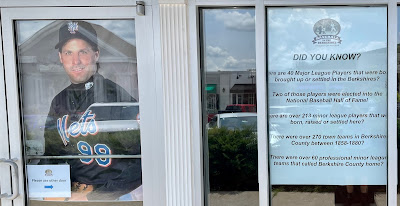
A long chain of events, fortunate and unfortunate, led me to factory outlet shopping in Lee, MA, over the weekend. I parked our car and turned around to see a local success story looking back.

DID YOU KNOW? I'M TURK WENDELL.

Earlier in July, a dedicated group of local historians opened a storefront museum featuring the many MLB, minor league, and amateur baseball teams that played local forms of our pastime since (by their count) at least 1791, with online details at Baseballinberkshires.org.

Jack Chesbro garnered a street-facing banner as half of their Cooperstown inductees.

African-American pioneer Frank Grant is their second HOFer

Local news coverage gave a good sense of the inside, including an on-camera chat with its curator: "Baseball in the Berkshires opens new exhibit in Lee" (July 6, 2023).

I spotted card sorting near the back, where they offered any visiting kids a free variety stack of 1960s to 2000s.

I hope those youngsters appreciate broadcasters well-known, lesser-known, and also Ron Salcedo.

Lots of recognizable names in those stacks, even in the minor league sets. Those exhibit hosts said all their cards came from local collectors and donors.

Their batch of hand-updated cards should be perfect for people playing Immaculate Grid. I've already used Jim Perry multiple times!


If you live anywhere near the Berkshires or take a roadtrip to Cooperstown, I recommend stopping by before the end of August. Tell them you heard about it from that guy holding a Calvin Klein bag!

Monday, July 17, 2023

1935 Goudey Big League Gum baseball: over the border line (for the SABR Baseball Cards blog)

Intro for my latest at the SABR Baseball Cards blog

I enjoy picking apart hard-to-explain details of vintage cards to see where that journey leads. This post puts three aspects of Goudey's 1935 Big League Gum baseball set, which most shorten to "1935 Goudey," under the microscope. It plays with definitions of "border" and considers how gum companies took advantage of legal gray areas to sell more gum to baseball fans. If you like learning about Prohibition's impact on greater society, this will be grist for your mill. You might even agree that "1935 Goudey" tells just half of its story.

Read the rest there!

Wednesday, October 28, 2020

Where did 1933 Big League Gum #106 Nap Lajoie come from?

Introduction

Welcome to another article about Goudey Gum and its 1930s business choices! They continue to fascinate me as an American company (born from Canadian roots) that used chewing gum innovations to succeed during the Great Depression, one of history's toughest times to make a buck.

We often think of card makers like Goudey and Topps as driving the hobby forward by injecting "fun" into packs of cardboard and gum. While those companies mean a lot to those end products, they share the road with us, the collectors who buy their stuff. When I think of what we contribute, I think of Nap Lajoie.

1933 Goudey Big League Gum #106, Napoleon Lajoie

If you know #106 at all, you know it as one of our hobby's treasured rarities. When we fantasize about "owning a Lajoie," most of us mean this one. He's a prize, in part, because collectors demanded his creation. If you don't know that origin story, I recommend starting with Anson Whaley's 7 fun facts about the Nap Lajoie 1933 Goudey card. Today's article covers that card's larger context and a "deadline trade" that I believe made him so hard to find.

1933's best-laid plans

Leo "The Lip" Durocher first served as the Big League Gum #106 proof card, but just at first. Prior to final printing, Goudey removed #106 from its 24-card sheet and added a second #144 Ruth, seeking to satisfy buyer demand for the Babe. Durocher's own number changed to #147, leaving a new hole in the checklist.


Note #106 Durocher's uneven edges, hand-cut from the proof sheet

By 1934, enough frustrated collectors complained to Goudey about a missing #106 that they created a real one, featuring Napoleon Lajoie, to hold and enjoy. There's our man alongside 1934 Big League Gum's fourth series, its scarcer "high numbers" (#73-96).


While this means Goudey printed as many 1933 #106 cards as they did 1934 Bill Werbers, Lajoie never went into wax packs. We can assume all copies available today came from 1930s mail-in requests or from Goudey's leftover stock sale in the 1960s. It's a good bet they discarded or destroyed the remainder. (Ouch, babe.)

Designing a white whale

When Goudey yielded to demand and decided to create the missing #106, they assembled it from a melange of 1933 and 1934 Big League Gum elements. On the front, Larry's sliding silhouette mimicked 1934 #65 Cliff Bolton.


Lajoie's back bio uses quote marks, as seen on 1934 "Lou Gehrig says..." cards. While the "G. G. Co © 1934" stamp also carried over, Goudey put it below 1933's "series of 240" footer, since #106 filled a gap in that set.


So that's why #106, you say. But why Lajoie, you ask? Check out that front again.


There's our Cliff Bolton slide alongside slimmer-than-1933 name lettering and a big empty shirt space where something else could be. That big jersey space reminded me of a different Goudey set: 1933-34 Sport Kings Gum.

1933 Goudey Sport Kings Gum #3, Babe Ruth

Sport Kings Gum covered a range of "Stars and Champs of Today and Yesterday" across two series, one released in late 1933 and the other in early 1934. Two baseball players appear in series one (Ruth, Cobb) and one in series two (Carl Hubbell). A few Sport Kings, like the Babe and Hubbell, were still active and doing their thing. Many others, like Cobb, were years removed from their famous professions or achievements.

1933 Sport Kings Gum series one window advertisement

I see Sport Kings Gum as a nostalgia pitch to older fans who remembered the 1910s and 1920s. Goudey also used it to sneak another Babe Ruth into 1933 before their license to use his image expired. That makes six different 1933 Goudey Ruths, if you count four Big League Gum cards and this mail-in premium.

1933 Goudey R309-1 premium, Babe Ruth

Pulled from the cold case files

While Big League Gum focused on active ballplayers, Sport Kings Gum covered people foundational to sports and culture in general, like Duke Kahanamoku, Babe Didrickson, and Jim Thorpe. Seeing how Lajoie's career lasted from 1896 to 1916, that's the mold he fits. Back in 1933, Nap's last on-card appearance was already a dozen years old and described him as "former 2nd base."

1919-21 W514, Nap Lajoie

So if Lajoie should've been in Sport Kings, why wasn't he? I suspect Big League Gum proved so popular that it changed Goudey's original plans.

Trading at the deadline

Jason Schwartz's "An alternate history of 1933 Goudey" describes the midseason scramble surrounding Big League Gum in great detail. While I recommend reading the whole thing, focus on three points.
  • Goudey's first five series cover 120 cards, half of their promised "series of 240," with no duplicate players
  • Thanks to baseball mania surrounding Chicago's "Century of Progress" exposition and MLB's first All-Star Game, Goudey sold more gum cards in 1933 than in any other year
  • Big League Gum's art style changed in late 1933 and became close to that seen on 1934, implying cards released a year ahead of plan

Sport Kings Gum's first series (#1-24) came out in late 1933, at about the same time Big League Gum's final series, allowing Goudey to compare results. Since Big League Gum's final series included all World Series players, 12 each Giants and Senators, they also gave New York ace Carl Hubbell his second card in the set.

1933 Big League Gum #234, Carl Hubbell

It's easy to imagine strong sales for a series of World Series players, King Carl included. If so, you can guess what came next.

Card Hubbell, circa 1933 World Series

1934 Sport Kings Gum #42, Carl Hubbell

I think Goudey had Sport Kings Gum series two (#25-48) ready to go with Lajoie at #42 and just bumped him in favor of New York's new World Champion and 1933 NL MVP. After all, Lajoie hadn't played baseball in 17 years. Give kids more of what they want!

That move left orphaned Lajoie art available for other purposes, like filling the gap at #106. While I doubt they predicted needing it later, Goudey's opportunism allowed them to avoid wasting completed work. Add some bits of 1933-34 design, slip it onto a Big League Gum print sheet, and move on to the next thing.


I can do more than just argue for Lajoie with words and phrases. Let's take him all the way home with some custom card work.


Now that's a Sport King we can root for. Slide, Larry, slide!

Conclusion

I never felt at ease with the idea of Lajoie dropping unexplained into a set otherwise full of active -- or at least recent -- players. It fails the sniff test for a company that made decisions with the bottom line in mind.

Knowing what we know about Goudey's business practices, set construction, and 1933 sales, I believe this series of events explains Napoleon Lajoie's appearance on 1933 Big League Gum #106. Other collectors and historians may disagree and alternative ideas are welcome. Either way, loving that look of Nap under a Sport Kings Gum banner.

Tuesday, May 21, 2019

1954 Bowman Baseball : Memo to The Man

How I got here

Somewhere in the middle of SABR's Cardboard Crosswalk article about 1954 Bowman and 1954 Topps baseball sets, I flipped through my own Bowman set and found some things I didn't expect or even remember. Weird player choices. Repainted uniforms for some offseason moves and not others. Missing autographs -- and even #123 Toby Atwell's odd-tograph. When professionals make these kinds of mistakes, I sound like my dad: "...and what can we learn from this?"

#101, Don Larsen. He's not mad at Bowman, he's just disappointed.

Using 1954's underlying structure and unexpected features, this article shows how team checklist consistency and exclusive player contracts explain the set's initial plan and final version. It also hints at what could've been, if Topps and Bowman cooperated more than fought.

Bowman by the numbers

First thing to know about 1954 Bowman: their team-sequenced numbering. At its root, Bowman wanted clean, 32-card sheets of players numbered #1 (Yankees) to #16 (Braves), with a steady sequence of guys slotted into two spots per team on each sheet. (Their 1949 and 1952 baseball sets followed similar patterns.)

1954 Bowman's "base" layout

This put #65 Mickey Mantle (Yankees slot) next to #66a Ted Williams (Red Sox slot), adjacent to #73 Don Mueller (Giants slot) and #74 Junior Gilliam (Dodgers slot).

Uncut sample panel, auctioned 2018 for $6K

Followed to its logical conclusion, this perfect layout adds two players per team, 32 per sheet, until you run out of guys "worthy" of cardboard. My gut says you top out at 20 "good enough" players, meaning 320 maximum set size. And yet, Bowman's own 1954 ads went bigger, promising over "400 major league headliners under exclusive contract!"

1954 Bowman season-opening ad

To the best of my knowledge, Bowman released #1-128 in April, followed by #129-224 around June. Despite aspirations to rival the 1952 Topps 407-card effort, they fell several sheets short of 400 "major league headliners," with at least three contributing factors.
  1. Slowing baseball sales. When kids stopped buying baseball, Bowman shifted card budgets to other projects, like 1954 NFL football and their military U.S. Naval Victories and Power For Peace sets.
  2. Not enough available players. The legal aftermath of fierce 1953 wrangling with Topps over exclusive player contracts led both companies to scale back 1954 set sizes. I doubt Bowman considered 400 cards a real goal.
  3. Quality problems. Text errors on 40 cards led to corrections on every print sheet, wasting money Bowman could've used on new players.

This final 1954 layout includes those late-game team changes, corrected print errors, and several "missing" player autographs, replaced by block letter names.

1954 Bowman team checklist, warts and all

These changes hint at who's left out of Bowman's original plans. They also tell us when they finalized the set. Let's start with the former, its absent players.

Missing player autographs

Most 1954 Bowman card fronts show a player's facsimile autograph, saving position and team names for the back. Some signatures loom larger than others!

1954 Bowman #65, Mickey Mantle

On the other hand, six 1954 baseball cards sport block lettering instead of autographs, two in series one (#60, 121) and four in series two (#179, 208, 219, 222).

1954 Bowman #179, Morris "Morrie" Martin

Three theories why Bowman left off some autographs.
  1. Bowman didn't possess a printable version, due to circumstances beyond their control. Based on this 1955 exchange with The Sporting News, we know they depended on media outlets for photos. Perhaps this extended to signatures.
  2. Block letter players served as "alternates," swapped into their team slot for someone Bowman couldn't secure the rights to print. (For example, #66 Ted Williams replaced by another Red Sox player, Jimmy Piersall.)
  3. Some autographs "failed" during test runs, so printers switched to letters.

For the six block letter cards, let's assess whether a) Bowman possessed usable autographs and b) on-card players served as stand-ins for other, better choices. Print failures could explain anything not covered by those two.

#60 Fred Baczewski (Reds pitcher, 1953 rookie)


Did Bowman own Fred's signature in time for printing? Based on 1953 game logs, his star rose well after mid-year, so perhaps not.

Did Fred step in for another Reds player? I think he did. Topps signed veteran Cincinnati teammate Bud Podbielan to an exclusive contract for 1954. Swapping in an emerging rookie on an otherwise moribund 1953 team makes sense to me.

#121 Ray Katt (Giants catcher, 1953 rookie)


Ray "arrived" even later in 1953 than Fred, serving as September fill-in for a fifth-place Giants team. I don't think they had his autograph ready by print time.

Did Ray step in for another Giants player? Topps signed OF star Monte Irvin to an exclusive contract for 1954. That could well be why Bowman substituted Katt, even though New York's everyday catcher (#25 Wes Westrum) also appeared in their "first series" (#1-128).

#179 Morrie Martin (A's pitcher)


Morrie first appeared in 1953 Bowman's black and white set, which feels like ample time to secure an autograph for 1954. If a player with prior cards can end up with block letters, other factors must be more important than service time.

Did he swap in for anyone? Martin did most of his work as mid-game reliever and "closer," not a glamor position in that era. Topps signed A's slugger Gus Zernial to an exclusive 1954 deal and could be who Morrie stood in for as a Bowman card.

#208 Johnny Antonelli (Giants pitcher)


Johnny serves double-duty set oddity, as both block lettered and occupant of #208, a "Braves" team number. When Milwaukee traded #208 Antonelli to New York for #201 Bobby Thomson, Bowman left them both in respective Giants and Braves checklist spots. More to say about these later.

As for the signature itself, Antonelli appeared in both 1950 and 1951 Bowman, removing time as a factor. This could be a legitimate autograph printing issue.

#216 Jerry Snyder (Senators shortstop)


Snyder's own 1952 Bowman card features an autograph, so we can skip that reason and look at player substitution. Based on field position alone, I bet Bowman planned this spot for Washington's everyday shortstop Pete Runnels, who Topps signed to an exclusive deal for 1954. Not sure Jerry's 29 games of spot duty merit a card otherwise.

#219 Hal Rice (Pirates outfielder)


Hal Rice first appeared on 1951 Bowman, so I doubt time's a factor for his signature. Topps held three Pirates exclusives for 1954 that look promising as swap-portunities: 1953 rookie 1B/OF Paul Smith and the O'Brien brothers (everyday 2B & SS), who Topps printed as their first multi-player card.

1954 Topps #139, Ed & John O'Brien

Topps also printed a card for absent Pirate shortstop Dick Groat, who served all of 1953-54 in Korea. I think Hal Rice appears in 1954 Bowman as stand-in for one of these four guys.

#222 Memo Luna (Cardinals pitcher, 1954 rookie)


After printing Stan Musial cards every year from 1948-53, Bowman failed to re-sign "The Man" for 1954. No doubt they hoped to include him, if at all possible. This spot serves as last gasp for St. Louis by team order, so I think Memo sits where Stan would be, if they'd landed him. As nice as Luna's card looks, he's far overshadowed by Musial's league-wide appeal.

1954 Red Heart dog food, Stan Musial

Musial declined to sign with Bowman or Topps after 1953, citing "insufficient compensation," and appeared on smaller sets like Red Heart dog food and Rawlings sporting goods until his return via the 1958 Topps All-Star subset.

1958 Topps #476, Sport Magazine AS Stan Musial

To Memo Luna's credit, he pitched in (1) and won (0) the same number of career MLB games as Musial. Stan faced a single batter (Frank Baumholtz) on Sept 28, 1952, as part of a first-inning marketing gimmick related to each man's pursuit of the NL batting title. (My "Selected By the Youth of America!" article says a lot more about Musial's impact on Topps and their All-Star sets.)

1954 Bowman #66a, Ted Williams

To summarize, Bowman's half-dozen, block-lettered players imply behind-the-scenes work to account for Topps 1954 exclusives that go beyond their infamous removal of #66a Ted Williams.

As Ted's exclusive contact with Topps happened after Bowman started 1954 production and distribution, let's use off-season player movement to narrow that "date of no return."

Players in the "right" or "wrong" team spot

Several off-season trades illuminate when Bowman prepared which parts of their 1954 set, based on their placement in or out of the intended team sequence.

#211 Al Robertson: Traded from Yankees to A's on Dec 16, 1953


Is Al in the right place? Yes, Bowman put #211 into an "A's slot" in the checklist and Al's card text leads with his trade. That repainted A's cap and uniform includes terrific detail on his catching mitt.

#75 Max Surkont: Traded from Braves to Pirates on Dec 26, 1953


Like Robertson, Surkont got a fresh coat of "Pirates" paint, his card text leads with the trade, and #75's the right checklist spot for Pittsburgh. This shows Bowman could make art, text, and numbering adjustments through the end of 1953 itself.

#180 Joe Tipton traded from Cleveland to Washington for #184 Mickey Grasso on Jan 20, 1954


#180 Tipton and #184 Grasso feature updated uniforms and card text leads with their trade. Both remain in "old team" checklist spots, so Bowman finalized their numbering before January 20, while text remained open for rewrites, at least for higher card numbers.

#128 Ebba St. Claire, #201 Bobby Thomson, #208 Johnny Antonelli traded on Feb 1, 1954


Bobby's the flip side to #208 Johnny Antonelli: Bowman repainted the 1951 Giants pennant hero to "Braves" without losing his autograph to block letters.


When Milwaukee and New York swapped these three as part of a six-player deal, Bowman card editors left #128 St. Claire, #201 Thomson, and #208 Antonelli in their "old" team number slots and noted the trades as postscript. That tells us Bowman finalized most of their back text by early February, while remaining open to player art and team bio changes.

#163 Dave Philley: Traded by A's to Indians on Feb 19


Three variations of Dave Philley exist, including one with a traded postscript. That tells us Bowman finalized its player art and initial back text prior to Feb 19, with further changes made during print revisions, even for higher-number cards like Philley. (You might ask, did Dave Philley ever play for the Phillies? Yes, he spent two-plus productive years there.)

#33 Vic Raschi: Purchased by St. Louis from Yankees on Feb 23


This Bowman trade variation added a postscript during later print runs, just like Dave Philley.

As mentioned earlier, Bowman made numerous stat errors in their initial 1954 set. Later print runs tweaked text for more than forty players, if you count both trade notes and things like "4.44 ERA" for Morris Martin, which means his career stats show 4.44 ERA (correct) and not .44 ERA (the "era-or").

1954 Bowman #179b, Morris Martin (corrected ERA)

While trades provide clear anchor points, I doubt we can pin down exact dates for these error-based variations, since they're backward-looking and not tied to anything known.

Chronological summary

Using our combo of block letter names and trade-related changes, we see Bowman finalized key parts of their design and checklist at the end of 1953. They locked player art soon after the start of February 1954 and started printing prior to February 19, making updates later for Vic Raschi and Dave Philley alongside stat error corrections.

Ah, Smilin' Ted, what secrets you hold

That implies Topps waited until at least mid-February to announce Ted's exclusive contract. At that late date, Bowman couldn't remove #66a Ted Williams from their first run of packs, at least not without paying a price they didn't care to bear. I surmise #66b Piersall appeared in their "corrected run," alongside the seven other error fixes in sheet three.


Thanks to their big trade with Milwaukee, 15 New York Giants appear in 1954 Bowman, breaking the tie with every other team at 14. That means the Braves drop to lucky 13. Those blue highlights from my "actual print sheet" show two more goofs to figure out.

Feeling loopy

Print oddities on two player pairs led to autograph variations, first found by former SCD editor Bob Lemke.

My article about #123 Toby Atwell's unusual autograph showed both pairs. It doesn't show them overlapped. Seeing is believing, so here you go.


Bowman corrected both cards in later printings by whiting out the loops. At least one more autograph overlap went unfixed, #184 Grasso to #192 Burdette, with Mickey's autograph overlaid to corroborate length of the "M."


Bowman's 1954 awkward autograph printing left themselves open to this kind of problem, disappointing kids with, say, "Willie Mau."


If Bowman sales trailed Topps in 1954, I think "poor name design" contributed. You can add that to my earlier ideas about "not enough available players" and "quality problems."

Summary of our knowns and known unknowns

1954 Bowman provides a lot to chew on, thanks to its cardboard curiosities and backstory of courtroom wrangling. While this post addresses several points to my satisfaction, some questions remain.

  • Why replace #66a Ted Williams with Jimmy Piersall, in particular, instead of another Boston guy? Creating a second card for Piersall implies, without confirming, that no other Red Sox player art existed to use once printing started.
  • How did Bowman identify stat errors to fix? Did players and teams call them out?
  • Would 1954 be a bigger set if Bowman decided not to spend money and time making corrections?
  • Why are the autographs so darn sloppy?

I invite any facts, opinions, and half-baked ideas on the above. Thanks for wading through the details of another set with me!