Happy 47th birthday to Braves legend Tom Glavine, 2-time Cy Young winner and future Hall of Famer!
I owned this 1991 Ultra #5, a glossier set Fleer produced to compete with Upper Deck's surge of photo-driven market success. Designers put no less than four different poses of Tom onto this one card, showing off several stages of his delivery and multiple uniform combos. Too bad the orange background gradient makes it look so dated!
Fleer upped their game in 1993 with a dedicated Glavine highlights subset (including this #5) and he rewarded collectors with a 3rd-straight 20-win season (career stats).
It feels weird in retrospect for a 27 year-old guy with barely 60 career wins to receive a dedicated subset, but Atlanta rode high during that Ted Turner era of Maddux, Smoltz, Glavine, and TBS. The junk wax era meant tons of product, so stars served double or triple shifts on cardboard.
An icon of durability, Glavine started at least 32 games 12 straight years from 1996 (age 30) to 2007 (age 41). Tom won 20 games for the 4th time in 1998, edging out Trevor Hoffman (53 saves) and Kevin Brown (18-7) for his second Cy Young.
Donruss matched Atlanta's team colors well, thanks to the team's taste for red, white, and blue. So glad it wasn't teal and tangerine.
At the 11 year mark in 1997, half Glavine's career, he'd won 153 games. Over the last 11, he won 152 more. EERIE CONSISTENCY.
Value: Cooperstown plaque or no Cooperstown plaque, most Glavine cards come cheap thanks to ready availability. All of these should cost less than $1 online or at shows.
Monday, March 25, 2013
Wednesday, March 20, 2013
1999 Upper Deck Century Legends & 1992 Front Row Hank Aaron Baseball #5, Portrait/Swing
Let's look at some Hammerin' Hank cards to mark my blog's 755th post, one of baseball's transcendent numbers. Aaron's inseparable from 755 and Ruth has 714. I wonder if future generations will similarly remember Barry Bonds for 762. You know, the home run record? I had to look up how many he hit, so maybe not. (Would've guessed 765.)
Hank hit #755 off California's Dick Drago on July 20, 1976, adding cushion to Milwaukee's 6-2 win. He played sparingly in August and September that season without adding another homer, but collected his last hit, an RBI single, in his last game (Oct 3).
Aaron drew 35 walks and knocked in 35 runs in 1976, his 23rd and final season. He managed at least as many BBs as RBIs three times, all after the age of 38, showing that Hank's eye stayed sharp even as that iconic swing lost its power.
This hybrid swing and portrait is not the most attactive baseball card you'll see today. 1992 Front Row's known for some big rookies in its 100-card Draft Picks series (full checklist), particularly Derek Jeter, but ran several subsets of vintage players that included Hank Aaron the same year. Sorry, but those fonts and logos haven't aged well.
In March 2013, Topps locked up the exclusive right to print MLB-licensed cards through 2020, a stark contrast to the wide-open field of companies trying to print cash for themselves in the early 1990s. As much as I bristle at the thought of a card "monopoly," Front Row's fast-break approach to design (and accompanying over-production) says something valuable about making companies put real work into their stuff. At least this #5 picked an interesting HOF induction speech excerpt for Aaron's back text.
The "former teammate Roy Campanella" line caught my attention, but they mean Jackie and Roy here, not Hank and Roy, as Campy was winning MVPs in Brooklyn by the time Aaron reached pro ball in 1952 (minor league stats).
On Twitter? You can follow The Hammer: @HenryLouisAaron.
Value: HOF or not, you should be able to find these #5s for $1 or less. Check Out My Cards offers several for around 50 cents.
Fakes / reprints: I assume that Jeter card's been faked or reprinted several times, but the Aaron cards are probably safe from counterfeiting, thanks to early 90s overproduction.
Hank hit #755 off California's Dick Drago on July 20, 1976, adding cushion to Milwaukee's 6-2 win. He played sparingly in August and September that season without adding another homer, but collected his last hit, an RBI single, in his last game (Oct 3).
Aaron drew 35 walks and knocked in 35 runs in 1976, his 23rd and final season. He managed at least as many BBs as RBIs three times, all after the age of 38, showing that Hank's eye stayed sharp even as that iconic swing lost its power.
This hybrid swing and portrait is not the most attactive baseball card you'll see today. 1992 Front Row's known for some big rookies in its 100-card Draft Picks series (full checklist), particularly Derek Jeter, but ran several subsets of vintage players that included Hank Aaron the same year. Sorry, but those fonts and logos haven't aged well.
![]() |
| 1992 Front Row Draft Picks (Gold Foil) #55, Derek Jeter |
In March 2013, Topps locked up the exclusive right to print MLB-licensed cards through 2020, a stark contrast to the wide-open field of companies trying to print cash for themselves in the early 1990s. As much as I bristle at the thought of a card "monopoly," Front Row's fast-break approach to design (and accompanying over-production) says something valuable about making companies put real work into their stuff. At least this #5 picked an interesting HOF induction speech excerpt for Aaron's back text.
The "former teammate Roy Campanella" line caught my attention, but they mean Jackie and Roy here, not Hank and Roy, as Campy was winning MVPs in Brooklyn by the time Aaron reached pro ball in 1952 (minor league stats).
On Twitter? You can follow The Hammer: @HenryLouisAaron.
Value: HOF or not, you should be able to find these #5s for $1 or less. Check Out My Cards offers several for around 50 cents.
Fakes / reprints: I assume that Jeter card's been faked or reprinted several times, but the Aaron cards are probably safe from counterfeiting, thanks to early 90s overproduction.
Thursday, March 14, 2013
Minnesota Twins Opening Day Giveaway Winner
Here are the favorite Twins cards chosen by entrants to 2013's first Opening Day Giveaway. (Five in all, so appropriate!)
Jose Velazquez: Smilin' Joe Mauer rookie card
Spiegel83: "Cool" Ed Bane
Superduperman99: Ben Revere's 2011 rookie card
Mariner1: Jim Nettles swinging dat bat
Gcrl: Jim Kaat at the bat, Jimmie Hall's rookie trophy, and the Pohlads
That Jim Kaat card's also a favorite of mine. Something ineffably "vintage baseball" about a great pitcher batting during the last year before DHs.
I tossed the names into a hat...drew one of them...and...congrats to Superduperman99! Please send your mailing address via my contact link and those Twins will head your way.
Thanks to all who chimed in, we're three days even closer to first pitch!
Jose Velazquez: Smilin' Joe Mauer rookie card
![]() |
| 2002 Topps #622, Joe Mauer |
Spiegel83: "Cool" Ed Bane
![]() |
| 1974 Topps #592, Ed Bane |
Superduperman99: Ben Revere's 2011 rookie card
![]() |
| 2011 Topps #99, Ben Revere |
Mariner1: Jim Nettles swinging dat bat
![]() |
| 1972 Topps #131, Jim Nettles |
Gcrl: Jim Kaat at the bat, Jimmie Hall's rookie trophy, and the Pohlads
![]() |
| 1973 Topps #530, Jim Kaat |
![]() |
| 1964 Topps #73, Jimmie Hall |
![]() |
| Carl and Eloise Pohlad statues at Target Field |
That Jim Kaat card's also a favorite of mine. Something ineffably "vintage baseball" about a great pitcher batting during the last year before DHs.
I tossed the names into a hat...drew one of them...and...congrats to Superduperman99! Please send your mailing address via my contact link and those Twins will head your way.
Thanks to all who chimed in, we're three days even closer to first pitch!
Monday, March 11, 2013
2013 Opening Day Giveaway: Minnesota Twins
Been way too long since I sent cards out the door. Let's count down to opening day with a Minnesota giveaway!
TWINS TRIVIA: Five Twins players have statues at Target Field: Harmon Killebrew, Rod Carew, Kent Hrbek, Kirby Puckett, and Tony Oliva. (Former owner Calvin Griffith is likewise honored.)
WHAT YOU WIN: There's a couple dozen in all from 1980 and up, including the handful of highlights above.
WHAT TO DO: What's your favorite card of a past or current Twin? (Pre-1961 Senators also in play, if you're a fan of Walter Johnson or young Harmon Killebrew.) Name it or link it in the comments and I'll randomly grab a winner from there. Cutoff for entries is end of the day this Wednesday, March 13.
UPDATE: The winner was Superduperman99! Thanks to all entrants.
Good luck and only three weeks to first pitch!
TWINS TRIVIA: Five Twins players have statues at Target Field: Harmon Killebrew, Rod Carew, Kent Hrbek, Kirby Puckett, and Tony Oliva. (Former owner Calvin Griffith is likewise honored.)
WHAT YOU WIN: There's a couple dozen in all from 1980 and up, including the handful of highlights above.
WHAT TO DO: What's your favorite card of a past or current Twin? (Pre-1961 Senators also in play, if you're a fan of Walter Johnson or young Harmon Killebrew.) Name it or link it in the comments and I'll randomly grab a winner from there. Cutoff for entries is end of the day this Wednesday, March 13.
UPDATE: The winner was Superduperman99! Thanks to all entrants.
Good luck and only three weeks to first pitch!
Friday, March 8, 2013
1971 Bazooka Numbered Baseball #5, Carl Yastrzemski
This is my third look at a numbered 1971 Bazooka Yaz card--first discussed here and followed up here--but this time it's a real one. Probably real. I mean, its eBay lot includes a bunch of other numbered cards and that's about the best you can do when collecting rare test sets unless it came directly from the Topps archives.
Finding a buyable version of a type card that's eluded me for years (and required the return of a fake) made me feel like Tim McCarver.
Then I saw the $1500 asking price (technically it's $1499.99) and felt like Clyde Wright.
Sorry Yaz, we're destined to remain apart for awhile longer. Guess I'll continue to watch-list you from afar. (At least you can use the listing's scans to enjoy almost the entire set: there's 45 of 48 cards or 15 of the original 16 three-player panels.)
UPDATE: The seller relisted for $1399! Who knows where this pricing adventure will end.
Value: Rare test set or no rare test set, $1500 is too rich for my blood. $50 for Yaz alone and we can talk.
Fakes / reprints: My earlier 1971 Bazooka post illustrated problems you'll find with faked versions of this rare set.
![]() |
| Card front (blank back) |
Finding a buyable version of a type card that's eluded me for years (and required the return of a fake) made me feel like Tim McCarver.
Then I saw the $1500 asking price (technically it's $1499.99) and felt like Clyde Wright.
Sorry Yaz, we're destined to remain apart for awhile longer. Guess I'll continue to watch-list you from afar. (At least you can use the listing's scans to enjoy almost the entire set: there's 45 of 48 cards or 15 of the original 16 three-player panels.)
UPDATE: The seller relisted for $1399! Who knows where this pricing adventure will end.
Value: Rare test set or no rare test set, $1500 is too rich for my blood. $50 for Yaz alone and we can talk.
Fakes / reprints: My earlier 1971 Bazooka post illustrated problems you'll find with faked versions of this rare set.
Tuesday, March 5, 2013
1993 Dunedin Blue Jays Classic/Best Baseball #5, Giovanni Carrara
Born on March 4, 1968, Venezuelan native and international pitcher of mystery, Giovanni Carrara.
This photo of Giovanni's A-ball duds--Dunedin played in the Florida State League--includes a splash of red from his batting gloves, a rare touch for cards of guys in a windup. It's likely from spring training, so the photographer might've pulled him off warmups or the batting cage to get his shot.
Classic included Giovanni's 1990 and 1991 winter league stats for this #5, a practice seen on many minor league sets to avoid showing nothing at all. He pitched in Venezuela during MLB's off-season for 24 years, setting that league's mark for durability. Carrara went on to pitch professionally on 4 continents, appearing in both the 2006 World Baseball Classic for Venezuela and multiple European Championships for Italy (career summary).
Few of the 30 players in Classic's Dunedin checklist reached the majors. Besides Carrara, the best-known are Paul Spoljaric, Chris Stynes, and 1960s pitcher Bill Monboquette (as a coach).
Value: This #5's listed for $3.20 on COMC and I assume 1990s minor league team sets run under $20, unless they include big stars.
Fakes / reprints: I rarely find reprints of minor leaguers and find it hard to believe 1990s Classic would be vulnerable to counterfeiting.
This photo of Giovanni's A-ball duds--Dunedin played in the Florida State League--includes a splash of red from his batting gloves, a rare touch for cards of guys in a windup. It's likely from spring training, so the photographer might've pulled him off warmups or the batting cage to get his shot.
Classic included Giovanni's 1990 and 1991 winter league stats for this #5, a practice seen on many minor league sets to avoid showing nothing at all. He pitched in Venezuela during MLB's off-season for 24 years, setting that league's mark for durability. Carrara went on to pitch professionally on 4 continents, appearing in both the 2006 World Baseball Classic for Venezuela and multiple European Championships for Italy (career summary).
Few of the 30 players in Classic's Dunedin checklist reached the majors. Besides Carrara, the best-known are Paul Spoljaric, Chris Stynes, and 1960s pitcher Bill Monboquette (as a coach).
Value: This #5's listed for $3.20 on COMC and I assume 1990s minor league team sets run under $20, unless they include big stars.
Fakes / reprints: I rarely find reprints of minor leaguers and find it hard to believe 1990s Classic would be vulnerable to counterfeiting.
Wednesday, February 27, 2013
1998 Mother's Cookies A's Baseball #5, Matt Stairs
Happy 45th birthday to the much-traveled Matt Stairs, native of New Brunswick, Canada and one of a handful of guys to suit up for at least a dozen MLB teams (13 in all), his career nicely bookended by Montreal in 1992 and Washington in 2011, two versions of the same franchise. By coincidence, they're also the only two teams he didn't homer for (career stats).
Matt's longest turn with any one team came in Oakland (1996-2000) and that's how I remember him as a fan.
Oakland-based Mother's Cookies first made baseball sets in the pre-expansion 1950s and featured Pacific Coast League teams (1952 set profile). They returned after a 30-year absence with MLB team sets in the 1980s and were one of many to capitalize on the late-80s Bash Brothers' success (full set list). I still own several 1980s Mariners team sets, giveaways from Seattle's annual "Baseball Card Day."
Unfortunately, this 1998 issue marked their last baseball year and financial problems (and accounting shenanigans) shuttered the original company in 2008 (SF Gate story). Kellogg's now produces the Mother's Cookies brand, but hasn't revived the card tie-ins.
Value: Mother's Cookies singles from the 80s and 90s rarely cost over $1. Team sets depend on that year's stars and 1998 Oakland can be had for $10 on eBay.
Fakes / reprints: Mark McGwire and Jose Canseco were both targets for fakes at the height of their popularity, but I haven't seen any counterfeit Mother's Cookies in the marketplace.
Matt's longest turn with any one team came in Oakland (1996-2000) and that's how I remember him as a fan.
Stairs holds the record for most pinch-homers (23), breaking the mark of 20 held by similarly well-traveled slugger Cliff Johnson (career stats) in 2010. He hit 11 of those pinch-homers from 2008 to 2010, becoming a sort of late-game, anti-relief specialist.
Oakland-based Mother's Cookies first made baseball sets in the pre-expansion 1950s and featured Pacific Coast League teams (1952 set profile). They returned after a 30-year absence with MLB team sets in the 1980s and were one of many to capitalize on the late-80s Bash Brothers' success (full set list). I still own several 1980s Mariners team sets, giveaways from Seattle's annual "Baseball Card Day."
Unfortunately, this 1998 issue marked their last baseball year and financial problems (and accounting shenanigans) shuttered the original company in 2008 (SF Gate story). Kellogg's now produces the Mother's Cookies brand, but hasn't revived the card tie-ins.
Value: Mother's Cookies singles from the 80s and 90s rarely cost over $1. Team sets depend on that year's stars and 1998 Oakland can be had for $10 on eBay.
Fakes / reprints: Mark McGwire and Jose Canseco were both targets for fakes at the height of their popularity, but I haven't seen any counterfeit Mother's Cookies in the marketplace.
Saturday, February 23, 2013
1914 Cracker Jack Baseball #5, Ward Miller
Just over a century since future ballpark staple "Take Me Out To The Ballgame" swept America in 1908, no snack connects to game day like Cracker Jack. I've seen its caramel-popcorn-nut boxes in every pro park and expect sales to continue as long as there's baseball to play. (Yankee Stadium tried to replace it with Crunch 'n' Munch in 2004--fans rebelled and Cracker Jack quickly returned.)
Back when Cracker Jack itself was young, the company cemented its baseball popularity with consecutive, near-identical sets of AL, NL, and Federal League stars: 1914 (144 cards) and 1915 (176 cards). That era's business and wartime context made them significant beyond being "just" 100 year-old cards.
Several 1914-15 Cracker Jack players later served in WWI, including Ty Cobb, Branch Rickey, Grover Cleveland Alexander, Christy Mathewson, and Hank Gowdy. (Eddie Grant, the first ballplayer killed in action, doesn't appear in either set.)
Christy Mathewson's already one of the key cards, but his pose change rates as the sets' most significant variation.
Card backs give a player bio and determines whether a given card's 1914 ("set of 144") or 1915 ("set of 176"). The "Three Eye League" mentioned on Miller's card was a minor league of teams from Iowa, Illinois, and Indiana, and fielded good talent for several decades.
Note the production company's Rueckhein & Eckstein, since Cracker Jack was just a product in 1914. They renamed to the Cracker Jack Company prior to their purchase by Borden in 1964.
Value: 1914 singles came on thin, semi-transparent paper and show damage easily. Low-grade singles cost $20-40, with prices in the hundreds for star players.
Fakes / reprints: So many have reprinted Cracker Jacks that I've personally struggled to separate ungraded fakes from authentic cards. The thicker stock used for 1915 holds up better than 1914 and is easier to find, so I recommend getting a type card from that set.
Back when Cracker Jack itself was young, the company cemented its baseball popularity with consecutive, near-identical sets of AL, NL, and Federal League stars: 1914 (144 cards) and 1915 (176 cards). That era's business and wartime context made them significant beyond being "just" 100 year-old cards.
- Cigarettes largely left the market after 1911, opening the door for candy makers to collect what money kids had to spend; this set gave them baseball without the preteen smoking habit
- Cracker Jack packaged prizes debuted in 1912, so buyers knew each box would have a card; 1915 is also one of the first times a publisher sold albums and complete sets
- 1914-15 matched the Federal League's brief lifespan, so is a collector's best chance to obtain cards of its players; Ward Miller, for example, suited up for its St. Louis Terriers
- Three pre-scandal Black Sox appear in the set, including Shoeless Joe Jackson; he's one reason PSA called the 1914 set "nearly impossible to complete...even with unlimited funds"
- Modern counterfeiters found Cracker Jacks an appealing target, given their thin paper stock and star power; both official reprints and fakes exist in today's marketplace
Several 1914-15 Cracker Jack players later served in WWI, including Ty Cobb, Branch Rickey, Grover Cleveland Alexander, Christy Mathewson, and Hank Gowdy. (Eddie Grant, the first ballplayer killed in action, doesn't appear in either set.)
![]() |
| 1914 Cracker Jack #88, Christy Mathewson (pitching) |
Christy Mathewson's already one of the key cards, but his pose change rates as the sets' most significant variation.
![]() |
| 1915 Cracker Jack #88, Christy Mathewson (portrait) |
Card backs give a player bio and determines whether a given card's 1914 ("set of 144") or 1915 ("set of 176"). The "Three Eye League" mentioned on Miller's card was a minor league of teams from Iowa, Illinois, and Indiana, and fielded good talent for several decades.
Note the production company's Rueckhein & Eckstein, since Cracker Jack was just a product in 1914. They renamed to the Cracker Jack Company prior to their purchase by Borden in 1964.
Value: 1914 singles came on thin, semi-transparent paper and show damage easily. Low-grade singles cost $20-40, with prices in the hundreds for star players.
Fakes / reprints: So many have reprinted Cracker Jacks that I've personally struggled to separate ungraded fakes from authentic cards. The thicker stock used for 1915 holds up better than 1914 and is easier to find, so I recommend getting a type card from that set.
Thursday, February 21, 2013
1981 Donruss Baseball #5, Alan Trammell
Happy 55th birthday to Alan Trammell! He appeared as #5 in Donruss's debut baseball set, who joined Fleer in finally pushing Topps off their MLB monopoly mountain in 1981 after attempts by others throughout the 60s and 70s came up short.
Is that big-eyed look surprise or intensity? Did the photographer jump Trammell in the middle of pre-game warm-ups? Is Alan is defending himself with that bat?
I collected 1981 Donruss fresh from packs as a youngster and burned much midnight oil reading their chronological highlights. Even basic evaluations like "was Tigers' most consistent player" set a context for pre-Internet fans who rarely (if ever) saw games outside their home city. "A shortstop who's also his team's most consistent hitter? I would trade my whole infield for that guy!"
My team, the Mariners, started Mario Mendoza at short for most of 1980. Good: Mendoza set a career high for OPS+! Bad: his "high" of 63 was still terrible, especially compared to Trammell's career 110 OPS+. (For reference, only 53 guys in Cooperstown amassed at least 2000 hits with 110 OPS+.)
Trammell holds a special footnote in collecting history because his solo Rookie Card comes not from Topps, where he shares the bill with Paul Molitor, but Burger King's 1978 Tigers set. His #15 shows off the crisp and classic Tigers home uniform, complete with matching undershirt, a great piece of cardboard for team or type collectors (full 1978 set profile).
TRIVIA: On Sept 24, 1982, Alan scored the winning run in baseball's longest game decided by a wild pitch (18 innings).
Value: 1981 Donruss cards come cheap, so this #5 costs less than $1.
Fakes / reprints: I doubt anyone would make money faking 1981 Donruss cards, but it's possible promotional reprints exist.
Is that big-eyed look surprise or intensity? Did the photographer jump Trammell in the middle of pre-game warm-ups? Is Alan is defending himself with that bat?
I collected 1981 Donruss fresh from packs as a youngster and burned much midnight oil reading their chronological highlights. Even basic evaluations like "was Tigers' most consistent player" set a context for pre-Internet fans who rarely (if ever) saw games outside their home city. "A shortstop who's also his team's most consistent hitter? I would trade my whole infield for that guy!"
My team, the Mariners, started Mario Mendoza at short for most of 1980. Good: Mendoza set a career high for OPS+! Bad: his "high" of 63 was still terrible, especially compared to Trammell's career 110 OPS+. (For reference, only 53 guys in Cooperstown amassed at least 2000 hits with 110 OPS+.)
| 1978 Burger King #15, Alan Trammell (RC) |
Trammell holds a special footnote in collecting history because his solo Rookie Card comes not from Topps, where he shares the bill with Paul Molitor, but Burger King's 1978 Tigers set. His #15 shows off the crisp and classic Tigers home uniform, complete with matching undershirt, a great piece of cardboard for team or type collectors (full 1978 set profile).
TRIVIA: On Sept 24, 1982, Alan scored the winning run in baseball's longest game decided by a wild pitch (18 innings).
Value: 1981 Donruss cards come cheap, so this #5 costs less than $1.
Fakes / reprints: I doubt anyone would make money faking 1981 Donruss cards, but it's possible promotional reprints exist.
Wednesday, February 13, 2013
1934-36 Batter-Up Baseball #5, Carl Hubbell
One of my favorite type cards in the collection, starring HOF lefty and master of the screwball, Carl Hubbell.
There's a little of everything in this photo, from visible spikes to high leg kick to bloused pants to an artistically foggy background. The die-cut edge surrounding Carl's upper half allowed collectors to detach and bend the top at an angle, standing their batters (and pitchers) "up," hence the set name. I bet many kids run games on bedroom floor ballparks, just as they built blanket mountains for army men or played house with stuffed animals.
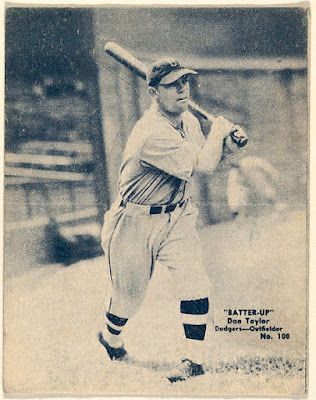
National Chicle printed two baseball sets in 1934, each innovative in their own way. Batter-Up! Gum's 192 photo cards showed almost everyone in full regalia, often shagging balls or swinging bats.
There's a little of everything in this photo, from visible spikes to high leg kick to bloused pants to an artistically foggy background. The die-cut edge surrounding Carl's upper half allowed collectors to detach and bend the top at an angle, standing their batters (and pitchers) "up," hence the set name. I bet many kids run games on bedroom floor ballparks, just as they built blanket mountains for army men or played house with stuffed animals.
National Chicle printed two baseball sets in 1934, each innovative in their own way. Batter-Up! Gum's 192 photo cards showed almost everyone in full regalia, often shagging balls or swinging bats.
National Chicle printed each Batter-Up! series in multiple colors, creating a challenging task for variation or master set collectors. #1-40 came out in six tints (black, red, brown, blue, purple and green) and #41-80 just four (black, brown, blue, purple). Its second series, #81-192, measures 1/4" shorter and comes in four (black, brown, blue, and green).
![]() |
| 1934 Batter-Up #31, Lefty Grove (tint variations) |
While Batter-Up! omits Lou Gehrig (exclusive to 1934 Goudey) and Babe Ruth, it's otherwise full of Hall of Famers (set checklist) and impresses me as the first set with modern dimensions to focus on full-card player photos. I love all the high socks, classic uniforms. and old gloves.
I first wrote about Batter-Up! and similar die-cut sets back in 2008 for Things Done to Cards. The die-cut on this sepia Hubbell's off-center a bit, so he'd lose a spike when folded.
TRIVIA: New York retired Hubbell's #11 in 1944, the first Giants player so honored.
2021 UPDATE: Thanks to research by Jason Schwartz, it appears National Chicle avoided creating new Batter-Up! cards in 1935, perhaps to continue selling excess 1934 inventory, and picked the set up again in 1936.
Value: Hubbell runs $20-40 in low-grade (e.g., missing the fold-down flap and moves into three figures in mid-grade or better.
Fakes / reprints: The die-cut makes this set harder to fake and I haven't seen any in the marketplace. Several modern retro sets repurposed Batter-Up's die-cut style and sepia design.
Value: Hubbell runs $20-40 in low-grade (e.g., missing the fold-down flap and moves into three figures in mid-grade or better.
Fakes / reprints: The die-cut makes this set harder to fake and I haven't seen any in the marketplace. Several modern retro sets repurposed Batter-Up's die-cut style and sepia design.
Subscribe to:
Posts (Atom)