Wednesday, February 27, 2013

1998 Mother's Cookies A's Baseball #5, Matt Stairs

Happy 45th birthday to the much-traveled Matt Stairs, native of New Brunswick, Canada and one of a handful of guys to suit up for at least a dozen MLB teams (13 in all), his career nicely bookended by Montreal in 1992 and Washington in 2011, two versions of the same franchise. By coincidence, they're also the only two teams he didn't homer for (career stats).

Matt's longest turn with any one team came in Oakland (1996-2000) and that's how I remember him as a fan.


Stairs holds the record for most pinch-homers (23), breaking the mark of 20 held by similarly well-traveled slugger Cliff Johnson (career stats) in 2010. He hit 11 of those pinch-homers from 2008 to 2010, becoming a sort of late-game, anti-relief specialist.


Oakland-based Mother's Cookies first made baseball sets in the pre-expansion 1950s and featured Pacific Coast League teams (1952 set profile). They returned after a 30-year absence with MLB team sets in the 1980s and were one of many to capitalize on the late-80s Bash Brothers' success (full set list). I still own several 1980s Mariners team sets, giveaways from Seattle's annual "Baseball Card Day."

Unfortunately, this 1998 issue marked their last baseball year and financial problems (and accounting shenanigans) shuttered the original company in 2008 (SF Gate story). Kellogg's now produces the Mother's Cookies brand, but hasn't revived the card tie-ins.

Value: Mother's Cookies singles from the 80s and 90s rarely cost over $1. Team sets depend on that year's stars and 1998 Oakland can be had for $10 on eBay.

Fakes / reprints: Mark McGwire and Jose Canseco were both targets for fakes at the height of their popularity, but I haven't seen any counterfeit Mother's Cookies in the marketplace.

Saturday, February 23, 2013

1914 Cracker Jack Baseball #5, Ward Miller

Just over a century since future ballpark staple "Take Me Out To The Ballgame" swept America in 1908, no snack connects to game day like Cracker Jack. I've seen its caramel-popcorn-nut boxes in every pro park and expect sales to continue as long as there's baseball to play. (Yankee Stadium tried to replace it with Crunch 'n' Munch in 2004--fans rebelled and Cracker Jack quickly returned.)


Back when Cracker Jack itself was young, the company cemented its baseball popularity with consecutive, near-identical sets of AL, NL, and Federal League stars: 1914 (144 cards) and 1915 (176 cards). That era's business and wartime context made them significant beyond being "just" 100 year-old cards.
  • Cigarettes largely left the market after 1911, opening the door for candy makers to collect what money kids had to spend; this set gave them baseball without the preteen smoking habit
  • Cracker Jack packaged prizes debuted in 1912, so buyers knew each box would have a card; 1915 is also one of the first times a publisher sold albums and complete sets
  • 1914-15 matched the Federal League's brief lifespan, so is a collector's best chance to obtain cards of its players; Ward Miller, for example, suited up for its St. Louis Terriers
  • Three pre-scandal Black Sox appear in the set, including Shoeless Joe Jackson; he's one reason PSA called the 1914 set "nearly impossible to complete...even with unlimited funds"
  • Modern counterfeiters found Cracker Jacks an appealing target, given their thin paper stock and star power; both official reprints and fakes exist in today's marketplace

Several 1914-15 Cracker Jack players later served in WWI, including Ty Cobb, Branch Rickey, Grover Cleveland Alexander, Christy Mathewson, and Hank Gowdy. (Eddie Grant, the first ballplayer killed in action, doesn't appear in either set.)

1914 Cracker Jack #88, Christy Mathewson (pitching)

Christy Mathewson's already one of the key cards, but his pose change rates as the sets' most significant variation.

1915 Cracker Jack #88, Christy Mathewson (portrait)

Card backs give a player bio and determines whether a given card's 1914 ("set of 144") or 1915 ("set of 176"). The "Three Eye League" mentioned on Miller's card was a minor league of teams from Iowa, Illinois, and Indiana, and fielded good talent for several decades.


Note the production company's Rueckhein & Eckstein, since Cracker Jack was just a product in 1914. They renamed to the Cracker Jack Company prior to their purchase by Borden in 1964.

Value: 1914 singles came on thin, semi-transparent paper and show damage easily. Low-grade singles cost $20-40, with prices in the hundreds for star players.

Fakes / reprints: So many have reprinted Cracker Jacks that I've personally struggled to separate ungraded fakes from authentic cards. The thicker stock used for 1915 holds up better than 1914 and is easier to find, so I recommend getting a type card from that set.

Thursday, February 21, 2013

1981 Donruss Baseball #5, Alan Trammell

Happy 55th birthday to Alan Trammell! He appeared as #5 in Donruss's debut baseball set, who joined Fleer in finally pushing Topps off their MLB monopoly mountain in 1981 after attempts by others throughout the 60s and 70s came up short.


Is that big-eyed look surprise or intensity? Did the photographer jump Trammell in the middle of pre-game warm-ups? Is Alan is defending himself with that bat?


I collected 1981 Donruss fresh from packs as a youngster and burned much midnight oil reading their chronological highlights. Even basic evaluations like "was Tigers' most consistent player" set a context for pre-Internet fans who rarely (if ever) saw games outside their home city. "A shortstop who's also his team's most consistent hitter? I would trade my whole infield for that guy!"

My team, the Mariners, started Mario Mendoza at short for most of 1980. Good: Mendoza set a career high for OPS+! Bad: his "high" of 63 was still terrible, especially compared to Trammell's career 110 OPS+. (For reference, only 53 guys in Cooperstown amassed at least 2000 hits with 110 OPS+.)

1978 Burger King #15, Alan Trammell (RC)

Trammell holds a special footnote in collecting history because his solo Rookie Card comes not from Topps, where he shares the bill with Paul Molitor, but Burger King's 1978 Tigers set. His #15 shows off the crisp and classic Tigers home uniform, complete with matching undershirt, a great piece of cardboard for team or type collectors (full 1978 set profile).

TRIVIA: On Sept 24, 1982, Alan scored the winning run in baseball's longest game decided by a wild pitch (18 innings).

Value: 1981 Donruss cards come cheap, so this #5 costs less than $1.

Fakes / reprints: I doubt anyone would make money faking 1981 Donruss cards, but it's possible promotional reprints exist.

Wednesday, February 13, 2013

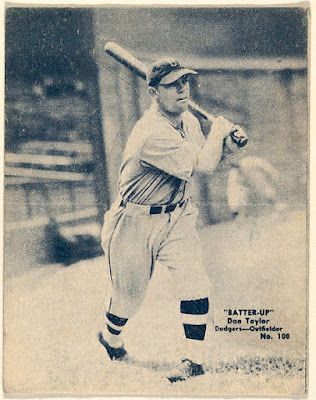
1934-36 Batter-Up Baseball #5, Carl Hubbell

One of my favorite type cards in the collection, starring HOF lefty and master of the screwball, Carl Hubbell.


There's a little of everything in this photo, from visible spikes to high leg kick to bloused pants to an artistically foggy background. The die-cut edge surrounding Carl's upper half allowed collectors to detach and bend the top at an angle, standing their batters (and pitchers) "up," hence the set name. I bet many kids run games on bedroom floor ballparks, just as they built blanket mountains for army men or played house with stuffed animals.

National Chicle printed two baseball sets in 1934, each innovative in their own way. Batter-Up! Gum's 192 photo cards showed almost everyone in full regalia, often shagging balls or swinging bats. 


National Chicle printed each Batter-Up! series in multiple colors, creating a challenging task for variation or master set collectors. #1-40 came out in six tints (black, red, brown, blue, purple and green) and #41-80 just four (black, brown, blue, purple). Its second series, #81-192, measures 1/4" shorter and comes in four (black, brown, blue, and green).

1934 Batter-Up #31, Lefty Grove (tint variations)

While Batter-Up! omits Lou Gehrig (exclusive to 1934 Goudey) and Babe Ruth, it's otherwise full of Hall of Famers (set checklist) and impresses me as the first set with modern dimensions to focus on full-card player photos. I love all the high socks, classic uniforms. and old gloves.


I first wrote about Batter-Up! and similar die-cut sets back in 2008 for Things Done to Cards. The die-cut on this sepia Hubbell's off-center a bit, so he'd lose a spike when folded.

TRIVIA: New York retired Hubbell's #11 in 1944, the first Giants player so honored.

2021 UPDATE: Thanks to research by Jason Schwartz, it appears National Chicle avoided creating new Batter-Up! cards in 1935, perhaps to continue selling excess 1934 inventory, and picked the set up again in 1936.

Value: Hubbell runs $20-40 in low-grade (e.g., missing the fold-down flap and moves into three figures in mid-grade or better.

Fakes / reprints: The die-cut makes this set harder to fake and I haven't seen any in the marketplace. Several modern retro sets repurposed Batter-Up's die-cut style and sepia design.

Monday, February 4, 2013

1980 TCMA Utica Blue Jays Baseball #5, Felix Feliciano

Pro baseball in Utica has a long history, including eras as both MLB affiliate and independent team (more at Wikipedia). Many fans know these Blue Jays better as the Blue Sox, the single-A squad that author (and team owner) Roger Kahn profiled in Good Enough To Dream, his up-close-and-personal look at running an independent team. Kahn's storytelling makes a good minor league companion to the player's perspective captured in Dirk Hayhurst's recent books.


Felix is...resting his eyes? Just one more reason to snap multiple pictures on team photo day.


If we believe Baseball-Reference, "rookie" describes Felix's entire career, just 7 games of low-A ball in Utica. That makes today's #5 his only known baseball card and twice the bummer that it's a lousy photo.

1988 Fleer #159, Juan Castillo

TCMA printed 33 cards for Utica, but just 3 of Felix's teammates eventually reached the bigs; Juan Castillo got the most MLB service time with 199 total games over 4 seasons.
  1. Larry Hardy, Manager
  2. Rich White
  3. Carlos Cabrera
  4. Jim Baker
  5. Felix Feliciano
  6. Rafael Harris
  7. Tom Norko
  8. Siverio Valdez
  9. Jon Woodworth, Trainer
  10. Bob Wilbur, Coach
  11. Hector Torres, Coach
  12. Tomas Castillo
  13. Juan Castillo
  14. Roberto Cerrud
  15. Jose Escobar
  16. Tony Gilmore
  17. Luis Guzman
  18. Toby Hernandez
  19. Mark Holton
  20. Dennis Howard
  21. Miguel Ortiz
  22. Tom O'Dowd
  23. Al Montgomery
  24. Bob McNair
  25. Tom Lukish
  26. Herman Lewis
  27. Carlos Leal
  28. Paul Langfield
  29. Mike Hurdle
  30. Bill Reade
  31. Rafael Rivas
  32. Miguel Rodriguez
  33. Rico Sutton

Value: This #5 cost $2 at MinorLeagueSingles.com. Few MLB stars means team sets top out at $20-25.

Fakes / reprints: TCMA reprinted several team sets for "collectors kits" in the late 1980s. Those reprints used black ink on the backs and originals have the blue ink shown above.

Friday, February 1, 2013

1921 W516-2-2 Baseball #5, Ty Cobb

We live in a hobby littered with questionable photography.


That shot is just one of so many to choose from (or avoid).

But at least guys like Ty Cobb don't have to worry about disrespect to their playing poses. Usually?


This 1921 W516 strip card commits three errors on one play. It shows Cobb backwards (glove on wrong hand, logo on wrong side of jersey), fielding instead of batting or running (his normal card M.O.), and missing 50% of his noggin from bad machine cutting or clumsy scissor work. What makes this botched image notable is that it's the first W516-2-2 #5 I've seen, one of several variations on a single strip card theme. Another apparent W516-2-2 from eBay nearly drops the "DETROIT OUTFIELD" tag line entirely.


1920s printers were nowhere near as organized as those today, so production differences prove common (and frustrating) for modern collectors. For example, W516-2-1 (profiled in 2009 and shown below) used the same image with a typeset name.


Note that IFC (C) sign at lower-right's backwards on both cards. There's also this W516-2-3 version with typeset name and corrected IFC (C).


W516-2-3 also "fixed" his flipped photo, as seen on W516-1-* Cobbs.

1921 W516-1-1 #6, Ty Cobb

W516-2-* checklists share the same 30 players with W516-1-*, but use different numbers. My profile of W516-1-1 #5 Tris Speaker goes into more depth on the set's origins. Many card references disagree on the W516-*-* classifications, but experts at Net54 discussed them in detail.

Value: An eBay seller listed this abused #5 for $50, more than I've paid for other VG/EX W516 Cobbs in the past. It's possible the market's ready to shell out more for these humble strip cards, but more likely that eBay encourages people to charge too much.

Fakes / reprints: Ty Cobb's always vulnerable to counterfeiting, so buy from dealers you trust and know the provenance of their stock.

Tuesday, January 29, 2013

1980 Indianapolis Indians Baseball #5, Joe Price

This 1980 entry caps Indy's vintage teams sets, nice full-color cards from a time when many minor league teams couldn't afford better than black-and-white. They measure slightly bigger than standard Topps, frustrating collectors who want to put everything in 9-count sheets, but satisfy the artistic spirit of making a better card.


Joe Price moved to the bigs in 1981 and played during my sweet spot as a collector, so I remember several of his cards, including this close look at Cincy's home uniform.


1985 Topps profiled #82 Joe Price in 2012, highlighting his high socks and even higher leg kick.


Advice to young players: "Perserverence." Advice to card editors: spelling (perseverance).

TRIVIA UPDATE: Joe Price started 84 games and finished 84 games, MLB's all-time leader in appearances (372) with equal "starts and finishes."

This 32-card set's a mix of group photos and individual shots, similar to Indy's previous efforts (Indianapolis set profiles).
  1. Team Picture
  2. Jim Beauchamp, Manager
  3. Sheldon Burnside
  4. Mike Grace
  5. Joe Price
  6. John Hale
  7. Geoff Combe
  8. Dave Van Gorder
  9. Bruce Berenyi
  10. Eddie Milner
  11. Jay Howell
  12. Paul O'Neill (minor leaguer, not future CIN/NYY star Paul O'Neill)
  13. The Braintrust
  14. Larry Rothschild
  15. Paul Householder
  16. The Relievers
  17. Scott Brown
  18. Mark Miller
  19. The Starters
  20. Blake Doyle
  21. Gene Menees
  22. Rafael Santo Domingo
  23. Bill Kelly
  24. Don Lyle
  25. Bill Dawley
  26. Duane Walker
  27. Angel Torres
  28. The Catchers
  29. The Infielders
  30. The Outfielders
  31. John Young, Trainer
  32. Checklist

As with many AAA teams, a bunch of included players (in bold) reached the bigs, either before or after their appearance in this Indians set.

Value: This #5 cost $2 at MinorLeagueSingles.com. Can't find a team set for sale right now, but assume they'd be $20-30.

Fakes / reprints: Haven't seen any in the marketplace.

Wednesday, January 23, 2013

1979 Indianapolis Indians Baseball #5, Harry Spilman

Fans of baseball history would cover more than just 568 miles with a summer drive from Rochester (NY) to Indianapolis. Rochester's Red Wings (b. 1899) and the Indianapolis Indians (b. 1902) are MiLB's oldest continuously operating franchises, with modern stadiums and big-league affiliations expected to keep both streaks intact into the foreseeable future.


Indy's the AAA affiliate for Pittsburgh today, but fielded future Reds in 1979. My strongest collector memory of Harry Spilman is 1981 Topps #94, complete with first base glove, the same position I played in little league.


Spilman's positional versatility (1B, 3B, C) and lefty hitting helped keep him in the bigs for more than a decade, sharing plate appearances as a starter (446) and pinch-hitter (460) equally (career splits). While not a protypical power guy, Harry slugged almost 100 points higher with runners in scoring position, something managers remember, even if anecdotally.


Harry's hobbies are hunting and chewing? First time I've seen chewing described as a "hobby," but that's one prominent wad in Spilman's cheek.

INDIANS INQUIRY answer: Indy's home (Bush Stadium) opened as Perry Stadium (1931), later took the WWII-style name Victory Field (1942), and finally renamed to honor player-exec Donie Bush (1967). (Further trivia: Movie crews took advantage of Bush's old-school look to stand in for both World Series stadiums in Eight Men Out.)

Today, Indy plays in a modern Victory Field and--according to Wikipedia--multiple sources consider it the minors' best place to catch game.


The 32-card Indy checklist includes individual players and several group shots. Most pictured reached the majors, including Mr. Spilman. The best-known might be Mario Soto and Jay Howell.


INDIANS INQUIRY questions sound pretty esoteric today. Card #16 asked, "who's the only player on the 1974 Indians not to play in the majors and what's he doing now?" (Gene Dusan, former catcher and 9-year manager in the minors.)

("Eddie Dick, Groundskeeper." Hee hee.)

Value: CheckOutMyCards asks $4.25 for this #5. It's the only single listing I've seen, so might be worth it. As of writing, you can get the whole set on eBay for $25.

Fakes / reprints: Haven't seen any in the marketplace.

Monday, January 21, 2013

1977 Indianapolis Indians Baseball #5, Tom Hume

Few of my minor league type cards portray guys with a future, so it's nice to run into future All-Stars like righty Tom Hume. He and those mid-70s shades are framed by Indy's home park, Owen Bush Stadium, their home from 1931-1995.


As a collector, I know the Indianpolis Indians for their full-color, self-produced team sets in a minor league era more likely to produce dingy black-and-white. Dodgy, shadowed photos still show up (e.g., Mike LaCoss), but you saw those every year from Topps itself.

1977 is the last of Hume's minor league cards, as Cincy's late-year promotion stuck and he spent the next 11 years scuffing big league baseballs for the Reds and Phillies. Tom joins 9-year vet Steve McCatty as the most successful rookies from 1978 Topps #701.


Hume posted 140+ innings each minor league season, as the Reds seemed keen on making Tom a starter. They ultimately shifted him to the bullpen, where he finished 30+ games five straight years (1979-1983) and saved the NL's 4-1 win in 1982's All-Star game (career stats).


I remember pre-1980 cards tracking more personal info on card backs, like hobbies and a favorite winter activity. Today, Tom's on Twitter @THume47. Judging by those tweets, he still likes to fish.

Indianapolis printed 26 cards and this unnumbered checklist in 1977, with team staff on the back.


Value: This #5 cost $2.50 at MinorLeagueSingles.com. Several of Tom's teammates joined him in the bigs, so you'll pay more than for a single-A team without any familiar names. (As of this writing, there's a set on eBay for $35.)

Fakes / reprints: Haven't seen any in the marketplace.

Friday, January 18, 2013

1980 TCMA Columbus Clippers Baseball #5, Garry Smith

Hey, another oddball minor league photo in a long line of them. Convincing 6'2" guys to bend double is the textbook look for "gangly." Did the photographer really catch Columbus outfielders during grounder practice?


Columbus looks like a Cubs affiliate with those hats and pinstripes, but were the Yankees AAA farm club for almost 3 decades, 1979-2006. Garry Smith bounced around New York's system for seven years, suiting up for as many as three teams annually (career stats).

Garry's frequent A-AA-AAA movement reminded me of another peripatetic player (recently mentioned by an OBC trading friend), Wally Wolf.


Wally got the Rookie Stars treatment twice, but seven years apart, the longest such gap I've seen.


Why, Wally hasn't aged a day! Oh, they just airbrushed his Colt .45s cap. (Read the Hope Springs Eternal posts at 1207 Consecutive Games for more of Topps "rookie mistakes" from the 60s and 70s.)

Unlike Garry Smith, Wolf got two cups of coffee in the majors, but his minor league travels look very similar.

This TCMA set's rich with future Yankees and past big-leaguers as coaches.
  1. Tim Lollar
  2. Roger Slagle
  3. Chris Welsh
  4. Wayne Harer
  5. Garry Smith
  6. Brad Gulden
  7. Roger Holt
  8. Joe Altobelli MG
  9. Roy Staiger
  10. Bob Kammeyer
  11. Jim McDonald
  12. Jim Nettles
  13. Brian Doyle
  14. Sammy Ellis CO
  15. Bruce Robinson
  16. Jim Lewis
  17. Dave Righetti
  18. Mark Letendre
  19. Dave Coleman
  20. Marshall Brant
  21. Greg Cochran
  22. Jerry McNertney CO
  23. Dennis Sherrill
  24. Marv Thompson
  25. Dave Wehrmeister
  26. Joe Lefebvre
  27. George Sisler Jr. GM
  28. Juan Espino

Value: This #5 cost $2 as part of my TCMA haul from MinorLeagueSingles.com. Some sellers ask as much as $50 for the team, but $20 seems more reasonable to me. (A team set with 5 autographs recently sold on eBay for $15 with shipping.)

Fakes / reprints: TCMA reprinted several 1980 teams for "collectors kits" in the late 1980s. Those reprints use black ink; originals have blue backs.