
Friday, March 6, 2009

Monday, March 2, 2009
1939 Gum, Inc. "Play Ball America" Baseball (aka "Play Ball") #5, Luke Sewell
We've gone back to the future by including Luke Sewell, younger brother of previous #5 guest (and Hall of Fame shortstop) Joe Sewell. Though he lacked the elder's powerful stick, durability and defensive skills sustained Luke's 20-year career behind the plate. Several years of managing followed, when he notably led the 1944 St. Louis Browns to their only pennant. That year's World Series also marked the last time both league winners shared the same home stadium. The cross-town Cardinals beat them in a six-game World Series that drew little national interest, given WWII's distractions and the moribund talent levels league-wide.
Manufacturer Gum, Inc. used real black-and-white photos on this debut set, splitting the composition between portraits and Sewell-like action shots. This marked a real change from Goudey's colorful 1930s efforts and Play Ball's follow-up sets (1940 and 1941) continued with a very similar, newspapery look.
Dozens of card companies tried their hand with baseball in the 1930s, but America's war effort sucked up almost all the cardboard from 1942 to 1947. Only rag stock remained, which led to sets like the poorly regarded MP & Co (checklist at GFG.com). Bowman finally picked up the major league baton in 1948 with a 1939 Play Ball look-alike of 48 cards and Topps finally pushed everyone past the age of small pictures with their 1952 set.
Gum, Inc's salesmen brought these overprinted cards to candy stores as promos to build retailer interest. A small number remain in the market and some collectors even specialize in them, though I'm not sure if it's possible to build a full set.
UPDATE: Thanks to 1939baseball.com, we get a look at Play Ball's wrapper and box stylings.

Baseball put a lot of effort into celebrating 1939 as the centennial of baseball, so this wrapper included a parade of game uniforms.

Value: Low-grade, low series Play Ball commons like Luke Sewell cost a few dollars each. Major stars like Joe DiMaggio and Ted Williams will cost you whatever you have. Seriously, it's enough money that you should just put your wallet in the freezer now to accumulate as much cold, hard cash as possible. Unfortunately, pre-war star card values don't drop much in a down economy, since you only need a few well-heeled collectors to maintain competition and high market prices.
Fakes / reprints: Full set reprints do exist, but probably not singles of Mr. Sewell.
 |
| Card front |
Manufacturer Gum, Inc. used real black-and-white photos on this debut set, splitting the composition between portraits and Sewell-like action shots. This marked a real change from Goudey's colorful 1930s efforts and Play Ball's follow-up sets (1940 and 1941) continued with a very similar, newspapery look.

Dozens of card companies tried their hand with baseball in the 1930s, but America's war effort sucked up almost all the cardboard from 1942 to 1947. Only rag stock remained, which led to sets like the poorly regarded MP & Co (checklist at GFG.com). Bowman finally picked up the major league baton in 1948 with a 1939 Play Ball look-alike of 48 cards and Topps finally pushed everyone past the age of small pictures with their 1952 set.
 |
| Red overprints are Gum, Inc. salesman sample cards |
Gum, Inc's salesmen brought these overprinted cards to candy stores as promos to build retailer interest. A small number remain in the market and some collectors even specialize in them, though I'm not sure if it's possible to build a full set.
UPDATE: Thanks to 1939baseball.com, we get a look at Play Ball's wrapper and box stylings.

Baseball put a lot of effort into celebrating 1939 as the centennial of baseball, so this wrapper included a parade of game uniforms.

Value: Low-grade, low series Play Ball commons like Luke Sewell cost a few dollars each. Major stars like Joe DiMaggio and Ted Williams will cost you whatever you have. Seriously, it's enough money that you should just put your wallet in the freezer now to accumulate as much cold, hard cash as possible. Unfortunately, pre-war star card values don't drop much in a down economy, since you only need a few well-heeled collectors to maintain competition and high market prices.


Fakes / reprints: Full set reprints do exist, but probably not singles of Mr. Sewell.
Friday, February 20, 2009
1955 Red Man AL #5, Bob Grim
Looking decidedly wistful here, and anything but "grim," today's guest kicked off his major league career with a bang, going 20-6 in 1954. This earned him AL Rookie of the Year and he followed with three more years of relative success, posting a 45-21 record in pinstripes before being traded to Kansas City.

His Wikipedia entry notes how arm troubles prompted a successful conversion to relief pitching, which no doubt prolonged his career in a sport where young players can fall off the planet in no time at all. Grim's career eventually ended in 1962 with the A's, but his stats change notably after those four seasons in New York. I wonder where today's pitching strategies and medical care would've taken him, compared to the 1950s and four-man rotations.
Like other Red Man issues I've covered, this over-sized, beautifully painted card design stands out among oddballs. They look a lot like Topps' 1953 cards, but repeated for several years running. Each tobacco pouch included a card ("for your boy!") with the chaw ("not for your boy!"), and printed one numbered set per league. See the RedManCards.com checklists for the full star power of the day and pictures of some ad placards. (Lest you think I made up the "for your boy" stuff.)

Card front
His Wikipedia entry notes how arm troubles prompted a successful conversion to relief pitching, which no doubt prolonged his career in a sport where young players can fall off the planet in no time at all. Grim's career eventually ended in 1962 with the A's, but his stats change notably after those four seasons in New York. I wonder where today's pitching strategies and medical care would've taken him, compared to the 1950s and four-man rotations.
Like other Red Man issues I've covered, this over-sized, beautifully painted card design stands out among oddballs. They look a lot like Topps' 1953 cards, but repeated for several years running. Each tobacco pouch included a card ("for your boy!") with the chaw ("not for your boy!"), and printed one numbered set per league. See the RedManCards.com checklists for the full star power of the day and pictures of some ad placards. (Lest you think I made up the "for your boy" stuff.)
Thursday, February 12, 2009
1980 Topps Superstars #5, Jim Rice
Cheer up, Mr. Rice, you’re in the Hall of Fame! Some thought you’d make it, others held you shouldn’t, and it dragged on long enough that still others debated the debating. I just marvel that your hair looks so good on TV!

I read through Jim’s Wikipedia entry to better understand all of the blather and palaver. The last section calls out a bunch of interesting similarities to fellow HOFer Ducky Medwick, who played for the Gashouse Gang inSt. Louis
All this observed, I care much for cards and not so much for the Hall itself, so hey—1980 Superstars! Topps crafted these 5”x7” beauties as an oddball companion to the normal 792-card set. Each paper-wrapped pack contained a handful of big, sharp photos and the checklist includes 59 of the era’s best players…and Sixto Lezcano. (Zing!) Curiously, the back states only the player name and team, a dearth of data drowning in dreary grey newsprint.
Two things bother me about this issue. First, the pictures seem like spring training one-offs. Rice’s pose, a pretty uninspiring shot, looks better than 90% of his competitors. Everyone else is looking away from the camera, caught at odd angles, or just not feeling their best. Hey Topps, how about using all that real estate to show a nice action shot? Second, the card backs say almost nothing, a real waste of 35 square inches of space. How about using them to make a big All-Star roster puzzle like they did with 1977’s cloth stickers? A few strategic changes would’ve made them super Superstars.

Card front (5" x 7")
I read through Jim’s Wikipedia entry to better understand all of the blather and palaver. The last section calls out a bunch of interesting similarities to fellow HOFer Ducky Medwick, who played for the Gashouse Gang in
All this observed, I care much for cards and not so much for the Hall itself, so hey—1980 Superstars! Topps crafted these 5”x7” beauties as an oddball companion to the normal 792-card set. Each paper-wrapped pack contained a handful of big, sharp photos and the checklist includes 59 of the era’s best players…and Sixto Lezcano. (Zing!) Curiously, the back states only the player name and team, a dearth of data drowning in dreary grey newsprint.
Two things bother me about this issue. First, the pictures seem like spring training one-offs. Rice’s pose, a pretty uninspiring shot, looks better than 90% of his competitors. Everyone else is looking away from the camera, caught at odd angles, or just not feeling their best. Hey Topps, how about using all that real estate to show a nice action shot? Second, the card backs say almost nothing, a real waste of 35 square inches of space. How about using them to make a big All-Star roster puzzle like they did with 1977’s cloth stickers? A few strategic changes would’ve made them super Superstars.


Friday, February 6, 2009
1968 Laughlin Baseball World Series #5, 1908 (Cubs vs. Tigers)
Artist Bob Laughlin published a bunch of oddball card sets featuring his cartoons and caricatures during the 70s and 80s, including a cute series (1974 Sportslang) I covered last July. His earliest work, a series of single-panel highlight cards covering each World Series, shows up today. This first card featured the Boston American and Pittsburgh Pirates from 1903, the former beating the latter in a best-of-9. Recent type collection tangent John McGraw (and Giant team management) refused to play in 1904, so skip one year and add four to reach 1908, today’s card.


To circle back to 1908, consider a few other Events of Significance surrounding that year’s World Series.

Card front
This plain-faced image, appearing humbly in black-and-white, relates to a great deal of baseball culture, old and new. Tinker, Evers, and Chance, most of the infield for Chicago

Card back
To circle back to 1908, consider a few other Events of Significance surrounding that year’s World Series.
- Tender 19 year-old Fred Merkle mis-runs the bases (the Merkle Boner) and snatches defeat from the Giant jaws of victory. He went on to play for 20 years, but never outlived that infamous day. “GIANTS
WINLOSE THE PENNANT,” etc., etc. - Gate attendance proved very low, partly from a
- “Take Me Out to the Ballgame,” written by two gentlemen who’d never seen a pro game, becomes a nationwide hit.
- The Chicago Cubs kick off a century of waiting for their fans.
Tuesday, February 3, 2009
1917 E135 Collins McCarthy Baseball #5, Fred Anderson
Today’s guest, John Frederick Anderson, is the first player I've written about who eventually took his own life. That tragic end came some forty years removed from Fred's half-dozen years in the game and a single 1917 World Series appearance, two brief and unremarkable innings in Game 2 against the Chicago White Sox. (The pale hose went on to win the series 4 to 2.)

Fred pitched his threeNew York Anderson

E135 cards don’t show up very often. I finally purchased a trimmed #5 (with a blank back) from an online store last year for $30. It presents a little better in real life than what you see in the scan, given the ancient, plasticky gloss they used in the first quarter-century. Some include an advertising stamp for the Collins-McCarthy store on the back in black ink.
The whole set’s rare enough to counterfeit, something I originally feared of Fred. West Coast dealer Mark McRae helped add confidence to this particular example. Careful examination of the printing details shows the right kind of dot pattern, something handled differently by modern printers and presses. Modern gloss also holds up better, while the surface of a handled E135 appears to “fracture” into tiny pieces like a shattered mirror (or 1970s Kellogg’s card). I don’t expect PSA to ever pass judgment on Mr. Anderson, but if it happened, they’d look for similar indicators—right after cashing my large check, of course.

Fred pitched his three

E135 cards don’t show up very often. I finally purchased a trimmed #5 (with a blank back) from an online store last year for $30. It presents a little better in real life than what you see in the scan, given the ancient, plasticky gloss they used in the first quarter-century. Some include an advertising stamp for the Collins-McCarthy store on the back in black ink.
The whole set’s rare enough to counterfeit, something I originally feared of Fred. West Coast dealer Mark McRae helped add confidence to this particular example. Careful examination of the printing details shows the right kind of dot pattern, something handled differently by modern printers and presses. Modern gloss also holds up better, while the surface of a handled E135 appears to “fracture” into tiny pieces like a shattered mirror (or 1970s Kellogg’s card). I don’t expect PSA to ever pass judgment on Mr. Anderson, but if it happened, they’d look for similar indicators—right after cashing my large check, of course.
Thursday, January 29, 2009
1910 Tip-Top Pirates Baseball #5, Tommy Leach
A century-spanning star for 4 of the sport's oldest franchises, Tommy Leach played third base and outfield from 1898 to 1918. This 1910 set marks his only championship, but he also appeared in baseball's first modern World Series (1903), collecting its first hit and scoring its first run.


Value: I picked up this antique from eBay about four years ago for $225. Check out a Robert Edwards Auctions listing for the whole set to see more pictures, including the anachronistic apron-wearing Tip-Top Boy Mascot.
Fakes / reprints: The set's valuable enough to fake, so don't make it your first early 20th century purchase--research others from the era first and get familiar with how authentic paper and ink looks. Buying from a reputable dealer also helps.
UPDATED: Paragon Auctions posted the original studio shot for this Tommy Leach card and probably others from the same era. Note that Tip-Top's artist added PITTSBURGH to his otherwise unadorned uniform.
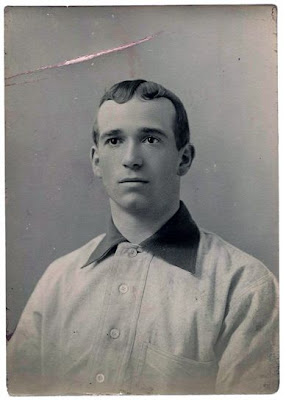

Card front
The fact that Tommy lived to age 91 says something good about his habits—probably that he didn’t drink or smoke too much. It's hard to remember now that Prohibition (and its undoing) came about after a century of alcohol-related cultural tumult. By the early 1900s, plenty of folks considered booze an absolute evil and demonstrated in the streets to that effect. Without its influence (so claimed their rhetoric), the poor would be unshackled and we’d have little reason for prisons and reform schools. It’s enlightening to compare that language to any number of social issues today! (Temperance organizations eventually delivered the political pressure necessary to pass the 18th Constitutional Amendment, which lasted from 1920 to 1933.)

Card back
Value: I picked up this antique from eBay about four years ago for $225. Check out a Robert Edwards Auctions listing for the whole set to see more pictures, including the anachronistic apron-wearing Tip-Top Boy Mascot.
Fakes / reprints: The set's valuable enough to fake, so don't make it your first early 20th century purchase--research others from the era first and get familiar with how authentic paper and ink looks. Buying from a reputable dealer also helps.
UPDATED: Paragon Auctions posted the original studio shot for this Tommy Leach card and probably others from the same era. Note that Tip-Top's artist added PITTSBURGH to his otherwise unadorned uniform.

Monday, January 26, 2009
1951 Topps Blue Back Baseball #5, Johnny Pesky
Today’s guest, John Michael Pesky, played for the Red Sox from 1942 to 1954, excepting 3 years in WWII service, and has worked for them in a advisory or promotional role ever since. He appears in 2 of Topps' earliest issues, in portrait on the 2" x 3" 1951 Blue Back and full-size as 1952 Topps #15.

A few years back, my first trip to the Baseball HOF coincided with promotional showings of the movie companion to the book The Teammates, which features Boston's own Ted Williams, Bobby Doerr, and Dom DiMaggio. I live nearby, so am slightly biased, but the show’s collection of film, interviews, and chronology really pumped my enthusiasm for the game’s Golden Age.

Like the more common Red Back set, Blue Back cards portray player busts hovering above a baseball diamond like disembodied gods. They’re also known as “Doubles,” as Topps joined two cards with a perforated edge for each penny pack. Set collectors could use the play results, like the “OUT” shown here, to hack out a tabletop game of baseball. This theme recurs throughout card history, starting as far back as the 1910s and continuing to my own childhood play, put into action with 1978’s card backs. When my vintage collecting group gets together, sometimes we bust out the 1951s—typically the easier Red Backs—for nine papery innings.

Card front
A few years back, my first trip to the Baseball HOF coincided with promotional showings of the movie companion to the book The Teammates, which features Boston's own Ted Williams, Bobby Doerr, and Dom DiMaggio. I live nearby, so am slightly biased, but the show’s collection of film, interviews, and chronology really pumped my enthusiasm for the game’s Golden Age.

Card back
Like the more common Red Back set, Blue Back cards portray player busts hovering above a baseball diamond like disembodied gods. They’re also known as “Doubles,” as Topps joined two cards with a perforated edge for each penny pack. Set collectors could use the play results, like the “OUT” shown here, to hack out a tabletop game of baseball. This theme recurs throughout card history, starting as far back as the 1910s and continuing to my own childhood play, put into action with 1978’s card backs. When my vintage collecting group gets together, sometimes we bust out the 1951s—typically the easier Red Backs—for nine papery innings.
Thursday, January 15, 2009
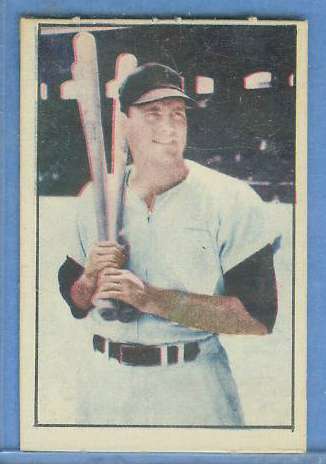
1953 Mother’s Cookies #5, Fletcher Robbe
Check out that purple background! I’m trying to imagine where a Portland Beaver would find that kind of cloudless, blueberry sky. A subtle plug for their state’s Growers Association, perhaps?

You see a lot of one-note card backgrounds in the late 40s and early 50s, as makers lurched shakily forward into the world of full-color photography. Mr. Robbe’s actually a hand-tinted black-and-white photo, not far removed from 1949 Bowman or 1952 Berk Ross. At least Topps’ own sets distinguished themselves with extra “features” like team logos and player positions.
My own collection includes a number of “modern” Mother’s Cookies cards, primarily Mariner sets from the early 1980s. I lived inSeattle throughout the decade and at least once per year, the team’s baseball card day gave kids a crack at glossy, round-cornered players of Seattle
This 50s PCL card (with an extra rounded corner) cost me about $5, a pretty affordable sum compared to what they run in really nice shape. Most of the “better” cards have smooth arcs or slightly angled corners. See this store page for two grizzled-looking examples, including Lefty O’Doul. TheCalifornia

Card front
You see a lot of one-note card backgrounds in the late 40s and early 50s, as makers lurched shakily forward into the world of full-color photography. Mr. Robbe’s actually a hand-tinted black-and-white photo, not far removed from 1949 Bowman or 1952 Berk Ross. At least Topps’ own sets distinguished themselves with extra “features” like team logos and player positions.

My own collection includes a number of “modern” Mother’s Cookies cards, primarily Mariner sets from the early 1980s. I lived in
This 50s PCL card (with an extra rounded corner) cost me about $5, a pretty affordable sum compared to what they run in really nice shape. Most of the “better” cards have smooth arcs or slightly angled corners. See this store page for two grizzled-looking examples, including Lefty O’Doul. The
Friday, January 9, 2009
1967 Topps Red Sox Baseball Stickers #5, Hank Fischer
Today’s guest is one severe, disembodied dude. The preponderance of hair, almost meeting twice on both the middle and sides of the forehead, makes me think of dark alleys and unpaid loan sharks.
Henry William Fischer came out ofYonkers Boston
Unrealized potential aside, Hank does appear in one of Topps’ more interesting 60s oddball issues. They printed two teams’ worth of paper-backed stickers in 1967, one of the Red Sox (who finished 9th in theAL New York City
Kids probably slapped these stickers on folders, wrapped them around bike frames, and otherwise made the set hard to finish. Most hobby examples come in decent shape, if only because collectors prefer unstuck versions. Lower grades often still possess a back, but exhibit stains, pen marks, or creasing. Mr. Fischer, around G/VG, came to my collection from eBay for $5. I recommend that type collectors get a hat-wearing player with a decent looking photo, even if it limits your selection somewhat. Joe Foy, George Scott, and Rico Petrocelli all look like sharp fellows you’d take home to Mama Binder.
 |
| Card front (blank back) |
Henry William Fischer came out of
Unrealized potential aside, Hank does appear in one of Topps’ more interesting 60s oddball issues. They printed two teams’ worth of paper-backed stickers in 1967, one of the Red Sox (who finished 9th in the

Kids probably slapped these stickers on folders, wrapped them around bike frames, and otherwise made the set hard to finish. Most hobby examples come in decent shape, if only because collectors prefer unstuck versions. Lower grades often still possess a back, but exhibit stains, pen marks, or creasing. Mr. Fischer, around G/VG, came to my collection from eBay for $5. I recommend that type collectors get a hat-wearing player with a decent looking photo, even if it limits your selection somewhat. Joe Foy, George Scott, and Rico Petrocelli all look like sharp fellows you’d take home to Mama Binder.
Subscribe to:
Posts (Atom)