Tuesday, September 30, 2008

1950 Big League Stars Baseball #5, John Simmons

Time for more multi-lingualism! The Big League Stars set features French and English on each card, all the better to socialize your medicine with. (Sorry, that's "appeal to its Canadian audience.") This batch of 48 blank-backed cards represents World Wide Gum's (WWG) first post-war effort and profiles the International League, which included both American and Canadian teams. Montreal's Royals, Brooklyn's AAA farm club known for prepping Jackie Robinson a few years earlier, won the 1949 title and WWG probably capitalized on the interest by making these cards.

Card front (blank back)

The 1950 set breaks WWG tradition by presenting all-new content, not just recycling Goudey's look-and-feel. (Boston-based Goudey owned Montreal-based WWG and they worked together on earlier Canadian sets a la the more recent Topps and O-Pee-Chee relationship.) It seems a misnomer to call a minors-only set "Big League," but that's in the modern context of huge money sports. Montreal, at least, owned multiple recent titles and the prestige of being connected to a New York parent. (Unknowingly, they even fielded the strong bat and arm of The future Rifleman.) You couldn't call this set "Major League," but many of its players would end up in the the bigs sooner than later.

John Simmons didn't have much of an MLB career, just one year with Washinton in 1949. However, I can't ignore the statistical oddity of his batting line. 20 hits in 93 at bats, a .215 average. More specifically, he had 20 singles in 93 at bats for a matching .215 slugging percentage. 11 walks against only 6 Ks bumped his OBP a bit, but is it mean of me to suspect that a few of those walks were cursory and intentional, just to get to the pitcher?

Friday, September 26, 2008

1962 Post Canadian #5, Mickey Mantle

Sometimes I wonder at the arbitrariness of how we collect and value cards. OK, we like the Mick. His picture still looks good. A wrinkled patch of whiteness, though? That matters? A half-inch square of murky upper-left corner that you can still read through? What about all the French on the card? Would a true patriot want this in their collection? He's a Yankee, right? Ah, a conundrum.

Card front (blank back)

Politics aside, I've always enjoyed other languages on cards. Before Topps and O-Pee-Chee's overlap kicked off in the mid 60s, Post jumped in with this appealing cereal box set. It represented a big investment, as 1962's design spread across three different issues: domestic Post, Canadian Post, and Jello. Two cards, Mantle and Maris, even turned up in Life Magazine as advertising. All share the same design elements, though Canada got reduced player text in exchange for its second language.

Post and Jello collectors often define their collection by the number of short prints obtained and remaining. Frustratingly, the SP numbers vary by set, so #55 Wynn is rare in the Posts and more commonly available in the Jellos. Collectors or dealers who don't understand the set history can easily buy or sell the "wrong" kind of rarity. At least the Canadian versions distinguish themselves with "RECORD DES FRAPPEURS." As for the others...bon chance, mes amis!

Value: This low-grade gem cost me about $15 on eBay. Multiple classic features like creasing, tape stains, and missing paper knock down the "condition," but none of them make Mickey any less Mantle.

Fakes / reprints: They're possible, but I haven't seen any fake Canadian cards in the marketplace.

Thursday, September 25, 2008

1960 Topps #5, Wally Moon

Sweet mercy, is that the mono-est monobrow that ever lived a life in California? Witness the calling card of Wallace Wade Moon, 1954 ROY for the Cardinals and later a fine outfielder for the LA Dodgers. A smart and more-than-capable hitter, even as a rookie he prompted St. Louis to ship future HOFer Enos Slaughter off to the Yankees to make room in the outfield.


Card front

Wally shares my birth date, if a couple of generations removed. We join Marlon Brando and Doris Day as coming from the traditional 93rd day of the year, though I'm only someone who wants to live in CA, compared to an actual former Dodger and some Hollywood types. (Sure, Brando and Day got the big bucks, but Mr. Moon garnered plenty of LA fans. What he lacked in screen presence, he made up for in bat speed and arm strength.)

Some people really enjoy the 1960 Topps set's horizontal layout. It recalls the classic 1956 sideways design and again features dual pictures. Its colors, though--hmm. The alternating, blocky typeface weighs down the front like an anchor made of cast-iron mediocrity. I think enlarging the player photo and minimizing the text would really improve things. After all, the 50s card really showed off players by capitalizing on the larger stock size and integrated portrait + action shot. Everything flowed together. In this case, unfortunately, the black-and-white photo, color photo, and overdone label work against each other.

The remainder of their 1960s sets went back to "vertical," so I assume sales didn't support this change in design. Classic elements like 1962's wood grain and 1965's pennants made for more memorable sets, though you'd see the occasional horizontal card again in 1973 and 1974.

Tuesday, September 23, 2008

1963 Salada Tea / Junket Dessert Coins #5, Juan Marichal

This coin features an optimistic, youngish Marichal, only three seasons into his dominant Hall-of-Fame career. 1963 proved Juan's first outstanding season, with a league leading 25 victories and 2.41 ERA. (He did make an amazing 40 starts and finished another game for 41 total appearances and 321 innings. Yow.) This performance garnered a few MVP votes, but wait...no Cy Young support? Blame it on bad timing, as our friend Sandy Koufax won the award unanimously and netted an MVP by going 25-5 with a 1.88 ERA in LA. (Juan's famous high-kick went on win at least 25 games twice more during the 60s and more than any other pitcher in the decade overall.)


This issue does a nice job considering the small size provided by a dollar-sized coin. Its clean layout includes a full-color photo, some player text on the reverse, and a raised edge to protect the front from scratches and other shenanigans. Most oddball releases fall significantly below the bar in release quality or content, but the Salada / Junket amalgam turned out a nice product that rivals Topps own coins from the 60s and 70s.


The 63 different coins in their 1963 "All-Star" set comprise most top players of the day, Hank Aaron to Maury Wills (who still hadn't appeared in a Topps set). Only one complaint, really--could we get more action shots? I know head shots take up less space, but it's always excellent to highlight players with such an individual style like Marichal's. It gets you that much closer to the game and shouldn't be overlooked, even today.

Tuesday, September 16, 2008

1980 TCMA 1914 Miracle Braves #5, Gene Cocreham

TCMA is best known for two things, minor league team sets and retrospectives that show off their stock of vintage photos. This set falls into the latter category and features the 1914 Miracle Braves. They're almost lost to history at this point, but represent one of the greatest turnarounds in sports, going from last place in July to World Series champs in October. (Thanks to Wikipedia for the link and see its article for an excellent game 3 photo of Fenway Park.)


Card front

Mr. Cocreham pitched infrequently for Boston that year, starting only three games and participating not at all in the series itself. That doesn't mean the card lacks interest, though. My little eyes spy a certain square-jawed Hall-of-Famer in the background, Johnny Evers. That penultimate member of the poetic Cubs double-play combo won his third championship with the Braves in 1914, following two with Chicago.

While critical to one's chances in Canton, the baseball HOF voters often look past "number of titles" as a prime determinant for one's candidacy. In the case of Tinker-Evers-Chance, however, the 1907 & 1908 series wins could be the main reason the 1946 Veterans Committee proved willing to induct a trio of decent-but-not-great players into Cooperstown--not just the creative efforts of Franklin Adams. Some fans support inducting the 1970s Dodgers infield as a unit and this is basically the old school equivalent. (In that vein, sometimes baseball research will turn up the question "Who was Harry Steinfeldt?" He was the Cubs third basemen--the "Ron Cey"--for those championship teams.)

Thursday, September 11, 2008

1979 Topps #5, 1978 Victory Leaders

Hey, it's another leaders card! Topps limited it to each league's top banana, however, and this pair of guys couldn't be more different. Guidry looks all business as the young ace, 25-3 in 1978, who can't wait to mow down another 27 guys. Perry seems mightily amused that 1978 saw him become the first player to win a Cy Young in both leagues--and at age 39. (He went 21-6 with a 2.73 ERA for the 84-78 Padres.) It'd be entertaining to have the two face off in their prime, if only for the contrast in styles, dominance versus guile (or spit).

That raises a question: is Perry famous for throwing spitballs, or famous for being reputed to throw them? He claims Bob Shaw (featured on yesterday's 1963 #5) taught him the pitch in the mid-60s. Plenty suspect he threw doctored pitches every game, leading opposing managers and umpires to regularly check his glove and uniform for shenanigans. Most of the funnyball stories (true or false) came via recollection and my favorite was told by former Mariner Julio Cruz following the final game at the Kingdome, where Gaylord was a guest.

"I remember it well, that final out for 300. Willie Randolph grounded a ball to me at second. I fielded it and carefully picked it up from the dry side..."

The Baseball Page notes that Perry wore a different uniform every inning during his 300th win, an avant garde take on memorabilia re-selling new to the 80s but more familiar to today's collector.

Guidry and Perry faced off as 1983 Opening Day starters, Seattle hosting New York. As it happens, both pitchers were gone by the 6th inning and neither figured in the decision. However, that was the exception for Ron and the rule for Gaylord. Of 30 starts that season, Perry finished only 3. Guidry went on to throw 21 complete games in 1983, easily the league leader. (For perspective, remember than Roy Halladay led the majors with 7 CGs last year and the runner-ups had only 4.)

After my LL design critiques yesterday, I like this clean layout much better. Two leagues, two guys, and no floating heads. Of course, it's not perfect. Adding the actual number of victories to the front would've been an easy improvement. Mentioning they were both Cy Young winners would've been a bonus.

Thursday, September 4, 2008

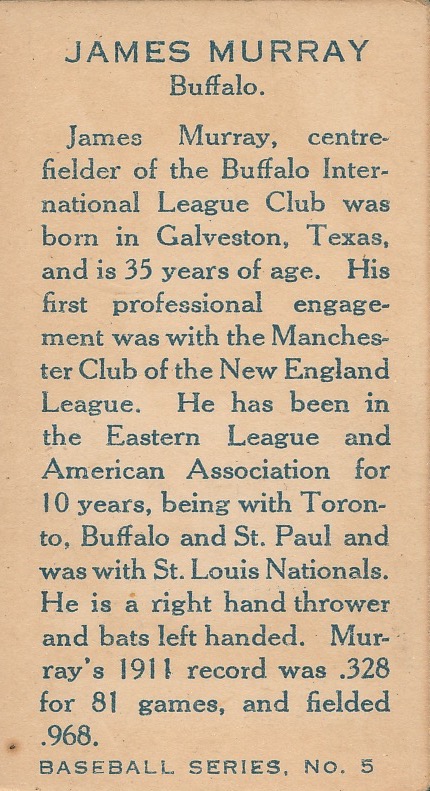
1912 Imperial Tobacco (C46) #5 baseball, James Murray

Numbering a set seemed an afterthought at the dawn of baseball's card era. Companies printed them as promotional materials, like banks make calendars and pizza places make magnets. I don't know of any individually numbered cards from the 19th century and the "E" cards from 1909 and 1910 include a complete checklist on each card back rather than actual digits. Is it fitting that a non-American company would be the first to organize a set this way?


This 90-card effort from Canada's Imperial Tobacco company presents players in the "minor" Eastern (aka International) League respectably with sepia-toned studio photos. Two HOFers prove its key cards, Joe Kelley and Iron Man McGinnity. Buffalo's Jim Murray might not be an essential component, but he looks pretty good for being 100+ years old.


As best I can tell, Mr. Murray appeared in very few major league games. After a handful of hacks in 1902 with Chicago, he bounced around other leagues until 1911, resurfacing in St. Louis for about 100 at-bats. Both years yielded a sub-.200 batting average with little power, so it's somewhat surprising the Braves picked him up in 1914. At least he "rewarded" them with a .232 performance, pulling his lifetime average north of the Mendoza line. (.203!) The St. Paul Saints purchased the 36 year-old in mid-1914 and he presumably wrapped up his career there or soon after.

Speaking of St. Paul and minor leagues in general, I'm halfway through Wild and Outside by Stefan Fatsis, which highlights the mid-90s rebirth of the Saints. Most don't expect lower leagues to really compete with the AL and NL these days. If anything, they move players up the ladder to their "peak" (A, AA, AAA, or MLB) and gradually--or quickly--drop anyone stuck in denouement. As an independent team, the Saints prove a good counter-point to this view, paired geographically as they are with the Minnesota Twins. The situation probably parallels how the Eastern League sought to succeed in the shadow of the majors' lock on most northeastern cities back in 1912. More to say once I'm done with the book itself!

Value: This obscure set doesn't get much attention, so remains affordable. A low-grade eBay auction closed at $15 in March 2010.

Fakes / Reprints: Like most tobacco sets, this is vulnerable to reprinting. The relatively low value lessens the risk, but definitely find out something about a card's history if you plan to get one.

Tuesday, September 2, 2008

1948 Swell "Babe Ruth Story" #5, Brother Matthias

This card kind of creeps me out, so it'll go by as quickly as possible.

Card front

Card back

1948 saw the release of The Babe Ruth Story, a little-regarded film about Ruth's life and gargantuan impact on the game. The Philadelphia Gum Company turned out a fairly small set to "celebrate" (i.e., cash in on) its release; each card tracks a character or event from the film.

The crafty veteran pictured here is Charles Bickford, who portrays the young Ruth's strong-handed spiritual guide, Brother Matthias of the reformatory St. Mary's Industrial School for Boys. This education, at least from Matthias, included the game of baseball. From what we can tell, the Babe's early skills developed almost entirely during his time at St. Mary's.

The speed of Ruth's introduction to the game bears little resemblance to what players go through today. At 19, he signed with Baltimore early in the 1914 season and appears on one card as an Oriole. They dealt him to Boston on July 9th. Ruth pitched (and won) his first game on July 11th. With little room on the roster for raw talent, the Red Sox sent him to Providence for most of the season's second half. These days, who knows? As a good young pitcher, perhaps teams would've stashed his good arm in a southern league for "seasoning" as a #2 lefty starter and told him to ignore that batting nonsense.

Tuesday, August 26, 2008

1963 GAD Fun Cards #5, Lou Gehrig

It's not made of unusual materials or packaged with ice cream, but the GAD Fun Cards set is certainly an oddball. No photos, just sketches of people who might be players, might be from New York, and so forth. Some cards talk about real players and others go the "wacky" route. This #5 does a little of both by slapping a red cap on the theoretical (and unhappy) Gehrig. We can only hope the Iron Horse felt a little better about fielding his position each day than what we see here.


Card front

This card came from eBay recently for what I considered a reasonable price. Many, many similar cards went by in recent years, usually from sellers who saw the name of a HOFer and decided it must be worth the big bucks. Unfortunately, there's not much to a card that could easily be a "caption this cartoon" contest!

An above-average number of GADs end up in PSA slabs, given the high grade you usually find them in. That implies the card maker distributed them in a small area, sold only sets, or stashed them somewhere safe for a while. Even at 45 years old, it's difficult to add much to a card's value when most of the others are in the same shape. No doubt lots of modern collectors run into the same problem when they get cards graded. You're better off hunting down a comparatively rare or nice card before taking the trouble.

Thursday, August 21, 2008

Comparison of Allen & Ginter Retail and Hobby Boxes

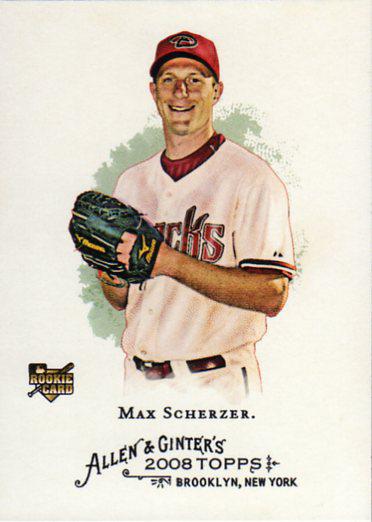
Enough of the #5s for now, it's time for a adrenaline rush of brand new cards! This year's Allen & Ginter design and contents very effectively floated my boat, so I picked up a few boxes to check out what can be ripped and enjoyed.


Collectors who spend below $100 per outing (that's me) have two basic options, the "retail" box of 24 packs and the "hobby" box of 24 packs. The hobby packs include 8 cards instead of the retail 6 cards, so the extra $25 you pay approximately evens out.

Retail box: 24 packs x 6 cards per pack = 144 cards (1 gross, as they say on the farm). BIN from eBay (+ postage) for $58 = .40 per card.

Hobby box: 24 packs x 8 cards per pack = 192 cards (1 gross plus, as they say in France). BIN eBay (+ free postage!) for $81 = .42 per card. The box includes a "topper" card, which could be a variety of different insert cards, such as over-sized "cabinets" or N43-style cards with an inset frame. (Mine was an N43 Joba Chamberlain.)

Most packs include an American state card for one of the 50, featuring its flag and an active player from that locale. Some players aren't great, but at least they covered the whole map. (Maybe they'll expand this to all the MLB countries next year?) You also get a parallel card, typically a "mini," in almost all packs. Occasionally, a rarer card comes along, but not frequently--just often enough to keep you going.

Retail box highlights:
1. Arkansas state card w/Torii Hunter: I like the state set quite a bit and Torii's a fine addition. The picture captures him mid-salute, like he knows the flag is just to his right.
2. Jed Lowrie RC: All Red Sox welcome here in Boston.
3. Lisa Leslie: Excellent subject to include in the set, especially with the USA Olympic team capturing gold. (There's a decidedly Olympic theme to the 2008 set, no big surprise.)
4. Rollins / Sizemore / Carlos Pena / Soriano / Derrek Lee in same pack, plus the Swiss mini World Leader card! (You get one or two of those per box.)
5. Mary Shelley a la Frankenstein! I love the writer / philosopher bent in this set.
6. Yadier Molina, the StL catching version of The Flyin' Molinas. All three have World Series rings, unique among sibling trios.
7. Nice throwing pose of Hanley Ramirez. Sadly, the card says "Marlins" instead of "Red Sox."
8. Jeanette Lee, the billiard world's Black Widow. She's got the pool equivalent of the Dave Stewart stare.
9. Feliz Hernandez: Almost makes up for getting Jason Schmidt in the same pack.
10. Magglio Ordonez: Dig the hair! Is it time to watch Shampoo again?
11. Marie Curie: Another in the line of interesting inclusions.
12. Same pack: Lowell / Johjima / Neshek / Pierzynski swatch / Bram Stoker / Trinidad & Tobago World Leader / nice Luke Scott hitting pose
13. Pluto / Charon: This is a cool card; Topps could've expanded the set to include more astronomy.
14. Andrew Miller: Nice cover-the-mouth pitching shot.
15. Mark Spitz contest card! Great timing, with the Olympics still in swing.
16. Jim Thome: One of the best personal poses in the set. You know it's Thome, name on the uni or not.
17. Golden Gate Bridge: The buildings are interesting enough to include a few. "Ancient Wonders" might've been better.
18. James Fenimore Cooper: not enough Natty Bumppos in the world today.
19. Bengie Molina vs. Jered Weaver: the A&G artistic styling isn't uniform and these two show how. Weaver looks mottled and bored with his washed-out speckling. Molina shines smoothly like a smooth-and-shiny thing.
20. Jay Bruce: sharp-hitting Cincy call-up who I saw in Louisville early this year, Mr. Bruce and I share birthdays.
21. David Eckstein: nice post-spinach forearms.
22. Nietzsche: People forget how his thinking on the "now" so permates today's world.
23. B.J. Upton mini: Looks about 15, but can play when he wants to.
24. Kazuo Fukumori RC: Intense pitching pose, something all sets could use more of.
25. Callix Crabbe: That's a heckuva name, pardner.

Retail Box lowlights:
1. Kevin Van Dam, a champion bass fisherman. I'm sure you're very skilled Mr. Van Dam, but I'd trade you for the planet Pluto without thinking twice.
2. Andrew Litz: Air guitar champion on YouTube = entertainment. In my card pack = teh lame.
3. Corey Hart: Any particular reason they didn't put him in sunglasses? I mean, come on.

Totals: 1 swatch, 2 World Leaders, 4 black minis, 6 checklists, 11 states, 18 regular minis, 108 base cards

Hobby Box Highlights:
1. Tim Wakefield: Nice pose for the veteran knuckler
2. Linen Balloon mini: Sweet picture that could've come right out of Oz.
3. James Bowie mini: He of the legendary knife and another famous death at the Alamo.
4. Carlos Guillen: A super-highlight if Seattle hadn't let him go.
5. Nate McLouth: Looks good in the Pirates uni, which can't be said of everyone.
6. Matt Cain "Rip It Card" 16/99: Topps challenges you to rip it open and expose the internal card. Some people will avoid doing so to "preserve the condition" and thus miss out whatever lies within. Ha! I RIPS IT! (Inside is one of the mini parallels, Nick Swisher. It looks to be a little thinner than normal minis.)
7. Takashi Saito mini: I love that the stats include WHIP and Saito's is a sparkling 0.82.
8. Davy Crockett: Both famous Alamo personalities in the same box! Rightfully shown without the eponymous cap.
9. John Maine: Laconic expression is dead-on Joel Hodgson.
10. Holy firetruck! Mark Spitz swatch back-to-back with Bruce Jenner card! Olympic fever!
11. Jim Thome swatch! Evan Longoria mini! Hiroki Kuroda RC! Same pack!
12. Kerri Strugg back-to-back with Bonnie Blair: OK, it's an Olympic year, I gets it.
13. Oscar Wilde mini: now we're talking my kind of sardonic phrase-turnings.
14. Charles Dickens: Another fine writin' machine. (Not to be confused with Charles Dikkens, the well-known Dutch author.)
15. Albert Pujols: and looking very serious about knocking the ball into next month.
16. Last pack has Davey Crockett mini and Albert Einstein!

Hobby Box Lowlights:
1. Carl Crawford: Seriously, is this whole image airbrushed?
2. Carlos Zambrano: Whoa, the eyebrows! He's officially every sci-fi movie villian, ever.
3. Derek Jeter mini: on the plus side, people will no doubt trade for this.
4. Les Miles: College football coaches in my baseball pack? Whaaaa?

Totals: 1 Rip It #/99, 1 N43, 2 contest cards, 2 swatches, 2 World Leaders, 2 black minis, 16 states, 21 regular minis, 146 base cards

Summary: The Allen & Ginter boxes make for good pack ripping. After a few, I've already got most of the base 350-card set. Really, though, it's not so much about the base set, which you can buy for fairly small money. With so many parallels and non-sport subjects, it's easy to pick out specific sub-collections to focus on. It's also tempting to send the cards out en masse for autographs and my first attempt went to Dean Karnazes, the crazy-long distance runner.