Friday, November 16, 2012

Remembering Hostess Brands and Baseball

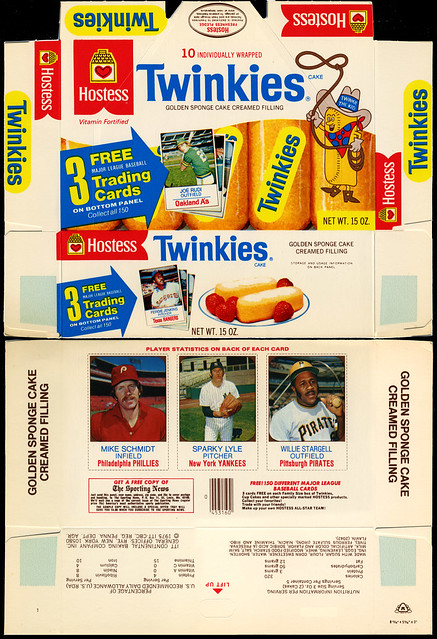
To quote The Beatles, "I read the news today, oh boy." If plans continue as announced, Hostess Brands expects to close operations and 18000+ workers worldwide will seek new jobs. This upheaval in the snack food market also shutters a long cooperative history between MLB properties, the Players Association, and their products, first seen in boxed form during the mid-1970s.

1975 Hostess Twinkies box with 3-player panel

Licensing fees from cross-promotion by Hostess and similar brands proved extremely helpful to baseball's players union (MLBPA) as it moved from "toothless" in the mid-60s to "muscular and growing" in the era of free agency. In the collecting context, their hundred-plus card snack sets also presented licensed competition for Topps during their longest monopolistic era (1955-1980).

More personally, their sets also turned out some badass photos like 1976 #5.


Promotions spilled onto the pages of comics and other things kids spent their money on, further building a love of cards in the minds of young collectors.

Hostess comic and magazine promo

I hadn't thought about the artistry of that ad before, but those are nice hand-drawn renditions of 70s stars Rudi, Jenkins, and Sutton, three guys (and two HOFers) you wouldn't necessarily remember from that era.

If you mourn the passing of Hostess, also remember their significant connections to a time of change and growth for baseball players, its fans, and collecting. Requiescat in pace!

Thursday, November 15, 2012

1980 TCMA Columbus Astros Baseball #5, Del Leatherwood (Letherwood)

The Astros, parent club to Columbus-circa-1980 and newcomers to the American League, just redid their duds in a way that's nostalgic for Del Leatherwood's hat and 1960s Houston road uniforms. Gone are the silhouette star caps and back are capital letter serifs.

What I don't see for 2013: design elements inspired by Houston's infamous 70s-80s disco astronaut look. Why do people today hate disco astronauts?


Speaking of classic hats, Delrick Leatherwood (Del's given name) sounds like a Yukon Mountie to me.


I'm just saying he and Sgt. Preston might work well together.


Leatherwood wore these duds in 1981 for the Tucson Toros, whose designers narrowed their palette to just warm colors one year after their bullfighter-themed fashion adventure nearly claimed "worst uniform ever" honors.


Leatherwood won 15 games for AA Columbus in 1979 and seemed ready to move up. He started even better in 1980, but ultimately finished with half the innings (career stats). I assume an injury stole much of that year and perhaps his career prospects, as Del retired after 1982.

TCMA printed 22 Columbus players in 1980, including future Pirates and Angels speedster Johnny Ray.
  1. Greg Cypret
  2. Val Primmante
  3. Tim Tolman
  4. Stan Leland
  5. Del Letherwood
  6. Chick Valley
  7. Johnny Ray
  8. Bert Pena
  9. Doug Stokke
  10. Matt Galante, MGR
  11. Greg Dahl
  12. Rod Boxberger
  13. John Hessler
  14. Simone Rosario
  15. Reggie Waller
  16. Riccardo Aponte
  17. Scott Loucks
  18. Keith Bodie
  19. Ron Meridith
  20. Jim MacDonald
  21. Mark Miggins
  22. Rex Jones

For the record, leather is the 3rd anniversary and wood is the 5th.

Value: This #5 cost $2 at MinorLeagueSingles.com. Ray became well-known enough to push team set prices higher than many other TCMA issues at $25-30.

Fakes / reprints: TCMA reprinted several 1980 team sets for "collectors kits" later in the 1980s. Those cards have black backs and the originals are blue.

Saturday, November 10, 2012

1980 TCMA Burlington Bees Baseball #5, Dave Grier

Not sure why it took 700+ posts to cover my girlfriend's hometown team, but here we are: the Burlington (Iowa) Bees! (Our family histories stretch back to Iowa and other Midwestern areas, but we actually met in Massachusetts.)

Like many lower-level squads, the Bees swapped affiliations over time. As pictured, they served Milwaukee, back when the Brewers were still in the AL. Today, they're linked with the Los Angeles of Anaheim Angels.


Excuse me, Mr. Grier, but are you any relation to Wally Moon?


No reason, just wondering.


Dave Grier pitched well in Burlington, going 16-8 with a 2.74 ERA in 1980 (minor league stats). Milwaukee bounced him around the farm system for three more years, hoping for similar success, but he dropped to about .500 in other cities and called it quits at age 25.

The Bees checklist includes 29 players, above average for TCMA team sets.
  1. Steve Gibson
  2. Kevin McCoy
  3. Mike Donovan
  4. Mark Lepson
  5. Dave Grier
  6. Greg Dehart
  7. Orlando Gonzalez
  8. Steve Manderfield
  9. Brian Thorson
  10. Duane Espy MGR
  11. Vince Pone
  12. Jesse Vasquez
  13. Al Walker
  14. Ty Coleman
  15. Steve Norwood
  16. Rich Bach
  17. Greg Cicotte
  18. Mike Anderson
  19. Kurt Kingsolver
  20. Walt Steele
  21. Jorge DeJesus
  22. Juan Castillo
  23. Mark Higgins
  24. Kirk Downs
  25. John Evans
  26. Curt Watanabe
  27. Stan Levi
  28. Karl McKay
  29. Bengie Biggus

Value: This #5 cost $2 at MinorLeagueSingles.com and team sets run $15-20 on eBay and elsewhere. (Infielder Juan Castillo's the only future major leaguer, so few people break the set for singles.)

Fakes / reprints: TCMA reprinted several 1980 teams for "collector kits" in later years. Those cards come with black backs and originals have blue.

Thursday, November 8, 2012

1973 Topps Baseball #334, Freddie "5-5" Patek and #42, Mike Andrews

Today's my first chance to honor Freddie Patek, Royals infielder and friend of the blog at 5'5", shortest active player for much of his career. This 1973 card from a recent post by Jeff Laws caught my eye, as it included not only The Flea himself but also Chicago's comparatively Brobdingnagian #5 baserunner. (We'll look more into who that is below.)

1973 Topps #334, Freddie Patek

Thanks to a 2008 post at Garvey Cey Russell Lopes for pairing these double-play shots. Field and sight lines match so closely, it's safe to say they're from the same White Sox-Royals game.

1973 Topps #42, Mike Andrews

Chris Stufflestreet (RIP) tried to sort out which game we're seeing in two 1973 Topps Photography posts: Double Play Starter? and Mystery Solved! The artificial turf and mix of uniform numbers led to general agreement on a spring training game at Terry Field, Kansas City's home from 1969-87. But when's the game from, 1973, 1972, or earlier?

There's a business reason so much 1973 Topps photography looks dodgy. MLB owners locked the players union out of team facilities for most of February, closing off a large window for spring training photo shoots. 1973's bargaining agreement (signed Feb 25) established tenets still in place today--salary arbitration, "5 and 10," contract tender deadlines--but the month-long delay left teams less than two weeks to prep players for games. The slim pickings for new photos likely pushed Topps into lower-quality archive shots and lots of player airbrushing.


Thanks to an eBay listing for Chicago's 1973 Spring Training schedule and Google news search, we can check these game situations for 1973, as KC hosted Chicago twice that spring in Ft. Myers.

How about 1972 spring training, when White Sox #5 was Tony Muser and KC #33 was Bob Oliver? I couldn't find a spring schedule on eBay this time, but located two Ft. Myers match-ups in the news archive.
  • March 12: Chicago beats KC 5-1 (news story and box score). Andrews plays 2B and homers, Patek plays SS, first basemen Muser and Oliver both reach base, and each team turns a double play.
  • March 16: White Sox win 9-5 (news story, back one page from link), but Andrews doesn't play.

Given available info, I conclude 1973 Topps #42 and #334 show double plays from Chicago's 5-1 win over KC on March 12, 1972, as Freddie Patek and Mike Andrews force runners Tony Muser and Bob Oliver at second. Batters were likely White Sox catcher Ed Herrmann and Royals 2B Cookie Rojas.

Mystery solved, again? Let me know if you can guess the umpire. :-)

UPDATE: Also read Bruce Markusen's dive into Mike Andrews' roller-coaster baseball story. Great stuff.

Wednesday, November 7, 2012

1980 TCMA Charleston Charlies Baseball #5, Brian Allard

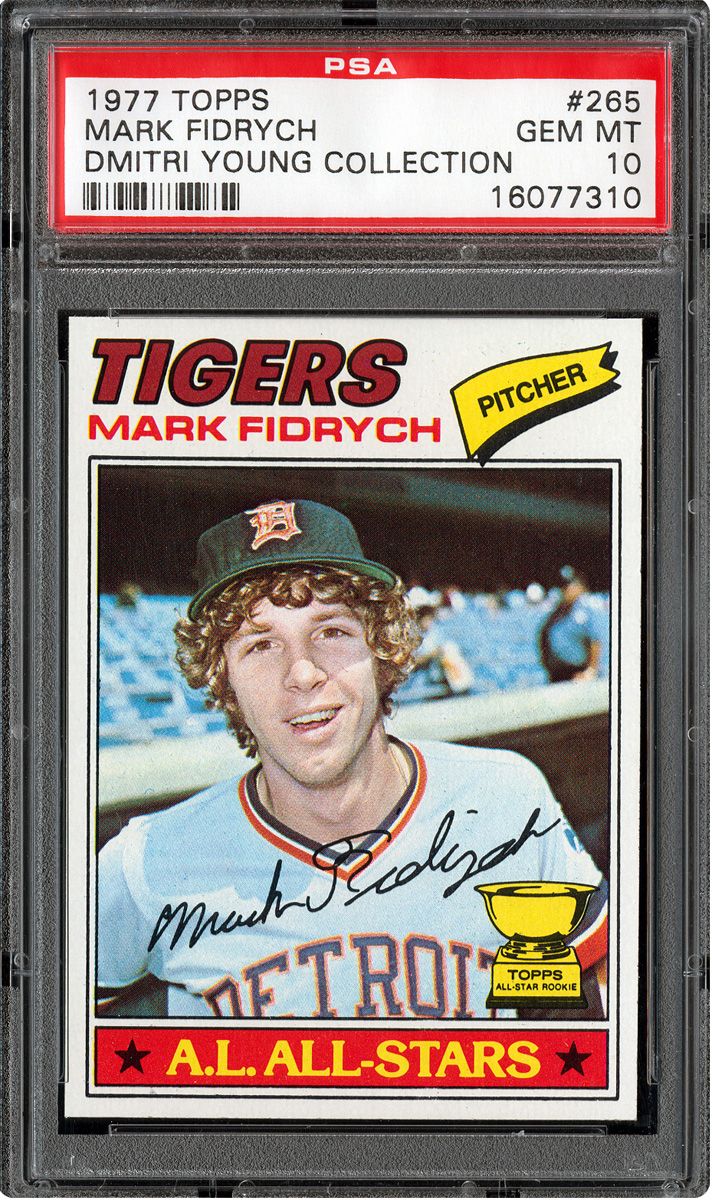
Not sure why I'm a fan of goofy blond curls on baseball players. Was it the post-disco zeitgeist? The Fidrych Effect? Anyway, add Brian Allard to that list of xanthic fashionistas.


Nice jersey! HARLIE-DAVIDSON WOOOOO! VROOM VROOOO....oh. "Charlies." As in, "the International League team from Charleston, West Virginia."


My 9 year-old self remembers Brian Allard for his 1981 stint in a Mariners uniform (game logs), which followed this big trade for Texas slugger Richie Zisk.
December 12, 1980: [Brian Allard] traded by the Texas Rangers with Steve Finch, Rick Auerbach, Ken Clay, Jerry Gleaton and Richie Zisk to the Seattle Mariners for Larry Cox, Rick Honeycutt, Willie Horton, Mario Mendoza and Leon Roberts.

Zisk stepped into the DH role vacated by 39 year-old Horton, who Texas ultimately released before the 1981 season. Rick Honeycutt nabbed an ERA crown as a starter in 1982, then evolved into a Tony LaRussa relief specialist for Oakland and St. Louis.

Speaking of roster moves, what else did Seattle's do with their side of the trade, other than Steve Finch (who never reached the bigs)?
October 23, 1981: The Seattle Mariners released Rick Auerbach.  
March 29, 1982: The Seattle Mariners released Ken Clay.
June 27, 1984:  Jerry Gleaton traded by the Seattle Mariners with Gene Nelson to the Chicago White Sox for Salome Barojas. 
January 16, 1985: Richie Zisk released by the Seattle Mariners.

At least Seattle got 3 solid (121 OPS+) seasons from Zisk, who retired following his 1985 release. A 1980 article about the trade noted a few other deals (both real and potential) I'd forgotten about. Fred Lynn almost swapped for Ron Guidry? Whitey Herzog acquiring future HOF relievers Bruce Sutter and Rollie Fingers and then flipping Fingers to MIL? That's a busy off-season.

Here's another look at that Seattle Mariners trading acumen.
November 18, 1980: The New York Yankees traded Brad Gulden and $150,000 to the Seattle Mariners for a player to be named later and Larry Milbourne. The Seattle Mariners sent Brad Gulden (May 18, 1981) to the New York Yankees to complete the trade.

Yup, trading a dude for himself. Mariners fever! Catch it!

TCMA printed 17 Charleston Charlies, below average for 1980 team sets.
  1. Tom Burgess
  2. Mark Scott
  3. Wayne Pinkerton
  4. Nelson Norman
  5. Brian Allard
  6. Greg Mahlberg
  7. Dave Moharter
  8. Mike Richardt
  9. Richard Lisi
  10. Mike Hart
  11. Mark Mercer
  12. Dan Duran
  13. John Butcher
  14. Fla Strawn
  15. Odie Davis
  16. Tucker Ashford
  17. Bob Babcock

Value: This #5 cost $2 from MinorLeagueSingles.com and team sets run $15-20 on eBay.

Fakes / reprints: TCMA reprinted several of their 1980 teams for "collectors kits" in the late 80s. The reprints have black ink backs instead of blue.

Monday, November 5, 2012

1980 TCMA Buffalo Bisons Baseball #5, Jim Buckner

Despite Jim's wide stance, this isn't the Buckner that infamously let a ball roll between his legs in 1986; that was bigger brother Bill. Three members of the family played pro ball, including oldest brother Robert. Bill's the only one to spend time in the majors, but they all knew how to grow manly-man mustaches and would make excellent Movember fundraisers.


Jim's "leadoff stance" is reserved on cards for speedsters--see also 1975 Topps Herb Washington or 1982 Topps Rickey Henderson--and Buckner ran often, topping out at 50 stolen bases for Lodi in 1973 (career stats). He also caught my eye as an alumni of Yavapai College in Prescott, AZ, a school where my dad taught for almost 20 years. It's yielded a number of minor leaguers over the years, and one World Champion, Curt Schilling.


Buckner couldn't drive AAA pitching at Toledo or Tidewater (1 HR, .564 OPS) in 1979, but rebounded in AA Buffalo (16 HR, .780 OPS) a year later.

Buffalo's original, 19th-century Bisons were an NL team for several seasons. All later incarnations played in the minors and this AA squad jumped to AAA in 1985 by switching affiliations with Wichita. TCMA printed just 16 cards for this team set, significantly fewer than others from 1980.
  1. Mike Barnes
  2. Ron Mitchell
  3. Rick Federici
  4. Dave Dravecky
  5. Jim Buckner
  6. Drew Macaluey
  7. Steve Farr
  8. Rick "Bubba" Evans
  9. Al Ortiz Jr. (no number on back)
  10. Paul Djakonow
  11. Mike Allen
  12. Bob Rock
  13. Al Torres
  14. Larry Nicholson
  15. Ed Vargas
  16. Steve Demeter

Value: This #5 cost $2 at MinorLeagueSingles.com and teams sets would be $20 or so.

Fakes / reprints: Haven't seen any in the marketplace. Dave Dravecky is its best-known major leaguer and probably not worth reprinting.

Friday, November 2, 2012

1937 Kellogg's Pep Sports Stamps #5, Gabby Hartnett

After seeing Wheaties succeed with a string of 1920s and 1930s pro endorsements (which birthed their enduring "Breakfast of Champions" slogan), Kellogg's built a competing stable of athletes and sports performers to push boxes of whole wheat cereal. Their shotgun approach is perhaps best represented by today's set, the multi-sport (and multi-species) Sports Stamps, packaged in boxes of Pep wheat cereal.


Kids could remove the yellow numbered banner, separate each stamp along perforations, and mount all 90 in a company-made album. Vintage fans might know Gabby Hartnett as a Hall of Fame catcher for the Cubs, who happened to post his last statistically great year in 1937 (career stats). So who are the other three?
  • George Lott's polo collar betrays that he played the more genteel sport of tennis. He won several doubles titles in the early 1930s and must've still been well-known in 1937.
  • Pompoon won five major races between 1936 and 1938 before succumbing to a kidney infection in 1939.
  • The college football Frank Thomas played for Notre Dame, roomed with The Gipper, and coached Alabama to significant success in the 30s and 40s. Frank was probably the best-known name on this panel in 1937.

This Pep promotion must've been popular, as I often see individual stamps at shows and on eBay. Full panels remain scarce, but succinctly describe the set itself. (Games that provide "endless pleasure?" Yes, please!)


Pep's panel-stamp dichotomy gives collectors multiple checklist options.

OldBaseball.com offers a hybrid, alphabetizing the players but including their panel number.
  • BB1 Luke Appling 7
  • BB2 Mordecai Brown 22
  • BB3 Leo Durocher 3
  • BB4 Johnny Evers 17
  • BB5 Rick Ferrell 16
  • BB6 Lew Fonseca 15
  • BB7 Gabby Hartnett 5
  • BB8 Billy Herman 6
  • BB9 Walter Johnson 13
  • BB10 Ducky Medwick 1
  • BB11 Buddy Myer 19
  • BB12 George Selkirk 12
  • BB13 Tris Speaker 20/23
  • BB14 Bill Terry 11
  • BB15 Joe Tinker 21
  • BB16 Arky Vaughan 8
  • BB17 Paul Waner 9
  • BB18 Sam West 18

Vintage collectors might've seen this set's spiritual successor, the unnumbered 1948 Kellogg's Pep Celebrities, which includes five baseball players, gallery at OldCardboard. (See also the White Sox Cards profile of Orval Grove from 2011.)

UPDATE: eBay provided these Pep Sports album cover and baseball page scans!


No idea about those criss-cross lines across home plate. Anyone know if that's really how fields looked in the 1930s and what the lines in foul ground demarcated?

Inside, one page held all 18 baseballers.


Value: Low-grade complete panels cost $20-$50, depending on players. Individual panels come cheap and I'd pay a few dollars at most. It'd be fun to find a complete album, but they might only turn up in auctions.

Fakes / reprints: Haven't seen any in the marketplace.

Thursday, November 1, 2012

1976-77 Redpath Sugar Montreal Expos Baseball #5, Pete Mackanin, Jr.

In a hobby world that treats Post cereal and Hostess snack baseball sets as normal, is it odd that someone would cut out the "grain" middleman and attach players directly to sugar? They're hard to find today, but it did happen at least once, thanks to that bastion of maple syrup and Tim Horton's to the north.


Redpath Sugar, then based in Montreal, printed packets featuring les Expos for two years in the mid-70s. Each showed a color bust photo, bilingual bio text, and uniform number. The above scan (click for detail) shows several uncut and unfolded sheets, with four players each.

Price guides checklist the set by uniform number, so utility infielder Pete Mackanin (career stats) got #5 in both years of production.


I nipped this black-and-white scan from an SCD price guide because Pete's barely visible on the uncut sheets. The bio notes his 12 homers in 1975 trailed only Joe Morgan (17) among NL second basemen.


A closer look at a bit of Pete on those uncut sheets.

Redpath Sugar printed 36 players in 1976, including 3 guys with no uniform number (Wayne Garrett, Chuck Taylor, and Del Unser). They cut back to 30 for 1977, but everyone received a number. Online checklists list players alphabetically, so I searched the SCD for "Redpath" using Google Books to get these numbered lists.

1976 Redpath Sugar:


1977 Redpath Sugar:


Value: Single packets, if you can find them, cost a few dollars. HOFers Gary Carter, Larry Doby (Expos coach in 1976), and Andre Dawson run $10 and up.

Fakes / reprints: Haven't seen any in the marketplace. The set's so obscure, I doubt many people would jump at the chance to buy one, let alone generate enough demand to encourage fakes.

Tuesday, October 30, 2012

2002 SP Authentic Prospects Baseball #P-MS, Marco (Marcos) Scutaro


Born in Yaracuy, Venezuela on October 30, 1975, World Series champion Marco Scutaro. Like many good glove infield journeymen before him, this year's success follows ten years spent in a multitude of uniforms, cities, and hotels; even his Prospects card can't decide between the Brewers and Mets.


Today's card shows Marco as a Brewer because he spent 2000-01 in their farm system, but names him as a Met, where he debuted as a big leaguer in 2002. Not sure how Upper Deck planned this release, as Scutaro's signature is just a white card under that windowed cut-out; collectors almost always want on-card signatures with photos that match the team. I suspect card makers anxious to get rookies on the market try to get autographs from everyone with a pro contract and put less concern into the set design itself.


Scutaro's 14-for-28 hitting and solid fielding against St. Louis netted the 36 year-old his first hardware, the 2012 NLCS MVP, a nice shelf companion to the Giants championship ring. March's go-ahead knock in game 4 was the first World Series RBI in extra-innings by a Giants player since Dusty Rhodes in 1954, who won game 1 with a walk-off homer (box score). Topps honored his august accomplishment with their first card in 1955.

1955 Topps #1, Dusty Rhodes

Topps had good reason to salute Dusty, as they and the Giants were both still in New York. Putting a relocated team hero like Marco on 2013 card #1 is wishful thinking, but would make a nice birthday present. Congrats to San Francisco fans; the rest of us look forward to next spring!

Friday, October 26, 2012

2011 Topps Diamond Anniversary Baseball #555, Madison Bumgarner

Hats off to Madison Bumgarner and his SF teammates for a 2-0 win over Detroit last night. That the Tigers managed no runs against a pitcher who posted league-average peripherals (103 ERA+ in 2012) is an ill omen for a (normally) strong lineup that no doubt hopes to feel more comfortable back in Detroit.


HOLY CRACKER BARREL, MY EYES.


This triple-5 card is one of many 2011 Topps parallels. According to a Series 1 checklist, there are several Diamond versions (for their Diamond Anniversary), with some real stones thrown into the mix. Did anyone here wrap one up as a gift for that special collector in your life?