Monday, February 28, 2011

1975 Hostess Twinkies Baseball #5, Joe Morgan

Hostess printed their baseball sets two different ways for several years: "normal" 3-player panels on snack boxes and "Twinkie" single-player inserts for their infamous sponge cakes. The former came printed on panels you could cut into separate cards and the latter served as a packaging base for plastic-wrapped Twinkies. Collectors know them in part by the large, yellowy oil stains evident on Mr. Morgan's lower half.


Twinkie panel cards match "normal" Hostess in picture and design, other than black bars just above and below the back's career stats box. While yellow cake stains are a strong hint, collectors usually look for the bars to positively identify a "Twinkie card."


Note that this set's specifically made up of single-card panels and uses the "Twinkie" designation for convenience. Larger snack cake packages, including Twinkies, offered three-card panels on the box itself, but card catalogs call those part of the "normal" Hostess issue. (Again, it comes down to the black bars shown above.)

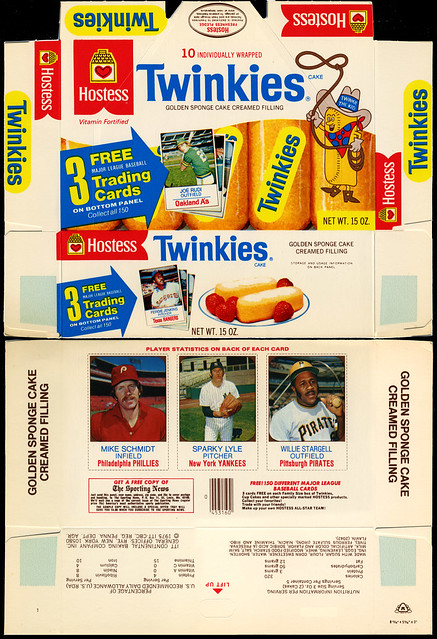
Uncut box of "normal" Hostess cards
Like other years, the 1975 Hostess set included 150 players and many survived to the present day, given how many folks love to snack on Hostess cakes. Check out this Net54 Baseball thread for photos of a Twinkie uncut sheet.

Value: Trimmed singles cost a dollar or two and complete panels cost a bit more due to rarity.

Fakes / reprints: Haven't seen any in the marketplace.

Saturday, February 26, 2011

1979 Hostess Baseball #5, Ross Grimsley

Not sure what the Hostess photographer said to Ross before he posed for this picture, but it must've been terrifying.

Card front

Montreal trained at Jackie Robinson Ballpark in Daytona, FL during the 1970s, so I assume that's what we see behind Ross. The park's Wikipedia page claims Brooklyn moved their spring training home to Daytona in 1947 after Jacksonville denied the Dodgers permission to play a 1946 pre-season game with Robinson on their AAA roster. (The team moved further south in 1948, building Dodgertown in Vero Beach.)

Card back

1979 marked the last vintage Hostess set published on their snack cake boxes and contained 50 three-card panels (for 150 players total), six of which are single-printed and listed below. (Thanks to the Super70s set checklist for the details.)

  • 28 Ron Cey*
  • 29 J.R. Richard*
  • 30 Greg Luzinski*
  • 31 Ed Ott*
  • 32 Dennis Martinez*
  • 33 Darrell Evans*
  • 73 Rick Dempsey*
  • 74 Vida Blue*
  • 75 Phil Garner*
  • 76 Rick Manning*
  • 77 Mark Fidrych*
  • 78 Mario Guerrero*
  • 79 Bob Stinson*
  • 80 Al Oliver*
  • 81 Doug Flynn*


Value: Hostess cards often show up like Mr. Grimsley, with odd edges left by young scissors, and even snack stains. They rarely cost more than a dollar or two.

Fakes / reprints: Haven't seen any in the marketplace.

Thursday, February 24, 2011

Poll wrap-up on 2011's turnaround team

Thanks to folks for voting! Baltimore edged out KC and Seattle for most likely to turn their team bus around this year and play some better ball.

The Oriole watch is on!

Can't blame the enthusiasm after their improved performance following Showalter's arrival, but it'll still be a hard division to compete in.

Wednesday, February 23, 2011

1977-78 Minnesota Twins Baseball #5, Jim Grant

The mid-1970s inspired a lot of "no frills" sets that show just player pictures with a white border, often created by fans who collected cards in their youth and now wanted to make some money at it. Mike Aronstein of TCMA and SSPC is a prominent example, but Minnesotan Barry Fritz followed the same path in this look back at 60s and 70s Twins players. He released today's issue in two series, #1-25 in 1977 and #26-50 in 1978, and sold them through team concession stands.


This clean-cut gentleman owns one of baseball's best nicknames, being Jim "Mudcat" Grant. Topps even used it on his 1959 rookie (see it at CheckOutMyCards.com), though reverted to Jim for their 60s and 70s cards.


Card backs include career stats and highlights, like Grant's two All-Star appearances and excellent 1965 performance. Not just a great pitcher, he also co-wrote The Black Aces, a profile of African-American 20-game winners.

Trivia bonus: a card-collecting friend recently pointed me to Ken McBride, a former Angel with three All-Star teams (1961 to 1963), but only 40 career wins. Based on my B-R research, here are the "record holders" in AS selections, but low career wins.
  • Ken McBride, 40 career wins (3 AS, 1961 - 1963)
  • Mark Fidrych, 29 career wins (2 AS, 1976, 1977)
  • Dave Stenhouse, 16 career wins (1 AS, 1962)

Obviously, other starters made 3, 2, and 1 All-Star teams, but those guys ended up with the fewest total wins at each level.

Value: Singles from this set cost a dollar or two and somewhat more for Harmon Killebrew and Tony Oliva.

Fakes / reprints: Haven't seen any in the marketplace.

Tuesday, February 22, 2011

1968 Topps All-Star Baseball Stickers #5, Willie Mays

This "card" is actually the middle panel from a vertical strip of stickers that Topps test-issued in 1968. They prove exceedingly rare for "small money"--I've only seen two #5s on eBay--so it's a stroke of luck that this PSA 1 found its way into my type collection.

Card front (blank back)

PSA obviously grades single panels, but full strips include a sticker both above and below Willie (note the edge perforation). Topps put their biggest names on that center card, like Mays, Clemente, Mantle, and Aaron. Top and bottom panels show 3 players each, with alternate poses for guys also on center panels. The set's complete at 16 strips, as numbered on the center panel's bottom edge.

Uncut sheet of All-Star Stickers

Big thanks to The Topps Archives blog for locating an uncut sheet image and lots of others for their Where the Action Is post. Check it out for tons of useful info and product scans from this set.

Value: This PSA 1 closed at $50 on eBay. So few turn up that it's hard to set a reliable price, but complete strips run well over $100.

Fakes / reprints: Don't know of any, but they're valuable enough for fakers to try. Only advanced collectors typically try to build this set, due to rarity and cost.

Sunday, February 20, 2011

Happy Presidents Day (and recent site updates)

Three things this weekend.

FIRST: Happy Presidents Day! It always reminds me of this exchange from Rocky and Bullwinkle.

Rocky: Here's a letter for you, Bullwinkle!
Bullwinkle: Wowee!
Rocky: Why so happy? You don't even know what's in the letter!
Bullwinkle: I know, but look at that stamp! A genuine picture of Lincoln-with a beard!
Rocky: You must be crazy about Lincoln.
Bullwinkle: No, I'm crazy about beards. What's the letter say?
Rocky: It's from Washington.
Bullwinkle: Washington? Do you suppose he heard I was a Lincoln fan?
Rocky: Bullwinkle -
Bullwinkle: I'd be a Washington fan too if he had a beard!
Rocky: This is -
Bullwinkle: And Washington needs all the fans it can get this year!

This came from the late 1960s, hence its dig at Washington's Senators (or politicians, take your pick).

SECOND: I found an auction listing for this original studio photo of 1910 Tip-Top Pirates #5 Tommy Leach, so went back and updated its set profile! Baseball never sleeps.


THIRD: 3 days left to vote (or comment) on Wednesday's poll for 2011's most likely turnaround team.

Saturday, February 19, 2011

1978 SSPC Yankees Baseball Yearbook #5, Yankee Stadium

Mike Aronstein, founder of card publishers SSPC and TCMA, turned his own baseball and business acumen into a wide variety of sets between 1970 and 1979--major league, minor league, historical, and artistic--but none larger in scope than today's "Baseball Yearbook" collection of magazines that ultimately covered ten cities and 270 cards (at exactly 27 per team, for reasons explained below). The Yankee version includes this aerial view of their original House That Ruth Built as #5.

Card front

SSPC scored a coup by leading off 1978 with this profile of the defending World Champions, who beat L.A. in 6 games for their 1977 title. Just two years prior, Topps successfully stopped Aronstein and SSPC from selling a league-wide 630-card set by mail order (1976 SSPC #5 profile), claiming an exclusive right to show active players on cards. Their legal footing was murky at best, but I assume Aronstein backed off to avoid an expensive fight in the courts. So how did he change tactics for 1978?

Yearbook front

This yearbook features two important changes from SSPC. First, what the cover calls 6 pages is actually 27 double-sided cards as a 3-panel gatefold. It includes 24 players, manager Billy Martin, a team photo, and today's stadium shot. (Thus, buyers didn't get real "cards," but could easily cut them apart with scissors.) Second, they licensed both MLB team logos and MLBPA player images, so Topps couldn't use baseball itself as a legal wedge. This combo proved distinctive enough to avoid another legal challenge, or at least one that could stick.

Uncut set fronts (3 pages)

SSPC's Yankee magazine must've been successful with fans, as they used the same 3-page, 27-card design for yearbooks of nine other teams. (It's possible they used proceeds from early sales to fund printing of later books.)

  • Phillies (#28 - 54 as "Baseball the Phillies Way")
  • Dodgers (#55 - 81 as "All-Star Gallery")
  • Rangers (#82 - 108 as "All-Star Gallery")
  • Reds (#109 - 135 as "All-Star Gallery")
  • White Sox (#136 - 162 as "All-Star Gallery")
  • Red Sox (#163 - 189 as "All-Star Gallery")
  • Angels (#190 - 216 as "All-Star Gallery")
  • Royals (#217 - 243 as "All-Star Gallery")
  • Cubs (#244 - 270 as "All-Star Gallery")

Were SSPC breaking new ground with magazine cards? Not exactly. Topps released their own half-page uncut sheets of their cards as inserts for the kid's magazine Dynamite starting in 1974 and probably inspired this concept, though SSPC used full-page versions exclusively for the team yearbooks and Aronstein's Collectors Quarterly. (This #5 back shows dotted line remnants, like most hand-cut versions.)

Card back

Check out the Mark's Ephemera blog for a nice profile of the Topps inserts at Topps Cards in Dynamite Magazine, and don't miss the Jimmy J.J. Walker's DY-NO-MITE cover, which is priceless.

Keith Olbermann, long-time card collector and former SSPC editor, included significant details from this era in his recent blog tribute to Chuck Tanner. It's quite a read, if just for the mental juxtaposition of "tentative young photographer" with his strong TV personality. Should I ever be lucky enough to meet or speak with Keith, I'd love to learn more about those years working with Aronstein at SSPC.

Value: Yankee Stadium hosts plenty of Hall of Fame players, but this #5 costs a dollar or less in hand-cut condition. (The complete yearbook with cards costs $10-15.)

Fakes / reprints: Haven't seen any in the marketplace.

Wednesday, February 16, 2011

Wednesday poll: Most likely to improve in 2011?

As a fan, you expect teams to play hard every day, whether or not pundits and betting lines expect them to win. Even the worst MLB squads end up with about 60 victories over a full season, after all, so who says Seattle or Pittsburgh won't beat Tampa Bay or Philly next time out? Today's poll asks who will turn their poor 2010 showing into a better 2011.

My personal and sentimental vote goes to Seattle, who plays in a middling division and can't possibly hit worse than they did last season. To do so would be an offense worthy of our criminal courts. Add your tally and optimism to the sidebar--do Baltimore folks think Showalter can make their strong 2010 finish run into this year?

1938 Goudey Baseball Movies #5, Wally Moses

Back in 2009, this blog profiled a set called 1937 Thum-Movies, which presented 24-image flip books as quick bursts of baseball action. Pitchers threw a single pitch and hitters took one cut, all in a second or two of flurried paper. It's hard to imagine why Goudey turned its card talents to such an odd set, but remember that theaters attracted plenty of attention (and dollars) during our Great Depression and these booklets echo the motion picture appeal.

Part 1 booklet front

Goudey didn't work hard to create 1938's version of their baseball booklets. They just split 1937's 1/4"-thick version into two 1/8" halves and added player pictures to the front, hoping folks would buy the same quick shots a second time. They proved popular enough at the time that you can find them on eBay in the 21st century, making the set "obscure" instead of "impossibly rare."

Part 2 booklet front

Joe DiMaggio represents this set's prime appeal for modern collectors, as the 1937 and 1938 booklets precede his better-known 1938 Goudey Heads Up "rookie" card. The full 13-player checklist also includes HOFers like Paul Waner, Bob Feller, and Luke Appling.

Booklet back (same for both parts)

Goudey's bio called Moses a left-hander, but its shadowy batter swings like a righty. Is this booklet animating the wrong guy, or did Wally switch sides to fool the photographer? (Without better information, I assume it's a printing mixup and actually shows someone else.)

Page from booklet interior

Value: High grade Joe DiMaggio booklets cost a few hundred dollars, but lesser-known players like Moses run $20-30 in low grade.

Fakes / reprints: It'd be difficult to reprint an entire flip book, though folks might try it with superstars like DiMaggio.

Friday, February 11, 2011

1950 Menko Baseball (JCM21) 5 of Hearts, Akiharu Tetsuka

In honor of our approaching Valentine's Day 2011, here's a candy-colored rainbow heart. I just wish Mr. Tetsuka looked happier to be pictured on it.

Card front

Whether or not Akiharu let it show, this set coincided with an explosion in Japanese baseball interest and sports as a profession. Spurred by successful international tours of American All-Star teams and their own Yomiuri Tokyo Giants, an 8-team pro league started play in the mid-1930s. As in America, domestic squads continued play throughout World War II--only stopping in 1945 due to Allied bombing of Japan itself--and their league went on to double in size by 1950, the year of this playing card-like set. (Find a more detailed history at Rob Fitts' own site.)

Card back

This Menko set, cataloged JCM21, contains the usual 52 suited cards, but added one joker--the Babe. Ruth helmed the American All-Star team that toured Japan in 1934 and crowds turned out in massive numbers for their 18-game schedule against local players. (Negative English connotations of "joker" might've been lost in translation--this card's clearly a salute to his enduring popularity.)

Babe Ruth as the Joker

Some complete set sheets remain in the hobby, though I'm not sure if they're leftovers from original production or people just bought it uncut and separated them into individual cards later.

JCM21 uncut sheet (11x5, with company logo)

Value: Menkos of non-HOF players cost $5 to $10 at most online sellers.

Fakes / reprints: Haven't seen any in the market, though Ruth might be popular enough to fake.