Friday, May 6, 2011

1964 Venezuelan Baseball #5, NL Strikeout Leaders

As a country situated close to the equator, baseball-loving Venezuela enjoys more consistent year-round temps than North America, and thus, better "off-season" weather for native players. It's no accident that their own pro baseball league starts in October, right when USA teams wrap things up. Its 8-team schedule runs through January, after which the title-winner competes in the Caribbean Series against champs from the Dominican Republic, Mexico, and Puerto Rico.


1964 marked some important changes to Venezuela's baseball card production. First, they expanded set size to 370, almost twice the 198 cards used in previous issues. Second, they issued an album to encourage collectors to amass and store that year's set.

Album scan courtesy the Topps-Venezuelan Yahoo forum

Over time, the practice of gluing cards into albums became synonymous with Venezuelan collecting, at least compared to American kids who stacked, boxed, or rubber-banded them together. Many cards from this set show paper loss or glue residue. Earlier sets from 1959, 1960, and 1962 generally don't include back damage, but are still hard to find in higher grades because of their lower quality stock and lack of surface gloss.

League Leaders like my #5 usually escaped the back damage because albums came organized by team, with no spaces set aside for leader cards or checklists. Venezuelan card backs use black ink instead of the American orange, so prove easier to distinguish than previous years. (They still turn up in boxes of Topps singles at shows--I found a black-backed Venezuelan in a quarter box in Nov 2010.)


Just three guys appear on this #5, following Topps "rule" of only showing more players when there's a tie in the top three. I think Juan Marichal deserves a spot there, too, since he finished barely behind Drysdale but well ahead of Gibson, so here's a mock-up that combines 1964 leaders #3 and #5.


Value: I bought this #5 from John Rumierz Cards for $20 several years ago. #50 Mickey Mantle, #125 Pete Rose, and #331 A.L. Bombers (also featuring Mantle) cards are the set's biggest stars.

Fakes / reprints: Haven't seen any Venezuelan reprints, but you can expect Topps to use this design for their Heritage set in 2014.

Thursday, May 5, 2011

Happy May Number Five

Taking a quick break in the Venezuelan profiles to say Happy Cinco de Mayo. Big creative props to PunkRockPaint, who pimped the Baseball Card Blog with a set of six Muppets custom cards today!


He labeled the Janice card as number 5, but the whole Electric Mayhem team looks great. Wish we had these cards when I was a kid!

Check out the whole band at Muppets...The Retro Baseball Card Set. Identify the 1972 Topps cards he used and win a custom card of your own!

Wednesday, May 4, 2011

1962 Venezuelan Baseball #5, Sandy Koufax

Today's profile marked the third year Topps licensed their set for printing in Venezuela, one of the world's few countries to follow baseball more fervently than soccer. (America being another.) This practice continued irregularly through the 60s, as baseball sets skipped over 1961, 1963, and 1965.


Four characteristics distinguish the 1962 Venezuelan set from the Topps American version.
  1. Back text in Spanish instead of English
  2. Venezuelan backs use darker red ink; USA looks orange
  3. Two local players (#199 Chacon and #200 Aparicio) replace Topps cards #197 and #198
  4. Little if any gloss (the front scan shows hazy wear gloss would protect against)

Almost all Venezuelan baseball cards, even the popular stars, prove a challenge to track down and take deep pockets to acquire. When Robert Edward Auctions offered a low-grade set in 2008, bidding closed at over $7000.


The league leader cards (#51-60) don't use Spanish on the back, so look almost identical to "normal" cards, except for missing gloss and back coloring. Check the backs for darker red ink and no gloss if you own any--they could be the much rarer Venezuelan version. (I've found them mixed into singles boxes at shows more than once.)

Here's one of the new native players, Elio Chacon; he and Luis Aparicio (#200) replaced cards #197 and #198. That makes #200 the highest number, but total set size remains 198.


The cartoon text translates as "TRAVELER: Elio was purchased by the Mets last winter."

Value: This low-grade Koufax cost $28 on eBay, a relative bargain. High grade examples run into the hundreds, though "high grade" usually means EX at best for Venezuelans.

Fakes / reprints: Haven't seen any Venezuelan fakes, but people sometimes mistake them for American versions. Look for the Spanish text and pinker back coloring.

Monday, May 2, 2011

1960 Venezuelan Baseball #5, Wally Moon

In 1959, Topps licensed their baseball design and players to Venezuelan printer Benco for local printing and distribution, a release that covered about a third of the American set. That financial arrangement worked well enough to secure a repeat performance in 1960 and its number five features skilled LA outfielder--and one of the best card "personalities"--Wally Moon. Unibrow power!


I originally profiled this set in 2009, but am revisiting it to show all the Venezuelan issues in sequence. (This version also has better scans.)

1960 marked Topps' final year for sideways-only sets, as seen previously in 1955 and, my all-time favorite, 1956. American and Venezuelan versions resumed their portrait layout in 1961, but left-to-right action photo reappeared in several 1970s sets. Night Owl profiled several of those cards in his 2009 article, Horizontal Bop.


Like 1959 Venezuelans, 1960 cards lack surface gloss and the stock feels rougher to the touch. The set contains about a third of Topps' full set of 572; both checklists match card-for-card from #1 to #198.

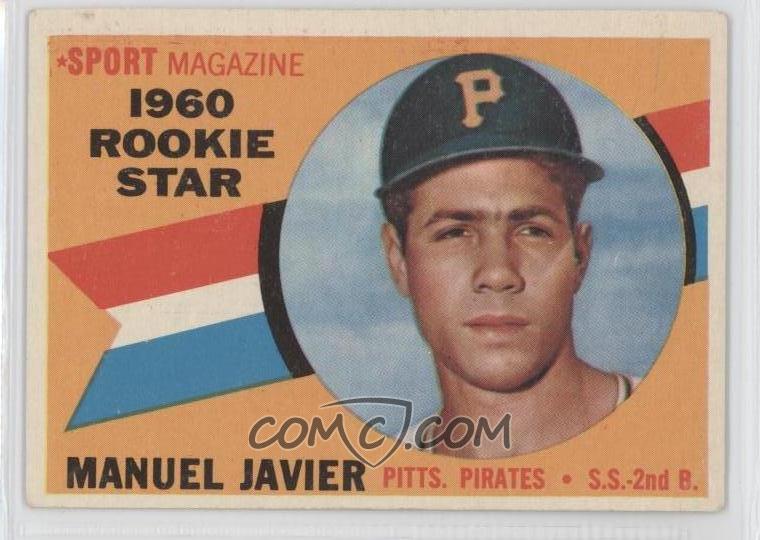
Close inspection of the set itself revealed one curiosity. Future All-Star (and Caribbean native) Julian Javier appears as "Manuel" on rookie card #133, as cribbed from his full name, "Manuel Julián Javier Liranzo."


Those selfsame Pirates traded Javier to St. Louis mid-year and he ultimately spent the whole decade starting at 2nd base for the Cardinals, helping them win championships in 1964 and 1967. Pittsburgh didn't really mourn the loss; they already had a guy named Mazeroski at 2B, which worked out OK for them in 1960.

Value: I picked up Mr. Moon for $5 from South American specialist John Rumierz Cards.

Fakes / reprints: Possible they exist, though fakes of American versions are more likely. Topps "reprinted" this design for their 2009 Heritage set.

Friday, April 29, 2011

Thanks for a six-pack of 1962 Post Canadians

Fellow collector (and member of OBC) Bob Neill sent me several cards yesterday, all hits to my 1962 Post Canadian baseball set. Like most of the cereal set, these six show close-cropped players and lots of text, matched with French for their francophone audience.


Note that 5 of the players come hand-trimmed from boxes, but #191 Jerry Kindall features edge perforations. Collectors could obtain some cards directly from Post, which came on punch-out sheets and left those tell-tale chads.

Further note that #104 Maury Wills appeared on Post, Fleer, and regional sets well before his "feature card" debut with Topps in 1967, who failed to sign him at the minor-league level and apparently left it unresolved for several years. If you're interested in his earliest cards, more than 20 issues predate his "rookie" card from 1963 Fleer. See Beckett.com's player search for a list and--surprise!--that 1960 Topps #389 actually featured an unnamed Wills in a fielding pose from the World Series. The exact definition of a "rookie card" remains tough to pin down!

See my 1962 Post Canadian #5 profile of Mickey Mantle for more about the set itself.

Thanks for the hits, Bob! If any readers are interested in vintage trading and not already an OBC member (headquartered at OldBaseball.com), check out our site and consider applying for membership. It's a great group for both cards and socializing.

Thursday, April 28, 2011

1959 Venezuelan Baseball #5, Dick Donovan

Today's card represents Topps' first foray into publishing cards overseas, an important step that paralleled the MLB's growing (and symbiotic) relationship with Caribbean baseball. The fact that  a Brooklyn-based candy maker could license their designs to a Venezuelan printer (Benco) also says something about the evolving sports economy.

In the generation following WWII, geographic expansion of America's pastime meant more teams and fuller integration with foreign-born players. MLB rosters featured three active Venezuelans in 1959: Chico Carrasquel, Ray Monzant, and future HOFer Luis Aparicio. Their high profile in a country that already loved the game made printing cards for local consumption worthwhile, a practice Topps continued on-and-off into the 1970s.


This card looks unusually faded, but that's no accident of the scanner. While Benco's design copied Topps in style, it lacked something in substance, using both cheaper paper stock and no finishing gloss. This surface scuffed more easily, left colors washed out, and made details harder to discern. (Dick's #22 remains easy to read, thanks to Chicago's switch to TV-friendly uniforms with jumbo numbers on the shoulder.)


Benco's version came out in two series, #1-110 and #111-198, matching Topps own #1 to #198 (not 196 as often reported). The card backs include a mix of "(C) T.C.G. PRINTED IN U.S.A." and "Impreso en Venezuela por Benco CA" tag lines, oriented vertically along the right edge. It's tough to discern low-grade American versions from the former; see the Topps Archives article on Venezuelans for distinguishing scans that compare card stock for each.

Value: A dealer who specializes in Venezuelans sold this low-grade single for $5. Stars are rare enough to vary in price quite a bit, often commanding triple digits.

Fakes / reprints: Don't know of any faked Venezuelans. Regular Topps are better known and valuable enough to reprint on their own.

Wednesday, April 27, 2011

1979 TCMA Savannah Braves Baseball #5, Brian Snitker

As a child of the 1970s, I was fascinated with guys who kept their MLB careers going into the 2000s, making rosters year after year. Tim Raines (debut 1979) fielded his last fly ball in 2001. Mike Morgan (debut 1978) made his last relief appearance in 2002. Rickey Henderson (debut 1979) stole base #1406 in 2003. That about wrapped it up for active players...but not for players on cards.


Brian Snitker never reached the big leagues as a catcher, but he's been with the Braves for more than 3 decades as a pro, coaching bullpens, pitchers, and teams. That's long enough to helm 9 different minor league teams and win manager of the year twice, South Atlantic League in 1997 and Carolina League in 2000. According to Beckett.com, he's even been on 29 different cards, a total not many guys from the 70s can match.

Keith Olbermann occasionally posts cards of current managers saved from his days at TCMA--see A Hairstyle is Temporary, A Baseball Card is Forever and Minor League Cards, Playoff Edition--but I don't think he's shown any coaches. Consider this post some "equal time."


Interesting meta-comment on the card back about the number of team photos Snitker played for in 1978. Even more notable, he caught at four different levels that year, A ball, high-A, AA, and AAA. Imagine handling that many different pitchers! Anyone who can do that deserves a shot at managing.

Value: Bought this for $2 at MinorLeagueSingles.com.

Fakes / reprints: Haven't seen any in the marketplace.

Tuesday, April 26, 2011

1979 TCMA Charleston Charlies Baseball #5, Gary Woods

Fans who track Toronto's expansion year of 1977 should remember Gary Woods, as he started their inaugural game in CF, an early April contest that featured snow on the field and sober fans in the stands. (Exhibition Stadium didn't sell alcohol, a rarity in non-Prohibition baseball.) Woods bunted for a single, stole second, and came around to score the franchise's second run in an eventual 9-5 win.


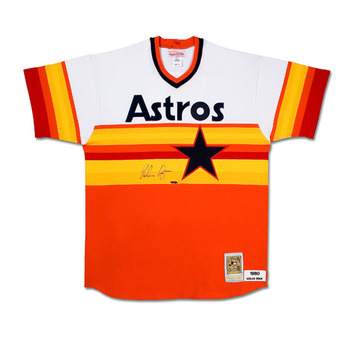
I'm a fan of colorful uniforms like those sported by Charleston's Charlies, which served at the time as Houston's International League affiliate. Those bright stripes probably carried over from their parent club, itself one of the most distinctive looks in baseball history.
Unfortunately, imitation isn't always for the best. This "uniform effect" carried over to another Houston farm team, the Tucson Toros, in a particularly garish way just a year later.


By the numbers, Woods "peaked" as a league-average MLB hitter in 1982 (career stats at Baseball Reference), but regrets nothing about his decade and a half playing pro ball. As he told the Chicago Tribune in 1986:
"There are a whole lot of guys with more talent than I ever had who never got the opportunity. I went to the big leagues, went down, made it back and stayed...I can look in the mirror and say I did all I could to be the best possible player I could be."
Woods now lives in California and coaches for the Santa Barbara Foresters, who play in a July-August summer league for college players.

Value: Bought this for $2 on MinorLeagueSingles.com.

Fakes / reprints: Haven't seen any in the marketplace.

Monday, April 25, 2011

Winners from the Easter Card Hunt

Thanks to everyone who entered my Easter Card Hunt contest. This list shows everyone's guess, interspersed with the cards in bold. Somewhat surprised no one went for #5!

  • 1974 Capital Publishing Co. #5
  • AstrosFreakCam #9
  • 1948 R346 #12
  • 1953 Topps #20
  • DodgerBobble #21
  • CubsFan #23
  • AdamE #40
  • Don WO #41
  • Mark #44
  • Mark A and 1971 Topps #55
  • 1934 Batter-Up #61
  • Chris S #69
  • Fuji #72
  • Greg Z #75
  • Hackenbush #80
  • 1933 Goudey #95
  • Beardy #99
  • Mariner1 #105
  • 1971 Topps #110
  • 1955 Topps #116
  • TiedGame #117
  • Nathan #124
  • 1941 Play Ball #128
  • Matt Hicks #133
  • 1953 Bowman Color #137
  • PlayAtThePlate #142
  • Captain Canuck #167
  • Andrew #175
  • BA Benny #177
  • 1962 Post Cereal #181
  • Night Owl #192
  • 1962 Topps #197

Congrats to Mark A, the only exact match, who picks up a 1971 Topps #55 Steve Carlton! Here's the full list of winners, judged by numerical proximity.
  • AstrosFreakCam: 1974 Capital Publishing #5 Roger Connor (StL) and 1948 R346 #12 Phil Masi (Boston Braves)
  • DodgerBobble: 1953 Topps #20 Hank Thompson (uh oh, it's a NY Giant :-)
  • Mark A: 1971 Topps #55 Carlton (Cardinals) and 1934 Batter-Up #61 McNair (A's)
  • Beardy: 1933 Goudey #95 Crowder (Senators)
  • Mariner1: 1971 Topps #110 Mazeroski (Pirates)
  • TiedGame: 1955 Topps #116 Bilko (Cardinals)
  • Nathan: 1941 Play Ball #128 Appleton (White Sox)
  • Matt Hickes: 1953 Bowman Color #137 Dente (White Sox)
  • BA Benny: 1962 Post Cereal #181 Hal Smith (Pirates)
  • Night Owl: 1962 Topps #197 Dick Hall (A's)

Now its final phase: TRADING. Want to swap something you won? Leave a comment in this post! I'll give people a few days to make any exchanges and then send out the cards.

Sunday, April 24, 2011

Easter Giveaway!

Happy Easter and Passover to readers who celebrate and good luck with your egg hunts to the rest!


In honor of the holiday, I'm giving away cards from 5 different decades. Exactly what cards they are remain a secret for now, but there's at least one from each of these.

  • 1930s
  • 1940s
  • 1950s
  • 1960s
  • 1970s

HOW TO ENTER: My cards range between #1 and #200, not necessarily inclusive. Comment with one guess in that range; I'll compare all entries to the giveaway cards and the closest win! It's a great time to test out your lucky numbers.

DEADLINE: Tonight (Easter Sunday) at midnight US Pacific time.

Make sure to include a contact email if you don't comment with your Google ID.